manuals.online logo
Brands
  1. Home
  2. •
  3. Brands
  4. •
  5. Bakers Pride
  6. •
  7. Grill
  8. •
  9. Bakers Pride Dante Series XX & CH User manual

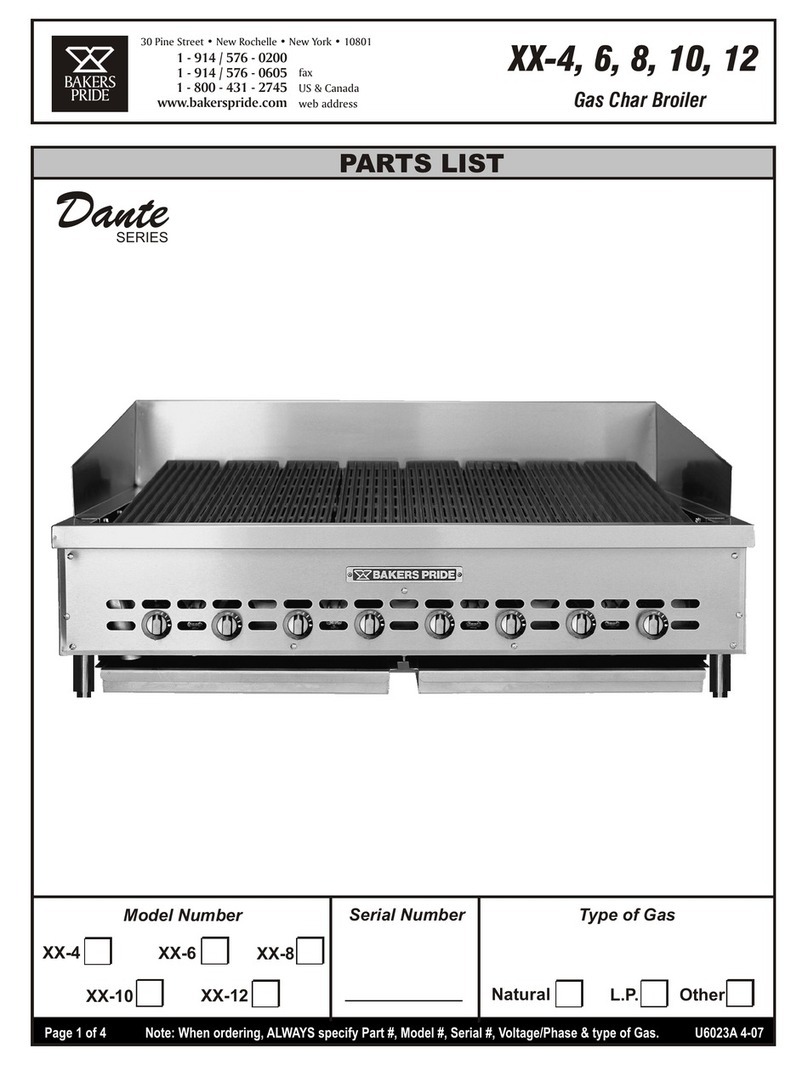
Bakers Pride Dante Series XX & CH User manual

This manual suits for next models

9

Other Bakers Pride Grill manuals

Bakers Pride CH-4 XX-4 User manual

Bakers Pride

Bakers Pride CH-4 XX-4 User manual

Bakers Pride Dante CTB-48GS User manual

Bakers Pride

Bakers Pride Dante CTB-48GS User manual

Bakers Pride Dante CBBQ-30S-CP User manual

Bakers Pride

Bakers Pride Dante CBBQ-30S-CP User manual

Bakers Pride SGBR User manual

Bakers Pride

Bakers Pride SGBR User manual

Bakers Pride DANTE CTB-24R User manual

Bakers Pride

Bakers Pride DANTE CTB-24R User manual

Bakers Pride DANTE XX-10 User manual

Bakers Pride

Bakers Pride DANTE XX-10 User manual

Bakers Pride CH Dante Series User manual

Bakers Pride

Bakers Pride CH Dante Series User manual

Bakers Pride Dante FLB-24GS User manual

Bakers Pride

Bakers Pride Dante FLB-24GS User manual

Bakers Pride Gas Char Broiler F-60R User manual

Bakers Pride

Bakers Pride Gas Char Broiler F-60R User manual

Bakers Pride DANTE LCB-60GS User manual

Bakers Pride

Bakers Pride DANTE LCB-60GS User manual

Bakers Pride GG Series User manual

Bakers Pride

Bakers Pride GG Series User manual

Bakers Pride Dante CTB-60GS User manual

Bakers Pride

Bakers Pride Dante CTB-60GS User manual

Bakers Pride DANTE C User manual

Bakers Pride

Bakers Pride DANTE C User manual

Bakers Pride DANTE CG User manual

Bakers Pride

Bakers Pride DANTE CG User manual

Bakers Pride DANTE XX User manual

Bakers Pride

Bakers Pride DANTE XX User manual

Bakers Pride L-24GS User manual

Bakers Pride

Bakers Pride L-24GS User manual

Bakers Pride Dante SGBR-2 User manual

Bakers Pride

Bakers Pride Dante SGBR-2 User manual

Bakers Pride Dante CTB-36GS User manual

Bakers Pride

Bakers Pride Dante CTB-36GS User manual

Bakers Pride Dante CBBQ-30S User manual

Bakers Pride

Bakers Pride Dante CBBQ-30S User manual

Bakers Pride Dante CTB-72GS User manual

Bakers Pride

Bakers Pride Dante CTB-72GS User manual

Bakers Pride COUNTERTOP GAS RADIANT XX-10 User manual

Bakers Pride

Bakers Pride COUNTERTOP GAS RADIANT XX-10 User manual

Bakers Pride CT User manual

Bakers Pride

Bakers Pride CT User manual

Bakers Pride Dante FLB-60GS User manual

Bakers Pride

Bakers Pride Dante FLB-60GS User manual

Bakers Pride Dante FLB-48R/GS User manual

Bakers Pride

Bakers Pride Dante FLB-48R/GS User manual

Popular Grill manuals by other brands

LMS BBQ08873P owner's manual

LMS

LMS BBQ08873P owner's manual

Cookworks LW-8010A Care & instruction manual

Cookworks

Cookworks LW-8010A Care & instruction manual

Campingaz CV Instructions for use

Campingaz

Campingaz CV Instructions for use

Metos XBL Series Installation and operation manual

Metos

Metos XBL Series Installation and operation manual

Fiesta ET34567 Use and care instructions

Fiesta

Fiesta ET34567 Use and care instructions

Mayer Barbecue BRENNA MKG-318A BASIC Assembly instructions

Mayer Barbecue

Mayer Barbecue BRENNA MKG-318A BASIC Assembly instructions

Landmann Avalon PTS Plus 5.1 Plus 12122 Assembly and operating manual

Landmann

Landmann Avalon PTS Plus 5.1 Plus 12122 Assembly and operating manual

Kenyon B70200 owner's manual

Kenyon

Kenyon B70200 owner's manual

Better Homes and Gardens GBC1486W owner's manual

Better Homes and Gardens

Better Homes and Gardens GBC1486W owner's manual

Orbegozo GR 2300 instruction manual

Orbegozo

Orbegozo GR 2300 instruction manual

bora PT11 Operating and installation instructions

bora

bora PT11 Operating and installation instructions

Klarstein 10031664 manual

Klarstein

Klarstein 10031664 manual

Garland MWE3W Installation and operation manual

Garland

Garland MWE3W Installation and operation manual

Char-Broil 463722714 Product guide

Char-Broil

Char-Broil 463722714 Product guide

MPM MOP-03 user manual

MPM

MPM MOP-03 user manual

Kenmore 415.16123800 Use and care guide

Kenmore

Kenmore 415.16123800 Use and care guide

Tucker Barbecues GTR Series Assembly, installation and operating instructions

Tucker Barbecues

Tucker Barbecues GTR Series Assembly, installation and operating instructions

Monogram ZGG540NCP1SS owner's manual

Monogram

Monogram ZGG540NCP1SS owner's manual

manuals.online logo
manuals.online logoBrands
  • About & Mission
  • Contact us
  • Privacy Policy
  • Terms and Conditions

Copyright 2025 Manuals.Online. All Rights Reserved.

BAKERS PRIDE OVEN CO., INC.
30 Pine Street
New Rochelle, NY 10801
(914) 576-0200 Phone
(914) 576-0605 Fax www.bakerspride.com Web Address
(800) 431-2745 US & Canada [email protected] e-mail
This equipment has been engineered to provide you with year round dependable service when used
according to the instructions in this manual and standard commercial kitchen practices.
P/N U6023A 9/08
INSTALLATION AND OPERATING INSTRUCTIONS
Dante SERIES
GAS CHAR BROILERS
Models: XX & CH
INTENDED FOR OTHER THAN HOUSEHOLD USE
RETAIN THIS MANUAL FOR FUTURE REFERENCE
BROILER MUST BE KEPT CLEAR OF COMBUSTIBLES AT ALL TIMES
IMPORTANT INSTRUCTIONS
After the gas supply has been connected to your unit, it is extremely important to check piping for possible
leaks. To do this, use soap and water solution or solutions which are expressly made for this purpose. DO
NOT USE matches, candles, flames, or other sources of ignition since these methods are extremely
dangerous.
Post in a prominent location instructions to be followed in the event you smell gas. Obtain these instructions
from your local gas supplier.
! !
WARNING
Improper installation, adjustment, alteration, service or maintenance can cause
property damage, injury or death. Read the Installation, Operating and
Maintenance Instructions thoroughly before installing or servicing this equipment.
! !
FOR YOUR SAFETY
Do not store or use gasoline or other flammable vapors
and liquids in the vicinity of this or any other appliance.
CERTIFIED
R
1
MANIFOLDMANIFOLDAABURNER VALVEMANIFOLDBURNERORIFICEORIFICE HOLDERBURNERORIFICEORIFICE HOLDERBURNER VALVEVALVE EXTENSION(STRAIGHT)
FIG.4 SIDE VIEW XXE SERIESFIG.1 XXE SERIES FRONT VIEWFIG.2 CHE SERIES FRONT VIEW
A- AIR MIXER CAP HOLD-DOWN SCREWVALVE HANDLEVALVE HANDLE
MANIFOLD AND VALVE ASSEMBLY VIEWS
AIR MIXER CAPAFLAME SENSORPILOT BURNERFLAME SENSORPILOT BURNERAIR MIXER CAPA
Bakers Pride Oven Co.30 Pine Street, New Rochelle, NY 10801Tel :(914) 576-0200 Fax: (914) 576-0605ILLUSTRATION DGW. # 1008-30 REV. 08-04-99FIG.3 SIDE VIEW CHE SERIES
VALVE EXTENSION(CURVED)MANIFOLDAIR MIXER CAPAIR MIXER CAP
2
CONTENTS
I. INSTALLATION INSTRUCTIONS
SECTION ITEM PAGE
1 General Description 3
2 Installation 3
3 Clearances 3
4 Gas Connection 3
5 Burners 4
6 Radiants 4
7 Top Grates 5
8 Lighting 5
9 Griddle Plates 5
10 Additional Installation Requirements 5
11 Installation with Casters 5
12 Optional Smoker Boxes 6
II. OPERATING INSTRUCTIONS
SECTION ITEM PAGE
1 Lighting Procedure 6
2 Broiling Procedure 6
(a) Seasoning 6
(b) Steaks and Chops 6
(c) Hamburgers 6
(d) Thickness 6
(e) Cooking Tools 7
(f) Operational Guidelines for Char Broiler Natural Smoke Essence 7
3 Helpful Hints 7
4 Maintenance 7
(a) Service 7
(b) Care and Cleaning of Top Grates 7
(c) Grease Collection 8
(d) Cleaning Tools 8
5 Average Production Guide 8
III. TROUBLESHOOTING GUIDE
SECTION ITEM PAGE
1 Burner Flame Adjustment 8
2 Pilot Flame Adjustment 8
3 Lack of Heat 8
4 One Burner Fails to Light 9
Troubleshooting Chart 9
5 Valve Assembly Views 10
IV. PARTS LISTS & EXPLODED VIEWS
ITEM PAGE
Models: XX-4, -6, -8, -10 & 12 Parts Lists & Exploded Views 11
Models: CH-6, -8, -10, -12 & 14 Parts List & Exploded View 14
V. WARRANTY
ITEM PAGE
Bakers Pride Limited Warranty 16
IMPORTANT FOR FUTURE REFERENCE
Please complete this information and retain this manual for the life of the equipment. For
Warranty Service and/or Parts, this information is required.
Model Number Serial Number Date Purchased
4. GAS CONNECTION:
The gas pressure regulator supplied must be installed at the gas inlet of each broiler. Each regulator is
adjusted to yield a manifold pressure of 5 in. water column for natural gas or 10 in. water column for propane
gas. No pressure regulator is required for propane gas in Canada.
For units using propane gas, supply lines less than ½” inside diameter should not be used, even for a small
unit.
On the XX and CH series, the gas connection is located on the right rear of the unit.
BE SURE TO CAP WHICHEVER SIDE IS NOT CONNECTED.
NOTE: A shut-off valve in a readily accessible location must be mounted on the gas supply line before the unit.
When making gas pipe connections, pipe joint compound resistant to the action of liquefied petroleum gases
should be used.
I. INSTALLATION INSTRUCTIONS
1. GENERAL:
The instructions in this manual apply to all XX series and CH series Broilers.
The XX series may include the following options:
! Ceramic briquettes designated by a GS Suffix on the model number.
2. INSTALLATION:
(a) In USA, INSTALLATION of this broiler must conform with the latest edition of the
National Fuel Gas Code, ANSI Z223.1 and/or local codes.
(b) In CANADA, INSTALLATION must conform with the latest edition of the National Gas
Installation Code, CAN/CGA-B149.1 or the Propane Installation Code, CAN/CGA-B149.2, as
applicable and/or local codes.
(c) n,
3. ACCEPTABLE CLEARANCES:
Due to intense heat generated by radiation, these broilers should be installed in non-combustible locations
only including above the grate level.
Series XX Series CH
Right Side 0 inches 0 inches
Left Side 0 inches 0 inches
Back 0 inches 0 inches
I MASSACHUSETTS All gas products must be installed by a “Massachusetts” licensed
plumber or gas fitter. Ventilation hoods must be installed in accordance with NFPA-96,
current edition, with interlocks as described in that standard.
MINIMUM CLEARANCE FROM NON-COMBUSTIBLE CONSTRUCTION
RECOMMENDED MINIMUM GAS SUPPLY LINES ARE LISTED BELOW
All XX Models CH-4 thru CH-8 CH-10 thru CH-16
3/4” 1” 1 1/2”
3
The broiler and its individual shutoff valve must be disconnected from the gas supply piping system during any
pressure testing of that system at test pressures in excess of ½ psig (3.45 kPa).
The broiler must be isolated from the gas supply piping system by closing its individual manual shutoff valve
during any pressure testing of the gas supply piping system at test pressures equal to or less than ½ psig (3.45
kPa).
5. BURNERS:
Check to see that AIR MIXER CAPS on the front of all burners are tightened and adjusted, allowing half the
opening to show. Install the burners and deflector shields first following the steps below.
(a) Install all burners with deflector shield assemblies attached.
(B) Place the front of the burner into the valve assembly by fitting the center hole of the mixer cap
over the brass orifice.
(c) Drop the rear end of the burner over the burner support pin on the back of the unit.
6. RADIANTS:
Mount the “V” shaped radiants over the burners with each end mounted on special supports on the front and
rear of the chamber. A radiant should be mounted over each burner assembly.
GS Ceramic Briquettes Option:
The radiants supplied for the GS option are flattened to allow for the installation of an expanded metal grate.
The grate is installed directly on top of the flattened radiant burner shield. Ceramic briquettes are installed on
the grate as shown:
FIGURE 1 Typical Ceramic Briquette Installation
4
7. TOP GRATES:
Place a grate over each of the radiants. For normal operation, the pointed side of the grate is facing up. For
use with foods that require extra support, the flat side may be used.
On XX Models, grates can be placed on three levels; two positions are built into the rear of the unit; the third
position requires a special adapter. On CH models, three positions are already built into the rear of the unit.
8. LIGHTING:
Each burner on the base char broiler has a standing pilot burner that must be lit before the burners can be lit.
To light the pilot burners:
(a) Turn all broiler valves to the off position.
(b) Remove each top grate and radiant.
(c) Open main gas SHUT-OFF valve (supplied by customer).
(d) Allow air to bleed from the gas line through the pilot burners.
(e) Light the pilot burners using a lit taper.
(f) Turn the burner control valves “ON” to light the burners.
(g) If any burner fails to light, turn the burner valves to “OFF”, wait five minutes and repeat the above
procedure.
(h) After all burners have been ignited properly, turn each burner valve “OFF” and allow the unit to cool.
NOTE: Make sure that the pilot burners stay lit.
(i) Replace radiants and top grates.
(j) Each burner may now be adjusted to the desired flame size by turning the individual burner valve
handle.
(k) To shut down the unit, turn all valves “OFF”
Wait five minutes before attempting to re-light.
NOTE: The pilot burners will stay lit until the gas supply to the unit is turned “OFF”.
9. GRIDDLE PLATE:
Griddle plates should not cover more than 50% of the BROILING area. Each Griddle Plate fits on top of two grates
(one 4 1/2” and one 6”). It is not necessary to remove the top grates and radiants before installing the griddle plate.
10. ADDITIONAL INSTALLATION INSTRUCTIONS
(a) Keep the area around the broiler free and clear of combustible materials.
(b) The provision of an adequate air supply to your broiler is essential. Provide for sufficient outside
air to enter the broiling area and assure that this airflow is not obstructed.
(c) Air enters the burner area from the front and bottom of your broiler. Assure that these areas are kept
open and unobstructed.
(d) Servicing is accomplished through the front and top of the broiler. Assure that these areas are kept
unobstructed for proper servicing and operation.
11. INSTALLATION WITH CASTERS
(a) Install the casters with the wheel brakes on the front of the appliance.
(b) Installation should be made with a connector that complies with the latest edition of the Standard for
Connectors for Movable Gas Appliances, ANSI Z21.69 in the USA (CAN/CGA-6.16 in Canada), and a
quick disconnect device that complies with the latest edition of the Standard for Quick Disconnect
Devices for use with gas fuel, ANSI Z21.41 in USA (CAN 1-6.7 in Canada) and adequate means must
be provided to limit the movement of the appliance without depending upon the connector and any
quick disconnect device or its associated piping to limit the appliance movement.
(c) The restraint should be attached to the legs on which the casters are mounted.
(d) If disconnection of the restraint is necessary, the restraint should be reconnected after the appliance
has been returned to its originally installed position.
5
12. Optional Smoker Base
Installation
(a) Remove the grease pans from their rails
completely and set aside.
(b) Unscrew to remove the legs from the
broiler. Discard.
(c) Set the broiler into the base unit. The
frame will fit into the lip around the top of
each side and the back.
(d) Install the #10 self-threading sheet metal
screws around the base into the broiler
frame to hold in place. Each screw
requires a 5/32 hole to be drilled into the
broiler frame.
(e) Get the grease pan(s) previously set
aside. Insert a log holder into each pan.
Slide the pan into the bottom of the base.
II. OPERATING INSTRUCTIONS
1. LIGHTING PROCEDURE:
See section 8 of INSTALLATION INSTRUCTIONS. Once the pilot burners are lit, the broiler may be turned
“ON” or “OFF” by turning the control valves on or off as necessary.
2. BROILING PROCEDURE:
BROILER TOP GRATES MUST BE HOT ENOUGH TO MAKE BLACK CHAR-MARKS WHEN STARTING
TO BROIL.
Adequate pre-heating time is necessary for the food to release from the broiler and to cook properly. Allow the
unit to pre-heat for 45 minutes to 1 hour before broiling.
(a) SEASONING:
Marinades with oil and vinegar or wine bases are best applied at least 1 to 2 hours before broiling.
Spice mixes, such as flavored salt etc., should be applied 10 to 30 minutes before broiling.
Tomato and sugar based products, such as barbecue sauces etc., have a tendency to burn and
should be used prior to removing the food from the broiler, or after removal.
(b) STEAK AND CHOPS:
Cuts of meat with bones require longer cooking times at lower temperatures to reach the same
internal doneness as cuts without bones. To prepare a well-done steak, trim the fat to reduce
flare-up and the tendency to burn the outside.
(c) HAMBURGERS:
Chopped steak, etc. MUST NOT BE TOO LEAN. For fat flare and smoking action in char-broiling,
hamburgers should have about 25% fat content.
Fat rendered out during broiling:
(1) Helps to release the burger from the grates.
(2) Helps the searing action that seals meat juices inside.
(3) Enhances the char-broil flavor by flaring-up in the form of smoke and flame.
(d) THICKNESS:
During the broiling process, the hamburger contracts and becomes thicker and smaller in
diameter. Pressing the hamburger out thin before broiling will compensate for the shrinkage.
Broil a hamburger as you would broil a steak.
(1) Be sure that the char-broiler has had adequate pre-heating time so that the hamburger
does not stick to the broiler grate.
(2) Place the hamburger on the grate and allow it to cook until release is attained.
(3) Once the hamburger releases from the grate, turn it over and allow it to cook for 1 minute,
then turn once a minute until the desired degree of doneness is attained.
6
! !
IMPORTANT SAFETY INFORMATION: AT THE END OF THE MEAL SERVICE, IF
THERE IS UNSPENT WOOD REMAINING IN THE LOG HOLDERS, BE SURE TO
EMPTY IT INTO A SEALABLE METAL CONTAINER, DOUSE WITH WATER, STIR
EMBERS, DOUSE AGAIN, THEN COVER WITH AN AIRTIGHT LID!!!
7
(e) COOKING TOOLS:
Bakers Pride has designed a number of tools to help you operate more efficiently including a special
spatula that is very effective for fish and hamburgers. Other tools are available. Contact the factory
for full details
(f) OPERATIONAL GUIDELINES FOR CHAR BROILER NATURAL WOOD SMOKE ESSENCE
Wood Smoke assist char broiling is more of an art than a science due to the many variables that affect
wood ignition, rate of combustion, as well as personal preference.
In order to obtain the optimal results and flavor transfer the wood should smolder, not flame. Place
wood in the log holders and follow the procedures recommended below and then adjust as required:
1) Preheat char broiler on maximum heat for ½ hour before adjusting for your various
temperature zones.
2) Fill log holders to approximately ¾ of capacity using dry or presoaked wood.
a) When the char broiler's burners are set to maximum flame, the wood will begin
smoking. While several factors will affect the rate of combustion of the wood, such
as moisture content of the wood, size of the wood, type of wood, elevation above sea
level, you can generally expect smoldering to begin in approximately 35-50 minutes.
However, the flavor transfer or ability to impart a smoky flavor into your food product
will occur sooner, approximately 15 minutes, or as soon as the aroma of burning
wood is evident.
3) As the wood incinerates and begins to turn to ash, it will lose its ability to impart a smoke
flavor. Periodically check the condition of the wood and replenish before it is completely
burned. This will ensure uninterrupted smoking capabilities throughout your service period.
4) If the wood flares up because of the dripping grease or oil, spray water generously, directly on
the burning wood.
5) If the wood tends to over flare, either pre-soak wood in water, or use a combination of dry and
pre-soaked wood as required to balance ignition and flare.
6) The amount of wood needed to complete the meal service will vary greatly depending on the
size of the wood pieces and the moisture content.
3. HELPFUL HINTS:
(a) Do not press the juice out of the meat because that will cause a dry product.
(b) Allow the meat to sit covered on a heated platter for 2 to 5 minutes after broiling before
cutting. This will allow the juices to “settle” and the product will be more moist.
(c) Do not use forks or other sharp objects which poke holes in the meat. Do not cut the meat as it cooks
(d) Thick pieces of meat require a longer broiling time with less flare-up. Reduce flare-up trimming
excess fat for a longer broil time without burning.
(e) Keep the unit clean. Food caught between the grates will not allow hot air to rise around the product.
This will result in uneven heating and increase cook time.
4. MAINTENANCE:
(a) SERVICE:
Shut off the main gas supply before attempting any maintenance on the unit. If required, contact
your Dealer, the Factory, or a local Service Company to obtain qualified maintenance and repairs.
(b) CARE AND CLEANING OF TOP GRATES:
The top grates should be cleaned using a stiff wire brush. If this is done daily, the accumulation of
8
MODEL NUMBER BROILING AREA 3 OZ. BURGERS 12 OZ. STEAKS
CH-4 XX-4
CH-6 XX-6
CH-8 XX-8
CH-10 XX-10
CH-12
CH-14
CH-16
21” x 24”
31 1/2” x 24
42” x 24”
52 1/2” x 24”
63” x 24”
73 1/2” x 24”
84” x 24”
600
900
1200
1500
1800
2100
2400
120
180
240
300
360
420
480
Estimated Hourly Production
The table above gives estimated hourly production as a guide only. Actual production may vary depending on required
doneness, thickness and weight of product.
5. AVERAGE PRODUCTION GUIDE:
XX-12
III. TROUBLE SHOOTING GUIDE
CAUTION: Take extreme care to assure that, if a valve is opened, a flame is present. If a valve is left open
without a flame, turn the valve off and wait at least five minutes before attempting to (re)light. Service should
be performed only by a qualified gas technician.
1. BURNER FLAME ADJUSTMENT:
(a) The burner flame should be as blue as possible. However, there will be traces of orange and/or yellow
from particles in the air burning in the flame. Slight yellow tips at the flame ends are acceptable.
(b) If the flame appears yellow, loosen the air-mixer cap hold down screw “A” (see figs. 2 and 3). Rotate
the air mixer cap counter-clockwise to allow more air into the burner, until the flame turns blue.
Tighten the screw.
2. PILOT FLAME ADJUSTMENT:
The pilot flame can be adjusted by turning the appropriate adjusting screw using a screwdriver or a 3/16
wrench (see fig. 2), counter-clockwise to increase, clockwise to decrease and close. The pliot flame should be
about ½ inch long.
3. LACK OF HEAT:
Check to see if the pilot flames are on. If they are on but the burners do not light, or the burner flames look
weak, then there is a possibility of a gas pressure loss to the broiler.
(a) Check that the unit's main valve is fully open. Normally in the open position, the valve handle will be
parallel to the piping. The valve should be located somewhere on the gas line feeding the char-
broiler. If the handle is NOT parallel to the piping, the unit is not getting the gas supply required to
operate properly. Turn the valve handle parallel to the gas supply line.
food and fat caught in the grates and work necessary to keep them clean will be reduced.
Periodically, they should be turned over and brushed and then put back. In the event that an extra
amount of fat is accumulated on the top, due to use of low heat, we recommend turning up the flame
of this section for about an hour, which will burn off much of the fat and residue and the brushing
operation will be easier. Under no circumstances should the grates be placed in a dishwasher.
Soap, water, or any detergents should never be used on the cast iron grates.
(c) GREASE COLLECTION:
Your char-broiler is designed to bring grease into the front channel which in turn drains the grease into
the grease collection pan in the lower section of the broiler. The pan in the lower section should be
cleaned daily or more often if necessary. The channel should be cleaned periodically with a stiff
brush or scraper.
(d) CLEANING TOOLS:
Several models of specially designed top grate brushes and grease drain scrapers are available from
Bakers Pride. Contact Bakers Pride for more information.
9
(B) If there is a problem with the gas supply, it may be checked fairly easily. Turn off half of the burners
or turn off all other gas appliances and see if the broiler flames increase. If there is an increase in the
flame height then there is a problem with the gas supply. A problem with the gas supply requires
immediate attention. IMMEDIATELY close all the burner valves (turn to the off position), including
the char-broiler's main valve. Contact a qualified service agency or the public gas company.
The following should be checked:
1. The building's main pressure regulator.
2. The size of the broiler's gas supply line (if it is a new installation).
3. The broiler's pressure regulator.
4. The orifice size of each burner.
4. ONE BURNER FAILS TO LIGHT:
NOTE: Always make sure that grates, radiants and burners are cold before handling.
(a) Check to see that the on/off valve to that burner is on.
(b) Check to see if the pilot flame is lit. Each burner has its own pilot, which is located on the manifold
along the front of the char-broiler (see fig. 2).
If the pilot is not lit, attempt to light it using a long taper. If it fails to light, turn off all the burners,
allow to cool and then remove the top grate and the radiant over the burner. With a thin wire or pin,
check that the hole is clear at the top of the pilot tube. Attempt to relight using a taper.
(c) If the pilot burner is lit, close all the burner valves, allow to cool and then remove the top grate and
the radiant over the burner, and check that the pilot flame is located over the first few holes in the
burner. The pilot tube can be bent slightly to reposition the flame.
(d) If the pilot is lit, positioned correctly, and has a proper flame, close all the burner valves , allow to
cool and then remove the top grate and radiant over the burner.
Remove the burner by lifting the rear of the burner off the support pin, slide it towards the rear of the
broiler, enough to clear the burner orifice (fig. 3 or 4).
Using a thin wire or pin, check to see that the orifice is clear, taking care not to enlarge the hole.
Replace the burner, radiant and grate and attempt to light it again.
If the burner will not light, the burner valve could be defective. Contact your dealer, the factory or a
local service company.
For additional information contact: Bakers Pride Oven Co., Inc. (914) 576-0200.
Burners & pilots will
not turn on
Burners produce
excessive carbon
deposits
Pilot will not remain lit
Excessive flare-up
Broiler doesn't seem
hot enough
Grates &/or radiants
&/or burners &/or gas
valves warp
Main gas supply to broiler is not
turned on.
Incorrect gas type.
Incorrect gas supply pressure.
Incorrect orifices.
Primary air not adjusted properly.
Pilot flame adjusted incorrectly.
Draft condition.
Improper ventilation system.
Overload of fatty meat.
Orifices may be dirty/clogged.
Low gas pressure.
Top grates may be dirty/clogged.
If the ventilation is too strong it will
suck heat from the cooking/broiling
surface.
Usually improper cleaning methods
ie; users cover grate top w/sheet pans
& crank up heat to burn-off debris
Turn on main gas supply.
Supply correct type gas.
Call local gas supplier.
Call Bakers Pride authorized service center.
Adjust air shutter.
Adjust pilot flame.
Remove draft.
Call an HVAC specialist.
Add water to grease pan.
When unit cools, check & clean orifices.
Increase gas pressure to 5" W.C. (Nat) or
10" W.C. (L.P.)
When unit cools, check & clean top grates.
Call an HVAC specialist.
Do not "Burn-Off" top grates. This causes the
firebox area to overheat excessively. *Never
Cover top grates.
TROUBLESHOOTING CHART
PROBLEM PROBABLE CAUSE SOLUTION

10
5. VALVE ASSEMBLY VIEWS: (A = Cap Hold-Down Screw)
FIGURE 4
SIDE VIEW - XX SERIES
Air Mixer Cap
Valve Handle
Burner Valve
Burner
Manifold
Orifice
A
FIGURE 2 AIR MIXER CAP AND PILOT BURNERS
Pilot Burners
Pilot Flame Adjusting Screw
Air Mixer Cap Manifold
A
Air Mixer Cap Valve Extension (Straight)
Valve Handle
Burner Manifold
Burner Valve
Orifice Holder Valve Extension (Curved)
Orifice
A
FIGURE 3 SIDE VIEW - CH SERIES