manuals.online logo
Brands
  1. Home
  2. •
  3. Brands
  4. •
  5. Beko
  6. •
  7. Dishwasher
  8. •
  9. Beko DWD 8657 User manual

Beko DWD 8657 User manual

Other manuals for DWD 8657

1

Other Beko Dishwasher manuals

Beko DIN59530 AD User manual

Beko

Beko DIN59530 AD User manual

Beko BDF1630X User manual

Beko

Beko BDF1630X User manual

Beko DFN16421W User manual

Beko

Beko DFN16421W User manual

Beko DFN29331W User manual

Beko

Beko DFN29331W User manual

Beko BDFS26120XQ User manual

Beko

Beko BDFS26120XQ User manual

Beko DFS 1511 User manual

Beko

Beko DFS 1511 User manual

Beko BDF1620X User manual

Beko

Beko BDF1620X User manual

Beko DIN28420 User manual

Beko

Beko DIN28420 User manual

Beko DFN59534XAD User manual

Beko

Beko DFN59534XAD User manual

Beko DIN28422 User manual

Beko

Beko DIN28422 User manual

Beko DVS Series User manual

Beko

Beko DVS Series User manual

Beko DFN28320W User manual

Beko

Beko DFN28320W User manual

Beko DIN36430 User manual

Beko

Beko DIN36430 User manual

Beko DWD5411 User manual

Beko

Beko DWD5411 User manual

Beko DFS05X10W User manual

Beko

Beko DFS05X10W User manual

Beko DIS35023 User manual

Beko

Beko DIS35023 User manual

Beko DSFS 6830 X User manual

Beko

Beko DSFS 6830 X User manual

Beko BDIN25320 User manual

Beko

Beko BDIN25320 User manual

Beko BDUN26645W User manual

Beko

Beko BDUN26645W User manual

Beko DUS26010W User manual

Beko

Beko DUS26010W User manual

Beko DEN59532XAD User manual

Beko

Beko DEN59532XAD User manual

Beko DFS26025W User manual

Beko

Beko DFS26025W User manual

Beko DIS15R10 User manual

Beko

Beko DIS15R10 User manual

Beko DSFN 6830 User manual

Beko

Beko DSFN 6830 User manual

Popular Dishwasher manuals by other brands

Electrolux ESI5211LOX user manual

Electrolux

Electrolux ESI5211LOX user manual

KitchenAid KUDB230B Use and care guide

KitchenAid

KitchenAid KUDB230B Use and care guide

Brandt BDJ424DB instruction manual

Brandt

Brandt BDJ424DB instruction manual

Asko DSD767UXXL.AU user manual

Asko

Asko DSD767UXXL.AU user manual

NEFF S153ITX00E INFORMATION FOR USE

NEFF

NEFF S153ITX00E INFORMATION FOR USE

Midea SV 4.45 wi manual

Midea

Midea SV 4.45 wi manual

LG LDF7932 Specifications

LG

LG LDF7932 Specifications

Gorenje GV63214 instruction manual

Gorenje

Gorenje GV63214 instruction manual

Hotpoint HDA1100ZWH Installation information

Hotpoint

Hotpoint HDA1100ZWH Installation information

Blomberg LDFN2240W instruction manual

Blomberg

Blomberg LDFN2240W instruction manual

AEG FFB83836PM user manual

AEG

AEG FFB83836PM user manual

Cylinda DM3220RFD user manual

Cylinda

Cylinda DM3220RFD user manual

Atag DW8214MB manual

Atag

Atag DW8214MB manual

GE GLD8000 Series owner's manual

GE

GE GLD8000 Series owner's manual

Siemens SN23HI02KE INFORMATION FOR USE

Siemens

Siemens SN23HI02KE INFORMATION FOR USE

Omega ODW717X instruction manual

Omega

Omega ODW717X instruction manual

BORETTI BVW-683 operating instructions

BORETTI

BORETTI BVW-683 operating instructions

Siemens SN 56N591 operating instructions

Siemens

Siemens SN 56N591 operating instructions

manuals.online logo
manuals.online logoBrands
  • About & Mission
  • Contact us
  • Privacy Policy
  • Terms and Conditions

Copyright 2025 Manuals.Online. All Rights Reserved.

contents
3
Introduction
Welcome 2
Know your dishwasher / specification 4
Standards and testing information /
EC declaration of conformity 4
Warning and safety information 5
Electrical Safety 5
Childrens safety 5
General 5
ecycling 6
Energy and water saving 6
What should not be washed in your dishwasher 6
Before first use 6
Turbo Fan Heat Drying System 6
Installation 7
Electrical requirements 7
This appliance must be earthed 7
Fitting a different plug 7
Water inlet hose connection 8
Drain hose connection 8
Installation of dishwasher 9
How to use 0
Water hardness & egeneration settings 10
Filling the (Water softener) Dishwasher salt 11
Detergent use 12
Filling the detergent dispenser 13
inse aid 13
Filling the rinse aid dispenser 13
Loading the Dishwasher 14
Folding plate support rods 14
Three-way split cutlery basket 15
Upper basket height adjustment (Unloaded) 15
Standard loading and testing institute
information 6
Operating the dishwasher 7
Function buttons 8
On/Off button 18
Start / Pause / Cancel button 18
Programme Selection button 18
Time Delay (+) / (-) button 18
Extra drying buttons 18
Half / Load button 18
Using your Dishwasher 9
Programme selection 19
Adding function to the program 19
Time delay 19
Child lock 20
Salt indicator 20
inse aid indicator 20
inse aid indicator setting 20
Cancelling a programme 20
Changing the programme 20
Programme progress display 21
Salt and rinse aid indicators 21
Unloading the dishwasher 21
Programme table 22
How to clean your Dishwasher 23
Stainless steel door cleaning instructions 23
Filters 24
Upper spray arm 24
Lower spray arm 24
Before calling service / Trouble shooting 25
Guarantee 27
How to obtain service 27
4
73/23/EC
89/336/EC
93/68/EC
IEC 436/DIN 44990
EN 50242
This appliance has been designed, constructed and
distributed in compliance with the safety requirements
of EC directives.
Load capacity : 12 place settings.
Upper basket
Dishwasher salt cap
ower basket
Cutlery basket
Detergent and Rinse
aid dispenser
Upper
spray arm
ower
spray arm
Filters
Upper basket track latch
Heating element
concealed behind
the liner
Programme
Selection&Starting
Guide
Removable
work top
Removable
kick plate
Turbo Fan Heat
Drying System
Top Spray
specification
Because we continually strive to improve our
products, we may change our specifications and
designs without prior notice.
Diameter of plates for :
Upper basket : 25 cm max.
Lower basket : 31 cm max.
Load Capacity
Height
Width
Depth
Depth/Height
(without worktop)
Net weight
Supply voltage
Fuse currrent
Total power
Heater power
Pump powers
12 Place settings
850 mm
598 mm
598 mm
570 mm / 820 mm
49 kg
220-240 V ~ 50 Hz
13 A
1900-2200 W
2000 W
90/30 W
:
:
:
:
:
:
:
:
:
:
:
LCD
Display
Extra drying button
3
Start / Pause / Cancel
/ button
Half load button
Programme selection button
(+) Button
(-) Button
Start / Pause / Cancel indicator light
On/Off button
Handle
The dishwasher should only be operated on
the voltage specified. For electrical safety,
only earthed plugs and sockets should be
used. Always use the fused plug provided
with the appliance. The user is responsible
for meeting these basic safety requirements.
The life of your machine and your safety
depend on you using an electrical installation
compliant to standards.
Do not use an extension cable.
When disconnecting your machine from the
mains supply, always pull from the plug.
Never pull the cord itself.
Never allow your children to play with your
dishwasher.
Dishwasher detergents contain irritants and
abrasives. These ingredients might have
caustic effects in the eyes, mouth and throat.
They can be extremely dangerous if
swallowed. Avoid contact with skin and eyes.
Check that the detergent receptacle is empty
after completion of the wash cycle.
Keep detergents out of childrens reach and
do not put detergent in the machine until
right before you start the washing
programme.
The water in your dishwasher is not suitable
for drinking, for this reason do not allow
your children near your machine when the
front door is open.
Never allow your children to play on or sit
onto the front door when the front door is
open.
After unpacking your machine, keep the
packing material out of childrens reach.
Warning !
ong cutlery, such as ladles and long
knives, etc must be placed horizontally on
top of the full cutlery basket or on the
racks to prevent accidental injury.
The appliance is not intended for use by
young children or infirm persons without
supervision.
This dishwasher has been designed to clean
your dirty dishes at home.
Never use chemical solvents in your machine;
this may lead to explosion risk.
Never use materials other than specially
produced softening salts in the salt dispenser
of your machine.
Never use materials other than specially
produced detergents and rinse-aids in the
detergent and rinse aid dispensers of your
machine.
Please dispose of the packaging material and
old appliances carefully. Please ensure old
machines do not become a threat to child safety.
It is known that children lock themselves in
unused machines. To avoid such a problem it
is advised that you cut the mains cable off and
break the door latch so it does not lock.
The door of your machine is designed to support
the weight of a full basket when the lower
basket is pulled all the way out. Never place
any other load on the door, otherwise the
machine may tip over.
After using the dishwasher always close the
door as an open door can be a hazard.
Do not open the door whilst the appliance is
in operation.
5
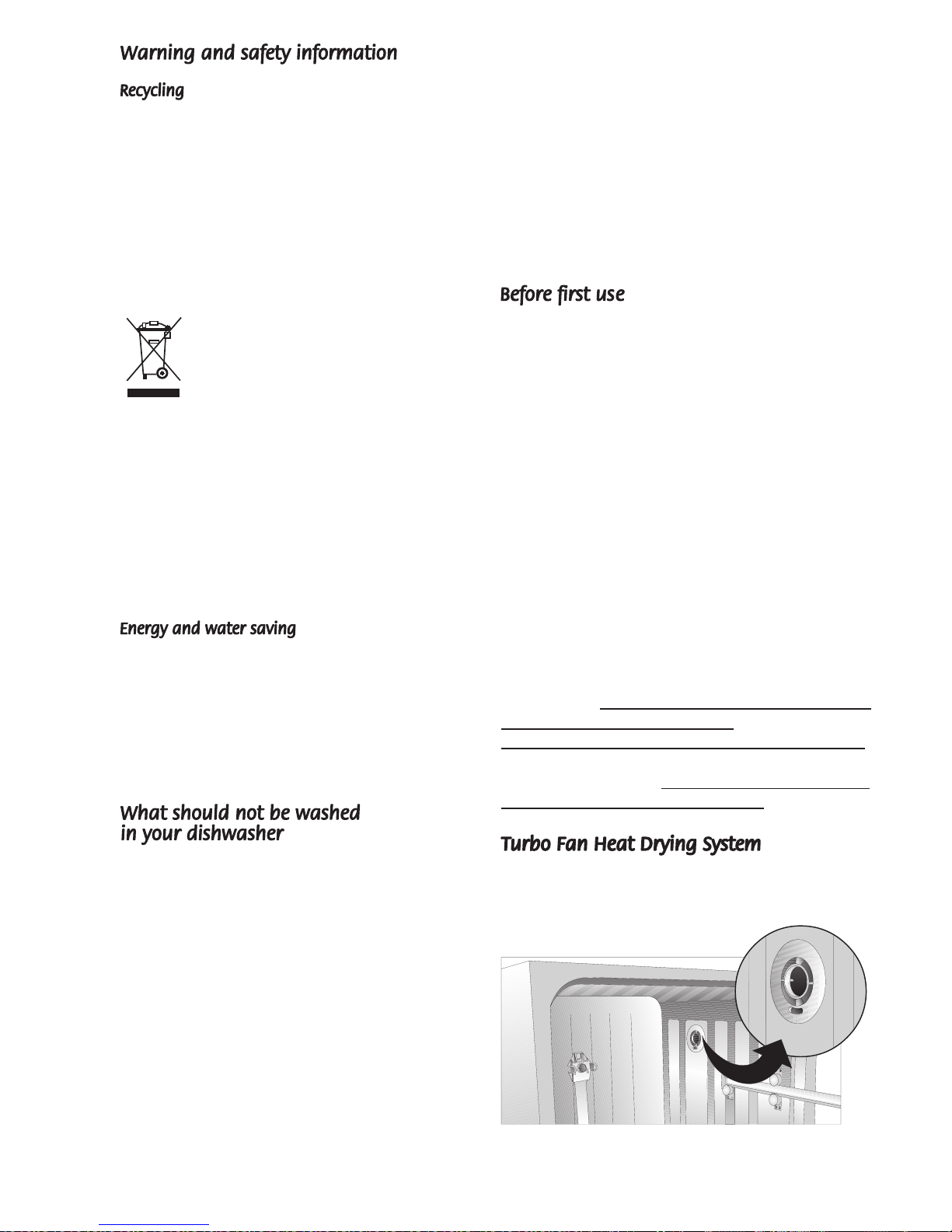
Turbo Fan Heat Drying System ensures your
dishes are dried efficiently.
!
During operation you may hear noises which
is normal.
Please help us to protect our environment. Packing
materials and some parts of your machine are
produced using recyclable materials. These materials
are marked up with recycling symbol and material
type information (>PE<, >PS<, >POM<, ). These
raw materials should not be mixed with daily
garbage and should be given to recycling centers.
We suggest you contact your local authority for
disposal information and facilities available.
6
After unpacking your dishwasher, check the machine
against any possible transportation damage. Never
install and use damaged machines. If your machine is
damaged contact your retailer. Always have your
machine installed by qualified electrician/plumber to
ensure correct installation.
Any repairs and maintenance work on this dishwasher
should be carried out by authorised service staff only.
epairs conducted by third persons are not only
dangerous, but also lead to the cancellation of your
warranty.
Make sure the electricity and water connections of your
dishwasher are in compliance with the instructions for
assembly as stated in the relevant part of this booklet.
Any water remaining in the dishwasher after production
should be carefully removed due to reasons of hygiene.
Therefore, always select a pre-wash
programme before first use
(Pre-wash or Economy programme).
Before the first wash, add 1 lt of water to the
salt container of your machine.
This product bears the selective sorting
symbol for waste electrical and electronic
equipment (WEEE).
This means that this product must be
handled pursuant to European Directive
2002/96/EC in order to be recycled or dismantled
to minimize its impact on the environment. For
further information, please contact your local or
regional authorities.
Electronic products not included in the selective
sorting process are potentially dangerous for the
environment and human health due to the presence
of hazardous substances.
Do not wash items soiled with cigarette ash, candle,
paint wax, dyes, chemicals etc. since these may
damage your machine
Do not wash forks, knives and spoons with wooden
or bone handles, items stuck together with
adhesives, plastic items not resistant to high
temperatures copper, tin items and aluminium
ware in your dishwasher.
As with hand washing, some on-glaze
decorated china, aluminum or silver have a
tendency to discolour or fade. Also, certain
types of glassware and crystals may loose their
shine and become opaque in time.
Scrape excess food from the dishes before loading
Start your dishwasher after fully loading the
machine. Do not use the pre-wash programme
unless required. Make your programme selection
as per the programme chart and quick reference
guide supplied.
A chemical reaction can occur between silver cutlery
and stainless steel cutlery. As a precaution, do not
wash together.
Iron and cast iron objects can rust and stain other
items.
Pay special attention to whether or not the item you
wash in the dishwasher is dishwasher-proof.
If in doubt, contact the manufacturer of the item.
Do not overload your dishwasher or do not load items
other than those mentioned in this manual.

7
When deciding on where to install your new
dishwasher, ensure that the position of your
dishwasher makes it easy and quick for you to
place the dishes in the dishwasher and also to
take them out and store away after the
dishwashing is completed.
Avoid placing the dishwasher where the ambient
temperature is likely to fall below. 0 degrees
C. (32° F)
When positioning your appliance, take care not
to damage your flooring, pipes wall coverings
etc. Do not move the appliance by pulling by
the door or handle
Before you insert the plug into the wall socket
make sure that the voltage and the frequency
shown in the rating label corresponds to your
electricity supply.
We recommend that this appliance be
connected to the mains supply via a suitable
switched and fused socket in a readily accessible
position.
Should the mains lead of the appliance become
damaged or need replacing at any time, it must
be replaced by a special purpose made mains
lead which can only be obtained from a Beko
Authorized Service Agent.
If the supply cord or the mains lead is damaged
please do not replace it by your own. The
supply cord or the mains lead must be replaced
by a Beko Authorized Service Agent personnel
or a similarly qualified person.
If the fitted moulded plug is not suitable for
your socket, then the plug should be cut off
and an appropriate plug fitted.
Destroy the old plug, which is cut off as a plug
with a bared cord could cause a shock hazard
if inserted into a socket elsewhere in the house.
The moulded plug on this appliance
incorporates a 13A fuse. Should the fuse need
to be replaced an ASTA approved BS1362 fuse
of the same rating must be used. Do not forget
to refit the fuse cover. In the event of losing
the fuse cover, the plug must not be used until
a replacement fuse cover has been fitted.
Colour of the replacement fuse cover must be
the same colour as that visible on the pin face
of the plug. Fuse covers are available from any
good electrical store.
As the colours of the wires in the mains lead of
this appliance may not correspond with the
coloured markings identifying the terminals on
your plug, proceed as follows:
1 Connect the green - yellow or green (earth)
wire to the terminal in the plug marked E or
with the symbol or coloured green and
yellow or green.
2 Connect the blue (neutral) wire to the terminal
in the plug marked N or coloured black.
3 Connect the brown (live) wire to the terminal
in the plug marked L or coloured red.
With the alternative plugs a 13A fuse must be
fitted either in the plug or adaptor or in the
main fuse box. If in doubt contact a qualified
electrician.
L
Brown or red
N
Blue or
black
Green and yellow
or green
Make sure your plumbing is suitable to
install your new dishwasher. If in doubt
contact a qualified plumber.
The appliance must be connected to the
water mains using the new hose set
supplied with your new dishwasher. Old
hose sets must not be re-used.
The water pressure coming from the water
mains supply must be a minimum of 0.3 and a
maximum of 10 bars.
Fit the drainage hose of your machine
to the drainage pipe without bending.
Secure your hose firmly to the waste
pipe to avoid it coming off during the
washing process.
The waste pipe must only be connected
into the foul drains and not surface water
drainage system.
The hose should be placed between
50 cm and 110 cm from the floor level
and must not be extended otherwise the
machine may not empty the waste water.
Connect the straight end to your water
mains supply Ensure plastic filter and
black rubber seal is in place.
Please turn on the tap and check for
leakages after connecting the hose.
Please ensure the tap is turned off when
the machine is not used;
If you only have one cold water feed (For
example for your washing machine) dont
worry. a Y adaptor will provide you with
the additional cold water feed you need
for your dishwasher. Y adaptor is available
from most DIY stores.
1
8
max 110 cm
01020 30 40
50
60 70 80 90 100 110
12cm
min 4cm
max 110 cm
min 50 cm
18
21
1
emove all packaging before positioning the
machine.
See the following diagram. Ensure there is a
clearance each side of the machine to allow slight
side ways movement for servicing.
Work top of your dishwasher is removable if
required. Height without the work top is 820 mm.
By removing the machines worktop, you can
install it under a close fitting sink unit or a pre-
existing top, if the dimensions of the recess
correspond to those shown in the picture.
Position the machine next to a water tap and a
drain.
When inserting the machine, ensure that the
water inlet and drain hoses are not kinked or
squashed.
Care must be taken to ensure that the appliance
does not stand on the electrical supply cable.
Good levelling is essential for correct closure and
sealing of the door,
Make sure your dishwasher is perfectly level using
the adjustable feet.
When the appliance is correctly levelled, the door
will not catch on the inner liner on either side of
the cabinet.
If the door does not close correctly, loosen or
tighten the adjustable feet, until the machine is
perfectly level.
15mm
9
min 850mm
10
Dishwashers require fairly soft water. If the hardness exceeds 6°dH lime scale will form on crockery. To avoid this
an automatic system adds a special salt to soften the water so that you obtain the best possible cleaning and
drying performance.
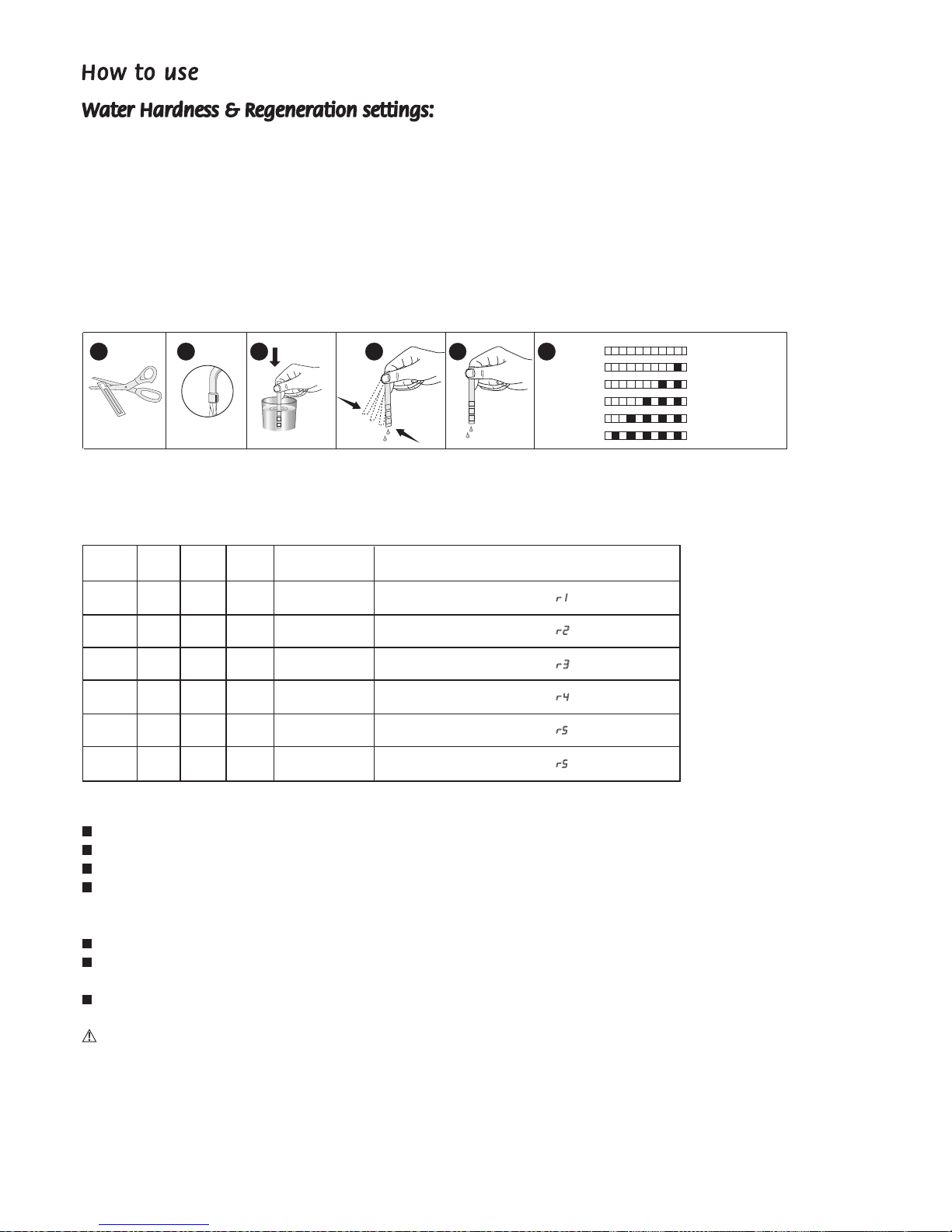
To find out the hardness level of your water contact your local water company, or use the enclosed test strip to
measure the water hardness:
Press the Program Selection Button before you switch the appliance on and keep this button pressed down.
Switch the appliance on using the On/Off Switch, then release the switch.
Hold the Program Selection Button down for 3 seconds.
The default regeneration phase recorded in your machine will be shown in "r" format and Start / Pause /
Cancel indicator light will start flashing. "r1" will appear on the screen if the regeneration phase recorded in
your machine is "r1".
elease Program Selection button.
Water hardness can be set to the desired level by pressing the (+) and (-) buttons. (Compare the test strip with
the Degrees of Hardness Table). The display shows the appropriate message.
Once you have set the hardness level press the Start / Pause / Cancel Button to save the value. The Control
Indicator on the Start/Pause Button now lights up permanently.
If the hardness level is saved as "r1", the salt level warning will never light under any circumstances regardless
of the amount of salt left in the salt container.
If the water hardness at your location is over 45°dH, you should consider using a water-softening device for your
dishwasher.
When using well or rain water, the installation of pre-filter is recommended.
After moving house, remember to reset the water hardness for your new location.
Warning !
The electricity and water connections of the dishwater must be in compliance with the instructions
in this booklet.
°dH: German degree 1 °dH = 1 mg CaO/100 ml Water = 0.179 mmol
Water Hardness Level
Le el 1
Le el 2
Le el 3
Le el 4
Le el 5
0-5
6-11
12-17
18-22
0-9
10-20
21-30
31-40
0-6
7-14
15-21
22-28
23-34 41-6029-42
Hardness
Level
Clarke
degree
s°d
German
degrees
°dH
French
degrees
°dF Hardness Level Displayed
Position of the
Programme Knob
1
2
3
4
5
*
Le el 6
35-45 61-8043-56 5
Display will show
Display will show
Display will show
Display will show
Display will show
Display will show
Test Strip
Let the water
flow from your
tap for 1
minute.
emove the
test strip from
its packing.
Fill a glass with
tap water and
dip the test strip
into water for 1
second.
Take the test strip
out of the water
and shake it.
Hold for
1 minute. Set the water hardness level of your dishwasher
according to the result shown by the test strip.
b
a
e
1 minute
1 second
cd f
No Lime
Very low lime content
Low lime content
Medium lime content
Lime content
High lime content
Level 1
Level 2
Level 3
Level 4
Level 5
Level 6