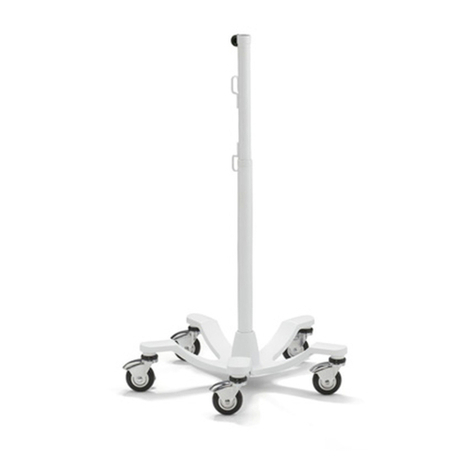
Brunson ROCK STEADY RS Series User manual

Heavy Duty Mobile
Metrology Stands
Manual for Models
RS Series and 232
Part No. 19399 Rev A

© Copyright 2023 Brunson Instrument Company
Brunson Instrument Company
8000 E 23rd Street
Kansas City, MO 64129
www.brunson.us
info@brunson.us
Tel 816-483-3187
Fax 816 -241-1945
Heavy Duty Mobile Metrology Stands
Manual for Models
RS Series and 232

Thank you for purchasing
a Brunson Rock Steady
or 232 Heavy-Duty Stand.
Remember that our customer
support does not stop after
shipment of a product—we
are here to help you with any
measurement challenges that
you may have.
Table of Contents
The Rock Steady Stand Line
The 232 Series Heavy Duty Mobile Stand
General Information
Safety Precautions
Unpacking and Setup
Moving and Positioning Your Stand
Stand Operation
Maintenance
Parts List and Diagram
Declaration of Conformity (CE Mark)
pg. 4
pg. 6
pg. 8
pg. 8
pg. 9
pg. 9
pg. 10
pg. 11
pg. 12
pg. 13

4
RS-230 Rock Steady Tall
RS-231 Rock Steady Short
RS-233 Rock Steady Medium
RS-231-MOD Extra Short
Rock Steady Adjustable Stands

5
RS-F-36
RS-F-6 RS-F-24
Rock Steady Fixed-Height Stands
RS-F-48

6
232 Series Heavy Duty Mobile Stands
The 232 Series Heavy Duty Mobile Stand
*232 Series models have a handwheel instead of a foot pedal.

7
*232 Series models have a handwheel instead of a foot pedal.
Foot Pedal*
Tribrach
Brace
Collar Locking Handle
Main Tube
Serial Number Location
Jam Nut
Trivet
Caster
Intermediate Tube (retractable)
Raise/Lower Control Handles
Ratchet Pawl
Figure 1

8
General Information
Safety Precautions
Congratulations and thank you for purchasing a Brunson Rock Steady metrology stand. At Brunson,
we recognize the importance of a stable, rugged and durable metrology platform, and the Rock
Steady stand line reects our passion for supporting accurate, tight-tolerance measurement.
Please take a moment to review this manual. It contains important safety and operational
information for the stand. Refer to Figure 1 on page 5 for part names referenced in the instructions.
Finally, for future reference, please record the model and serial number for the stand in the space
provided below.
Model Number
Serial Number
Static (non-moving) stability:
1. These stands are designed for use on level surfaces. Operating a stand on non-level surfaces
increases the tipping hazard.
2. Instrumentation / equipment used with the stand should be centered over the axis of the
Intermediate Tube. Extending unbalanced loads from the centerline axis increases the tipping
hazard.
Dynamic (moving) stability:
1. Stands should be moved only when no instrumentation / equipment is attached and the
Intermediate Tube is in its fully retracted (lowest) position.
2. Stands should be moved by manually pushing or pulling no faster than a normal walking
pace over smooth, level surfaces. Do not move a stand by pushing or pulling with a powered
vehicle.
3. Avoid sudden starts and stops.
These stands are designed for indoor use only. Wind (or other external) loading was not considered
when determining stability. Do not exceed the load capacity of the stand for any attached
instrumentation / equipment. The maximum load capacity is listed in Table 1.

9
It is the
responsibility of
the end user to
ensure that any
instrumentation/
equipment attached
to the stand is
safely secured.
Model
RS-230
RS-231
232 Series
RS-233
RS-231-MOD
RS-F-6
RS-F-24
RS-F-36
RS-F-48
Stand Weight
205 lbs (93 kg)
174 lbs (79 kg)
587 lbs (267 kg)
191 lbs (86.6 kg)
152 lbs (69 kg)
96 lbs (43.5 kg)
140 lbs (63.5 kg)
156 lbs (70.8 kg)
173 lbs (78.5 kg)
Max Load Capacity
150 lbs (68 kg)
150 lbs (68 kg)
150 lbs (68 kg)
150 lbs (68 kg)
150 lbs (68 kg)
150 lbs (68 kg)
150 lbs (68 kg)
150 lbs (68 kg)
150 lbs (68 kg)
Unpacking and Setup
Take o the top and sides of the crate by removing the screws. Cut the three band clamps holding
the tribrach legs down. With an overhead crane (or suitable alternative), lift the stand o the crate
and place on a level surface (refer to Table 1 for stand weights). If a foot pedal is present ensure it is
not engaged—the foot pedal should be “up” and free to move.
Tighten the lower (jam) knob on each trivet.
!
!
CAUTION! This is the safety alert symbol. This symbol alerts you to hazards that can hurt
you and others, and/or cause damage to equipment. Additional information specic to the
hazard will be included with this warning.
Moving/Positioning Your Stand
Ensure that the intermediate tube is in its lowest position and no instrumentation / equipment is
attached to the stand.
A foot pedal is used to extend the casters on the RS Series stands. The 232 Series uses a
handwheel. To extend the casters using the foot pedal, use your body weight and step on the pedal.
The locking latch is spring-loaded and will “click” into place when the stand is locked onto the
casters. For 232 Series Models, turn the hand wheel until the casters extend to
the ground.
Manually push or pull the stand into the desired position. The stand should be positioned so that
the tribrach leg on which the foot pedal (or handwheel) is mounted points toward the midpoint of the
work.
Table 1

10
Lower the stand onto the three trivets. If the oor is something other than concrete (e.g. wood, tiled,
etc.), you may wish to use pads under the trivets to provide protection for the oor. Lower the stand
by stepping down on the foot pedal to take the weight of the stand and rock your foot downward
using the ball of your foot to release the spring-loaded latch.
MAINTAIN SUFFICIENT PRESSURE ON THE FOOT PEDAL TO PREVENT THE STAND FROM
SUDDENLY DROPPING ONTO THE FLOOR WHEN THE LATCH IS RELEASED.
!
!
!
!
CRUSHING HAZARD! Stands are very heavy! Prior to lowering the stand, ensure area
below Tribrach is clear of all obstacles.
TRIPPING HAZARD! Due to the size of the footprint necessary for stand stability, the legs
of the stand can create a tripping hazard.
Stand Operation
With the intermediate tube fully retracted, attach the instrument / measuring equipment to the stand.
Raise the collar locking handle until the intermediate tube can be raised easily by rotating the
control handles.
To raise the intermediate tube, rotate the control handle counter-clockwise (when looking
at the hub).
!
!
TIPPING HAZARD! Move the stand over smooth, level surfaces only, with the intermediate
tube in its lowest position and no instrumentation / equipment attached. Move the stand by
manually pushing or pulling (no faster than a walking pace). Do not tow or push the stand
with a powered vehicle.
!
!
ROTATING HAZARD! The stands are equipped with an air-check mechanism to
prevent rapid descent of the intermediate tube. However, until sucient air pressure
has built up to slow the descent of the intermediate tube, considerable force can be
exerted by the free spinning control handle. Therefore, always lower the intermediate tube
by applying a resistive force to the control handle.
This manual suits for next models
1
Other Brunson Rack & Stand manuals

Popular Rack & Stand manuals by other brands

Salamander
Salamander Acadia AC/W/L400/WH Assembly instructions

Fohhn
Fohhn VAT-09 Mounting instruction

ricoo
ricoo FS0522 quick start guide

AMSOIL
AMSOIL BMK-22 Installation and service instructions

Kargo Master
Kargo Master 48220 installation guide

Milestone AV Technologies
Milestone AV Technologies SIMPLICITY SLF2 installation instructions