IMPORTANT SAFETY PRECAUTIONS
This symbol is used to call attention to safe-
ty precautions that should be followed by
the operator to avoid accidents. When you
see this symbol, carefully read the message
that follows and heed its advice. Failure to
comply with safety precautions could result
in serious bodily injury.
n addition to the design and configuration of equipment, hazard control and accident prevention are
dependent upon the awareness, concern, prudence and proper training of personnel in the operation,
transport, maintenance and storage of equipment. Lack of attention to safety can result in accident, person-
al injury, reduction of efficiency and worst of all—loss of life. Watch for safety hazards and correct deficien-
cies promptly. Use the following safety precautions as a general guide to safe operations when using this
machine. Additional safety precautions are used throughout this manual for specific operating and mainte-
nance procedures. Read this manual and review the safety precautions often until you know the limitations.
ACCIDENT PATTERNS TO AVOID
1. CONTACT W TH THE ROTAT NG BLADE - This accident usually happens when the operator is
clearing the discharge chute of grass, (especially when the grass is wet), or when the operator adjusts
the machine without turning it off and waiting for the blades to completely stop.
2. PROPELLED OBJECTS - Sticks, rocks, wires, and other objects can be propelled out through the dis-
charge chute or from under the mower housing. Bystanders are particularly vulnerable.
3. GRASS D SCHARGE CHUTE - The mower shall not be operated without the grass discharge chute
in its lowered position.
4. OVERTURN NG - This happens when riding mowers are used on steep slopes, embankments or hills.
The operator in these cases can come in contact with blades or sustain injuries during a fall.
5.
MOWER RUNN NG OVER THE V CT M - This usually happens when a riding mower is driven in reverse.
The accident victims are most often young children whom, unseen by the operator of the mower, were
in the area being mowed.
WE SHARE YOUR DESIRE TO PROTECT YOURSELF, YOUR FAMILY, YOUR FRIENDS AND YOUR
NEIGHBORS FROM ACCIDENTAL INJURY. OBSERVING AND ENFORCING THE FOLLOWING GUIDE
LINES WILL HELP TO INSURE THE SAFETY OF EVERYONE.
SAFETY INSTRUCTIONS AND RECOMMENDATIONS
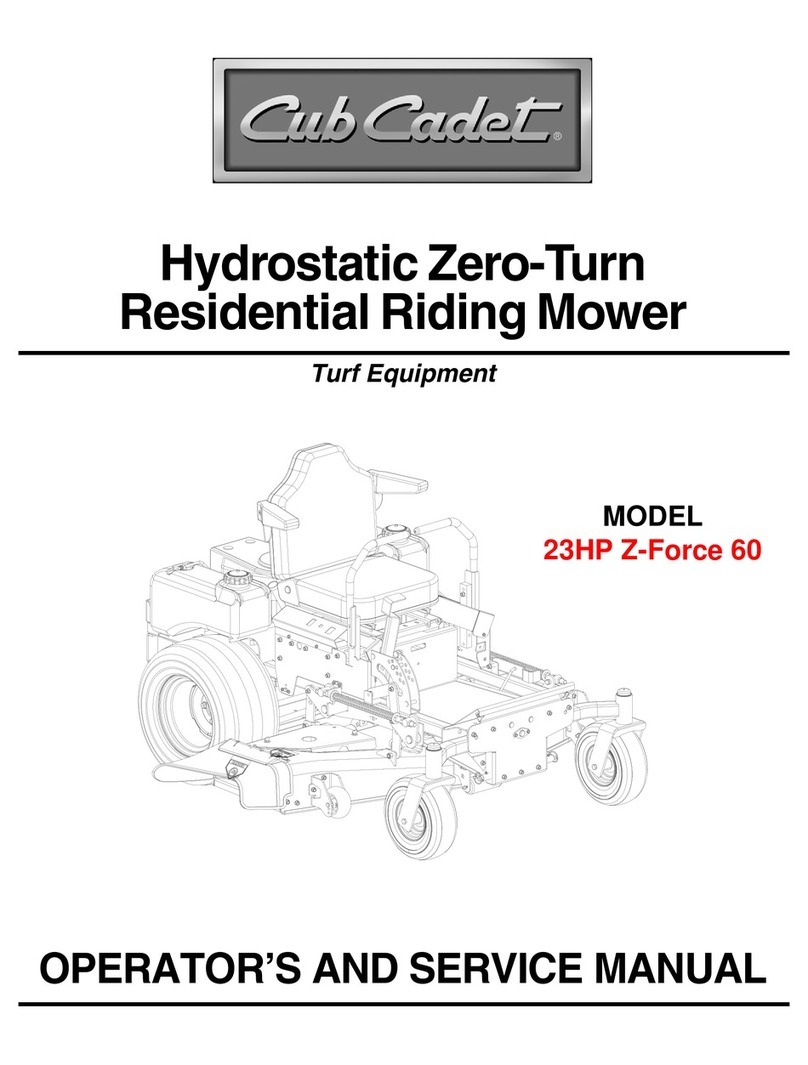
1. PEOPLE WHO OPERATE, SERV CE, OR ARE OTHERW SE ASSOC ATED with the Zero Turning
Riding Mower should be trained in its proper use and warned of its dangers. Before operating, adjusting,
or servicing the Zero Turning Riding Mower they should read and understand this entire manual and the
engine manual.
2. AVO D CONTACT W TH MOV NG PARTS. Keep hands and feet from under mowing deck and away
from blades at all times. Turn engine (motor) off if you must unclog the chute.
3. AVO D H LLS AND SLOPES. Use EXTREME caution when mowing and/or turning on slopes as loss of traction
and/or tip-over could occur. Drive slower on slopes. DO NOT mow slopes greater than 15 degrees. Watch for
ditches, holes, rocks, dips and rises, which change the operating angle. Keep away from drop-offs and steep
banks. Avoid sudden starts when mowing uphill - mower may tip backwards. Loss of traction may occur going
downhill - weight transfer to the front wheels may cause drive wheels to slip and cause loss of braking. DO NOT
mow slopes when grass is wet - slippery conditions affect steering and reduce traction and braking. The operator
is responsible for safe operation on slopes.
4. D SENGAGE POWER TO MOWER BEFORE BACK NG UP. Do not mow in reverse unless absolutely
necessary and then only after turning around and observing the entire area behind the mower. Go slowly.
Most “running over victim” accidents occur in reverse.
5. BEG NN NG OPERATORS SHOULD LEARN HOW TO STEER the Zero Turning Riding Mower before
attempting to mow. Start with slow engine speed and drive without the blades engaged in open area until
comfortable with the machine.
5