REFRIGERATION & ELECTRICAL SPECIFICATIONS
Refrigeration
Refrigerant Type: R134A
Capacity: 25 Ounces
High Side Pressure= 135 psig
Low Side Pressure= 25 psig
1/2 H. P. Compressor
Electrical
120 Volts Single Phase, 50/60 Cycle
Total Amps= 14
Provided with a NEMA 5-20P Plug
Requires a NEMA 5-20R Receptacle
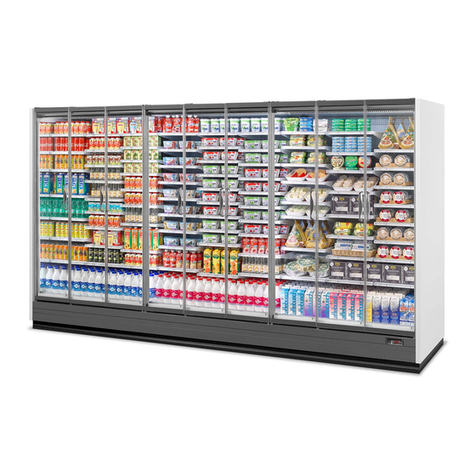
The Air Screen Refrigerator was designed to operate at a
range of 36 F (2.22 C) to 40 F (4.44 C). The pull down time
(time required to go from room temperature to 36 F) is
approximately 40 minutes.
The Air Screen Refrige rator ope rates basically the same as
other refri g e rated ca rt s, except it maximizes air flow through
s pecial duct s. The Ra n co therm o s t atmonitors the ca rt te m-
pe rat u re and turns the condensing unit on when be l ow
se tp oint te m pe rat ure. The condensing unit then conden se s
the ref ri g e ra nt to crea te the cold air, which is cycled thro ugh
the eva po rator located in the top housing. The two ce nter
fa ns, which are always on, then circul ate air through the
eva po rator cold coils and into the ca rt . When the ca rt rea ches
the set te m pe rat u re the therm o s t at turns the con d en s in g
unit off. Mo i s t u re is removed from the air when the co n-
d e n s ate unit is energ i ze d. When this oc cur s, the moisture
will drip into the pan located be n e ath the evapo rator. The
mo ist ure then drains down to the co n d e n s ate eva po rator,
which boils the water away. When the ca rt door is ope n e d,
the two outer fans turn on and increase the air flow. Th i s
in creased airf l ow through the ducts cause a screen of air
ac ross the car t holding the cold air inside.
IMPORTANT:
To maintain proper temperatures in the air curtain and
to prolong the life of the compressor, the condenser coils
must be cleaned on a regular basis. It is recommended
that the coils be checked and cleaned on a m o nt hl y.
This proce d u re is not cove red under warra nty, however
is to be performed only by qualified engineering/main-
tenance personal.
Cleaning procedure:
• Tu rn unit off and unplug from elect ri cal power source.
• To access the coils, remove the louve red panels locate d
at the bottom of the unit.
• Use a vacuum cleaner with a brush at t a c h m e nt to clean
the co ils. In ext reme cases of dust and grease buildup,
co m p ressed air may be re q u i red for cleaning the coil
fins. Use caution when doing this. The air curtain must
be moved to an isolated location to pe r fo rmthis proce-
d u re. O n ce the coils have been cleaned, i ns p e ct for be nt
coil fins. St raighten be nt fins using a straightening too l
called a comb.
• The co m p ressor motor and other co mp one nts can be
cleaned using stiff brush or whisk broo m .
CAUTION: Do not use steel wool pads as they will result in
rusting from the ferrous metal in the pads.
Page 4
!
Routine Cle a ning Daily Soap,ammo n ia
deterg e nt & water
Sponge with cloth,rinse
with clear water & wipe dry.
PURPOSE
RECOMMENDED “TIPS”
FOR CLEANING STAINLESS STEEL
CLEANING
AGENT
METHOD OF
APPLICATION
FREQUENCY
Smears/
fingerp ri nt s
As needed Stainless steel
cleaner or similar
prod u ct s
Rub with cloth as dire cted
on packag e. Rub in dire ction
of grain of stainless steel .
Do not use on vinyl tri m .
Stubbo rn spots &
stains
Daily
As needed
Any chlori de- free
or phosphate-free
cleaner
Apply with damp sponge or
cloth. Rub in dire ction of po l-
ish lines.Rinse thoroughly
after use, especially if cleaner
co ntains chlorine bleach.
Do not use on vinyl tri m .
Hard water spots Daily
As needed
Vineg ar Swab with cloth.Rinse with
water & wipe dry.
Maintenance
Air Screen Refrigerator
2. Vinyl trim should be washed with a chlorine-free deter-
gent and water. Rinse thoroughly with clear water and
allow to dry. Never use abrasive cleaners, waxes, car pol-
ish, or substances containing strong aromatic solvents or
alcohol. Use of direct steam/hot water cleaning at tem-
peratures above 190° F may result in “bubbling” or loos-
ening or vinyl adhesive.
3. To clean stainless steel surfaces use only cleansers,
detergents, degreasers, or sanitizers that are certified to
be “chloride-free” and “phosphate-free,” and cleansers,
degreasers, or sanitizers only in the recommended
concentrations. DO NOTexceed recommended concen-
trations or mixing ratios. After cleaning and sanitizing,
rinse all exp osed surfaces thoroughly with large amount s
of clear water. Wipe off any standing liquid or residue
from all horizontal surfaces in corners, or near edges.