Coercion
Coercion reveals new dialogue options that can convince other characters to change their
minds, sometimes revealing new paths through a plot or more favorable terms for a deal.
If a Persuade option appears in dialogue, your chance of success is determined by your
rank in Coercion and your cunning score. If an Intimidate option appears instead, success
depends on Coercion and your strength score.
Stealing
Characters who have learned to steal can attempt to pick the pockets of other characters,
whether friendly, neutral, or hostile, although a high rank in the skill is necessary to steal
during combat. In most cases, items you receive from stealing are in addition to those that
an enemy would normally drop after dying in combat.
Trap-Making
Characters who have learned this skill can construct traps or lures from common
components, so long as they also possess a plan to build the mechanism. The second and
fourth rank of this skill also increase the range at which the character can detect enemy
traps. Note that while all characters who have learned this skill can set traps, only rogues
can disarm them.
Survival
Survival lets a character detect enemies who would otherwise be hidden. Higher ranks also
bestow bonuses to nature resistance and physical resistance.
Herbalism
Herbalism allows a character to make a wide variety of potions, poultices, salves, balms,
elixirs, and so forth, whenever raw ingredients and a recipe are at hand. At higher ranks,
the character can complete more difficult recipes, producing particularly potent items.
Poison-Making
Poison-Making focuses on mixing deadly substances that the character can apply to melee
weapons, inflicting extra damage and often leaving enemies immobile. Those skilled in
this art can also create explosive bombs and flasks designed to be hurled at the enemy. As
with Herbalism and Trap-Making, creating items using this skill requires a recipe and raw
ingredients. Note that this skill is required not just to create poisons—it is also required to
use them.
Combat Training
For warriors and rogues, each rank in this skill opens up a new tier of weapon talents that
the character can learn, as well as providing other small benefits. Although mages cannot
learn weapon talents, this skill significantly increases the damage they can take from an
attack before it interrupts an attempt at casting a spell.
Combat Tactics
Each rank in this skill increases the number of slots available on a character’s combat
tactics sheet (see p. 26). Since each slot governs one conditional action during combat—for
example, instructing a mage to heal any character whose health falls below 50%—having
more slots available means you can design more elaborate battle plans for your party.
TALENTS/SPELLS
Talents (for warriors and rogues) and spells (for mages) are special abilities that are unique to a certain type of
character, as distinct from skills, which any character can learn. They are almost always related to combat. Using
a talent or spell often draws from the character’s pool of stamina or mana, although some are passive, providing
permanent advantages without stamina or mana expenditure. A character gains one talent or spell each level,
as well as at a few other points in the game. You begin with one talent or spell pre-determined by your class and
can learn one more of your choosing for free. If you skip advanced character creation, the game chooses for you.
Unlike skills, talents and spells do not offer higher ranks; instead, related abilities are grouped in chains
of four. Learning a talent or spell unlocks the next ability in that chain—so long as the character meets
other prerequisites like character level and attribute scores.
Some spells and talents are available to all characters of that class, and a few groups of talents, like
Dual Weapons and Archery, are available to both warriors and rogues. Other spells and talents are linked
to a single specialization, which characters can earn later in the game.
There are hundreds of talents and spells in Dragon Age: Origins—far too many to list here. Each is
described in the game.
Activated Abilities
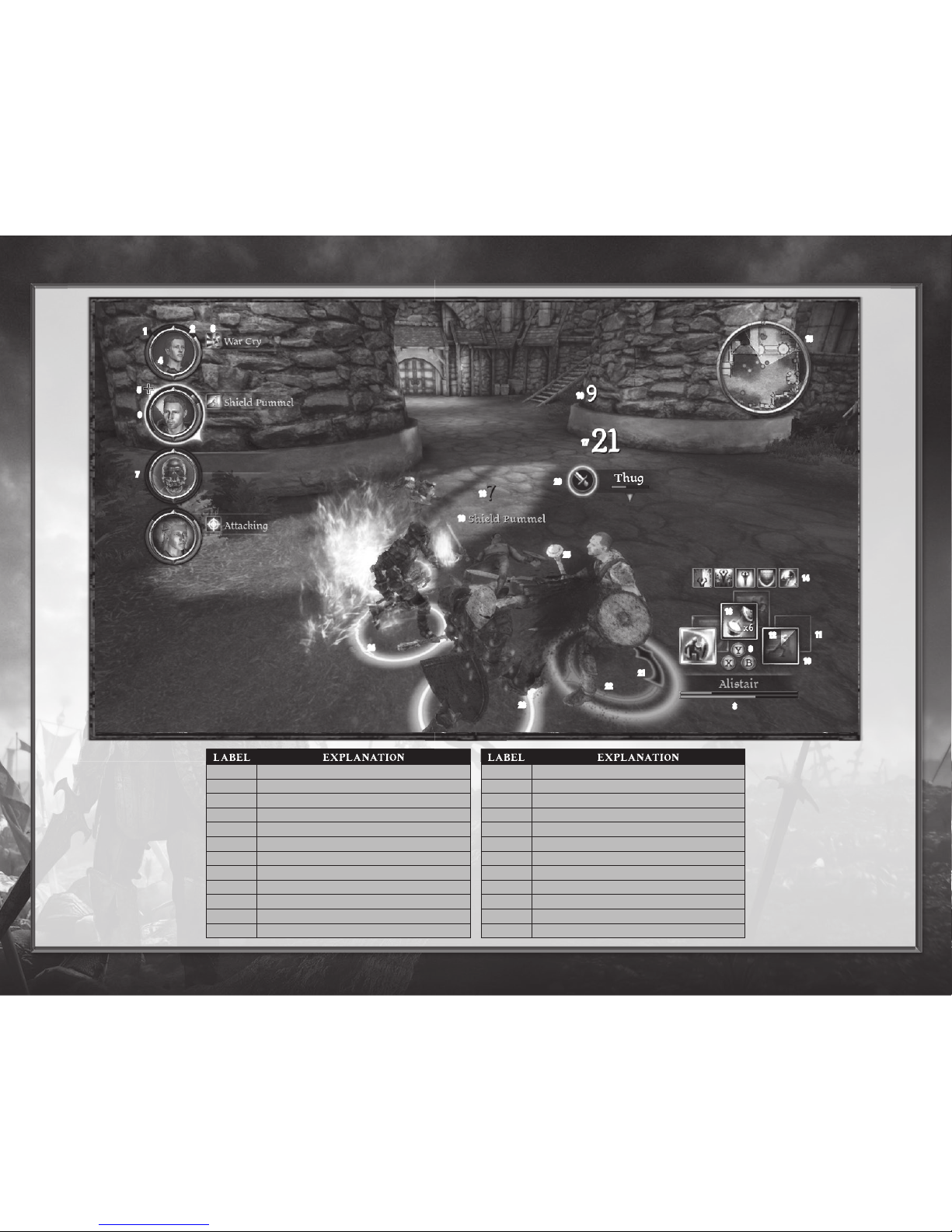
The most common talents or spells are those marked “activated,” which the current character uses
only when directed. (Other characters in your party use their activated abilities whenever appropriate, or
whenever the conditional instructions you set up in the combat tactics screen tell them to.) These abilities
vary widely—some have positive effects on your character or allies, whereas others act offensively against
one or more enemies, or even against everyone in an area, no matter whose side they’re on. Some activated
abilities are in effect for only a second, while others remain active for a short time. Most activated abilities
incur an immediate cost in stamina or mana, although a few are free to use. After you use a particular
activated ability, there is a short cooldown period before you can use it again.
Passive Abilities
Talents or spells marked “passive” are permanent effects. They do not consume stamina or mana, and,
because you do not need to activate them, they do not appear in your battle menu or radial menu. If you
wish to review which passive abilities your character has learned, take a look at your spells or talents sheet.
Sustained Abilities
Once you use a talent or spell marked “sustained,” it remains active either until you disable it or until the
ability exhausts all of your character’s stamina or mana. Some sustained abilities are free to use, and
thus remain active for as long as you like. Using a sustained ability is tiring, however, and thus imposes
a fatigue penalty, which means that each subsequent ability you use simultaneously with that sustained
ability requires more stamina or mana. After you deactivate a sustained ability, there is a short cool-down
period before you can use it again.
EXPERIENCE AND LEVELS
Whenever you complete a quest or kill an enemy in combat, you’ll earn experience points (sometimes
called XP). Once you have enough XP to cross a certain threshold, your character gains a new level; you
can see your progress towards that threshold just below the character’s name in the main interface or in
the character record. It takes 2000 XP to move from level 1 to level 2, and the amount of new experience
required for each successive level is 500 XP greater than the previous. (That is, the threshold for level 3
is 4500 XP—2500 XP more than level 2.) There is no hard cap on the number of levels.
At each new level, a character gains the following:
Three attribute points
One spell or talent
Possibly a skill point (every two levels for rogues; every three levels for warriors and mages)
Several health and mana/stamina points, depending on class (see p. 8)
A small increase to base attack damage
In the character record, you can specify whether you would prefer to spend attribute points, skill points,
and spell/talent points yourself or whether the game should level your characters up automatically.