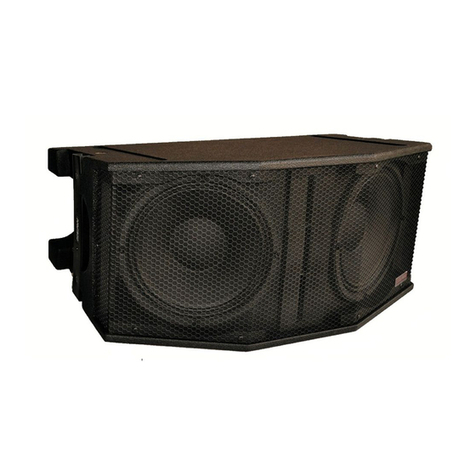
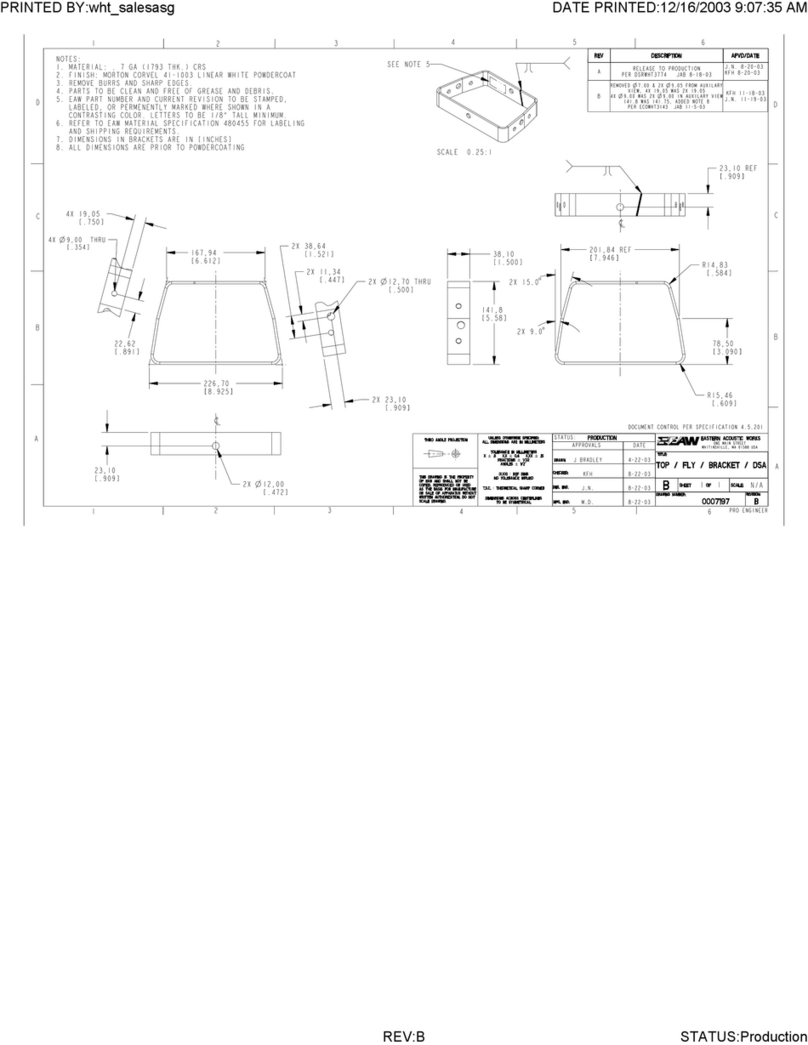
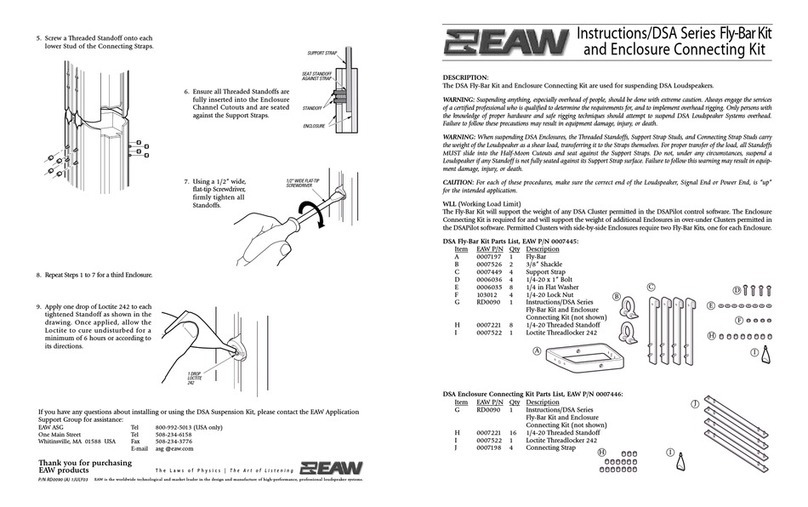
EAW CLA37 User manual

INSTRUCTION MANUAL
CLA37
Column Loudspeaker

2 – CLA37
CLA37– 3
1. SAFETY INSTRUCTIONS
1. Read these instructions.
2. Keep these instructions.
3. Heed all warnings.
4. Follow all instructions.
5. Do not use this apparatus near water.
6. Clean only with a dry cloth.
7. Do not block any ventilation openings. Install in accordance with the manufacturer’s instructions.
8. Do not install near any heat sources such as radiators, heat registers, stoves, or other apparatus
(including ampliers) that produce heat.
9. Only use attachments/accessories specied by the manufacturer.
10. Refer all servicing to qualied service personnel. Servicing is required when the apparatus
has been damaged in any way, such as liquid has been spilled or objects have fallen into the
apparatus, the apparatus has been exposed to rain or moisture, does not operate normally, or has
been dropped.
11. The entire sound system must be designed in compliance with the current standards and laws
regarding electrical systems.
12. When installing and using this apparatus, keep in mind the technical specications indicated in the
dedicated section of the manual.
13. Exposure to high sound levels can cause permanent hearing loss. The sound pressure level which
leads to hearing loss varies considerably from one person to another, and depends on the duration
of exposure. The U.S. Government’s Occupational Safety and Health Administration (OSHA) has
established the maximum sound pressure levels that can be with stood without causing damage,
which are shown in the table below. According to the OSHA regulations, any exposure over the
maximum limits indicated in the table can reduce the hearing capacity of a person. To prevent
potentially dangerous exposure to high sound pressure levels, anyone subjected to such levels
must use suitable protection. When a EAW Commercial product capable of producing high sound
levels is being used, it is therefore necessary to wear ear plugs or protective earphones when
the limits shown in the table are exceeded. Consult the specications provided in the instruction
manual to know the maximum sound pressure (SPL) the loudspeaker is capable of producing.
WARNING! This
equipment has been
designed to be installed
by qualied professionals
only! There are many factors
to be considered when
installing professional sound
reinforcement systems,
including mechanical and
electrical considerations, as
well as acoustic coverage and
performance. EAW Commercial
strongly recommends that this
equipment be installed only by
a professional sound installer or
contractor. Part No. 0012959 Rev.A 09/2004
© 2004 LOUD Technologies Inc. All Rights Reserved.

repnoitaruD
)sruoh(yad
leveldnuoS
)ABd( elpmaxelacipyT
8 09 bulcllamsaniouD
6 2
9
4 59 n
iartyawbuS
3 7
9
2 0
01 cisumlacissalcduolyreV
5.1 201
1 5
01 teef05taevitomocoL
5.0 011
sselro52.0 511 trecnockcoratastraptseduoL
The exclamation point within an
equilateral triangle is intended to
alert the user of the presence of
important operating and maintenance
(servicing) instructions in the literature
accompanying the apparatus.

2 – CLA37
CLA37– 3
14. Rigging Precautions: When mounting or suspending EAW Commercial loudspeaker
enclosures, it is essential that load ratings, rigging techniques, and special safety
considerations be appropriate for the installation. Use only the mounting/rigging points
on the loudspeaker enclosure intended for this purpose. The user must determine the load
requirements, dynamic loading, and any other contributing factors affecting the loudspeaker
installation. The user must determine the proper design factor for specic applications and
the required load rating of the connection to structure. Comply with all applicable federal,
state, and local regulations.
EAW Commercial strongly recommends the following rigging system practices:
• Documentation: Thoroughly document the mounting/rigging design with detailed
drawings and parts lists.
• Analysis: Have a licensed structural engineer or other qualied professional review and
approve the mounting/rigging design before its implementation.
• Installation: Use personnel experienced and qualied for mounting/rigging loudspeakers
in accordance with and in compliance with all federal, state and local regulations.
DANGER: Loudspeakers should be mounted or suspended only by persons with knowledge
of the proper hardware and rigging techniques. When stacking or pole-mounting
loudspeakers, be sure that they are stabilized and secured from falling over or being
accidentally pushed over. Failure to follow these precautions may result in damage to the
equipment, personal injury, or death.
TABLE OF CONTENTS
1. SAFETY INSTRUCTIONS........................................................ 2
2. INTRODUCTION....................................................................... 4
3. INSTALLATION ........................................................................ 5
4. CONNECTIONS........................................................................ 8
5. OPERATION.............................................................................. 10
6. SPECIFICATIONS..................................................................... 11
Dimensions.............................................................................. 11
Performance Graphs .............................................................. 12
7. TROUBLESHOOTING .............................................................. 13
8. SERVICE and MAINTENANCE............................................... 14
9. WARRANTY ............................................................................. 15

4 – CLA37
CLA37– 5
2. INTRODUCTION
Congratulations on the purchase of your new EAW Commercial loudspeaker. You now
own one of the nest professional audio products available – the result of exceptional
engineering and meticulous craftsmanship. Please read these instructions to get the
maximum performance from your new loudspeaker.
Each EAW Commercial loudspeaker is intended for professional use. The construction,
components, and hardware have been designed to provide robust, reliable performance for
its intended application. Please ensure that you fully understand its proper installation and
operation before use.
This manual describes the CLA37 frequency-shaded column loudspeaker. The CLA37 is an
economical solution for exceptional delity in speech reinforcement and background music
applications. It is especially suited for small to mid-sized spaces with excessive reverberation
or problematic sound reections. The drivers and system voicing are designed to maximize
vocal range clarity and speech intelligibility, without compromising the broadband frequency
response required for pleasing music reproduction.
The CLA37 uses sophisticated, frequency shading to progressively shorten its acoustic
length with increasing frequency. The result is a well-behaved nominal vertical beamwidth
of 30 degrees to below 1 kHz that eliminates troublesome lobing. In the horizontal plane, the
drivers act as direct radiators. A waveguide loads the three center drivers to maintain the
nominal 120 degree beamwidth at high frequencies.
The included bracket allows setting the enclosure’s vertical angle for both wall-mounting
and suspension. An optional input panel has an integral transformer for 70 V or 100 V
distributed applications. The cross-ply laminated birch enclosure is available in either black
or white nish, and the powder-coated steel grille is foam-backed to hide the drivers from
view.
Features:
• Frequency-shaded, full-range,
column loudspeaker
• Seven high-quality 3-inch drivers
• 120 degree horizontal x 30
degree vertical nominal
beamwidth
• Passive crossover for
economical, single-amplier
operation
• Optional 70 V / 100 V multi-tap
transformer
• Includes mounting/suspension
bracket
• Five-year warranty
Applications include:
• Houses of Worship
• Transportation Terminals
• Museums
• Theme Parks
• Schools
• Meeting Rooms

4 – CLA37
CLA37– 5
3. INSTALLATION
Unpacking and Inspection
Visually inspect the outside of the shipping carton and check for any damage. After
unpacking, if you nd concealed damage to the loudspeaker, save the packing materials for
the carrier’s inspection, notify the carrier immediately, and le a shipping damage claim.
Although EAW Commercial will help in any way possible, it is always the responsibility of
the receiving party to le any shipping damage claim. The carrier will help prepare and le
this claim.
Mounting Precautions
The mounting bracket provided can be used for wall mounting the loudspeaker.
WARNING: Installation should only be done by an experienced technician.
Improper installation may result in damage to the equipment, injury or death. Make
sure that the loudspeaker is installed in a stable and secure way in order to avoid any
conditions that may be dangerous for persons or structures:
• Check to make sure that the support surface (e.g., wall, etc.) has the necessary
mechanical characteristics to support the weight of the loudspeaker without the
danger of it falling.
• Always use support elements suitable for the material of the wall that will support
the loudspeaker (e.g., screw anchors for bricks, screw anchors for cement, etc.). Due
to various construction methods and materials used today, the hardware for securing
the bracket to the mounting surface is not supplied. Consult a building professional
for the proper mounting hardware before mounting the bracket.
• Before suspending the loudspeaker, carefully check all the components to be used to
make sure there is no damage, deformation, corrosion and/or missing or damaged
parts that could reduce the safety of the installation.
• Consult a professional rigger or structural engineer prior to suspending loudspeakers
from a structure not intended for that use. Always know the working load limit of the
structure supporting the loudspeaker. Always make sure that the rigging hardware
minimum rating is at least ve times the actual load.
• Avoid installing the loudspeaker in places exposed to harsh weather conditions.
6 – CLA37
CLA37– 7
Fly bracket and wall bracket mounting instructions
Follow these instructions to mount the y bracket to the enclosure, hang the assembly
at various forward tilt angles, and attach the enclosure/y bracket assembly to the wall
bracket. Make your speaker-wire connections before proceeding.
Warning: Installation should only be done
by an experienced technician. Improper
installation may result in damage to the
equipment, injury or death.
1. Mounting the Fly Bracket to the Enclosure:
a. Remove the screws from the top and bottom
of the enclosure.
b. Onto each of these two screws, place a lock
washer and a at washer.
c. Insert a screw (with washers) through the
top hole of the y bracket. Thread into the
enclosure’s top mounting hole.
d. Insert a screw (with washers) through the
bottom hole of the y bracket. Thread into the
enclosure’s bottom mounting hole.
e. Angle the enclosure so it is at a right angle to
the y bracket and tighten the two mounting
screws.
2. Hanging the Enclosure/Fly Bracket Assembly:
a. Support the enclosure/y bracket
assembly from each side of the y
bracket using one set of the paired
holes along its top and back.
b. The hardware for hanging the
enclosure/ y bracket assembly is
not supplied. It is recommended
that you consult a rigging
professional to determine the
proper hardware to hang the
enclosure/y bracket assembly.
3. Mounting the Wall Bracket:
a. Mount the wall bracket to the desired surface (see picture on next page). The
hardware for securing the wall bracket to a mounting surface is not supplied. It
is recommended that you consult a rigging professional to determine the proper
hardware for mounting the bracket. Make sure the two holes nearest one end of the
wall bracket are toward the oor.
SCREW 1/4 INCH-20
X 1.25 INCH LON
G
HEX HEAD
2 PLACES
FLAT WASHER
1/4 INCH
2 PLACES
LOCK WASHER
1/4 INCH
2 PLACES
FLY
BRACKET
REUSE EXISTING
SCREW FROM TOP
REUSE
EXISTING
SCREW FROM
BOTTOM
FLYING ANGLES
(CABINET SHOWN
VERTICAL AT 0°)
16°
12°
9°
20°
22°
30°
36°
40°
32°
27°
31°

6 – CLA37
CLA37– 7
4. Mounting the Enclosure/Fly Bracket Assembly to the Wall Bracket:
The y bracket is used to secure
the enclosure to the wall bracket.
The enclosure may be tilted
forward at various angles or
mounted vertically. For a forward
tilt, refer to the gure to the right
and these instructions:
a. Insert a 4.25 in screw with a
at washer, through the middle
hole in the ange of the wall
bracket, through the channel
in the connecting bracket, and
through the second center
hole in the opposite ange
of the wall bracket. Onto the
threaded end of the screw,
place a at washer and a lock nut. Do not tighten
just yet.
b. Insert a 4.25 in screw with a at washer, through
the bottom hole in the ange of the wall bracket,
through the horizontal channel in the y bracket,
and through the second bottom hole in the opposite
ange of the wall bracket. Onto the threaded end of
the screw place a at washer and a lock nut. Do not
tighten just yet.
c. Secure the other end of the connecting bracket
to the desired holes in the enclosure/y bracket
assembly, using the 4.25 in screw/washer held in
place with the at washer and lock nut. Refer to
the gure to the right to achieve the desired angle.
Tighten all three lock nuts.
5. Vertical Mounting:
To mount the loudspeaker enclosure/y bracket assembly vertically,
discard the connecting bracket, and follow these instructions:
1. Align the top hole in the wall bracket ange with the top rear holes in
the enclosure/y bracket assembly, and insert a 4.25 in screw with a
at washer.
2. Onto the threaded end of the screw, place a at washer and a lock
nut. Do not tighten just yet.
3. Repeat step 4b above, to insert a screw into the wall bracket’s lowest
hole.
4. Tighten both lock nuts.
Step 4b.
Step 4a.
Step 4c.
SCREW 1/4 INCH-20
X 4.25 INCH LON
G
HEX HEAD
3 PLACES
FLAT WASHER
1/4 INCH
6 PLACES
LOCK NUT
1/4 INCH-20
3 PLACES
ENCLOSURE AND
FLY BRACKET
CONNECTING
BRACKET
WALL
BRACKET
13°
10°
16°
18°
22°
25°
4°
7°
25°
CONNECTING
BRACKET
TILTING THE
ENCLOSURE
MOUNTING THE
ENCLOSURE VERTICALL
Y

8 – CLA37
CLA37– 9
4. CONNECTIONS
WARNING: To prevent the risk of electric shock, do not connect the loudspeaker
with the amplier switched on. The protective cover over the terminal strip
is a safety feature per CE requirements. Replace this cover after making the signal
connections.
1. Remove the insulating cover from the loudspeaker input
terminal strip.
2. The positive (+) input terminal of the loudspeaker connects
to the positive (+) output of your power amplier.
3. The negative (–) terminal of the loudspeaker connects to
the negative (–) output of your power amplier.
4. Using a small phillips screwdriver, secure the connections.
5. Replace the insulating cover over the loudspeaker input
terminal strip.
CAUTION:
SUSPENDING THIS SYSTEM SHOULD BE DONE BY QUALIFIED
TECHNICIANS FOLLOWING APPROPRIATE SAFETY STANDARDS
--
+
IN
P
UT
Bracket Dimensions
4x
11 mm dia
1.50"
(38.1)
3.50"
(89)
3.00"
(76.2)
6.00"
(152.4)
8.00"
(203.2)
25.57"
(649.6)
22.00"
(558.8)
26.57"
(675)
25.08"
(637)
10.00"
(254)
3.43"
(87.16)
3.67"
(93.2)
1.00"
(25.4)
2x 8 mm dia
0.70"
(17)
4.14"
(105.1)
9x 8 mm dia)
NOTES:
UNLESS WHERE SPECIFIED:
1. DIMENSIONS ARE IN INCHES,
DIMENSIONS IN BRACKETS ARE MILLIMETERS.
2. DIMENSION TOLERANCE ± 0.03" (0.8 MM)
Wall bracket
Fly bracket
Connecting bracket

8 – CLA37
CLA37– 9
Loudspeaker Cables
• Use loudspeaker cables with a minimum
conductor size for the length you need, as
listed in these tables. This will minimize
power losses to less than 0.5 dB. The
cable lengths listed are “up to” lengths.
For in-between lengths, use the next larger
conductor gauge. Using larger than the
recommended conductor size is always
permissible. Using smaller than recommended
conductor size will result in higher power
losses.
• The recommended conductor gauges are
listed for AWG (American Wire Gauge) and
Metric WG (Metric Wire Gauge). Note that
smaller AWG numbers = larger conductors
and smaller Metric WG numbers = smaller
conductors. The Metric WG is equal to ten
times the nominal conductor diameter in millimeters.
• For cable lengths over 200 feet / 60 m at 8 ohms, and over 100 feet / 30 m at 4 ohms,
the conductor sizes needed for less than 0.5 dB power losses are rarely practical
for physical and cost reasons. As a practical compromise for these situations the
recommended conductor gauge is 10 AWG or 25 metric.
Precautions
• To prevent inductive phenomena causing humming or distortion, the speaker cables
should not be run together with electrical energy conductors, microphone cables, or
line-level audio lines.
• Use speaker cables that have markings to distinguish the polarity, such as insulation
or conductors of different colors.
• Before using the loudspeaker, carefully check that all the connections have been
made correctly to make sure there are no accidental short circuits that could cause
electrical sparks.
• Verify that the polarity of the connections to all of your loudspeakers are correct.
When more than one loudspeaker reproduces the same frequencies, but with
opposite polarity, there will be sound cancellations. Therefore, if any of the
loudspeakers are wired so that the +/- connection polarity is reversed with respect
to the others, incorrect reproduction will result. Most notably, the bass response will
suffer. This is especially true when loudspeakers are situated in adjacent positions
where the sound waves readily interact with each other.
Minimum AWG 4 ohm 8 ohm
18 10 ft 25 ft
16 25 50
14 25 75
12 50 125
10 100 200
Min Metric WG 4 ohm 8 ohm
12 3 m 8 m
14 8 15
16 8 25
20 15 40
25 30 60

10 – CLA37
CLA37– 11
5. OPERATION
Signal Processing
Sometimes external signal processing is desirable to “voice” the loudspeaker to
accommodate particular program material, less than optimum acoustics, feedback control, or
personal taste. For these purposes, use a suitable electronic signal processor. This can be as
simple as a 1/3 octave graphic equalizer or a fully capable DSP (digital signal processor) such
as the EAW Commercial DX810, or the EAW MX8750.
Choosing a Power Amplier
There is no exact answer to the question of what amplier size you should use for a
loudspeaker. The loudspeaker power rating in EAW Commercial’s specications only means
it has passed a standard power test. This provides a rating that can be used as a point of
comparison with other loudspeakers. This rating does not necessarily correspond to the best
amplier size to use nor is it a measure of a “safe” amplier size to use. Rather, the amplier
should be sized according to both the sound levels required and the type of audio signals
that will be reproduced. If you are unsure of how to determine this, consult with a qualied
professional or contact EAW Commercial Technical Support.
Preventing damage to the loudspeaker is a function of operating your audio system so
that the loudspeaker is not stressed beyond its design limits.
Operating Tips
• Do NOT drive any of your electronic equipment into clipping, particularly the power
ampliers. This can easily damage the loudspeaker.
• If driven into clipping, even an amplier with a power output rating lower than the
loudspeaker’s power rating can cause damage to a loudspeaker.
• Avoid sustained microphone feedback. This can quickly cause failure of high-
frequency drivers.
• Avoid extreme boosts on equalizers as these can cause excessive input to the drivers
at the boosted frequencies. Generally, cutting frequencies is preferred to adjust the
frequency response.
• With appropriate signal processing, your loudspeaker should produce exceptionally
good sound. If it is used in a room with problematic acoustics, there is little you can
do to overcome the room problems with electronic adjustments. Your best solution
is careful placement and aiming of the loudspeaker so most of the sound is directed
only at the audience.
• Most EAW Commercial loudspeakers are capable of sound levels that can be
damaging to human hearing. Take precautions so that audiences are not exposed
to such levels. If you must expose yourself to these kinds of volume levels, wear
adequate hearing protection.
• Take care when moving or lifting the loudspeaker. Injury to you or damage to the
loudspeaker can result from careless handling.
Other manuals for CLA37
1
Table of contents
Other EAW Speakers manuals