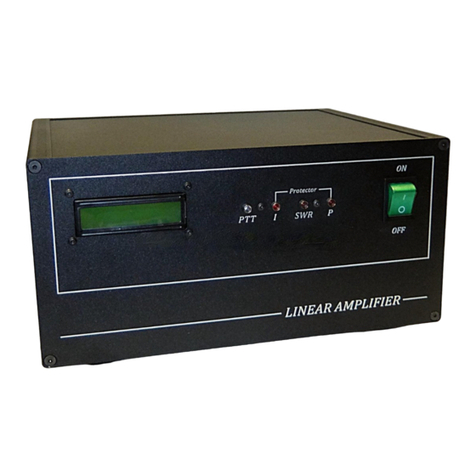
Functional features of the EB1200 amplifier
The built-in potentiometers in the protection circuit and the BIAS voltage control circuit
are set to the correct position during equipment setup and testing. Spontaneously changing the
position of these potentiometers will lead to the need to readjust the amplifier using precision
measuring instruments.
Before using the power amplifier, you must connect a 50 Ohm dummy load, 1200 W or
a matched antenna to the antenna output connector. No-load operation of the amplifier
negatively affects the operation of the RF output transistors.
For 1200 W output power, the input power level must be no more than 85 W. It is not
recommended to use transmitting devices with a power of more than 100 watts with the
amplifier.
The amplifier is designed for an impedance of 50 ohms. If the antenna-feeder devices
are matched to a resistance of 50 Ohm, and the VSWR in all operating ranges does not exceed
2.0: 1, then the amplifier can wor without additional matching. If the VSWR exceeds 2.0: 1, it
is recommended to use additional matching devices.
An LDMOS transistor is used in the output stage of the power amplifier.
The broadband characteristics of the power amplifier ensure complete readiness for
operation after selecting the operating range, without any additional steps to match the final
stage. The use of a high-linear transistor also made it possible to obtain an IMD3 -36 dbC.
The transmit-receive switching process in the amplifier is provided by the TIANBO relay with a
switching time of 12ms.
The power amplifier is equipped with special high-speed protection circuits. For
example, from exceeding the output power, high VSWR in the antenna, exceeding the drain
current of the output transistors and overheating.
To control the operating parameters of the power amplifier, a 5-inch touch screen is
used, which displays the output power level, SWR value, supply voltage, current, LPF control
mode - automatic / manual, transmission mode, power amplifier temperature.