QUICK START GUIDE
EPC – EFFICIENT POWER CONVERSION CORPORATION | WWW.EPC-CO.COM | COPYRIGHT 2017 | | 3
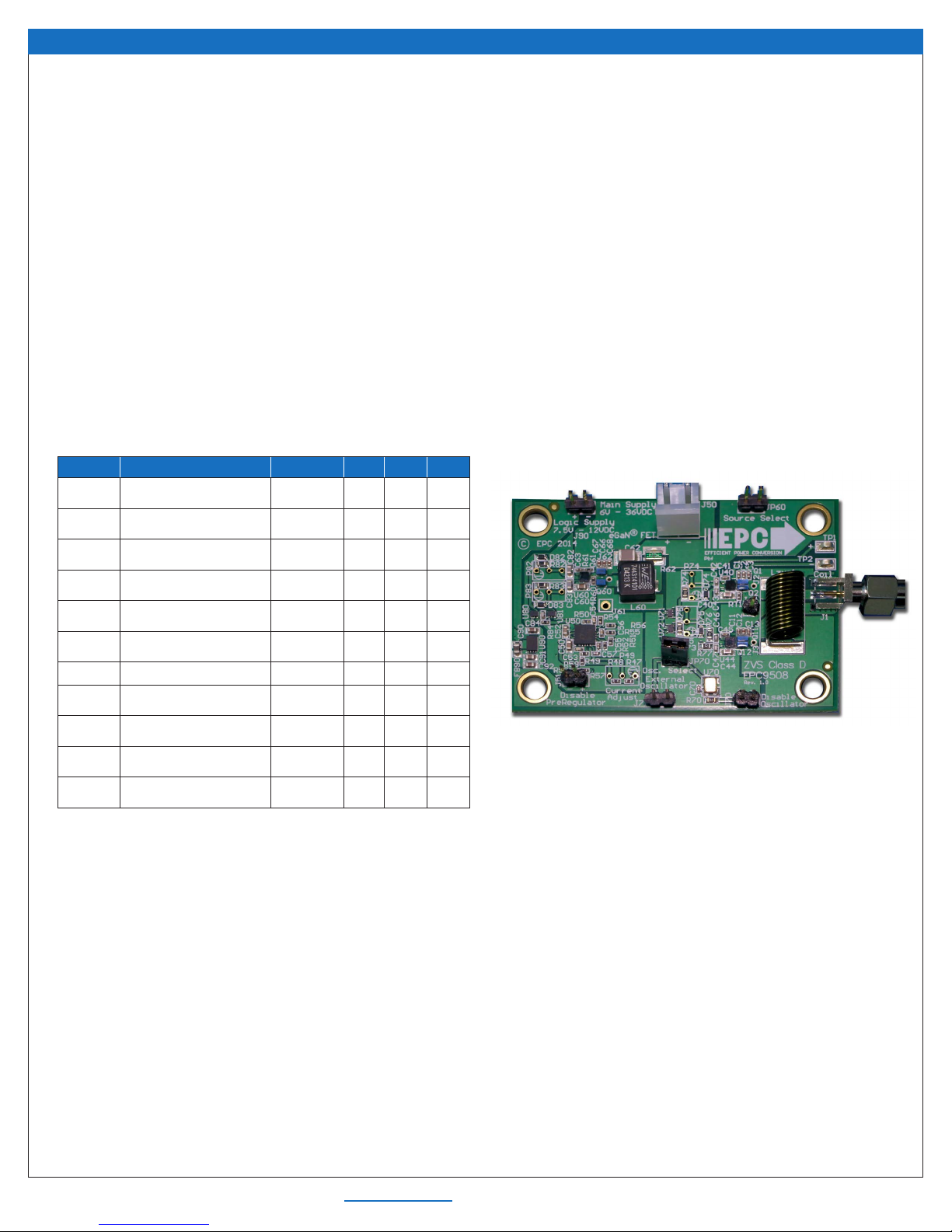
Demonstration System EPC9508
DETAILED DESCRIPTION
The Amplier Board (EPC9508)
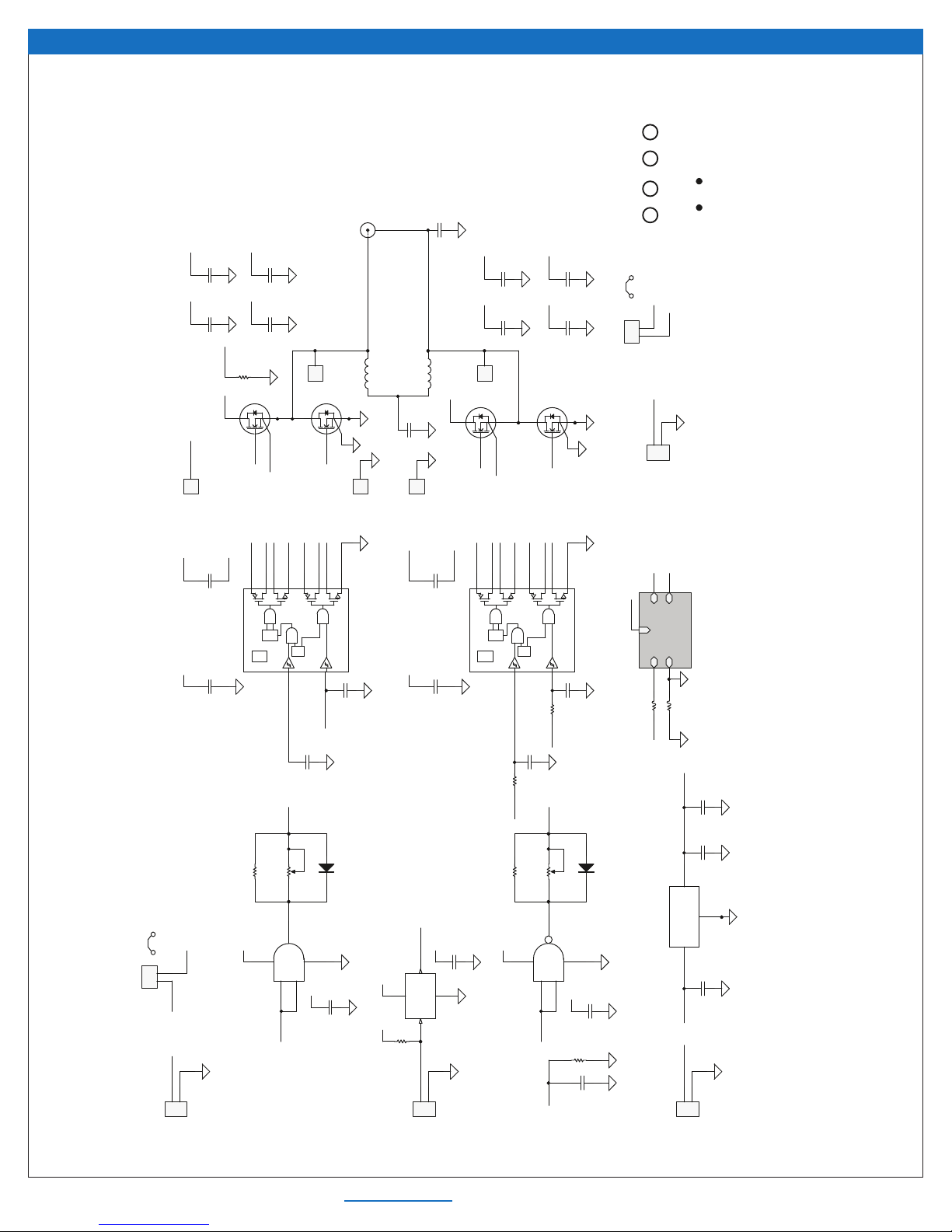
Figure 1 shows a diagram of the EPC9508 ZVS class-D amplier with pre-
regulator. The pre-regulator is set to a specied current limit (up to 1.5 A)
by adjusting P49 and operates from 6 V through 36 V input. The output
voltage of the pre-regulator is limited to approximately 2 V below the in-
put voltage. The pre-regulator can be bypassed by moving the jumper
(JP60) over from the right 2 pins to the left 2 pins. To measure the current
the amplier is drawing, an ammeter can be inserted in place of the jumper
(JP60) in the location based on the operating mode (pre-regulator or bypass).
The amplier comes with its own oscillator that is pre-programmed to
6.78 MHz ± 678 Hz. It can be disabled by placing a jumper into J70 or can
be externally shutdown using an externally controlled open collector / drain
transistor on the terminals of J70 (note which is the ground connection).
The switch needs to be capable of sinking at least 25 mA. An external os-
cillator can be used instead of the internal oscillator when connected to
J71 (note which is the ground connection) and the jumper (JP70) is moved
from the right 2 pins to the left 2 pins.
The pre-regulator can also be disabled in the same manner as the oscilla-
tor using J51. The pre-regulator can be bypassed, to increase the operating
voltage (with no current or thermal protection) to the amplier or to use
an external regulator, by moving the jumper JP60 from the right 2 pins to
the left 2 pins. Jumper JP60 can also be used to connect an ammeter to
measure the current drawn by the amplier (make sure the ammeter
connects to the pins that correspond to the mode of operation either
bypass or pre-regulator).
Single Ended Operation
The amplier can be congured for single ended operation where only
devices Q1 and Q2 are used. In this mode only LZVS1 and CZVS are used to
establish ZVS operation. If Q11 and Q12 are populated, then the following
changes need to be made to the board:
1) Remove R76 and R77
2) Short out C46 and C47
3) Short the connection of JMP1 (back side of the board)
4) Remove LZVS11
5) Check that CZVS1 is populated, if not then install.
6) R74 and R75 may need to be adjusted for the new operating
condition to achieve maximum eciency (see section on ZVS timing
adjustment).
ZVS Timing Adjustment
Setting the correct time to establish ZVS transitions is critical to achiev-
ing high eciency with the EPC9508 amplier. This can be done by
selecting the values for R74 and R75 respectively. This procedure is best
performed using potentiometer P74 and P75 installed that is used to
determine the xed resistor values. The procedure is the same for both
single ended and dierential mode of operation. The timing MUST initial
be set WITHOUT the source coil connected to the amplier. The timing
diagrams are given in Figure 4 and should be referenced when following
this procedure. Only perform these steps if changes have been made to
the board as it is shipped preset. The steps are:
1. With power o, connect the main input power supply bus to +VIN
(J50). Note the polarity of the supply connector.
2. With power o, connect the control input power supply bus to +VDD
(J90). Note the polarity of the supply connector.
3. Connect a LOW capacitance oscilloscope probe to the probe-hole J2
and lean against the ground post as shown in Figure 3.
4. Turn on the control supply – make sure the supply is between 7 V
and 12 V range (7.5 V is recommended).
5. Turn on the main supply voltage to the required predominant oper-
ating value (such as 24 V but NEVER exceed the absolute maximum
voltage of 36 V).
6. While observing the oscilloscope adjust P74 for the rising edge
of the waveform so achieve the green waveform of gure 4.
Repeat for the falling edge of the waveform by adjusting P75.
7. Check that the setting remains optimal with a source coil attached.
In this case it is important that the source coil is TUNED to resonance
WITH an applicable load. Theoretically the settings should remain
unchanged. Adjust if necessary.
8. Replace the potentiometers with xed value resistors.
Dierential Operation
The amplier can be congured for dierential operation where all the
devices are used; Q1, Q2, Q11 and Q12. In this mode either LZVS1, LZ V S11 and
CZVS or LZVS12 only is used to establish ZVS operation.
Determining Component Values for LZVS
The ZVS tank circuit is not operated at resonance, and only provides the
necessary negative device current for self-commutation of the output
voltage at turn o. The capacitance CZVS is chosen to have a very small
ripple voltage component and is typically around 1 µF. The amplier
supply voltage, switch-node transition time will determine the value of
inductance for LZVSx which needs to be sucient to maintain ZVS opera-
tion over the DC device load resistance range and coupling between the
device and source coil range and can be calculated using the following
equation:
(1)
Where:
Δtvt = Voltage transition time [s]
fsw = Operating frequency [Hz]
COSSQ = Charge equivalent device output capacitance [F].
Note that the amplier supply voltage VAMP is absent from the
equation as it is accounted for by the voltage transition time.
The charge equivalent capacitance can be determined using the
following equation:
(2)
To add additional immunity margin for shifts in coil impedance, the
value of LZVS can be decreased to increase the current at turn o
of the devices (which will increase device losses). Typical voltage
transition times range from 2 ns through 12 ns. For the dierential case
the voltage and charge (COSSQ) are doubled.
LZVS = ∆tvt
8 ∙ fsw∙ COSSQ
COSSQ =
VAMP
∙
∫
0
VAMP
COSS (v) ∙ dv
1