EnglishDeutsch
 logo
Brands
  1. Home
  2. •
  3. Brands
  4. •
  5. GE
  6. •
  7. Microwave Oven
  8. •
  9. GE JKP61G User manual

GE JKP61G User manual

Other GE Microwave Oven manuals

GE JEB1095 User manual

GE

GE JEB1095 User manual

GE Spacemaker HVM1540 User manual

GE

GE Spacemaker HVM1540 User manual

GE JES1146BF User manual

GE

GE JES1146BF User manual

GE Spacemaker JVM1850DMBB User instructions

GE

GE Spacemaker JVM1850DMBB User instructions

GE PVM9195SFSS Operating manual

GE

GE PVM9195SFSS Operating manual

GE JES1139 User manual

GE

GE JES1139 User manual

GE JES1344 User manual

GE

GE JES1344 User manual

GE JEB1860DM Manual

GE

GE JEB1860DM Manual

GE JNM3184 User manual

GE

GE JNM3184 User manual

GE JE635 User manual

GE

GE JE635 User manual

GE Monogram ZMW2000 Series User manual

GE

GE Monogram ZMW2000 Series User manual

GE JES1655 User manual

GE

GE JES1655 User manual

GE Spacemaker JVM1540 User manual

GE

GE Spacemaker JVM1540 User manual

GE SpacemakerXL JVM3660 User manual

GE

GE SpacemakerXL JVM3660 User manual

GE Profile Advantium PSA2200R User guide

GE

GE Profile Advantium PSA2200R User guide

GE JHP976 Installation instructions

GE

GE JHP976 Installation instructions

GE JES1039 User manual

GE

GE JES1039 User manual

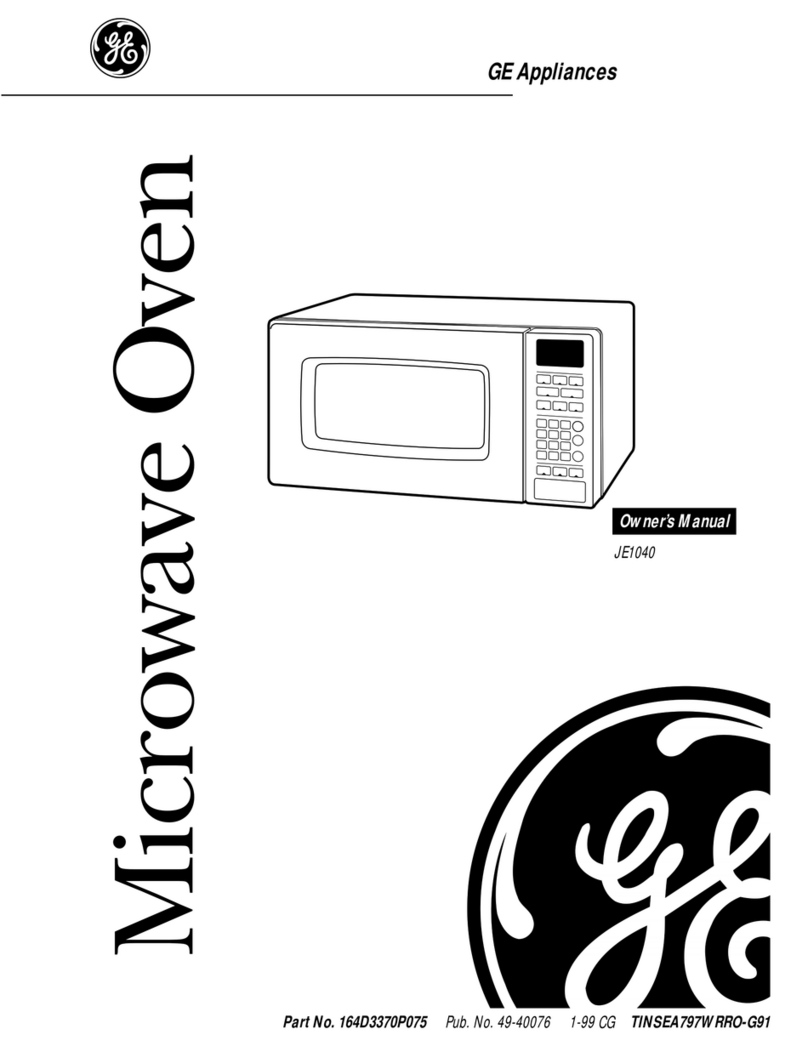
GE JE1040 User manual

GE

GE JE1040 User manual

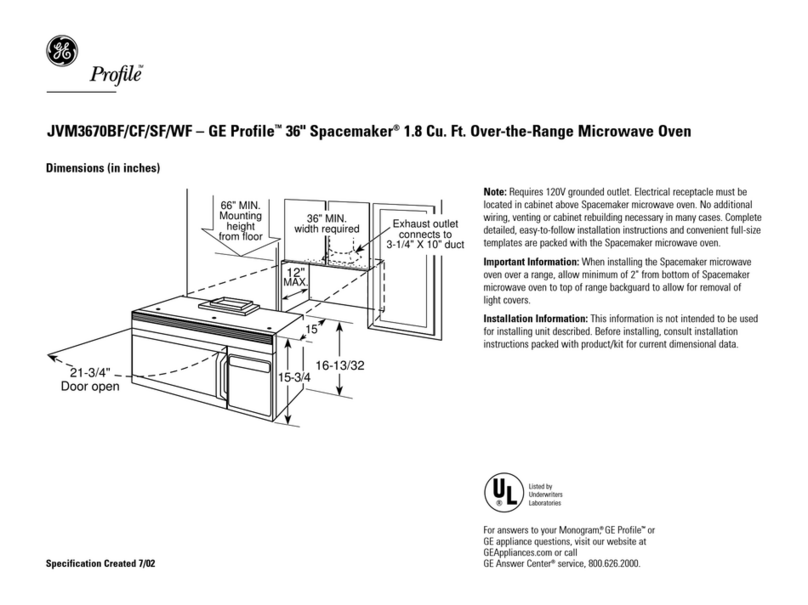
GE JVM3670BF User manual

GE

GE JVM3670BF User manual

GE Appliances JES1455 User manual

GE

GE Appliances JES1455 User manual

GE Spacemaker JVM1540SMSS User manual

GE

GE Spacemaker JVM1540SMSS User manual

GE PNM9216 User manual

GE

GE PNM9216 User manual

GE JES1139 Manual

GE

GE JES1139 Manual

GE JKP60 Installation instructions

GE

GE JKP60 Installation instructions

Popular Microwave Oven manuals by other brands

Samsung CE2815NR null

Samsung

Samsung CE2815NR null

Panasonic NN-S553WF null

Panasonic

Panasonic NN-S553WF null

Daewoo KOG-574R0S Service manual

Daewoo

Daewoo KOG-574R0S Service manual

LG MH7040SS instruction manual

LG

LG MH7040SS instruction manual

Sharp R-895(AL)M Service manual

Sharp

Sharp R-895(AL)M Service manual

Dometic DOTRM13W installation instructions

Dometic

Dometic DOTRM13W installation instructions

Sanyo EM-X680 instruction manual

Sanyo

Sanyo EM-X680 instruction manual

Sharp R-393M quick start guide

Sharp

Sharp R-393M quick start guide

KitchenAid KMCX4510 Use and care

KitchenAid

KitchenAid KMCX4510 Use and care

Smeg S45MCX1 Instructions for use

Smeg

Smeg S45MCX1 Instructions for use

Russell Hobbs RHM2044 user guide

Russell Hobbs

Russell Hobbs RHM2044 user guide

Sunbeam SMW759 owner's manual

Sunbeam

Sunbeam SMW759 owner's manual

Bosch CEG732X.1B User manual and installation instructions

Bosch

Bosch CEG732X.1B User manual and installation instructions

Dometic Roadmate 230 operating manual

Dometic

Dometic Roadmate 230 operating manual

Samsung SJ0396W Owner's instructions

Samsung

Samsung SJ0396W Owner's instructions

Sanyo EM-P494WS Supplement of service manual

Sanyo

Sanyo EM-P494WS Supplement of service manual

Sharp R-240 Operation manual

Sharp

Sharp R-240 Operation manual

Electrolux EMS2840 user manual

Electrolux

Electrolux EMS2840 user manual

https://manuals.online logo
https://manuals.online logoBrands
  • About & Mission
  • Contact us
  • Privacy Policy
  • Terms and Conditions

Copyright 2026 Manuals.Online. All Rights Reserved.

-
How from
w
UseandCareof
model
Features pti
AUTOROASTfeature p8
CODETMfeature p14
Howtooperatethe
loweroven p24
Usethe Solver
~
m
~
Line to
-
me
i
Red. ‘thisbook Gmfully.
His intendedto help youoperate
and maintain your new Cooking
Center properly.
Keepit handy for answersto your
questions.
If youdon’tunderstand something
or need more help, write (include
yourphone number):
Consumer Affairs
General Electric Company
Appliance Park
Louisville, KY40225
-whitedown the model and
mid Jnlm-dm’s.
Youll find them on alabel on the
front of the lower oven behind the
door.
These numbers are also on the
Consumer Product Ownership
Registration Card that came with
your Cooking Center. Before
sending in this card, please write
these numbers here:
Use these numbers in any corres-
pondence or servicecalls con-
cerning your Cooking Center.
Be sure your oven is regishmx.1.
It is important that we, the manu-
facturer, know the location of your
Cooking Center should aneed
occur for adjustments.
Your supplier is responsible for
registering you as the owner,
Please check with your supplier to
be sure he has done so; also send in
your Consumer Product Ownership
Registration Card, If you move, or
if you are not the original purchaser
please write to us, stating model
and serial numbers. This appliance
must be registered.Pleasebe Icer-
tainthat it k.
Write to:
General Electric Company
Range Product Service
Appliance Park
Louisville, KY 40225
H‘youreceived adtlmaged
oven. ● ●
immediately contact the dealer (or
builder) that sold you the Cooking
Center.
save time and money.
Before you request service,check
the ProblemSolveron page 29. It
lists minor causes of operating
problems that you can correct
yourself.
The electric outputofthis
microwaveovenis 625 watts.
mibw iS ch~md
tthe o
The panel displays four 8’sand all
of the oven functions on the lower
portion. After 15seconds, all lights
disappear and “PF” appears in the
upper portion. Touch the CLEAR/
OFF pad and oven is ready for use
and the clock can be set.
If power is disrupted at any time,
the above sequence reoccurs, and
you must reset CLOCKafter
touching CLEAR/OFF,
(a) Do Not Attempttooperate this
oven with the door open sinceopen
door operation can result in harmful
exposure to microwave energy. It is
important not to defeat or tarnper
with the safety interlocks.
(b) Do Not Place any object
between the oven front face and the
door or allow soil or cleaner
residue to accumulate on sealing
surfaces.
(c) Do Not (@mate the oven if it is
damaged. It is particularly impor-
tant that the oven door close prop-
erly and that there is no damage to
the:
(1) door (bent),
(2) hingesand latches (broken or
loosened),
(3) door sealsand sealing surfaces.
(d) The Oven Should PM be
adjusted or repaired by anyone
except properly qualified service
personnel.
T
@Make sure all utensils used in
your microwave oven are labeled
“suitable for microwaving”. Check
your Cookbook for specifictest
to determine “microwave-safe”
utensils.
@Paper towe]s, wax paper, and
plastic wrap can be used to cover
dishes in order to retain moisture
and prevent spattering.
@Some microwaved foods require
stirring, rotating, or rearranging.
Check your Cookbook for specific ,.~.
instructions. ..........
-’%%
@Some foods such as unshelled
eggs and hot dogs must be pierced $$&,
to allow steam tc escape during ~)
,>:-.<
-=:::.
cooking,
~WuresofYourOwn .........6
CookingCompleteReminder. ...6
TouchControl Panel ...........7
Au~ornaticRoasting&
Guide ..................8, 9
Defrosting. .................10
TimeCook . . . . . . . . . . .......11
AUTOSTART...............H
TempCook/Hold . . . . . .......12
.Minute/SecondTimer. ........13
COOKCODETfi’ControI.. .....14
COOKCODETMControl Guide. .15
SafetyInstructions ..........3-5
Features . . . . . . . . . . . . . . . . . . . .6
OvenContro.k . . . . . . . ........6
—OvenLight . . . . . . . . . . .......17
-=----OvenShelves . . . . . . . . .......17
—IbfinuteTimer, Clock,
.AutomaticOven Timer .. ....17
aking . . . . . . . . . . . . . .. .....18
BakingGuide . . . . . . . . .......19
Roasting ....................20
RoastingGuide. . . . . . . .......21
Broiling . . . . . . . . . . . . .......22
BroilingGuide ..............23
Self-CleanOperation......24,25
BeforeUsing Your
CookingCenter ............2
Energy-SavingTips ...........5
Model&Serial Number
Location . . . . . . . . . . ........6
Care ofYourCooking Center. ..26
Limp Replacement...........27
O\VJIT/em
Duct . . . . . . .......27
ChfenThermostat
,%djustment...............27
-hClcanhg Guide .............28
--2..
;+ The Problem Solver ......,29, 30
‘“-’~fl~o~]iJ~fz~~ervi~e ....,.....31
.<y:.-iirr~,~i~y...........Back Cover
.- .]
Mkn using electrical appliances
basic safety precautions should
be followed, including the
foilowing:
WARNING—TO reduce the
electricshock,fire,
injuryto persons or exposureto
excessivemicrowaveenergy:
49 Usethis applianceonlyfor its
intendeduse as describedin this
manual.
@Besure your applianceis prop-
erlyinstalledand groundedby a
qualif~edtechnicianin accordance
with the providedinstallation
instructions.
~This appliancemust becon-
nectedto agrounded, metallic,
permanent wiringsystem,or an
equipmentgrounding conductor
should be run with the circuit
conductorsand connectedto the
equipmentgroundingterminalor
lead on the appliance.
&This applianceshouldbe ser-
vicedonly by qualilledserviceper-
sonnel.Contact nearestauthorized
servicefacilityfor examination,
repair or adjustment.
@Beforeperformingany
service,DISCONNECT THE
OVEN POWER SUPI%X AT
THE HOUSEHOLD DR3TRI-
BUTICJNPANEL BY RE-
MOVING THE FUSE OR
SWITCHING OFF THE CR-
CXJITBREAKER.
@Do not coveror blockany
openingson the appliance.
aI Do not use outdoors.
sDo not operate this appliance
if it is not workingproperly,or if
it has been damaged or dropped.
63 As with any appliance,close
supervisionis necessarywhen used
by chiklren.
@13Mm’tallow to cM@b9
stmlldor hang on the door. They
$xNdd the Gwen.
@m-l Ii’lotkm%? akin%’===
chikhen should nbe leftalone
or unattended in area where
applianceis in use.Theyshould
neverbe allowedto sit or stand on
any part of the appliance.
@Cfimm’r+i: m) No%’STORE
rrm!w$ W? m
m
AN o’vEN=- ON
THE OVEN‘IDREACH r
COULD BE
WMMOproper clothing. Loose
fitting or hanginggarmentsshould
neverbe wormwhile’usingthe
appliance.Flammablematerial
could be;gnitedif brought in con-
tact with hot heatingelementsand
may causeseverebums.
@uUmlydry
moist or damp potholderson hot
surfacesmay resultin burns from
steam. Do not let potholders
touch hot heatingeltiments.Do
not use atowelor other bulky
cloth.
@Never use your fox’
m’ the I!x3@m.
@Do not shin? m3k-
ri$als the oven.
@Keep hood and $pwase
cleanto maintain good venting
and to avoid greasefires.
@lh rHwinking grease or
other auwi-
n’ndate the oven k
@Do nU!M3wgrt?ast?
fown cm be SE-m9th”
6X-WIby ckx!ingdkm
tw’ld
@CX.3dk.hgpork follow our
directionsexactly and alwayscook
the meat to at least 170°.This
assuresthat, in the remote possi-
bilitythat trichina may be present
in the meat, it willbe killedand
meat willbe safe to eat.
(continued next page]
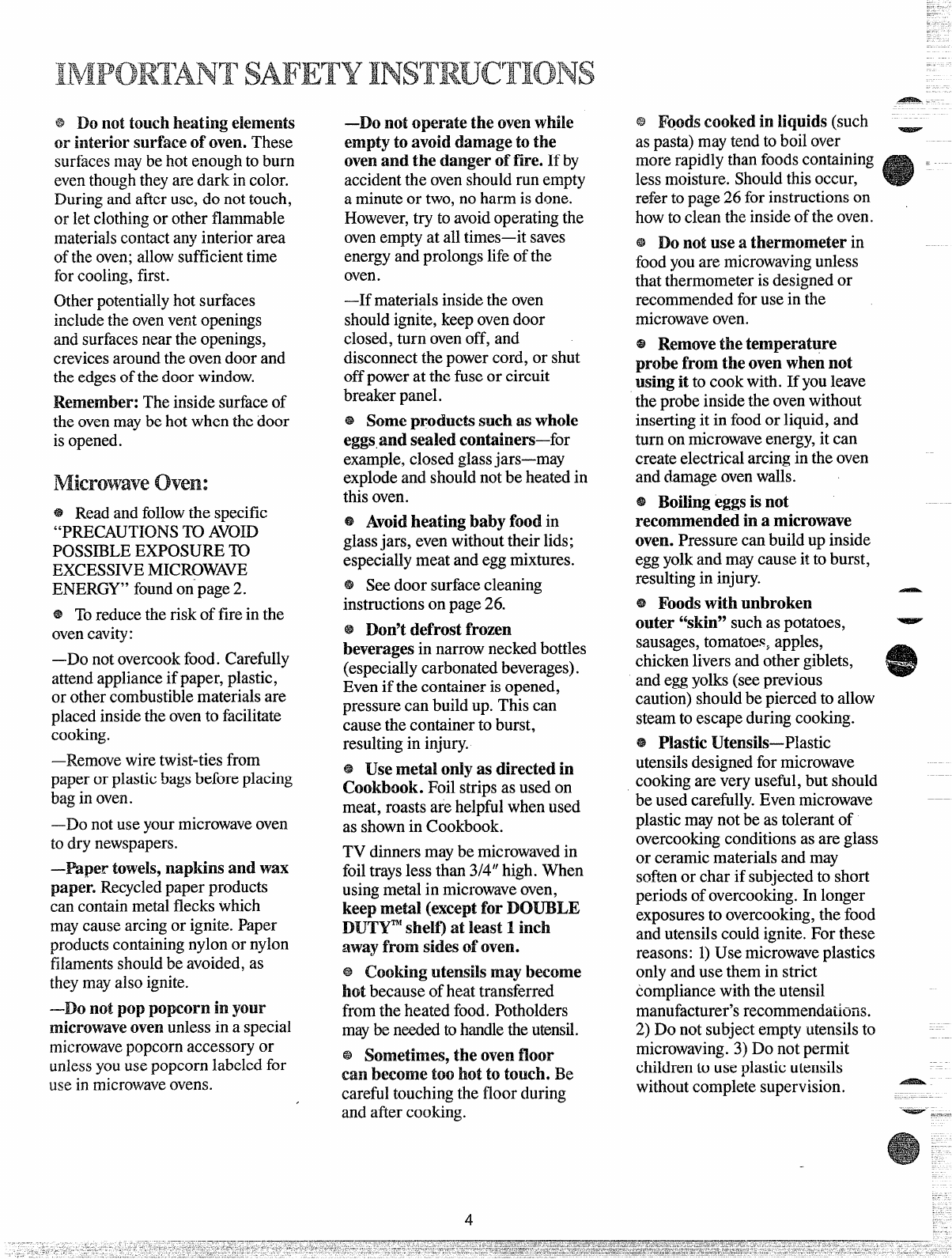
*Do notouchheating ekments
or insof mm. These
surfacesmaybe hot enough toburn
eventhoughthey are dark in color.
During and after use, do nottouch,
or letclothingor other flammable
materialscontactany interior area
of theoven;allowsufficienttime
forcooling, first.
Other potentiallyhot surfaces
includetheovenventopenings
and surfacesnear the openings,
crevicesaround the ovendoor and
theedgesof the door window.
Remember: The inside surfaceof
the ovenmay be hot when the door
isopened. oven
@Read and followthe specific
“PRECAUTKINS TO AVOID
POSSIBLE EXPOSURE TO
EXCESSIVE MICROWAVE
ENERGY” foundon page 2.
@Toreduce the risk of fire in the
ovencavity:
—Donotovercookfood. Carefully
attendapplianceif paper, plastic,
or other combustiblematerials are
placed insidethe ovento facilitate
cooking.
—Removewire twist-ties from
paper or plastic bagsbefore placing
bag in oven.
—Donot use your microwaveoven
to dry newspapers.
—Paper towels, napkins andwax
paper.Recycledpaper products
can contain metalflecks which
maycause arcing or ignite. Paper
productscontainingnylon or nylon
filamentsshould be avoided, as
theymay also ignite.
—Donot pop popcorn in your
microwave oven unless in aspecial
microwavepopcorn accessory or
unlessyou use popcorn labeled for
use in microwaveovens.
—Donot operate the oven while
empty to avoiddamagetothe
ovenandthedangeroffire.If by
accidentthe ovenshouldrun empty
aminuteor two, no harm is done.
However,try to avoidoperatingthe
ovenempty at all times—itsaves
energy and prolongslifeofthe
oven.
—Ifmaterials insidethe oven
should ignite, keep ovendoor
closed, turn ovenoff, and
disconnectthe power cord, or shut
offpower at the fuse or circuit
breaker panel.
@Some productssuchaswhole
eggsandsealedcontainers-for
example, closed glassjars—may
explodeand shouldnotbe heated in
this oven.
@Avoidheatingbabyfoodin
glassjars, evenwithouttheirlids;
especiallymeatandeggmixtures.
@Seedoorsurfacecleaning
instructionsonpage26.
43Don’tdefrostfrozen
beverages
in narrow neckedbottles
(especiallycarbonated beverages).
Even if the container is opened,
pressure can build up. This can
cause the container to burst,
resulting in injury.
@Use metal only as directed in
Cookbook. Foil strips as used on
meat, roasts are helpfid when used
as shownin Cookbook.
TV dinners maybe microwavedin
foiltraysless than 3/4”high. When
usingmetal in microwaveoven,
keep metal (except for DOUBLE
DUTYTM
she~t)atleast1inch
awayfromsidesofoven.
@Cookingutensilsmaybecome
hotbecause ofheat transferred
from the heated food. Potholders
maybe neededtohandletheutensil.
@Sometimes,theovenfloor
canbecometoohottotouch.Be
careful touching the floor during
and after cooking.
4
@FQodscookedinliquids(such
as pasta)may tend to boil over
more rapidly than foodscontaining
less moisture. Shouldthisoccur,
refer to page 26 for instructionson
howto clean the inside of the oven.
@Do notuseathermometerin
food youare microwavingunless
that thermometer is designedor
recommended foruse in the
microwaveoven.
@Removethetemperature
probefromtheovenwhennot
usingitto cook with. If youleave
the probe insidethe ovenwithout
inserting it in foodor liquid, and
turn on microwaveenergy,it can
create electrical arcing in the oven
and damage ovenwalls.
@Boilingeggsisnot
recommendedinamicrowave
oven.Pressure can build up inside
eggyolk and may cause it to burst,
resultingin injury.
@Foodswithunbroken
outer‘&skin”
such as potatoes,
sausages,tomatoe~,apples,
chicken livers and other giblets,
and eggyolks(seeprevious
caution) shouldbe pierced to allow
steamto escape during cooking.
@PlasticUtensils—Plastic
utensilsdesigned for microwave
cookingare very useful, but should
be used carefully.Even microwave
plastic may not be as tolerant of
—
overcookingconditions as are glass
or ceramic materials and may
softenor char if subjectedto short
periods ofovercooking. In longer
exposuresto overcooking,the food
and utensilscould ignite. For these
reasons: 1)Use microwaveplastics
only and use them in strict
compliance with the utensil
manufacturer’srecommendations.
2) Do not subjectempty utensilsto
microwaving.3) Do not permit
children to use plastic utensils
without complete supervision.
--

*‘g~oila~]fyWMng pouches
andtightly C1OSMIplastic bags
shouldbe slit, pierced or ventedas
directed in Cookbook If theyare
not, plastic could burst during
or immediately after cooking,
possiblyresulting in injury. Also,
plasticstorage containers shouldbe
atleastpartially uncoveredbecause
theyform atight seal. Vi’hen
cookingwith containers tightly
coveredwith plastic wrap, remove
co~’eringcarefully and direct steam
awayfrom hands and face.
@Spontaneous boiling-Under
certainspecial circumstances,
liquidsmay startto boil during or
shortlyafter removalfrom the
microwaveoven. Toprevent burns
from splashing liquid, stir the
liquidbriefly beforeremovingthe
containerfrom the microwaveoven.
@Use of the DOUBLE DUTYTM
sheifaccessory.(Seeyour
Cookbook for proper use.)
—Removethe shelffrom oven
whennot in use.
–Do not store or cook with shelf
onfloor of oven. Product damage
mayresult.
–Use potholders when handling
theshelf and utensils. They may
behot.
—Donot use microwave
browningdish on shelf. The shelf
couldoverheat. Use of shelfwith
AutomaticCooking feature isnot
recommended.
JJy$yfy oven:
~Stand away from the oven
when opening oven door. The hot
air or steam which escapes can
cause burns to hands, face
andlor eyes.
@Don%heat unopened food
containers in the oven. Pressure
could hdd up and the container
could burst cawing an injury.
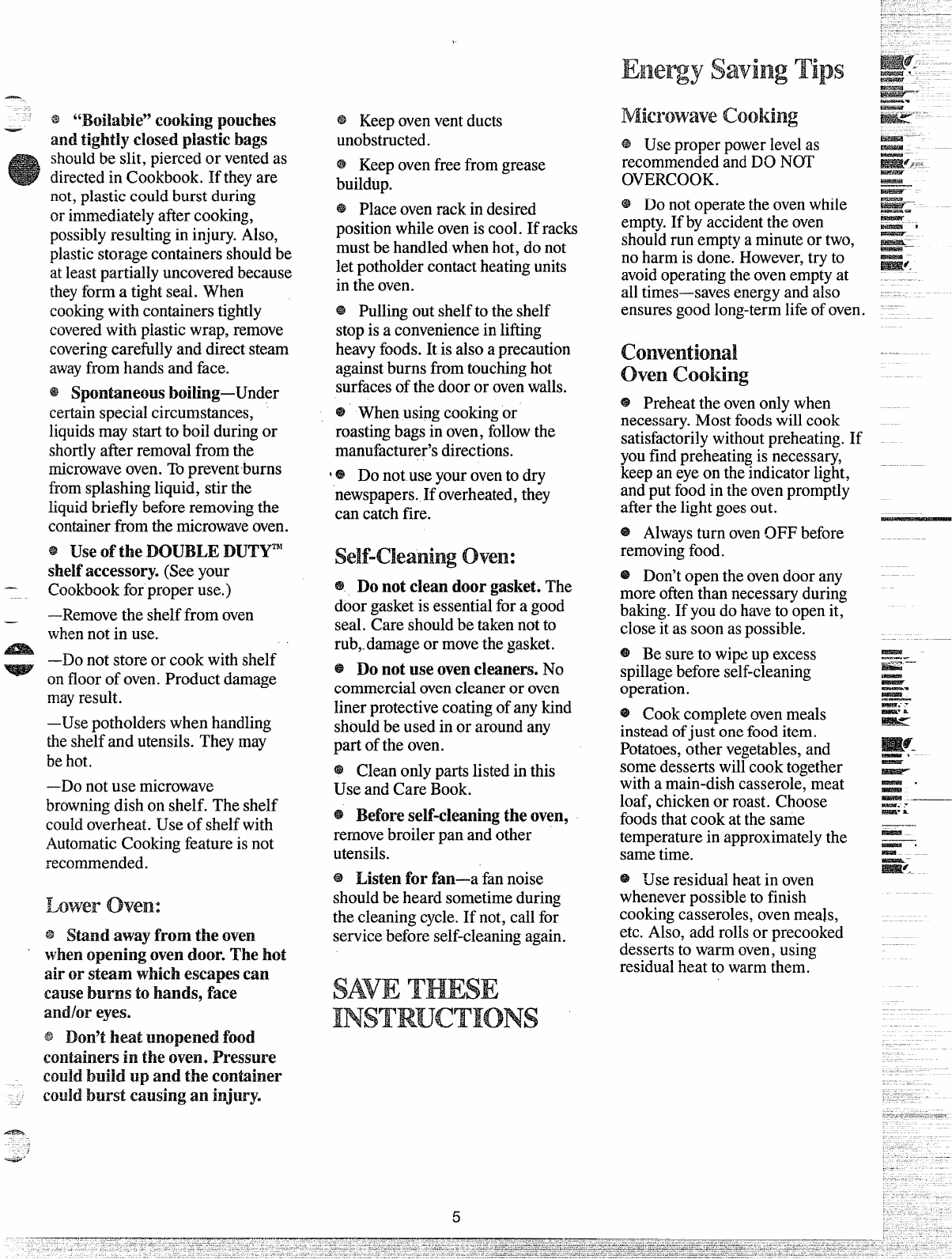
@Keep ovenventducts
unobstructed.
@Keep ovenfree from grease
buildup.
@Place ovenrack in desired
position while ovenis cool. If racks
must be handled when hot, do not
let potholder contactheatingunits
in the oven.
*Pulling out shelfto the shelf
stopis aconveniencein lifling
heavyfoods. It is also aprecaution
againstburns from touchinghot
surfacesof the door or ovenwalls.
@When using cookingor
roastingbags in oven, followthe
manufacturer’sdirections.
‘@ Do notuseyourovento dry
newspapers. If overheated,they
can catch fire. ow
@Do notcleandoorgasket.The
door gasketis essential for agood
seal. Care shouldbe takennotto
rub,.damage or movethe gasket.
@Do notuseovencleaners.No
commercial ovencleaner or oven
liner protectivecoating ofany kind
shouldbe used in or around any
part ofthe oven.
@Clean only parts listed in this
Use and Care Book.
@Beforeself-cleaningtheoven,
removebroiler pan and other
utensils.
@Listenforfan—a fan noise
shouldbe heard sometime during
the cleaning cycle.If not, call for
service before self-cleaningagain.
C130khg
@Use proper powerlevelas
recommended and DO NOT
OVERCOOK.
@Do not operatethe ovenwhile
empty.If by accidentthe oven
shouldrun empty aminuteor two,
no harm is done. However,try to
avoidoperating the ovenempty at
alltimes—savesenergy and also
ensures good long-termlife ofoven.
ov
cooking
@Preheat the ovenonly when
necessary. Most foodswill cook
satisfactorilywithoutpreheating. If
youfind preheating is necessary,
keep an eyeon theindicator light,
and put food in the ovenpromptly
after the lightgoesout.
*Alwaysturn ovenOFF before
removingfood.
@Don’topen the ovendoor any
more oflen than necessary during
baking. If you do haveto open it,
close it as soon aspossible.
@Be sure to wipeup excess
spillagebefore self-cleaning
operation.
@Cook complete ovenmeals
insteadofjust onefood item.
Potatoes,other vegetables,and
some desserts willcook together
with amain-dish casserole, meat
loaf, chicken or roast. Choose
foodsthat cook at the same
temperature in approximatelythe
same time.
~Use residual heat in oven
whenever possibleto finish
cooking casseroles, ovenmeals,
etc. Also, add rollsor precooked
desserts to warm oven, using
residualheat to warm them.
5
—
—LLL
L
2.
3
. .
4.
5.
6.
‘7.
8.
9.
10.
H.
12.
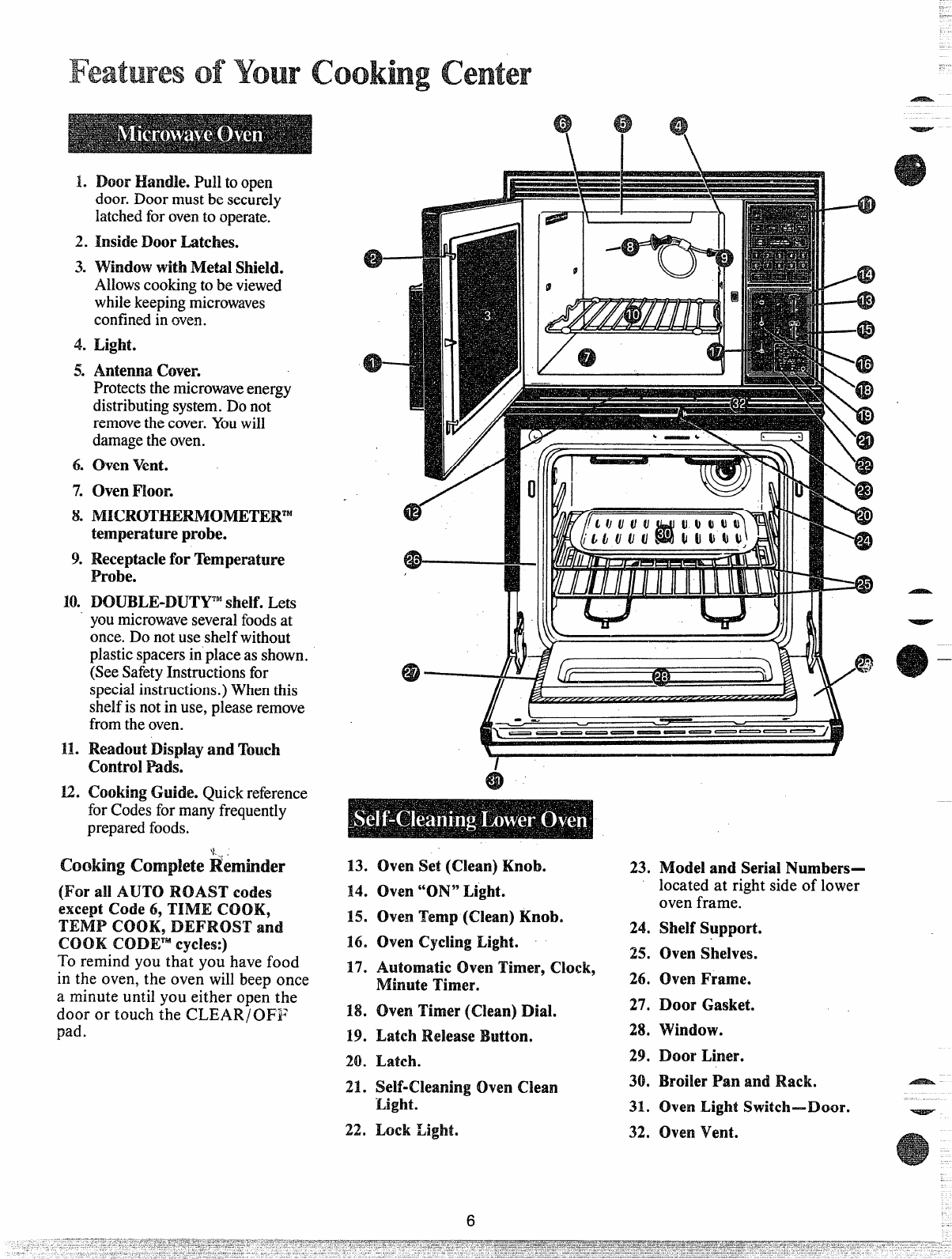
Door Handle.Pulltoopen
door.Doormustbesecurely
latchedforovento operate.
Inside Door Latches.
Windowwith Metal $hiekl.
Allowscookingtobeviewed
whilekeepingmicrowaves
confinedinoven.
Light.
Antenna Cover.
Protectsthemicrowaveenergy
distributingsystem.Donot
removethecover.Youwill
damagetheoven.
Oven Vent.
OvenFloor.
MI(3WH3ERMOMETERTM
temperatureprobe.
ReceptacleforTemperature
Probe.
DOIJBLE-DUTYTMshelf. Lets
youmicrowaveseveralfoodsat
once.Do notuseshelfwithout
plasticspacersinplaceas shown.
(SeeSafetyInstructionsfor
specialinstructions.)Whenthis
shelfis notin use, pleaseremove
fromtheoven.
ReadoutDisplayand Touch
ControkPads.
Cooking(hide. Quickreference
ix Codesformanyfrequently
]reparedfoods.
1@k’-’t
((’(1“*
r
IllfYrIL.9%. \-’dim-l “4?)
4
1
(
ModelandSerialNunrbers-
located at right side of lower
oven frame.
Shelf Support.
OvenShelves.
OvenFrame.
Door Gasket.
window.
Oven Set (CHean)hobo
t .,
cooking CWnpk!teR?mimk?l’
(For all AUTO ROAST codes
except Code6, TIME COOK,
I’EMP COOK,DEFROST and
COOK(XIIIEYMcycles:)
To remind you that you have food
in the oven, the oven willbeep once
aminute until you either open the
door or touch the CLEAR/OFF
pad.
13.
14.
15.
16.
17.
18.
19.
23.
24.
25.
26.
2’7.
28.
Owen “ON”Light.
OvenTemp(Clean)Knob.
OvenCyclingLight.
Automatic OvenTimer,C1OCIK,
Minute Timer.
Oven ‘1’imer(Clean) Dial.
Latch Release Button. Door Liner.
BroilerPm andRack. Ama-
29.
30.
31.
32.
20.
21.
22.
Latch.
SeN-CleaningOvenClean
Light.
Lock Light. Oven LightSwitch-Door.
-%?4z
Wan Vent.
6
—
—
●
2.
3.
4.
5.
~
-6.
7.
8*
.—
..
—-
1
DISPLAY. Displays time of’
day, time or temperature dur-
ing cooking functions, power
levelbeing used, cooking mode
and instructions.
POWER LEVEL.Touch this
pad before entering another
power level number if you want
to change from automatic
Power Level 10(HIGH) for
cooking or Power Level 3
(LOW) for defrosting.
START. After all selectionsare
made, touch this pad to start
oven.
CLEAR/OFF. When touched,
it shuts off the oven and erases
all settings (except time of
day).
MIN/SEC TIMER. This fea-
ture uses no microwave energy.
It functions as either akitchen
timer, as aholding period after
defrost or as adelay timer
before time or temperature
cooking. (See page 13.)
CLOCK.Touch this pad to
enter time of day or check time
of day while microwaving. To
set clock, first touch CLOCK
pad and then enter time of day.
For example, if time is 1:30,
touch number pads 1, 3, and O
and 1:30willappear in display.
“Start” will flash on display
directing you to tough START
thus setting the clock. To reset
or cb.angetime, simply repeat
above process.
NIJMBERPADS. Touch these
pads to enter cooking, defrost-
ing time, time of day, tempera-
ture, Power Leveland COOK
CODET”Codes.
AUTOSTART.
program your oven to begin
cooking at apreset time of
day—up to a12hour delay.
(Seepage 11.)
COOK CODE’MCONTROL.
Use this pad as ashort-cut
method for entering cooking
time and power level.(See
page 14.)
AUTO ROAST. Insert Probe,
touch this pad, and desired
number pad for Code to slow-
cook or temperature cook meat
with automatic preset program.
(See page 8.)
TIME COOK. Microwave for
apreset amount of time using
automatic Power Level 10
(or change power levelafter
entering cooking time. See
page 11.)
@
/
o
.----:
a)
—0
—
-—
%i.?aw“-
—— -—-
——-—
—
—
&.
-
—
W
—”.-..—
—
-
..-.——
-
~
—
-
-
E
—
—
—
—
F–
~
-
-
—
E
=k
E
—
—
—
—
~
—
12. DEFROST. Gentle, generally
uniform thawing at automatic
Power Level3, (or change
power levelafter entering
defrosting time. See page 10.)
13. TEIWPCOOK/HOLD. Use
the temperature probe to cook
by using apreset tempera-
ture. Once oven reaches preset
temperature, it switchesto
HOLD setting and.maintains
that temperature until you
touch the CLEAR/OFF pad.
(See page 12.)
~y--
—.
—.
—
—
—
—–
-
-
-
E
-
——
—–
—
—
—
--
—-
—
-T
-
—.
—
—
7
SeeAutoRoastGuideam page !$.
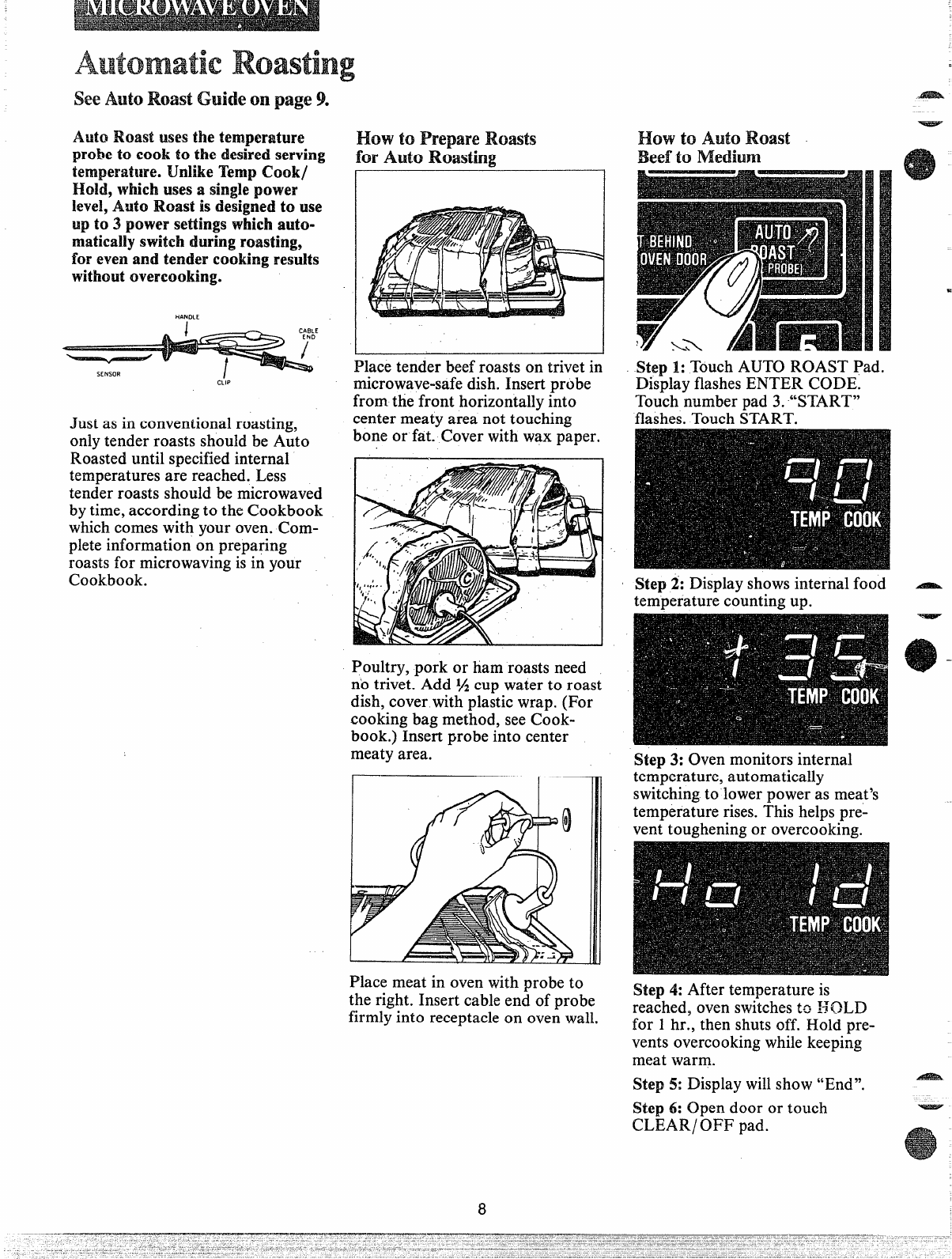
Auto Roast t.westhe temperature
pmheto cook tothe desiredserving
temperature.UnlikeTempCook/
Hold, whichuses asinglepower
level,AMo Roast is designedto use
upto 3power settingswhichauto-
maticallyswitchduringroasting,
forevenandtendercookingresults
withoutovercooking.
H
Sc
Just as in conventional roasting,
only tender roasts should be Auto
Roasted until specified internal
temperatures are reached. Less
tender roasts should be microwaved
bytime, according to the Cookbook
which comes with your oven. Com-
plete information on preparing
roasts for microwaving is in your
Cookbook.
mtP1’epiweRmsts
fAUtO
Place tender beef roasts on trivet in
microwave-safe dish. Insert probe
from the front horizontally into
center meaty area not touching
bone or fat. Cover with wax paper.
Poultry, pork or ham roasts need
no trivet. Add 1/2cup water to roast
dish, cover with plastic wrap. (For
cooking bag method, see Cook-
book.) Insert probe into center
meaty area.
Place meat in oven with probe to
the right. Insert cable end of probe
firmly into receptacle on oven wall.
8
Step 1: Touch AUTO ROAST Pad.
Display flashes ENTER CODE.
Touch number pad 3. “START”
flashes. Touch START.
Step2:Display shows internal food
temperature counting up.
Step 3: Oven monitors internal
temperature, automatically
switching to lower power as meat’s
temperature rises. This helps pre-
vent toughening or overcooking.
Step 4: After temperature is
reached, oven switchesta H(OLD
for 1hr., then shuts off. Hold pre-
vents overcooking while keeping
meat warm.
Step 5: Display willshow “End”.
Step 6: Open door or touch
CLEAIZ/OFF pad.
—
.-
25-1o
3
Well s
M:
4
P1
‘:::::, I~I~:I~J~
“
I I .
[ns
h
20
20
*~ecommended beforesefing.
andJ4mww’s
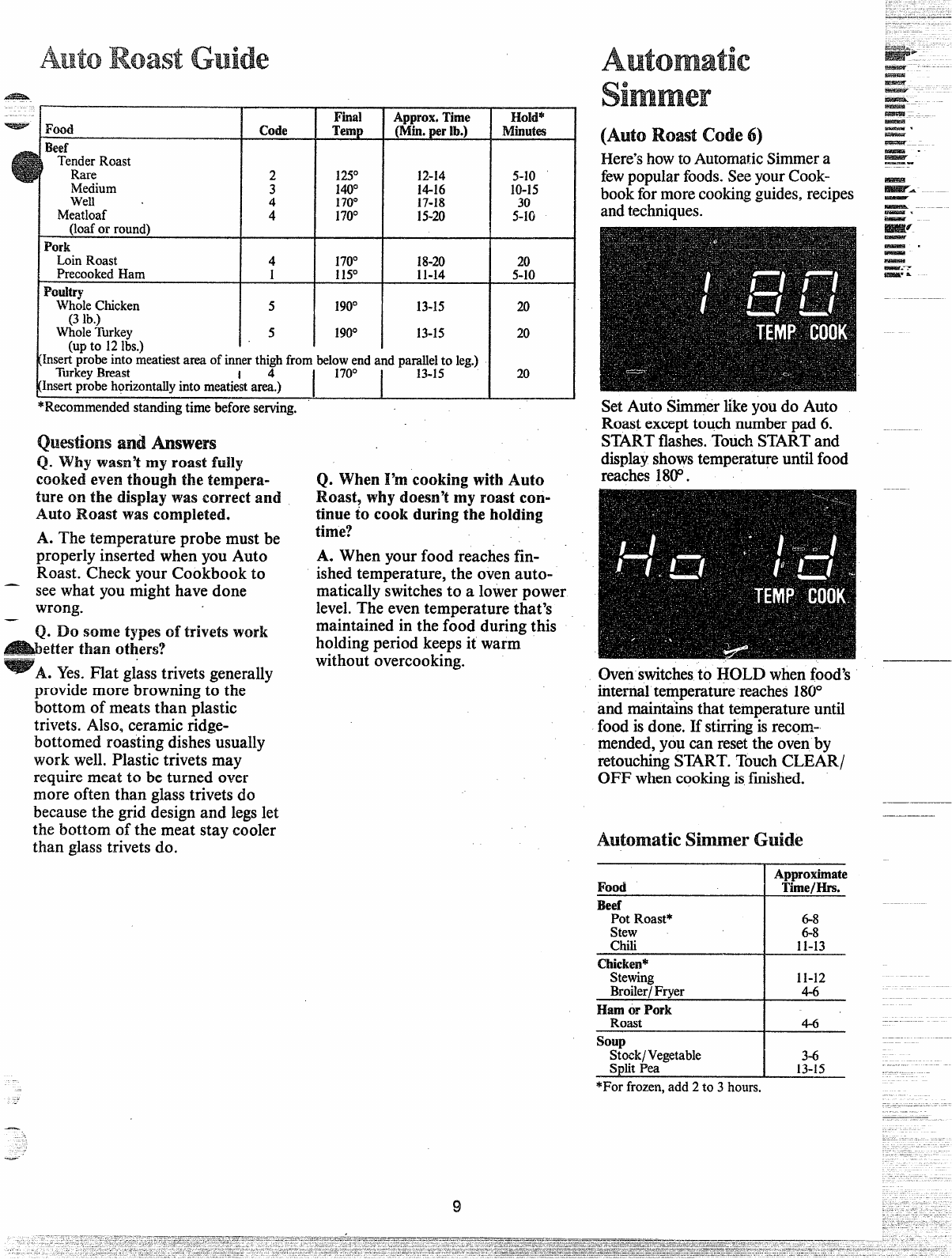
Q. Whywasn’tmy roastfully
cookedeventhough thetempera-
tureon the displaywas correctand
Auto Roast was completed.
A. The temperature probe must be
properly inserted when you Auto
Roast. Check your Cookbook to
—seewhat you might have done
wrong.
—Q. Do some types of trivets work
than others?
yes. Flat giatrivetsgenerally
provide more browning to the
bottom of meats than plastic
trivets. Also, ceramic ridge-
bottomed roasting dishes usually
work weI1.Plastic trivets may
require meat to be turned over
more often than glass trivets do
because the grid design and legslet
the bottom of the meat stay cooler
than glass trivets do.
Q. WhenI’mcooking withAuto
Roast, whydoesn’tmy roastccm-
tinueio cook duringthe holding
time?
A. Whenyourfoodreachesfin-
ishedtemperature,theovenauto-
maticallyswitchesto alowerpower
level.The even temperature that’s
maintained in the food during this
holding period keeps it warm
without overcooking.
9
(AutoRoastCode6)
Here’showtoAutomaticSimmera
fewpopularfoods.SeeyourCook-
bookformorecookingguides,recipes
andtechniques.
SetAutoSimmerlikeyou do Auto
Roastexcepttouchnumberpad6.
STARTflashes.TouchSTARTand
displayshowstemperatureuntilfood
reaches18(F.
Ovenswitchesto IJOLI)whenfood’s
internaltemperaturereaches180°
and maintainsthat temperatureuntil
food isdone. If stirringis recom-
mended,you can resetthe oven by
retouchingSTART. TouchCLEAR/
OFF when cookingisftisbed.
AutomaticSimmerChide
SI
2 3
.—
The Defrost settingis designedfor
speedythawingoffrozenfoodsand
isme of the greatadvantagesof a
microwavemm.
e~~wLevel~iautomatically
set for defrosting, but you may
change this for more flexibility.
~See your Cookbook for
defrosting help.
When the oven completes defrost-
ing, it automatically shuts off. R
willthen display “End” and beep
onceaminute until you either open
the door or.touch the CLEAR/ OFF
pad.
To become better acquainted with
the defrost functions, defrost frozen
pork chops using the following
steps.
Step 1:Place package of frozen
chops in the oven and closedoor.
Step2:TouchDEFROST.Display
reads:0and PowerLevel-3isauto-
maticallysetin the ovenbutdoes
notappear on display.ENTER
DEF. TIME flashes.
Step 3:Touch 8,0 and Ofor 8min-
utes. DEF. TIME and 8:00are
displayed. If you wish to change
Power Level, touch POWER
LEVEL pad and then new number.
,,: .
Step4:Touch START. T~mecounts
down on display. When cycleis
completed, the oven si~nalsand
automatically shuts off:
Step 5:Turn package over, close
door and repeat Steps 2,3 and 4.
Step&Whenovensignalsand
shutsoff,displaywillshow“End”.
Step 7:Open door or tou&
CLEAR/OFF pad. Remove
package and separate chops to
finish defrosting. :L
r
Defrosting’Tips ‘“
eFoods fr~zen-in paper or plastic
can be defrosted in the package.
eFor even defrosting, many’foods
need to be broken up or separated
part of the way through the defrost-
ing time.
e~omemade dinners can@frozen
in shallow foil trays and heated for
later use. (Do not heat on ~OUBLE
DUTYMshelf.) TV dinne@!canbe
microwaved using wire shelfif
metal tray is returned to b6x b,efore
placing on wi~eshelf. Select ’foods
which microwave well. :, I
,,
@Pre-packaged frozen dinners can
be defrosted:and microwavecl.
eCheck your Cookbook for other
defrosting tips.
WdiAmw#ws
Q. When Ipress STARI”,Ihear a
dull thumpingnoise. Whatis it?
A. This sound is normal. It is let-
ting you know the oven is using a
Power Levellower than HIGH.
Q. GUIIDefrost smallitems in a
hurry?
A. Yes,but they willneed more
frequent atfention than usual. Raise
the Power Level after entering the
time by touching POWER LEVEL
and 7or 10.Power Level 7cuts the
time about in $4;Power Level 10
cuts the time to approximately 1/3.
During either, rotate or stir food
frequently.
Q. CarrIopen Wdoor during
DEFROST to checkon the pro-
gressof my food?
A. Yes.You may open the door at
any time during microwaving. To
resume defrosting, close the door
and press START.
Q. Why don’tthe defrostingtimes
in the Cookbook seemrightfor
my food?
A. Cookbook times are average.
Defrosting,tim.ccan vary according
to the temperature in your freez~r.
Set your oven for the time indicated
in your Cookbook. If your food is
still not completely thawed at the
end of that time, re-set your oven
and adjust the time accordingly.
Q. CanIselectaPower LeveIother
than automaticPower Level3for
defrosting.?
A. Yes.Some smaller foods maybe
defrosted quicker on higher Power
Levelsbut for even, carefree defrost-
ing, Power Level3is suggested.
Check the chart in the Cookbook
for specifictimes and Power Levels.
—