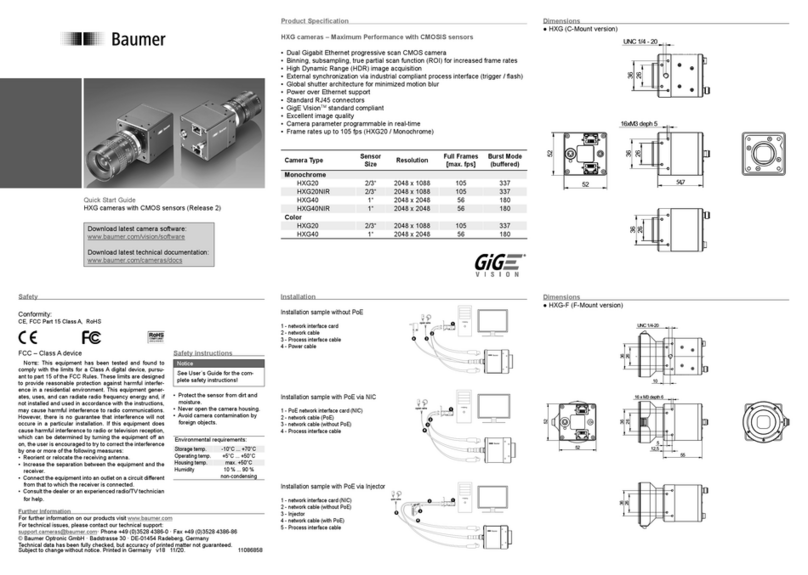
TECHNICAL DRAWINGS
STATUS LED
The
Flea3
is equipped with a bi-color LED that can be red, green, or yellow (when both green and red are
turned on). If the LED does not turn on at all when the camera is connected to the GigE host adapter card,
check that the camera is receiving adequate power.
LED Behaviour Description
Off Not receiving power
Green ashing slowly, low intensity Camera is receiving power, no IP connection is established or
establishing connection with camera control software
Green ashing quickly, low intensity Establishing IP connection
Steady green, high intensity Streaming images
Red ashing quickly Firmware update in progress
Red ashing slowly General error - contact technical support
29.0
29.0
30.0
VARIES
C-MOUNT
LENS THREAD
12.0
2.0
2x M2
2.5
23.7
12.0
20.0
3.0
22.0
4.5
12.0
2x M3
2.6
2x M2
2.5
2x M3
2.5
2x M2
2.0
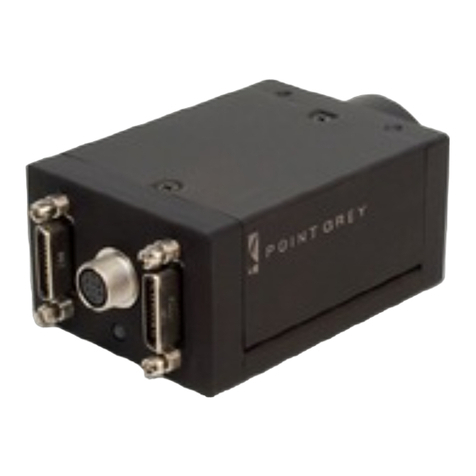
8 PIN GPIO CONNECTOR
STATUS LED
GIGABIT ETHERNET CONNECTOR
WITH JACKSCREWS
The FlyCapture®User Guide and other technical references can be found in the
Programs > Point Grey Research > PGR FlyCapture > Documentation
directory. Our on-line Knowledge Base (www.ptgrey.com/support/kb/) also addresses
the following problems:
• Article 88: Vertical bleeding or smearing from a saturated portion of an image
• Article 145: Image discontinuities or horizontal tearing of images when displayed on monitor
• Article 365 A Guide to Transitioning from the Flea3 FireWire to the Flea3 GigE Camera
3TROUBLESHOOTING
For all general questions about please contact us at info@ptgrey.com.
For technical support (existing customers only) contact
us at www.ptgrey.com/support/contact/.
Main Office:
Mailing Address: Tel: +1 (604) 242-9937
Point Grey Research, Inc. Toll Free (N.America only): +1 (866) 765-0827
Richmond B.C. Canada Fax: +1 (604) 242-9938
12051 Riverside Way Email: sales@ptgrey.com
V6W 1K7
CONTACTING POINT GREY RESEARCH
Use of the filter driver is recommended, as it can reduce CPU load
and improve image streaming performance. Alternatively, Point Grey
GigE Vision cameras can communicate directly with the Microsoft
UDP stack. GigE Vision cameras operating on Linux systems
communicate directly with native Ubuntu drivers. To uninstall or
reconfigure the Image Filter Driver at any time after setup is complete,
consult the FlyCapture SDK Help.
Note: For more information about accessing customer downloads, see Knowledge Base
Article 35 (http://www.ptgrey.com/support/kb/index.asp?a=4&q=35).
6. Configure IP Settings
After installation completes, the Point Grey GigE Configurator opens. This
tool allows you to configure the IP settings of the camera and network card.
Note: If the GigE Configurator does not open automatically, open the
tool manually from: Start -> Point Grey Research -> FlyCapture2
-> Utilities -> GigE Configurator. If prompted to enable GigE
enumeration, select Yes.
• In the left pane, select the Local Area Connection corresponding to the
GigE network interface card (NIC) to which the camera is connected.
• In the right pane, review maximum transmission unit (MTU). If not
9000, enable jumbo frames on the NIC by clicking Open Network
Connections. (While most GigE NICs support 9000-byte jumbo frames,
this feature is often disabled by default.)
• In the left pane, select your GigE Vision camera. (Note: there may be
a delay of several seconds before the camera is detected by the GigE
Configurator on startup)
• Under ‘Current IP Configuration,’ review the IP address. (By default, a
dynamic IP address is assigned to the camera according to the DHCP
protocol. If DHCP addressing fails, a link-local address is assigned. If
necessary, change the IP address of the camera to be on the same subnet
as the NIC. If the subnets do not match, the camera is marked ‘BAD’ on
the left pane.
• Under ‘Packet Size Discovery,’ click Discover Maximum Packet Size
and note the value.
Note: For more information about using the GigE Configurator, see the online Help
included with the tool.
7. Configure Packet Size and Confirm Successful Installation
• Run the FlyCap demo program
Start -> Point Grey Research -> FlyCapture2 -> FlyCap2
• In the camera selection dialog, select the GigE camera that was installed,
and click Configure Selected.
• In the Camera Control dialog, click Custom Video Modes By default,
Packet Size is set to 1400 bytes. We recommend increasing this value
to the size noted in the previous step, as maximizing packet size reduces
processing overhead. For more information about packet size, see your
camera’s technical reference manual.
The FlyCap application is a generic, easy-to-use streaming image viewer
included with the FlyCapture SDK that can be used to configure GigE
network parameters and test many of the capabilities of your camera. It
allows you to view a live video stream from the camera, save individual
images, adjust video formats, frame rates, properties and settings of the
camera, and access camera registers directly.
Note: For more information about using the FlyCap demo program, see
the online Help included with the tool.
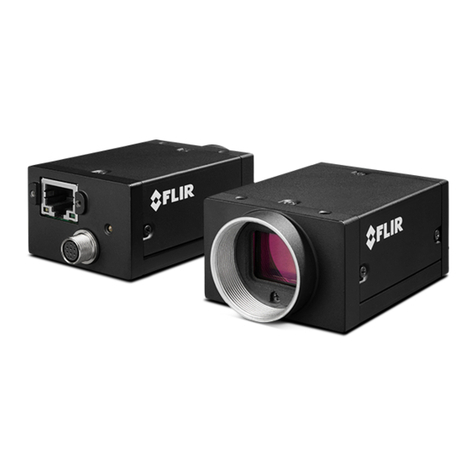
CAMERA INTERFACE
GigE Connector
The 8-pin Halo RJ-45 Ethernet jack is equipped with two M2 screwholes for secure connection. Pin assignments
conform to the Ethernet standard. For more information about the orange and green status LEDs on each side of
the connector, refer to your camera’s technical reference manual.
General Purpose I/O Connector
The Flea3 has a Hirose HR25 8-pin general purpose input/output (GPIO) female connector on the back of the
case (P/N: HR25-7TR-8SA).
Inputs can be configured to accept external trigger signals. Outputs can be configured to send an output signal or
strobe pulse. Refer to the section 3.4 of the Flea3 Technical Reference for detailed GPIO electrical characteristics.
Diagram Pin Function Description
1 IO0 Opto-isolated Input (default Trigger in)
2 IO1 Opto-isoloated Output
3 IO2 Input / Output / RS232 Transmit (TX)
4 IO3 Input / Output / RS232 Receive (RX)
5 GND Ground for bi-directional IO,VEXT, +3.3 V pins
6 GND Ground for opto-isolated IO pins
7V
EXT Allows the camera to be powered externally
8 +3.3V Power external circuitry up to a total of 150mA
To congure the GPIO pins, consult section 3.4 “General Purpose Input / Output” of the
Flea3 Technical Reference Manual