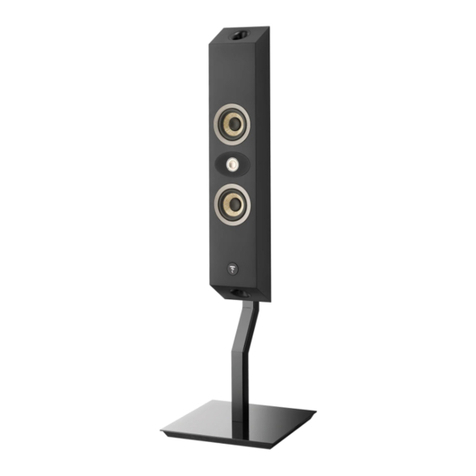
GoldenEar Technology ►Aon Series Manual
Preventing Speaker Damage
GoldenEar Technology Aon speakers are efficient and can be driven to loud listening levels with moderate
amplifier power. They are also able to handle the output of very powerful amplifiers. To prevent damage to your
speakers, please read all of the following guidelines before hooking them up.
Amplifier Distortion — #1 Threat to your New Speakers!
Amplifier distortion is the principal cause of speaker damage. When listening at loud levels your amplifier may run
out of clean power. It will then begin to produce speaker-damaging distorted power. This will damage any brand
of speaker very quickly! More powerful amplifiers are actually safer – For example: A 40 Watt/channel amplifier
will have substantial distortion above 40 Watts. If driven to 50 Watts, this amplifier will deliver speaker-damaging
distorted power! But a 100 Watt/channel amplifier will have very low distortion below 100 Watts. Therefore, when
the speaker requires 50 Watts, this more powerful amplifier will deliver clean power and speaker damage is less
likely to occur. (See your GoldenEar Technology dealer for amplifier recommendations.)
Volume Setting
Do not be fooled by the Volume setting of your receiver/preamplifier. It only adjusts listening level — it is not
a “power-output” dial. The amount of amplifier power actually used at a given Volume setting depends solely
on the nature of the source material you are listening to (at a given Volume setting a quiet section of music will
use less amplifier power than a loud section). With typical material, the rated output power of many receivers/
amplifiers is often reached when the Volume is set to around -10dB, or between the “11” and “1 o’clock”
settings with an analog control (with bass/ treble and loudness controls not used — otherwise rated power may be
reached at even lower Volume settings). Remember, all amplifiers produce distortion when operated beyond their
rated output power. The resulting distortion will damage all speakers! If you listen at loud levels, be careful to listen
for the point of audible distortion — if the speakers begin to sound distressed, turn the Volume down or your speak-
ers and/or amplifier(s) will be damaged! This type of damage constitutes abuse and is not covered by the warranty.
If louder volumes are desired, consider a more powerful amplifier.
There is Actually a Limit!
Even with these safer, more powerful amplifiers, there is a point at which you could have more power than the
speaker can handle. At that point you will overpower the speaker and damage it. At loud levels do not increase
bass/treble controls from zero and ensure that all loudness/contour/bass EQ buttons are off (otherwise rated
output power will be reached at even lower volume control settings).
3
USE AN APPROPRIATE AMPLIFIER. At high volumes a very powerful amplifier can overdrive your
speakers and damage them. And if the amplifier is not powerful enough, it can produce distortion
that can easily damage your speaker. (Consult your dealer for assistance.)
DON’T BE FOOLED BY YOUR RECEIVER’S VOLUME CONTROL. It only adjusts how loud, it is not an
indication of power output. If your speakers begin to sound harsh or grating or if you hear other forms
of distortion, turn down the volume immediately!
PROPER SETUP IS THE KEY. Please Note: Avoid use of tone controls and loudness controls as they will
demand even more power from an amplifier.