The joint operation of cooker hoods and stoves using open fire like gas, oil or coal stoves in the same
room are restricted subject to country regulations. We recommend the advice and approval of the
district chimney sweeper or the local building authority.
minimum distances
Distance to an electric hob
From the electric cooking area to the lower edge of the hood a
minimum distance of 600mm must be maintained.
Distance to the gas hob
Between gas hobs (upper edge of pot carrier) and lower edge of the
hood a minimum distance of 700mm should comply.
Other notes
Please take care, that hotplates in operation are always covered, so the device will not be damaged
by excessive heat.
When deep-frying under an extractor hood, the appliance used for frying has to be supervised at all
time during operation.
Oils contained in deep fryers may self-ignite due to overheating. Using old and dirty oil can lead to
this even more easily.
We point out that overheating can cause a fire. Furthermore, we point out expressly that flambé
under the hood is not allowed.
For all work on the cooker hood, even when changing the bulb, the hood has to be de-energized (turn
off circuit breaker or remove the screw fuse from the socket). It is also important to follow the filter
change and cleaning intervals.
If ignored, there is an acute fire hazard due to grease deposits!
Energy-saving tips
Preparation, warming and keeping food warm should always be done in pots or pans with closed lids.
The appliance should be switched off immediately after cooking or, if available, the time-delayed
shutdown be used.
The lighting of the appliance should be switched off after the end of cooking.
Pot sizes should be adapted to the diameter of the cooking zones used.
Use the highest motor speed of the unit only at a high concentration of cooking fumes.
To increase the efficiency of the device, regularly clean the grease filters.
Carbon filters (when used in recirculation mode) should be replaced regularly according to the
manufacturer's specifications.
Technical specifications
power
- power consumption in watts 206W
- Of which lighting (LED) 2x 3W
- Voltage in volts 220-240V
- Volume 49-68dB
- Fan volume max. 1000m³/h
Dimensions
- Height in cm 73.5-97cm
- Width in cm 60/80/90cm
- Depth in cm 38cm
- Exhaust outlet in mm ø150mm
- Net weight in kg approximately 7.6/8.1/8.3kg
specifications
- Connection with safety plug
- 3-level control
- LED lighting (2x 3W)
- grease filter (dishwasher-safe)
- Suitable for recirculation and exhaust air
safety instructions
power supply
The connection is made via a fixed cable with earthing contact plug.
In the case of a required permanent connection, the hood may only be installed by an electrician,
registered at the responsible electricity supply authority.
On the installation side, a disconnecting device (this includes fuses, contactors and circuit breaker
acc. VDE 0730, §7, Part 1) has to be used.
Use in exhaust mode
In order to ensure optimal operation with exhaust air, we recommend implementation of the following
activities
- Short, straight tube guide
- As few pipe bends as possible
- Laying the pipes in flat bends and avoiding sharp angles
- The largest possible pipe diameter
Failure to comply with these points may result in drastic loss of performance and possible raise of
operating noise. This is not to be regarded as a malfunction of the device.
In addition, it is in any case inadmissible to blow the exhaust air in otherwise used chimneys or other
kinds of culverts. It should only be used for the air of the cooker hood.
If the exhaust air is discharged into a non-operational chimney, we recommend to obtain approval of
the responsible chimney sweeper.
For all exhaust air ducts, the official regulations must generally be adhered to. In exhaust mode it
has to be ensured, that enough air supply exists.
Parts of the hood
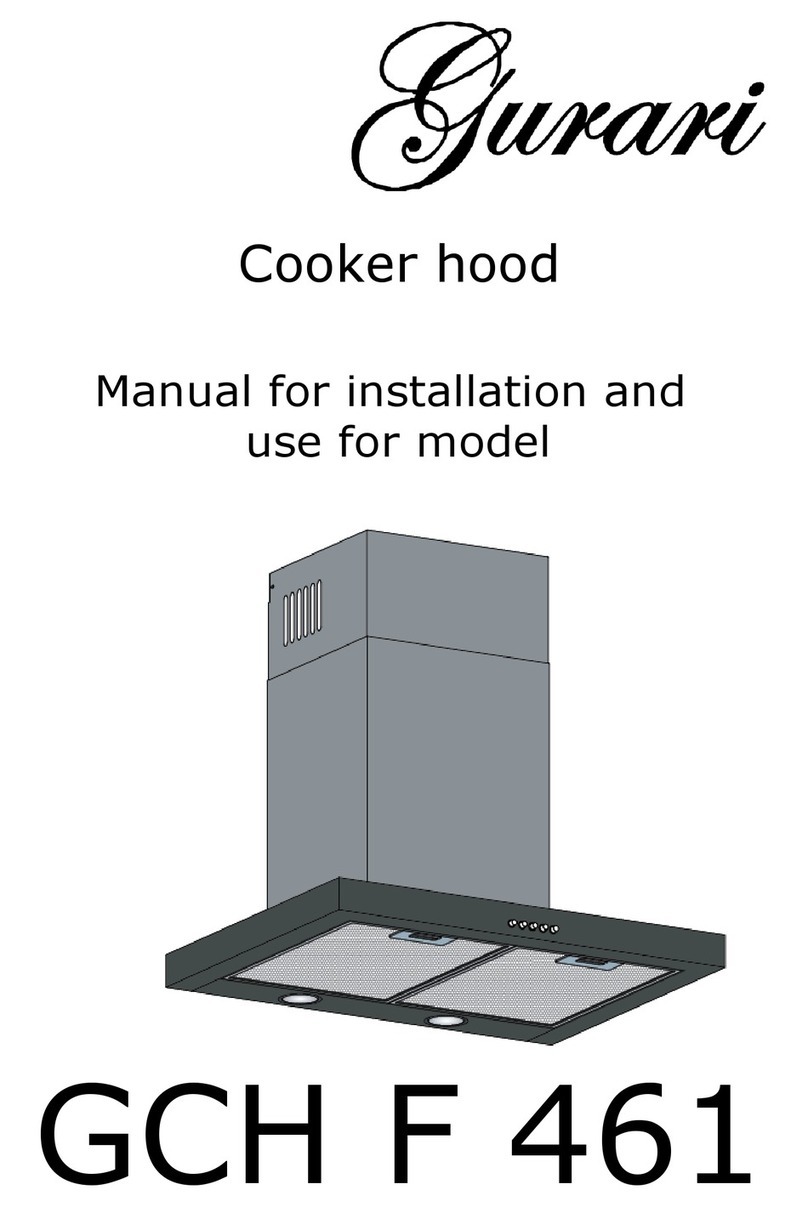
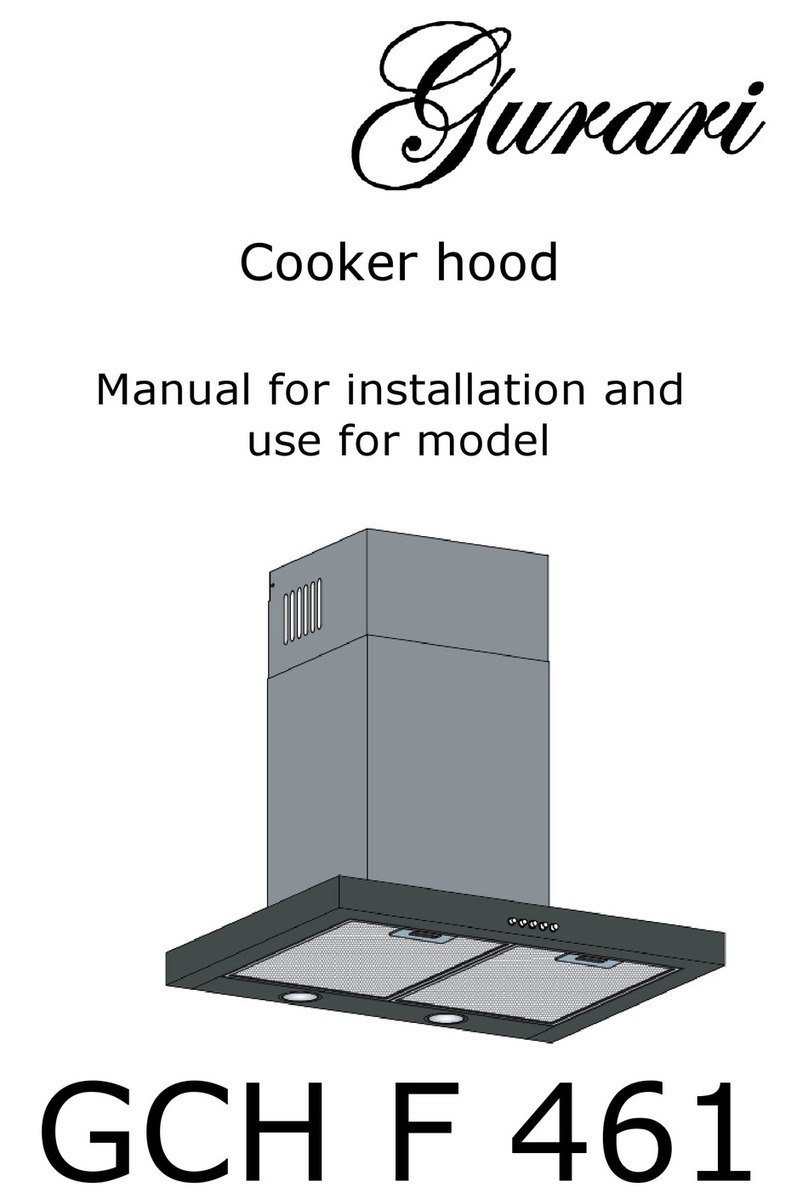
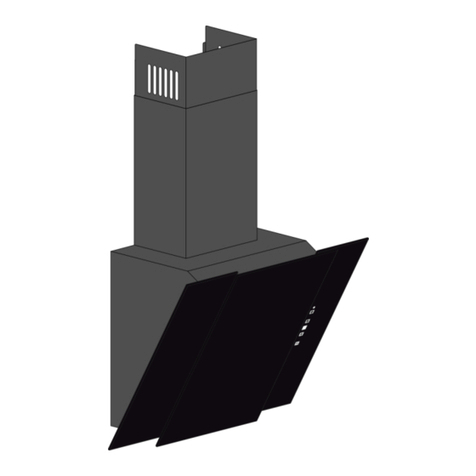
The extractor hood consists of the following parts
Dimension Drawings
Assembly
1. examination
Before starting the actual installation, the device should be checked. In addition to the control of
externally recognizable damage, a function check has to be done. Take out the device from the
packing, get rid of all packing materials and put the device with the back on the floor / table. After
connecting to a power supply, the lighting as well as the function of each stage should be checked.
Please take care that exhaust outlet is open through check.
2. Taking dimensions
The relevant wall bracket is located behind the air outlet at the top edge of the rear wall of the
device. The distance between the existing openings must be taken and be transferred to the wall in
the same way. Best way is to start from the middle of the hob, take this to the appropriate height and
take the distance to the left and right. The height depends on several components. For example, an
existing tile mirror as well as the overall height of the kitchen influences the distance of the hood to
the hob. If the supplied chimney should reach the ceiling, the hood can not be hung lower as allowed
by the fully extended telescopic chimney. The aforementioned minimum distance must be taken into
account. Also, a higher tile level than the aforementioned minimum distance may require a higher
positioning on the wall. In that sense, the position can only be finally determined on the basis of local
conditions.
Start with the measurement from the minimum distance. In case the hood has to be hung higher
because of other installations on the wall, though this is basically possible, we recommend the hood
not to be placed more than 70cm above the hob (regarding the lower edge of the hood). If the lower
edge height is set, check if the chimney can cover the distance to the ceiling. If this is not the case,
then the hood may also have to be positioned higher. Again, the aforementioned maximum distance
applies. If your ceiling is too high, you have to come up with a different solution. Basically, the use of
the telescopic chimney is optional, since it only serves to cover and has no important technical
function for the operation of the hood. It is for optical purposes only.
3. Attachment
If you have marked the holes for the screws in the appropriate height and width, now you can drill
them and screw in the supplied dowels and screws. The screws should be firmly but not completely
screwed into the wall. Now you can hang the hood body to these screws.
4. chimney installation
You can simply put the lower chimney on the hood. The upper part is screwed to the supplied wall
rail. Place the wall rail in the upper part of the chimney (the one with the slots) at the level of the
side screwing and take the distance of the drill holes to each other and to the top of the chimney
piece. Draw these measurements to the wall and drill the appropriate holes and screw the
Wall bracket to the wall.
If you use the hood in the exhaust mode, before finally installing the chimney, you need to install the
exhaust pipe between the air outlet of the hood and the wall connection of the wall opening. This
assumes that the wall exit will be hidden by the chimney after installation. If this is not the case, a
special design must be made. Consult, if necessary, a specialist. In recirculation mode, this step can
be skipped.
Now connect the hood to the power supply which is best in the area later hidden by the chimney (we
recommend the consultation of a Specialist as well if this is not the case). Slide the two chimney
pieces into each other and screw the top to the wall bracket. Now let the lower part down onto the
hood. This completes the assembly.
Usage
Inserting and changing the carbon filter
For recirculation mode we recommend the use of a carbon filter,
which frees the cooking fumes from the smell. The carbon filter
consists of two charcoal-filled cassettes, mounted left and right to
the suction opening of the engine. For mounting please check
picture.
To mount the carbon filter, please take the following steps:
1. First remove the metal grease filters
2. Place the charcoal filter on both sides of the motor in front of the
suction openings
3. In the middle of the filter is a receptacle and on the fan a suitable insert
4. If the filter is seated correctly, you can fix it with a small twisting motion
5. Then reinsert the grease filter
The matching carbon filter for this model is called GE15
Metal grease filter
The aforementioned grease filters are in front of the engine and ensure the absorption of greasy
ingredients from the kitchen haze. The cleaning can be done in the dishwasher. It is recommended to
do this all 14 days (at least once a month). Too long cleaning intervals lead to a blockage of the filter
and thus reduced power.
Cleaning in the dishwasher
The grease filters of your hood are dishwasher safe (55 ° C). However, light discoloration of the metal
can arise. These have no influence on the function of the grease filter and are not considered a
reason for complaint. Put the filters loosely in the dishwasher. Do not bend or pinch them. NOTE: Do
not clean very dirty grease filters together with other dishes.
Cleaning by hand
If cleaned manually, first soak the grease filter extensively in hot rinse liquor, then brush well and
above all, rinse well with clean water. After that drain well. Avoid use of aggressive, acidic or alkaline
detergent. For very stubborn dirt you can resort to commercially available degreaser sprays.
Usage
The control takes place via a 3-stage sensor control on the front panel of the extractor hood.
1, 2 and 3 turn on the engine at the appropriate power level. Touch again the lighted power level
switches the motor off again.
The field on the far left switches the LED lighting on and off again.
Alternatively, the cooker hood can also be controlled via the included remote control.
Timer / off timer
The extractor hood has a switchable automatic off timer (5 min). To activate this, keep the desired
power level pressed for 5 seconds. After that the timer activates automatically and turns off the
engine and lights after 5 minutes.
Cleaning and care
- De-energize the device to clean it.
- Clean the outer parts with mild soapy water. Avoid hot cleaners, brushes, or scrubbing cloths.
- Conventional glass cleaner can be used for the glass surfaces.
It is important to follow the filter changes and cleaning intervals. Failure to comply
can be a fire hazard as a result of fat deposits.
Disposal of the transport packaging
The packaging protects the device against damage during transport. The packaging materials are
selected to be environmentally friendly and recyclable.The return of the packaging into the material
cycle saves raw materials and reduces waste. Your seller will take back the packaging.
Packing parts (e.g., foils, styrofoam) can be dangerous to children. There is danger of suffocation!
Keep packaging parts out of reach of children and dispose them as soon as possible.
Disposal of the old device
Electrical and electronic devices often contain valuable materials. They also contain
harmful substances that are essential to their function and safety were necessary.
Disposal as residual waste can harmful to human health and the environment in case
of wrong treatment. Therefore do not put your old device to residual waste. Instead,
use those collection and return points established by your community or municipality
for return and recovery of electrical and electronic waste.
service
If you have any questions or problems, please contact our customer service.
BIB Handelshaus GmbH
Gremberger Str. 18
51105 Köln
Tel.: 036602 473898
MO - FR from 8:30 - 16:30
Please have the serial number and the model name of the device ready. The serial number can be
found on the nameplate inside the hood.
All data subject to design changes in the context of technical development of our products.
© 2019 BIB Handelshaus GmbH
1. Upper chimney
2. Ventilation slots
3. Wall bracket for chimney
4. Lower chimney
5. Reducer
6. Power cable with plug
7. Hood body
8. Touch control
9. Glass front
10. Grease filter
11. Light LED