Step 3a Preparation
1. Mark on the wall where your bracket will fit using the wall fixing plate as a template or measure accurately
between wall fixing plate mounting holes. Then mark accordingly using a spirit level and pencil (ensure
mounting holes are clearly marked level horizontally and vertically on the wall).
This bracket is designed to be attached to either fixed wooden studs within traditional plasterboard
(drywall) walls or into solid brick or concrete walls.
Step 3b Wood Stud Installation
1. For mounting to wooden studs – carefully locate the
wooden stud and mark the position of the holes level
vertically and drill into the wood using a 4mm drill bit
drill to a depth of 80mm.
2. To mount your bracket hold in position and insert the
supplied screws ‘B’ into washers ‘L’ and fully tighten into
the wood using a ratchet and 12 mm socket or Socket
(12mm side) and Allen key ‘F’ - see diagram ‘D’.
Plastic plugs are not required but you may need
additional plasterboard fixings for fixing holes that
do not land on a stud.
Step 3c Brick & Concrete Installation
1. For mounting to concrete or brick walls, please mark the
wall carefully and using a 10mm masonry drill bit drill to a
full depth of 80mm minimum ensuring the holes drilled
are free from debris - see Step 3d and diagram ‘F’.
2. Fully insert the plastic plugs ‘A’ into the solid wall (pushed
beyond any plaster). Please ensure they fit securely and are
not visible in the holes.
3. Insert screws ‘B’ into washers ‘L’ and fully tighten into the
plastic plugs using a ratchet and 12mm socket or Socket
(12mm side) and Allen key ‘F’ until secure - see diagram ‘E’.
Step 3d
Many modern houses have an air-gap behind plasterboard or drywall. Our fixings are only designed to work
with the plastic plug fully inserted into the masonry that lies behind any plaster or drywall air gap. To use our
fixings in this way YOU MUST insert the plug past any plaster/drywall and fully into the underlying masonry
to gain a secure fixing. (The drill depth may have to be increased to make sure the plug can be fully inserted
into the masonry).
When fitting, the screw must be at least 3/4 of the way into the plug, and the plug must be fully inserted into
brick or concrete to be effective.
Depending on the plasterboard/dry wall air gap you may need to purchase longer fixings to ensure a secure
fix.
L
Diagram ‘D’
L
Diagram ‘E’
3
Diagram ‘F’
4
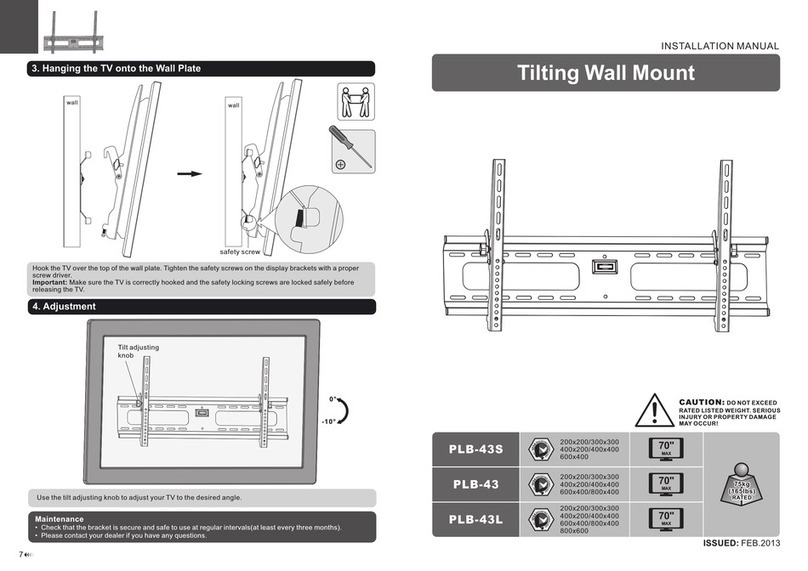
Step 4 Securing and Level Adjustment of TV
Two people are recommended to complete this
step
1. Carefully lift the TV and mounting plate assembly
and hook the keyhole slot (1.) on to the wall brackets
circular securing point (2.) - see diagram ‘G’.
Before letting go pull down gently to test TV is
located securely whilst keeping a firm grip of the
TV.
2. Once located in place, replace and finger tighten
the 2x securing bolts which were removed in Step 1.
Adjust the TV until level and once positioned tighten
both security bolts with either screwdriver, ratchet
and 10mm socket or Socket (10mm side) and Allen
key ‘F’.
3. Re-attach the wall plate covers removed in step 1.
F
Diagram ‘G’
securing
bolts
Step 5 Cable Management and Tilt Adjustment
1. Route TV cables along arms of bracket, leaving
slack around joints and clip on the cable management
covers - see diagram ‘H’.
2. To set tilting operation, tighten to required torque
using ratchet and 10mm socket or Socket (10mm side)
and Allen key ‘F’ so the TV tilts freely by hand, but not
of its own accord.
Diagram ‘H’
Your installation is now complete - Sit back & enjoy!
Cable management
covers
F
Troubleshooting:
Don’t panic! In case of any issues with compatibility or for any advice on fitting, please contact our team at
help@InvisionTechnology.co.uk and we will help you overcome any problems. All our products carry our
Compatibility Promise.
To activate your 25 year warranty please email your name, order number and
product ref HDTV-DXL to: warranty@InvisionTechnology.co.uk