4
ONGRATULATIONS!
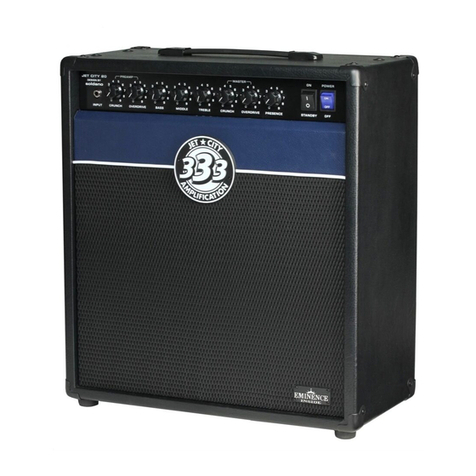
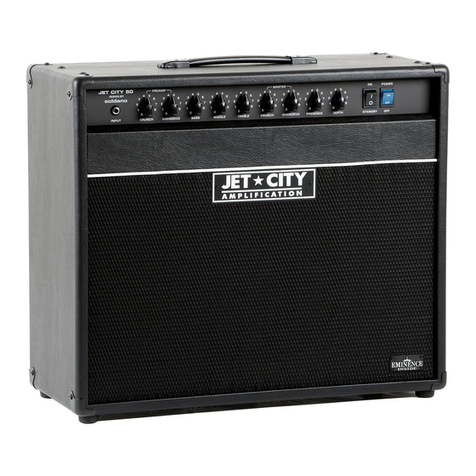
Your JCA5212RC was designed by the world-renowned tube
amp designer Mike Soldano, in SEATTLE, WASHINGTON, and
meticulously assembled to assure that it meets the highest
quality standards and value.
The JCA5212RC is an all-original Soldano design for Jet City
Amplification. Like all previous Soldano-designed amps from
Jet City Amplification, the JCA5212RC features the “Crunch”
circuit capable of a wide range of character – from clean and
bright to muscular and powerful. Our top-of-the-line combo
adds Soldano’s “Clean” circuit. Previously only available in
the Soldano Lucky 13, the Clean channel is wide-open with
no gain control. Each channel also has a dedicated EQ, for
added tonal versatility.
There are a few more tubes here, too – both the 3-spring
reverb and the effects loop are tube-driven for rich, warm
effects. And like all Soldano designs, it’s all about the purity
of tone in 5212 again – not a mini-switch, pull-pot, or other
secret-sauce knob will be found anywhere on this amp.
•Plug the power cable into the back panel and plug the cable
into a power receptacle. Turn on the power switch on the
amplifier and wait about 30 seconds for the tubes to warm
up.
•Turn on the standby switch.
•Turn up your volume switch on your guitar and impress your
friends with your amazing new tone.
9
match the amp’s speaker output impedance with a speaker’s
impedance (sometimes called “load” .
3.
OK, how does that relate to my J A5212R ?
Your amp has outputs on the back marked “16 ohm” and “8
ohm.” You need to pick the correct output for your speaker
configuration. To be specific, if your speaker cabinet is listed
as “16 ohms” then use the “16 ohm” output on your amp.
Things get a bit more complicated when you want to use
more than on speaker cabinet. Speaker cabinets often have
a set of ¼” jacks labeled “series” or “parallel.” This allows you
to run a speaker from your head to one cabinet and then
from that cabinet to another one. When you use the
“series” output, the load increases so you add each cabinet’s
impedance to determine the overall load (two 8-ohm cabs in
series = 16-ohm load .
When you use the “parallel” output, the load decreases. If
all cabinets have the same impedance, then divide that
impedance by the number of cabinets (two 8-ohm cabs in
parallel = 4-ohm load . If the cabinets are of different
impedance, then multiply the impedances together and
divide this by the sum of the cabinet impedances (one 8-ohm
cab and one 16-ohm cab in parallel = 5.33-ohm load . In case
of an awkward number, default to the impedance closes to,
but lower than, the number (for a 5.33-ohm load, use the 4-
ohm output .
4.
Um…could you make that a little easier?
Sure! Just read the chart below to find what your speaker
configuration.
Connect your JCA5212 to:
Single JCA24S amp’s 8-ohm out to cab’s 8-ohm in (mono mode
Single JCA48S amp’s 16-ohm out to cab’s 16-ohm in (mono mode
Dual JCA48S
amp’s 8-ohm out to cab 1’s 16-ohm in (mono
amp’s 2nd 8-oh out to 2nd cab’s 16-ohm in (mono