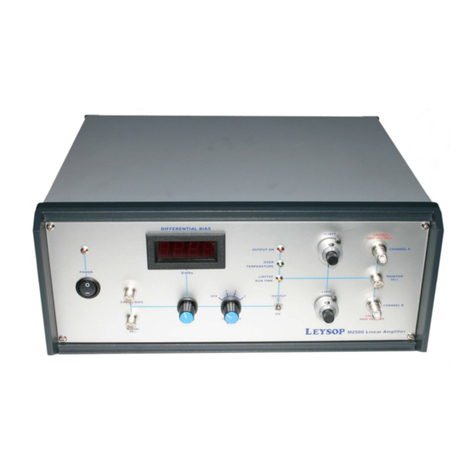
LEYSOP M500 User manual

LEYSOP LTD
Manufacturers and suppliers of optical and electro-optical components
Model M500
High Voltage Differential Amplifier
LEYSOP 18 Repton Court, Repton Close, Burntmills, Basildon, Essex, SS13 1LN ENGLAN .
Telephone: 01268 - 522111 Fax: 01268 – 522111 e.mail: sales@leysop.com

2
THIS MUST BE READ BEFORE USING THE
M500 AMPLIFIER
WARNING
THE MAXIMUM OUTPUT UNDER NORMAL CONDITIONS FROM EITHER A OR B
OUTPUT CHANNELS IS 300V. THESE OUTPUTS ARE POTENTIALLY LETHAL
AND EXTREME CARE MUST BE USED IN BOTH USE AND SERVICING OF THE
AMPLIFIER. IT IS ESSENTIAL THAT THE OPERATING INSTRUCTIONS ARE
EXPLICITLY FOLLOWED IN USE, AND SHOULD THERE BE ANY DOUBT ON THE
PART OF THE OPERATOR ABOUT THE USE OF THE AMPLIFIER THE
MANUFACTURERS SHOULD BE CONSULTED.
The amplifier must not be operated out of its case. Only qualified
engineers competent in high oltage engineering should operate or
ser ice this equipment
IMPORTANT
The amplifier uses BNC output plugs.
Take Care not to plug cables from low voltage equipment into the output
connectors as this could damage both the amplifier and external equipment
RE E BER THAT THEY ARE LIVE AND POTENTIALLY LETHAL.

3
SPECIFICATIONS
AC POWER INPUT 90 – 264 volts AC
50 – 60Hz
SIGNAL INPUT
Input voltage swing for linear operation + 4.5 V
Maximum permissible input voltage + 15 V
OUTPUT VOLTAGES
Normal voltage range for each channel 10 V to 300V
Maximum differential output voltage swing (overdriven) ∼310 V
Maximum differential output voltage swing without clipping ∼600 V
Output voltage for zero input signal
and zero differential bias setting 160 V each channel
Output voltages for zero input signal one channel 320 V
and maximum differential bias setting other channel 25V
Output swing for + 1.5 volt signal input swing + 100 V each Channel
about bias value
Effective differential output swing
for + 1.5 volt input swing 400 V
Gain (differential output swing) 133 ( + 2% )
(input swing)
OUTPUT CURRENT
The amplifier is not designed to provide output current into resistive loads.
Capacitive loads will reduce performance.
NOTE
At full amplitude the amplifier can be operated continuously up to 5 MHz normal room
temperatures (up to ∼ 30°C). Operation At higher temperatures the unit may shut down when the
thermal limit is reached. The “Limited Run Time” LE will light to indicate that thermal shut
down is possible.
O NOT BLOCK THE VENTILATION GRILLS ON THE REAR OF THE AMPLIFIER
FREQUENCY RESPONSE

4
RISE TIME @ Maximum amplitude (500V differential) <70 nS
@ 400V differential or less <60 nS
FALL TIME @ Maximum amplitude (500V differential) <70 nS
@ 400V differential or less <60 nS
RESPONSE -3dB @ ifferential amplitude (400V differential) 6 MHz
OUTPUT MONITOR
The monitor output is an accurate representation of the differential voltage at the amplifier
output terminals and can be connected to an oscilloscopes 50Ω or high impedance input.
Monitor voltage for 500V diffential output voltage 1 V into 50Ω load
2V into High Z load
AMPLIFIER FUNCTIONS
Front Panel differential bias setting Varies differential
output over range + 250V
External C Bias Input +/- 5V C input varies differential
output over range +/- 100V
Output ON switch Turns high voltage outputs on
Output ON indicator Lights when HVoutputs are on
Limited Run Time indicator Lights when thermal shut down
Possible
Over temperature indicator Lights when thermal shut down
has occured
OPERATING INSTRUCTIONS

5
SWITCHING ON
ALWAYS ENSURE THAT THE VENTILATION GRILLS ARE CLEAR OF OBSTRUCTIONS
Switch on the mains switch and note that the AC Power lamp comes on.
NORMAL OPERATION
For normal operation the controls should be set as follows:-
IFFERENTIAL zero
POSITIVE LIMIT 100%
NEGATIVE LIMIT 100%
The signal input to the amplifier is connected to the ‘SIGNAL 50Ω’ BNC connector. This presents a 50Ω
load resistance to the signal source which should be suitable to drive this load. The signal input is C
coupled to the amplifier and any offset voltage present will be reflected in the output signals.
A positive transition from zero on the input will cause the A channel output to rise and the B channel
output to reduce and conversely for a negatiove transition. Channel A output, the nett differential output
voltage and the monitor output are in phase with the input while Channel B output is 180 degrees out of
phase with the input.
IFFERENTIAL BIAS CONTROL
The ‘ C BIAS’ control adjusts the mean levels of the A and B output channels.
With the bias control set to zero both A and B channel outputs will be biased to ∼150V.
When the ‘ C BIAS’ control is set to maximum clockwise rotation the A output bias will be ∼275V,
and the B output bias will be ∼25V. Thus the differential output voltage will be V
A
- V
B
=∼+250V.
When the ‘ C BIAS’ control is set to maximum anticlockwise rotation the A output bias will be ∼25V,
and the B output bias will be ∼275V. Thus the differential output voltage will be V
A
- V
B
=∼-250V
The ‘ C BIAS’ control allows the output levels to be precisely adjusted across the pockels cells for 'zero
voltage input conditions', thereby achieving the best extinction ratio or lowest residual phase modulation.
Similarly a voltage at the ‘EXT C BIAS’ input will alter the output C bias across the amplifiers
dynamic range. An input of +5V produces a bias of +250V and -5V produces a bias of -250V. The ‘ C
BIAS’ control and the ‘EXT C BIAS’ can be used together and the net bias will be the sum of the two
settings.
The digital meter will show the actual C bias voltage at the outputs. (The meter reading will be affected
by very low frequency and/or non symmetrical waveforms).

6
Typic l Differenti l Output W veform t 1MHz nd 400V
Typic l rise nd f ll times t 400V output

7
Typic l Tri ngul r W ve (White=Differenti l Output t 100kHz nd 400V
Typic l Monitor Output (Blue) comp red with Differenti l Output (White)
500 Volts Output

8
A SIMPLE SETTING UP AND FAMILIARISATION PROCEDURE FOR THE
M500 AMPLIFIER AND EM500 SERIES MODULATION
Ensure ll connections to the mplifier re m de correctly nd s fely.
1. Connect the modulator to the amplifier using the two leads provided.
2. Connect external oscillator to input with 1Hz square wave and amplitude at min.
3. Set Slew rate switch OFF
4. Set positive and negative Output Limits fully clockwise.
5. Switch Output On and increase the input signal amplitude.
6. Check that the amplifier is working by observing the monitor output using an oscilloscope.
7. Hold the modulator between two squares of polaroid with the axis of the polaroid film lying
along the radial axis of the BNC HV sockets and observe a white light source through this
combination. With the polaroids crossed a MALTESE fringe pattern should be seen thus.
As the 1Hz square wave amplitude is increased the Maltese Cross will be changed until at full
amplitude the cross will switch between right hand and left hand output polarisation states as
shown below.
Full +
Output & Sense
Voltage -
There is then a phase shift between the ordinary and extraordinary rays leaving the modulator of
+ 180°. Precise square wave + phase shifting can be achieved between 0 - 180° by adjustment of
the limit potentiometers.
7. If one limit potentiometer is set at zero, only one side of the modulator crystal is driven and the
output polarisation state will switch in one direction only. This arrangement can be used for
amplitude modulation of a laser beam.

9
SETTING UP THE MODULATOR WITH A LASER BEAM
The input polarisation must be along the BNC axis or at 90° to that axis.
A suitable output polariser should be crossed to the input polarisation state.
Initially set up the modulator with back reflections along the beam axis. Place a fine ground glass screen
between the input polariser and the modulator and a Maltese cross should be observed after the analiser.
Adjust the modulator position until this cross is central to the beam axis. The best extinction ratio is then
achieved. This must be performed with the EHT switched OFF.
Issue 1.0 7th October 2020
Table of contents
Other LEYSOP Amplifier manuals