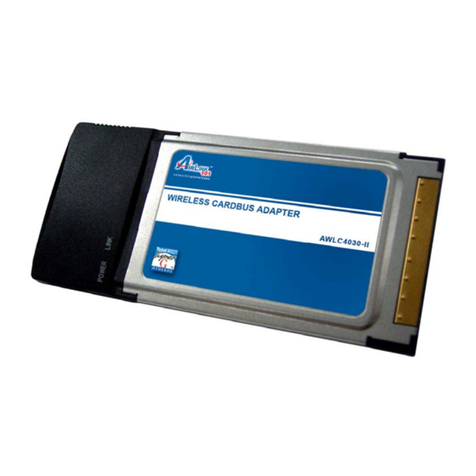
MaxTech PCN2000 Series User manual

User's Guide
PCN2000 Series
High Performance
Ethernet PCMCIA
Adapters
Part #MAN004 Rev. 1.1

Please take a moment to note the following infor-
mation.Includethisformintheunlikelyeventthat
youneedtoreturntheproductforwarrantyservice.
Refer to Section Eight for complete Warranty
information and procedures on returning your
product.
Product: _________________________
Serial Number: ____________________
Purchase Date: ____________________
Purchased From: __________________
Your Name: ______________________
Address: _________________________
City, State, Zip: ___________________
Day-time Phone #: _________________
Company Name: ___________________
CompletethefollowinginformationONLY
afteryouhavebeenassistedbyaTechnical
Support Representative:
RMA Number: ____________________
Problem Description: _______________
_________________________________
_________________________________
_________________________________
_________________________________
_________________________________
___________________________________
_______________________________________
_________________________________________
REPAIR INFORMATION FORM

1
Contents
Section One Introduction ............................ 1
Section Two Installation .............................. 2
Section Three Network Driver Installation.. 7
Section Four Troubleshooting ...................... 7
Section Five Cable Information .................. 9
Section Six Specifications ........................ 10
Section Seven Technical Support ................ 11
Section Eight Warranty, FCC And Other
Information ........................... 11
Section One - Introduction
Maxtech'sPCN2000SeriesPCMCIAnet-
work adapters are high performance, credit-card
sizedEthernetnetworkadapters.Theadapterplugs
into a PCMCIA Type II (or higher) slot providing
a 16-bit bus interface and a 16 KB network data
packetbuffer.Theadapteralsofeatureslow-power-
consumption design and is software configurable.
The adapter complies with the Personal Computer
Memory Card Industry Association (PCMCIA)
Release 2.1 Type II standard and also with the
IEEE 802.3 standards for Ethernet.
Minimum hardware requirements are an
IBMAT(orbetter)fullycompatiblePCwith512K
RAM running DOS 3.3 or higher, equipped with
a PCMCIA Release 2.1 Type II slot.

2
Section Two - Installation
This section will provide step by step
instructions on how to install your new PCMCIA
network adapter. Installation of this network
adapter is a two-step process consisting of actual
hardware installation and PCMCIA device driver
installation/configuration. This network adapter
is designed to be software configurable using the
included installation diskette.
2.1 Unpacking Your Network Adapter
Two types of network adapter cards are
available.Beforeyouproceed,determinethemodel
you have purchased. The following table summa-
rizes the contents and features for your PCMCIA
Ethernet products:
Model
PCN PCN
2000T 2000BT
PCMCIA Card x x
RJ-45 Coupler x
BNC/RJ-45 Coupler x
LEDs x x
BNC T-connector x
Driver diskette x x
User's Guide x x
2.2 Hardware Installation
Installation of this adapter requires ac-
cessing and configuring your PCMCIA Type II
slot. All Maxtech PCMCIA products feature a
built-in static electricity discharge mechanism,
however,youshouldexerciseallnecessaryprecau-

3
tions described in your PC's manual regarding
static electricity discharge at all times when work-
ing with your PC.
1. Turn off the computer
2. Hold the PCMCIA Ethernet adapter with
the 68-pin female PCMCIA connector fac-
inganavailablePCMCIATypeIIslot(refer
to Figure 1-A or 1-B).
To
PCMCIA
Type 2.0
Slot
Female Media
Coupler connector
68-pin female
PCMCIA connector
To Hub
or
Figure 1-B Adapter with
10Base-2/10Base-T Coupler
ThinCoax Cable
10Base-2/10Base-T Media Coupler
To Hub
68-pin female
PCMCIA connector Female Media
Coupler connector
To
PCMCIA
Type 2.0
Slot
Figure 1-A Adapter with
10Base-T Coupler
10Base-T Media Coupler

4
3. InserttheEthernetadapterintothePCMCIA
Type II slot. The keyed guide slots on the
PCMCIA Ethernet adapter will not allow
incorrect insertion. Insert the Ethernet
adapter gently but firmly into the slot until
it stops.
4. Insert the 10Base-T (or 10Base-2/10Base-
T) MediaCouplerintotheadapter.Oneend
of this coupler has a special spring-action
connector which fits into the PCMCIA
Ethernet adapter. To insert or remove the
spring-action connector, squeeze the lock-
ing arms on either side of the connector.
This connector is keyed and will not allow
incorrectinsertion(refertoFigure1-Aor1-
B).
5. Attach the network cable to your Media
Coupler. Use either UTP cable for 10Base-
Tnetworksorthincoaxialcablefor10Base-
2 networks. Refer to Section Five for de-
tailed cable information.
2.3 PCMCIA Device Driver Installation
Before any network driver or software is
loaded, you must first install a PCMCIA device
driver for the PCMCIA Ethernet adapter. Your
computer should already provide support for
PCMCIA products via special programs on the
utility diskette shipped with the COMPUTER
(known as Socket Service/Card Service). Execute
the Socket/Card Service programs according to
specific instructions supplied by the computer’s
manual. If your computer DOES NOT provide
support for PCMCIA products, contact your com-
puter vendor for information on availability of
Socket/Card Services. You will now install the
PCMCIAEthernetdevicedriverfromthesupplied

5
driver diskette. Consult the README file on the
driver diskette for specific instructions on how to
install the driver.
Note: If you are unable to obtain Socket
Service and Card Service from your computer
manufacturer, you may still be able to use the
PCMCIA Ethernet adapter with the included
PCMCIA device driver. Consult the README
file to determine if your computer is supported in
this configuration and for instructions on how to
proceed.
The PCMCIA Ethernet adapter uses the
memory region D400-D7FF to read Ethernet ID
and other information from on-board flash ROM.
Please be certain that this memory region is ex-
cluded from usage by other programs, including
memory managers. Memory management is a
componentofMicrosoftDOS andWindowsandis
used extensively. If you are running a Microsoft
memory manager, make sure that the x=D400-
D7FF parameter appears in the
Device=EMM386.EXE entry in your
CONFIG.SYS.
Example:
DEVICE=EMM386.EXE NOEMS X=D400-D7FF
Since Socket Service and Card Service
generally require 4-8 KB of contiguous space in
the Upper Memory Blocks, we recommend using
the following entry:
Example:
DEVICE=EMM386.EXE NOEMS X=D000-DFFF
If you do not have a
DEVICE=EMM386.EXE entry in your

6
CONFIG.SYS, add the above example to your
CONFIG.SYS by using a text editor.
Consult your memory manager's manual
for the appropriate exclusion parameter if you are
not using the Microsoft memory manager.
ThePCMCIAdevicedriver allowsselec-
tion of operating parameters such as I/O Base
Address and IRQ selection. The recommended
adapter configuration parameters are:
I/O Address: 0300H IRQ Line: 5
2.4 Testing The Adapter
It is not necessary to test the PCMCIA
Ethernetadapter.However, if you encounter prob-
lems with your network connection, run the diag-
nostic program provided on the driver diskette.
The diagnostic program runs several tests and the
results are indicated by either PASS or FAIL.
Make sure that the network cable is attached (and
properly terminated if using a BNC connection) to
the adapter when running this program. If any test
fails, the program notifies you of the error and
suggestsactionstocorrecttheproblem.Followthe
on-screen prompt to start or stop the Network
Function Test.
The following suite of tests are available
through the diagnostic program:
1. Configuration Test: Identifies the host PC
2. I/O Test: Tests configured I/O port
3. ID Test: Verifies the adapter’s node ID
4. RAM Test: Checks on-board RAM
5. Internal Loop back Test: Performs trans-
mit/receive tests within the controller
6. External Loop back Test: Performs trans-

7
mit/receive tests on the network link
7. Interrupt Test: Checks Interrupt Line
8. Network Function: Performs network
packet transmit/receive tests
Section Three - Network Driver
Installation
The supplied network drivers allow the
Ethernet adapter to work with various network
operatingsystems(i.e.,NovellNetware, Microsoft
LAN Manager, etc.). Drivers for most popular
network operating systems are included in the
driver diskette in separate subdirectories. Each
directory also includes a README.TXT file de-
scribing the driver. Refer to the RELEASE.TXT
file on the driver diskette for more information on
the available drivers.
Note: Consult the README file in the
ROOT directory of the driver diskette for addi-
tional information on installation of these net-
work drivers for your particular network operat-
ing system.
Section Four - Troubleshooting
This section describes some of the com-
mon problems you may encounter while using
your network adapter. When troubleshooting, you
should make sure that the network you are con-
nected to is functioning. If you suspect that the
adapter is malfunctioning, replace it with another
adapter which is known to function properly. Also
try the adapter in another computer. This can
indicate whether the adapter or computer causes
the problem. If you can not resolve your difficulty

8
after reading the following information, contact
your dealer or vendor for assistance.
Most adapter failure after installation is
causedby:A)IncorrectlyinstalledPCMCIAdriver,
B)Not excluding memory address D400-D7FF
when using a memory manager, C)I/O base ad-
dress andIRQ Line conflict,or D)Cableproblems.
4.1 Incorrectly Installed PCMCIA Driver
The included PCMCIA driver runs as a
Card Service Client and should only be loaded
aftertheSocketandCardServicesareloaded. Be
certain that the CONFIG.SYS file contains DE-
VICE= entries in this order.
4.2 Not Excluding Memory Address D400-
D7FF
ThePCMCIAEthernet adapter usesthe
memory region D400-D7FF to read Ethernet ID
andotherinformationfromon-boardflashROM.
This memory region must be excluded from
usage by other programs, including memory
managers. If you are running Microsoft's memory
manager, make sure that the x=D400-D7FF or
x=D000-DFFF parameter appears in the
Device=EMM386.EXE entry in your
CONFIG.SYS. Refer to Section 2.3 for detailed
information.
4.3 I/O Base Address and IRQ Conflict
Make sure that the I/O address and IRQ
used by the adapter is not already in use by
another device in your PC.If your PC has built-in
serial ports then you will not be able to use IRQ 4
(COM1)or IRQ3(COM2). Otheradaptersin your
Table of contents