manuals.online logo
Brands
  1. Home
  2. •
  3. Brands
  4. •
  5. McIntosh
  6. •
  7. Amplifier
  8. •
  9. McIntosh C15 User manual

McIntosh C15 User manual

Other manuals for C15

3

This manual suits for next models

1

Other McIntosh Amplifier manuals

McIntosh MC257 User manual

McIntosh

McIntosh MC257 User manual

McIntosh C49 User manual

McIntosh

McIntosh C49 User manual

McIntosh MCC301M User manual

McIntosh

McIntosh MCC301M User manual

McIntosh C8 - SCHEMATICS User manual

McIntosh

McIntosh C8 - SCHEMATICS User manual

McIntosh MX113 User manual

McIntosh

McIntosh MX113 User manual

McIntosh MC312 Instruction manual

McIntosh

McIntosh MC312 Instruction manual

McIntosh 60TH ANNIVERSARY SYSTEM - annexe 1 User manual

McIntosh

McIntosh 60TH ANNIVERSARY SYSTEM - annexe 1 User manual

McIntosh MC275 User manual

McIntosh

McIntosh MC275 User manual

McIntosh MC206 User manual

McIntosh

McIntosh MC206 User manual

McIntosh MC 2100 User manual

McIntosh

McIntosh MC 2100 User manual

McIntosh C1000 User manual

McIntosh

McIntosh C1000 User manual

McIntosh C100 User manual

McIntosh

McIntosh C100 User manual

McIntosh D1100 User manual

McIntosh

McIntosh D1100 User manual

McIntosh C29 - User manual

McIntosh

McIntosh C29 - User manual

McIntosh MA5 - SCHEMATICS User manual

McIntosh

McIntosh MA5 - SCHEMATICS User manual

McIntosh MC462 Instruction manual

McIntosh

McIntosh MC462 Instruction manual

McIntosh MA5100 - B User manual

McIntosh

McIntosh MA5100 - B User manual

McIntosh MA5200 User manual

McIntosh

McIntosh MA5200 User manual

McIntosh MC602 User manual

McIntosh

McIntosh MC602 User manual

McIntosh 20W-2 User manual

McIntosh

McIntosh 20W-2 User manual

McIntosh MA12000 User manual

McIntosh

McIntosh MA12000 User manual

McIntosh C24 Operating and installation instructions

McIntosh

McIntosh C24 Operating and installation instructions

McIntosh MA6100 - SERVICE MANUAL C Reference manual

McIntosh

McIntosh MA6100 - SERVICE MANUAL C Reference manual

McIntosh MC301 User manual

McIntosh

McIntosh MC301 User manual

Popular Amplifier manuals by other brands

Magnat Audio EDITION FOUR Owner's manual/warranty document

Magnat Audio

Magnat Audio EDITION FOUR Owner's manual/warranty document

Inter-m PA-2000A Operation manual

Inter-m

Inter-m PA-2000A Operation manual

Yamaha TX6n owner's manual

Yamaha

Yamaha TX6n owner's manual

Peavey TNT 150 user guide

Peavey

Peavey TNT 150 user guide

Bosch LBB 1903/10 Installation and user instructions

Bosch

Bosch LBB 1903/10 Installation and user instructions

Avocent Emerge DA1200D Installer/user guide

Avocent

Avocent Emerge DA1200D Installer/user guide

Redgum RGi35 operating instructions

Redgum

Redgum RGi35 operating instructions

Cambridge Audio AXA25 user manual

Cambridge Audio

Cambridge Audio AXA25 user manual

Alpine MRP-M200 owner's manual

Alpine

Alpine MRP-M200 owner's manual

Technical Pro H1502UrBT user manual

Technical Pro

Technical Pro H1502UrBT user manual

FMS EMGZ307 operating manual

FMS

FMS EMGZ307 operating manual

Racal Instruments 5601 user manual

Racal Instruments

Racal Instruments 5601 user manual

Valcom V-1094A Technical specifications

Valcom

Valcom V-1094A Technical specifications

Cambridge Audio 851D user manual

Cambridge Audio

Cambridge Audio 851D user manual

QSC 3800 Specifications

QSC

QSC 3800 Specifications

NAD C300 owner's manual

NAD

NAD C300 owner's manual

Rotel RMB-1077 owner's manual

Rotel

Rotel RMB-1077 owner's manual

Peavey Monitor 300 Series operating guide

Peavey

Peavey Monitor 300 Series operating guide

manuals.online logo
manuals.online logoBrands
  • About & Mission
  • Contact us
  • Privacy Policy
  • Terms and Conditions

Copyright 2025 Manuals.Online. All Rights Reserved.

McIntosh Laboratory, Inc. 2 Chambers Street Binghamton, New York 13903-2699 Phone: 607-723-3512 FAX: 607-724-0549
OWNERS
MANUAL
C15
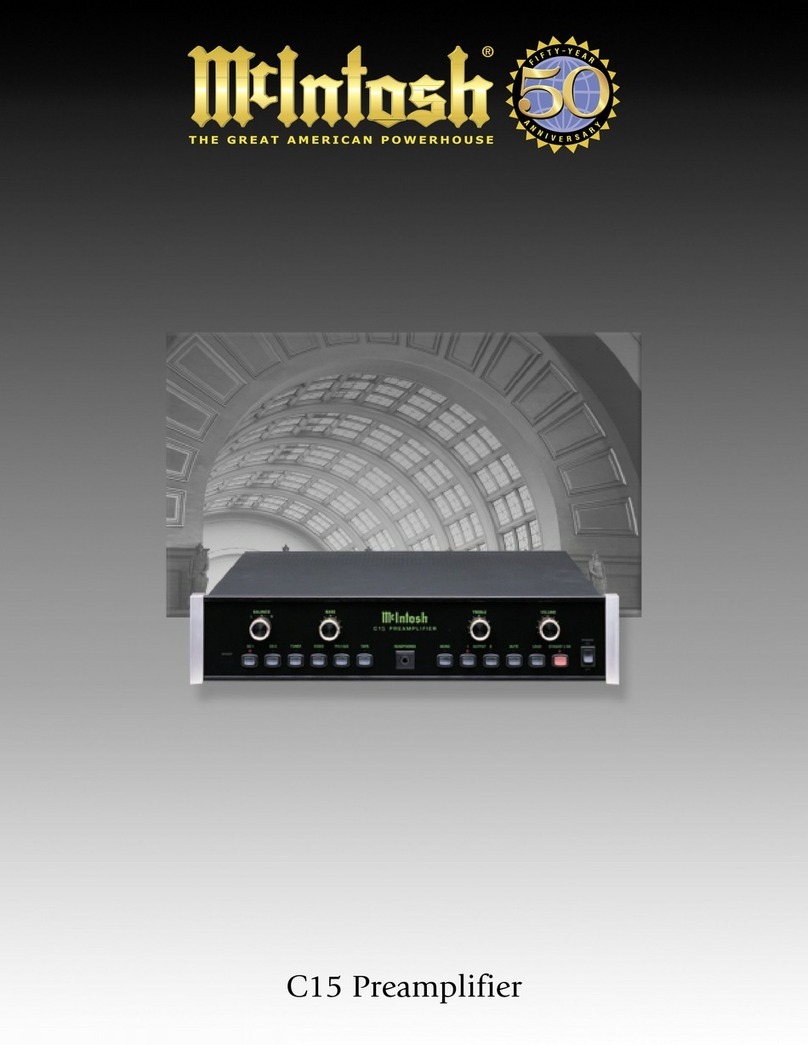
C15 Preamplifier
2
Thank You.......................................................................... 2
Please Take a Moment ....................................................... 2
Customer Service ............................................................... 2
Table of Contents ............................................................... 2
Safety Instructions ............................................................. 3
Introduction ........................................................................ 4
Performance Features ........................................................ 4
Installation ......................................................................... 5
Rear Panel Connections ..................................................... 6
How to Connect ................................................................. 7
How to Connect for Video Switching................................ 8
Front Panel Controls, Push-Button and Switches.............. 9
How to Operate................................................................ 10
HR033 Push-Buttons ....................................................... 12
How to Operate by Remote Control ................................ 13
Specifications .................................................................. 14
Packing Instruction .......................................................... 15
NOTES:
1. Connecting Cables are available from the McIntosh Parts
Department:
Data and Power Control Cable Part No. 170-202
Six foot, shielded 2 conductor, with 1/8 inch stereo mini
phone plugs on each end.
2. For additional connection information, refer to the owners
manual(s) for any component(s) connected to the C15
Preamplifier.
3. There is a built-in turn on delay which will mute the speaker
outputs for approximately two seconds when the preamplifier
is turned on.
Thank You, Please Take A Moment,
Customer Service and Table of Contents
Thank You
For your decision to own this McIntosh C15 Preamplifier
ranks you at the very top among discriminating music lis-
teners. You now have The Best. The McIntosh dedication
to Quality, is assurance that you will receive many years
of musical enjoyment from this unit.
Please take a short time to read the information in this
manual. We want you to be as familiar as possible with all
the features and functions of your new McIntosh C15. This
will ensure that you receive all the performance benefits this
equipment can offer you, and that it will become a highly
valued part of your home entertainment system.
Customer Service
Copyright 1998 by McIntosh Laboratory, Inc.
Please Take A Moment
The serial number, purchase date and McIntosh dealer
name are important to you for possible insurance claim or
future service. The serial number is located on the rear
panel of the equipment. The spaces below have been pro-
vided for you to record that information:
If at any time you have questions about your McIntosh C15
Preamplifier, contact your McIntosh dealer. Your dealer is
familiar with your McIntosh equipment as well as other
brands that may be included in your system and is best
qualified to help you.
If it is determined that your C15 is in need of repair, you
can return it to your dealer or you can return it to McIntosh
Laboratory. Contact the McIntosh Repair Department for
assistance at,
McIntosh Laboratory, Inc.
2 Chambers Street
Binghamton, New York 13903
Phone: 607-723-3512
FAX: 607-724-0549
Serial Number:
Purchase Date:
Dealer Name:
Table of Contents
3
IMPORTANT SAFETY
INSTRUCTIONS!
PLEASE READ THEM BEFORE
OPERATING THIS EQUIPMENT.
Safety Instructions
General:
1. Read all the safety and operating instructions, con-
tained in this owners manual, before operating this
equipment.
2. Retain this owners manual for future reference about
safety and operating instructions.
3. Adhere to all warnings and operating instructions.
4. Follow all operating and use instructions.
5. Warning: To reduce risk of fire or electrical shock,
do not expose this equipment to rain or moisture.
This unit is capable of producing high sound pres-
sure levels. Continued exposure to high sound pres-
sure levels can cause permanent hearing impair-
ment or loss. User caution is advised and ear protec-
tion is recommended when playing at high volumes.
6. Caution: to prevent electrical shock do not use this
(polarized) plug with an extension cord, receptacle
or other outlet unless the blades can be fully in-
serted to prevent blade exposure.
WARNING SHOCK HAZARD -
DO NOT OPEN.
The lightning flash with arrowhead, within an equilateral
triangle, is intended to alert the user to the presence of
uninsulated dangerous voltage within the products
enclosure that may be of sufficient magnitude to consti-
tute a risk of electric shock to persons.
AVIS RISQUE DE CHOC -
NE PAS OUVRIR.
The exclamation point within an equilateral triangle is
intended to alert the user to the presence of important
operating and maintenance (servicing) instructions in
the literature accompanying the appliance.
NO USER-SERVICEABLE
PARTS INSIDE. REFER
SERVICING TO
QUALIFIED PERSONNEL
To prevent the risk of electric shock, do not remove
cover (or back). No user serviceable parts inside. Refer
servicing to qualified personnel.
Attention: pour pevenir les chocs elecriques pas
utiliser cette fiche polarisee avec un prolongateur,
une prise de courant ou un autre sortie de courant,
sauf si les lames peuvent etre inserees afond ans en
laisser aucune partie a decouvert.
7. For added protection for this product during a lightning
storm, or when it is left unattended and unused for long
periods of time, unplug it from the wall outlet and dis-
connect the antenna or cable system. This will prevent
damage to the product due to lightning or power line
surges.
8. Do not use attachments not recommended in this
owners manual as they may cause hazards.
Installation:
9. Locate the equipment for proper ventilation. For ex-
ample, the equipment should not be placed on a bed,
sofa, rug, or similar surface that may block ventilation
openings; or, placed in a built-in installation, such as a
bookcase or cabinet, that may impede the flow of air
through the ventilation openings.
10. Locate the equipment away from heat sources such as
radiators, heat registers, stoves, or other appliance (in-
cluding amplifiers) that produce heat.
11. Mount the equipment in a wall or cabinet only as de-
scribed in this owners manual
12. Do not use this equipment near water; for example,
near a bathtub, washbowl, kitchen sink, laundry tub, in
a wet basement or near a swimming pool, etc.
13. Do not place this product on an unstable cart, stand,
tripod, bracket, or table. The equipment may fall, caus-
ing serious injury to a person, and serious damage to
the product.
Connection:
14. Connect this equipment only to the type of AC power
source as marked on the unit.
15. Route AC power cords so that they are not likely to be
walked on or pinched by items placed upon or against
them, paying particular attention to cords at plugs, con-
venience receptacles, and the point where they exit from
the instrument.
16. Do not defeat the inherent design features of the polar-
ized plug. Non-polarized line cord adapters will defeat
the safety provided by the polarized AC plug. If the
plug should fail to fit, contact your electrician to re-
place your obsolete outlet. Do not defeat the safety pur-
pose of the grounding-type plug.

4
·Multiple Inputs
Six high level inputs and one Moving Magnet phono input
provide for all popular program sources.
·Tone Control Bypass
At the flat settings the Bass and Treble control circuit ele-
ments are removed from the signal path.
·Loudness Circuity
A push-button Loud switch adds loudness compensation to
the volume control for improved bass response at low level
listening.

·Electronic Input Switching
Digital Logic integrated circuits drive Electromagnetic
switches on all inputs and operating functions for reliable,
noiseless, distortion free switching
·Output and Speaker Switching
Front panel Output push-buttons control two switched out-
puts that allow you to send signals to two separate power
amplifiers.
·Front Panel Headphone Jack
A convenient headphone jack allows the convenience of
private listening when the main outputs to the power am-
plifier are muted.
·Special Power Supply
Fully regulated power supply with double shielded power
transformer ensures stable noise free operation even though
the power line should vary.
Safety Instructions cont,
Introduction and Performance Features
Introduction
The C15 Remote Controlled Preamplifier is a simple but
elegant instrument that allows you to enjoy outstanding
music reproduction. It includes a wide range of convenient
operating functions to enhance your listening experience.
The classic McIntosh C15 will perfectly complement a
McIntosh stereo power amplifier for a stereo system of in-
comparable performance and style.
17. Do not overload wall outlets, extension cords or inte-
gral convenience receptacles as this can result in a risk
of fire or electric shock.
Care of Equipment:
18. Clean the instrument by dusting with a dry cloth. Un-
plug this equipment from the wall outlet and clean the
panel with a cloth moistened with a window cleaner. Do
not use liquid cleaners or aerosol cleaners.
19. Do not permit objects of any kind to be pushed and/or
fall into the equipment through enclosure openings.
Never spill liquids into the equipment through enclo-
sure openings.
20. Unplug the power cord from the AC power outlet
when left unused for a long period of time.
Repair of Equipment:
21. Unplug this equipment from the wall outlet and refer
servicing to a qualified service personnel under the fol-
lowing conditions:
A. The AC power cord or the plug has been damaged,
B. Objects have fallen, or liquid has been spilled into
the equipment,
C. The equipment has been exposed to rain or water,
D. The equipment does not operate normally by follow-
ing the operating instructions contained within this
owners manual. Adjust only those controls that are
covered by the operating instructions, as an im-
proper adjustment of other controls may result in
damage and will often require extensive work by a
qualified technician to restore the product to its nor-
mal operation,
E. The equipment has been dropped or damaged in any
way,
F. The equipment exhibits a distinct change in perfor-
mance - this indicates a need for service.
22. Do not attempt to service beyond that described in the
operating instructions. All other service should be re-
ferred to qualified service personnel.
23. When replacement parts are required, be sure the ser-
vice technician has used replacement parts specified by
McIntosh or have the same characteristics as the origi-
nal part. Unauthorized substitutions may result in fire,
electric shock, or other hazards.
24. Upon completion of any service or repairs to this prod-
uct, ask the service technician to perform safety checks
to determine that the product is in proper operating con-
dition.
Performance Features
5
Installation
Front View of the C15
custom installed
Side View of the C15
custom installed
Bottom View of the C15 cus-
tom installed
Installation
The C15 can be placed upright on a table or shelf, standing
on its four feet. It also can be custom installed in a piece of
furniture or cabinet of your choice. The required panel cut-
out, ventilation cutout and unit dimensions are shown.
Always provide adequate ventilation for your C15. Cool
operation ensures the longest possible operating life for
any electronic instrument. Do not install the C15 directly
above a heat generating component such as a high powered
amplifier. If all the components are installed in a single
cabinet, a quiet running ventilation fan can be a definite
asset in maintaining all the system components at the
coolest possible operating temperature.
A custom cabinet installation should provide the follow-
ing minimum spacing dimensions for cool operation. Allow
at least 1-1/2 inches (3.8cm) above the unit so airflow is
not obstructed. Allow 17-1/2 inches (44.5cm) depth behind
the mounting panel, which includes clearance for connec-
tors. Allow 1-1/8 inches (2.9cm) in front of the mounting
panel for knob clearance. Be sure to cut out a ventilation
hole in the mounting shelf according to the dimensions in
the drawing.
17-1/2"
444mm
17-1/16"
433.4mm 7/32"
5.3mm
Support Shelf
Outline of Front Panel
Edge of Cutout
Panel Height
3 1/2"
88.9mm
3-1/16"
77.8mm
1/4"
6mm
3/16"
5.1mm
End Caps
3-9/16"
90.0mm
Bottom of Cutout and Top
of Support Shelf Must
Coincide
Mounting Surface
Outline of Unit
(Side View)
Support Shelf
Mounting Bracket at Both Sides of the Rear Panel.
Fasten with 6-32 x 3/8 Machine Screw and Washer to Chassis.
Fasten with 6 x 1/2 Wood Screw and Washer to Support Shelf
6"
15"
9"
Mounting Surface
Cut Out Center
for Ventilation
(Bottom View)
(Front View)
6
C15 Rear Panel Connections
Connect the C15
power cord to a live
AC outlet. Refer to
information on the
back panel to deter-
mine the correct
voltage.
The EXT
(external)
Sensor for a
McIntosh
Keypad or
IR sensor.
DATA PORTs send
signals to compat-
ible source compo-
nents to allow you
to remote control
them.
POWER
CONTROL
Outputs send
turn-on sig-
nal to a
McIntosh
Component.
CD1 and CD2
inputs accept
signals from
separate CD
players.
The HOME
Data Port is for
use with the op-
tional HC-1
Home Control-
ler.
OUTPUTS 1 and 2
the signal output
controlled by the
front panel OUT-
PUTS push-buttons
PROCESSOR
FROM and TO
jacks for a signal
processor
The PH/AUX
Switch selects
signals from a
Moving Magnet
phono cartridge or
an audio high
level signal
TUNER inputs
accept signals
from the output
of a tuner.
TAPE inputs
are for tape
recorders
The SUM Data
Port connector
accepts a con-
trol cable from
a McIntosh
Remote Con-
trol Translator
GND terminal
accepts a
ground wire
from a turn-
table.
VIDEO inputs
for audio signals
from a LD, VCR,
TV or the op-
tional MVS-3 A/
V Selector.
TAPE OUT-
PUTS supply
record signals for
tape recorders
PROCESSOR
IN/OUT Switch
turns the signal
processor loop
On or Off
PH (Phono)/AUX IN-
PUTS accept signals
from a Moving Magnet
phono cartridge or an
audio high level signal,
depending on the posi-
tion of the PH/AUX
Switch
7
How to Connect the C15
To AC Outlet
Tape Recorder
Turntable
McIntoshTuner
Signal
Processor
McIntosh Power Amplifier
McIntosh PC-3
McIntosh CD Player
1. Connect the C15 power cord to a live AC outlet.
2. Connect cables from OUTPUTS 1 or 2 to the power
amplifier inputs.
3 Connect cables from a signal processor output to the
C15 PROCESSOR FROM jacks, and the signal pro-
cessor input jacks to the C15 PROCESSOR TO jacks.
NOTE: When a signal processor is connected and the C15 IN-
OUT PROCESSOR Switch is set to the IN position,, the
processor must be on, or in bypass mode, for a signal to
pass through the preamplifier.
4. Connect cables from the TAPE OUTPUTS to the
record inputs of the tape recorder and the TAPE IN-
PUTS to the tape recorder outputs.
5. Connect the ground wire from a turntable or record
player to the GND terminal.
6. Connect cables from a record player with a moving
magnet cartridge to the PH/AUX INPUTS when the
PH-AUX switch is in the PH position, or. from an aux-
iliary source component when the PH-AUX switch is
in the AUX position.
7. Connect cables from a McIntosh CD Player to the C15
CD1 or CD2 INPUT jacks.
8. Connect cables from a McIntosh tuner output to the
C15 TUNER INPUTS.
9. Connect a cable from the C15 POWER CONTROL
mini phone jack to the Power Control In on a McIntosh
Power Amplifier or component.
10. Connect a cable(s) from the DATA PORT(S) to a
product that is to be controlled by the C15.
8
McIntosh Video/Audio Selector
How to Connect the C15
for Video Switching
How to Connect the C15 for Video Switching
Monitor
McIntosh Video Disc Player
1. Connect a Data cable from the C15 VIDEO DATA
PORT to the MVS-3 DATA IN jack.
2. Connect the MVS-3 CONTROL CENTER AUDIO
OUTPUTS to the C15 VIDEO INPUTS.
3. Connect the MVS-3 VIDEO MONITOR OUTPUT to a
TV or Monitor.
4. Connect a McIntosh LD Player Audio Outputs to the
MVS-3 LV AUDIO INPUTS, the Video output to the
MVS-3 VIDEO INPUT and the Control Out to the
MVS-3 DATA OUTPUT jack.
5. Connect other video source components to the appro-
priate audio and video and data jacks on the MVS-3.
9
C15 Front Panel Controls, Push-
Buttons and Switches
C15 Front Panel Controls, Push-Buttons and
Switches
POWER
switch turns
all AC power
completely
ON or OFF
MUTE push-
button mutes
audio in the
Ouputs 1 and
2, headphones
output is not
affected
STANDBY/ON
push-button turns
the C15 ON, or
OFF (Standby)
LOUDNESS provides
frequency response
contoured to compen-
sate for the behavior of
the human ear at softer
listening levels
MONO push-button
combines the left and
right channel signals for
Mono operation at Out-
puts 1 and 2. The
Record outputs are not
affected by this switch.
TREBLE control provides
12dB boost or cut with a
flat center position
BASS control provides
12dB boost or cut with
a flat center position
OUTPUT 1 and 2 push-
buttons turn the 1 and 2
outputs On or Off
VOLUME control
allows you to adjust
the listening level.
The Record outputs
are not affected by
the Volume control
The BALANCE control
allows you to adjust the
relative volume balance
between channels
IR Sensor receives
commands from a
remote control
Select any one of the six
Audio signal sources
HEADPHONES jack
allows connection of
Stereo Headphones for
private listening
10
How to Operate the C15
Power On
Press the POWER switch to ON. The Red LED above the
STANDBY/ON push-button lights to indicate the C15 is in
Standby mode. To turn on the C15 press the STANDBY/
ON push-
button. The
MUTE LED
will light for
approxi-
mately two
seconds af-
ter turn on.
Refer to Fig-
ure 1.
Note: You may also turn on the C15 using the HR033 Remote
Control.
Source Selection
Select the desired listening source with the appropriate
push-button switch. If an MVS-3 Audio/Video Selector is
connected, use the HR033 Remote to first select Video and
then any
of the A/
V
sources
con-
nected to
the
MVS-3.
Refer to
Figure 2.
Volume Control
Adjust the VOLUME control for the desired listening
level.
Balance Control
Adjust the BALANCE control as needed to achieve ap-
proximately equal listening volume levels in each loud-
speaker. Turn the BALANCE to the Left to emphasize the
left channel by reducing the level of the right channel. Turn
the BALANCE to the right to emphasize the right channel
by reducing the level of the left channel.
Bass and Treble Controls
Adjust the BASS and TREBLE controls to suit your listen-
ing preferences. The bass or treble intensity can be in-
creased with clockwise rotation and decreased with coun-
terclockwise rotation. All tone control circuit elements are
removed from the signal path when the controls are in the
center or flat position.
Mono
Press the MONO push-button to combine left and right ste-
reo signals to mono at the OUTPUTS 1 and 2 and HEAD-
PHONES output.
Mute
Press the MUTE push-button to mute audio in all outputs
except the HEADPHONES. The MUTE LED above the
push-button will flash on and off to indicate that Mute is
active. Press MUTE a second time to unmute audio.
PH/AUX Inputs
When using a phono player with
a moving magnet cartridge con-
nected to the PH/AUX inputs, set
the PH-AUX switch to the PH
position. When using an auxiliary
program source component con-
nected to the PH/AUX inputs, set
the PH-AUX switch to the AUX
position. Refer to Figure 3.
Loud Switch
Press the LOUD push-button to add loudness bass compen-
sation to the volume control for improved low level listen-
ing.
Output 1 and 2
Press OUTPUT 1 or 2 push-buttons to send audio to sepa-
rate power ampli-
fiers connected to
the rear panel
OUTPUTS 1 or 2.
You can press ei-
ther push-button
individually or
both together. Re-
fer to Figure 4.
Figure 1
Figure 4
Figure 3
Figure 2