Pairing With an Audio Accessory
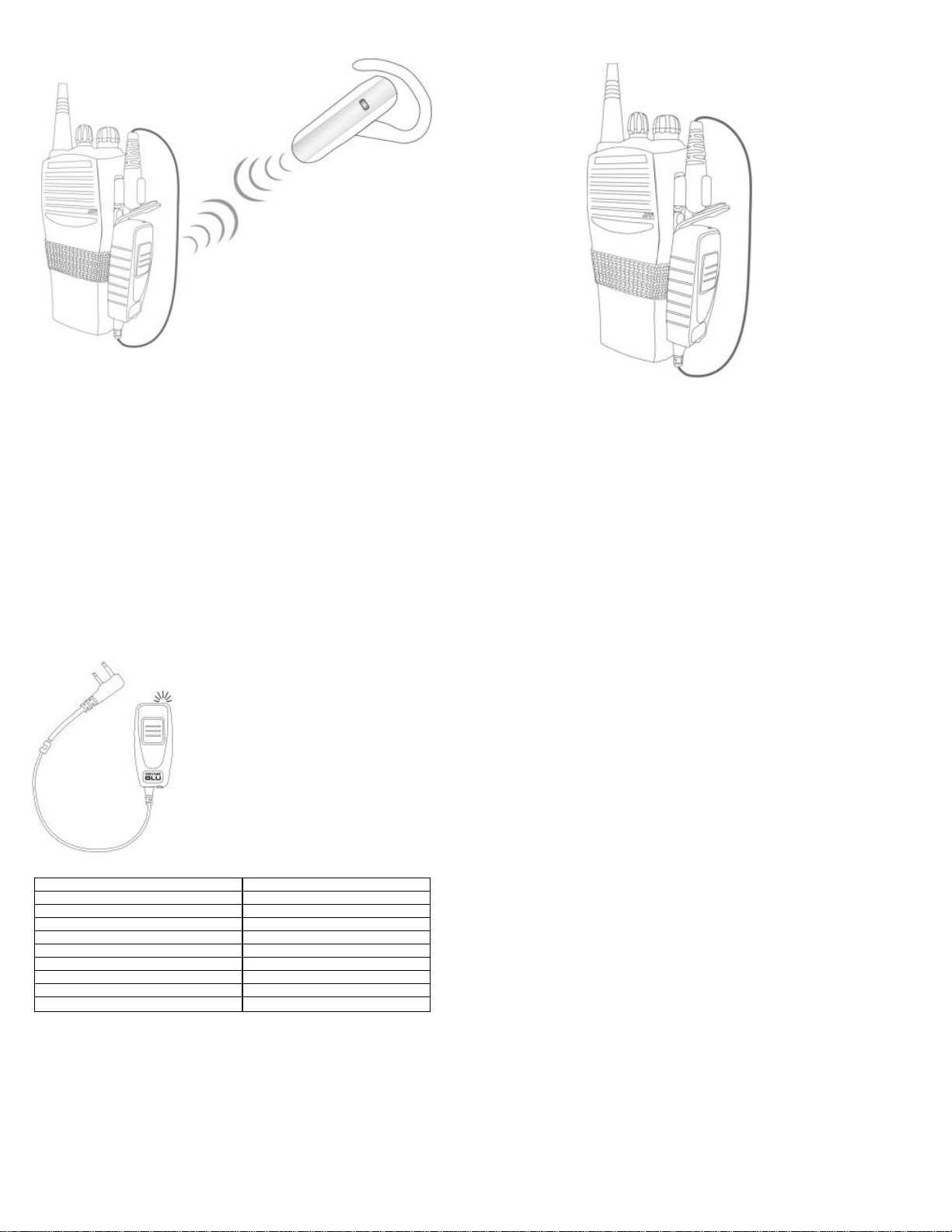
STEP THREE:Pairing with an AudioAccessory
*When pairing the Bluetooth Dongle with aheadset, make sure that both the Bluetooth Dongle and the 2-way radio the dongle is
connected to are both powered off.
*Turn the power switch on the back of the Bluetooth Dongle to the ON position while holding down the Talk button on the front of the
BluetoothDongle.
*Continue to hold the Talk button down for approximately three seconds. Release the Talk button when the status LED on the Bluetooth
dongle begins to flash two times per second.
*The Bluetooth Dongle is now in audio accessory pairing mode. Activate the pairing mode on your compatible wireless audio
accessory following the instructions provided by the headset manufacturer.
*Once the wireless audio accessory and Bluetooth Dongle are paired with each other, the status
LED on the dongle will show aconstant blue light for three seconds.
*If the Bluetooth Dongle does not detect acompatible wireless accessory within 60 seconds
of being put into pairing mode, the dongle will exit the pairing mode and resume normal operation.
*Once successfully paired, turn the 2-way radio on. You will be able to operate your 2-way radio using your compatible Bluetooth wireless
accessory.
Reconnecting to aPreviously Paired Headset
Once the Bluetooth Dongle has been successfully paired to aBluetooth headset it will remember that connection. If the headset is
powered off or loses connection, the dongle will attempt to reestablish the connection. The dongle and headset will attempt to
reestablish their link whenever when the radio/dongle and headset are both turned on and in within range of each other. Re-
establishing this connection can take 10-60 seconds.
Testing and Using the Bluetooth Dongle
STEP FOUR: Transmit and Receive Operation
Once your Bluetooth Dongle and wireless Bluetooth headset have been paired together:
Received signals will be heard over your Bluetooth headset’s speaker
When transmitting, the operator’s voice is picked-up by the microphone in the Bluetooth headset
Push-to-Talk can be activated one of two ways:
*By pressing and holding the Talk button on the Bluetooth Dongle
*Using an optional Bluetooth Wireless Bluetooth PTT (model BT-PTT, sold separately)
If you are using aBluetooth PTT, you will first need to pair the dongle with the PTT device, using the
instructions located in the Bluetooth PTT User’s Guide.
56
Status LED Messages
The meanings of the various status LED messages shown
by the Bluetooth Dongles are shown on the following table:
SUPPORTAND WARRANTY
PRYME Radio Products warrants this product against defects in materials or workmanship for
a period of one year from the date of retail purchase. PRYME will repair or replace a defective
unit, at our option, without charge for parts or labor. The limited warranty is extended only to
the original purchaser and is valid only to consumers in the United States and Canada. It does
not cover damage or failure caused by or attributable to Acts of God, abuse, misuse, improper
or abnormal usage, faulty installation, improper maintenance, lightning, or other incidences
of excessive voltage, or any tampering or repairs by other than a PRYME authorized repair
facility. It does not cover replacement of consumable parts, transportation costs, or damage
in transit.
Repair or replacement under the terms of this warranty does not extend the terms of this
warranty. This warranty can only be modified by an officer of PRYME Radio Products, and
then only in writing. Should this product prove defective in workmanship or material, the
consumer’s sole remedies shall be such repair or replacement as provided by the terms of this
One single blue flash per second
Two blue flashes per second
Headset pairiing mode activated
Three blue flashes per second
Bluetooth PTT pairing mode activated
One long blue flash for 3 seconds
Successfully paired or re-paired
Constant amber (with or without blue flashes)
Blue flashes while green shows constantly
Blue flashes while red shows constantly
Low battery or hardware failure
warranty. Under no circumstances shall PRYME Radio Products be liable for any loss or
damage, direct, consequential, or incidental, arising out of the use of or inability to use this
product. Some states do not allow limitations on how long an implied warranty lasts or the
exclusions or limitations of incidental or consequential damages, so the above limitations or
exclusions may not apply to you. This warranty gives you specific legal rights. You may also
have other rights, which may vary, from state to state.
For support or warranty service on your PRYME product, contact us at 1-800-666-2654 or visit
us on the web at www.PRYME.com.
Troubleshooting
My wireless audio accessory will not pair with the Bluetooth Dongle.
Follow the instructions to place the Bluetooth Dongle into the correct pairing mode and then activate the pairing mode on the
accessory. Make sure that the Bluetooth Dongle and accessory being paired are within one meter of each other.
My wireless audio accessory or worked before, but is not working now.
Make sure that the Bluetooth dongle is properly connected to the 2-way radio and that the radio is turned on. Ensure that your
wireless audio accessory and the Bluetooth Dongle both have fully charged batteries and are turned on. If the devices will still not
work, re-pair the Bluetooth dongle to the wireless accessory.
After Charging, My Bluetooth Dongle Does Not Power Up
Power cycle the Bluetooth Dongle by setting the power switch to off, waiting ten seconds, and then turning the power
switch on. The dongle should now operate normally. Always make sure that the power switch on the Bluetooth PTT is
turned to the off position when charging.
COPYRIGHTANDTRADEMARKINFO
© 2011 PRYME Radio Products, Brea CA. All rights reserved.
PRYME® and Bluetooth® are trademarks owned by PRYME Radio Products. All other product or
service names are the property of their respective owners.
DISCLAIMER: The Bluetooth wireless link used by Bluetooth products is an open standard,
unsecured technology. As such, it is not recommended for first-responder or other mission
critical users.
78