| 8 | | 9 |
your medical history. By using the unit
and recording the results regularly for
your physician to interpret, you will keep
your physician informed of the continuing
changes in your blood pressure.
•
If you have one of the circulatory
problems as arteriosclerosis, diabetes,
liver disease, kidney disease, severe
hypertension, peripheral circulation……,
please consult your healthcare profes-
sional before using the device.
• Blood pressure measurements taken
with this device are equivalent to those
obtained by a trained observer using
the cuff / stethoscope auscultation
method and are within the accuracy
limits prescribed by the Standard of EN
1060-4 and American National Standard
for Manual, electronic, or Automated
Sphygmomanometers.
•
Results are not intended for direct
diagnosis. Please consult with a
physician if you have any questions
or concerns about your results.
* People with arrhythmias
*
Undergoing intravenous injection
on any limb
* Currently in a dialysis treatment
* In pre-eclampsia condition
• For those who have had mastectomy
surgery (especially whose’ lymph nodes
were removed), it’s recommended to take
a measurement on the unaffected side.
• When used among medical electronic
equipments on the same limb, pressur-
ization of the cuff may cause temporarily
interference to other devices.
•
Keep in mind that blood pressure
naturally varies from time to time
through out the day and is affected by
lots of different factors such as stress,
eating, smoking, alcohol consumption,
medication, and physical activity, etc.
•
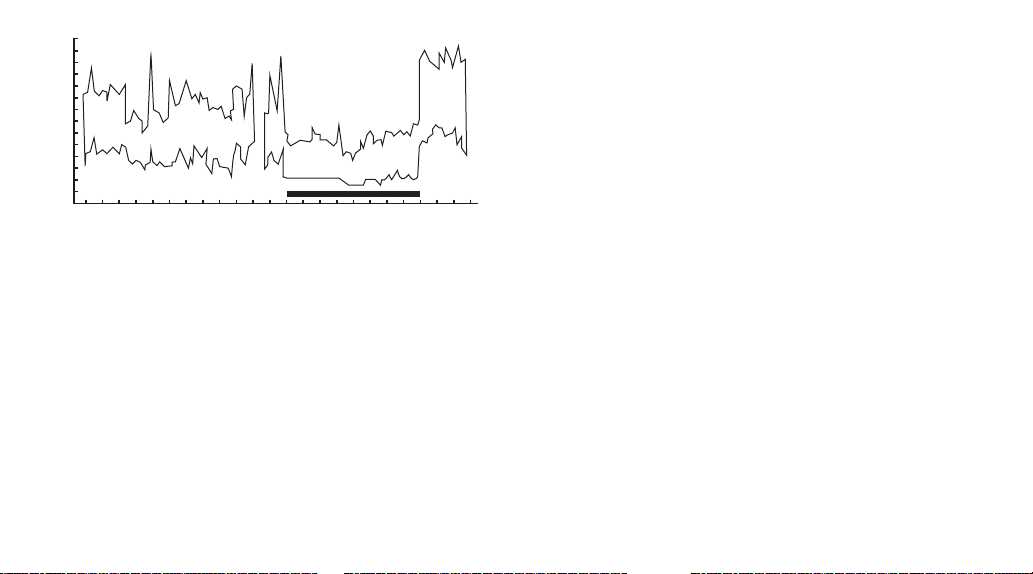
Normally the blood pressure rises
while at work and is at its lowest during
sleeping period.
•
Blood pressure measurements should
be interpreted by a physician or a trained
health professional who is familiar with
•
Rest at least 5 ~ 10 minutes before
taking a measurement.
• To allow your blood vessels to return
to the condition prior to taking the
measurement, please wait at least 3 ~
5 minutes in between measurements.
You may need to adjust the wait time
according to your physiological situation.
•
We recommend you using the same wrist
(preferably the left wrist) and measuring
around the same time each day.
•
Sit down comfortably and place your
elbow on the table with your feet flat
on the floor. Please do not cross your
legs during measurements.
•
Keep the device at heart level. Relax
your hand with the palm facing up.
•
Perform measurements in a quiet
and relaxed environment at room
temperature.
•
Do not move or shake the device during
a measurement. Please keep quiet
and do not talk during measurements.
• This product is not suitable for:
* Pregnant women
a medical problem, promptly consult
your healthcare provider.
•
Read the Instruction Manual thoroughly
before measuring and keep it at hand
for your reference.
•
This device uses the oscillometric method
to measure systolic and diastolic blood
pressure as well as your heart rate.
It’s recommended for use by people
over the age of 18 and not to be used
on infant or children.
•
The device is designed for home use
and not suitable for clinical use.
• This monitor is not intended for use in
the MR environment.
•
Do not take a measurement in a low
(less than 41 °F/5 °C) and high (more
than 104 °F/40 °C) temperature, nor in
a place outside humidity ranges (15% ~
93% R.H.), and atmospheric pressure
ranges (700 ~ 1060 hPa), or you may
get inaccurate readings.
•
Wait 30 ~ 45 minutes before measure-
ment if you’ve just consumed caffeinated
beverages or smoked cigarettes.