AI-Objektive
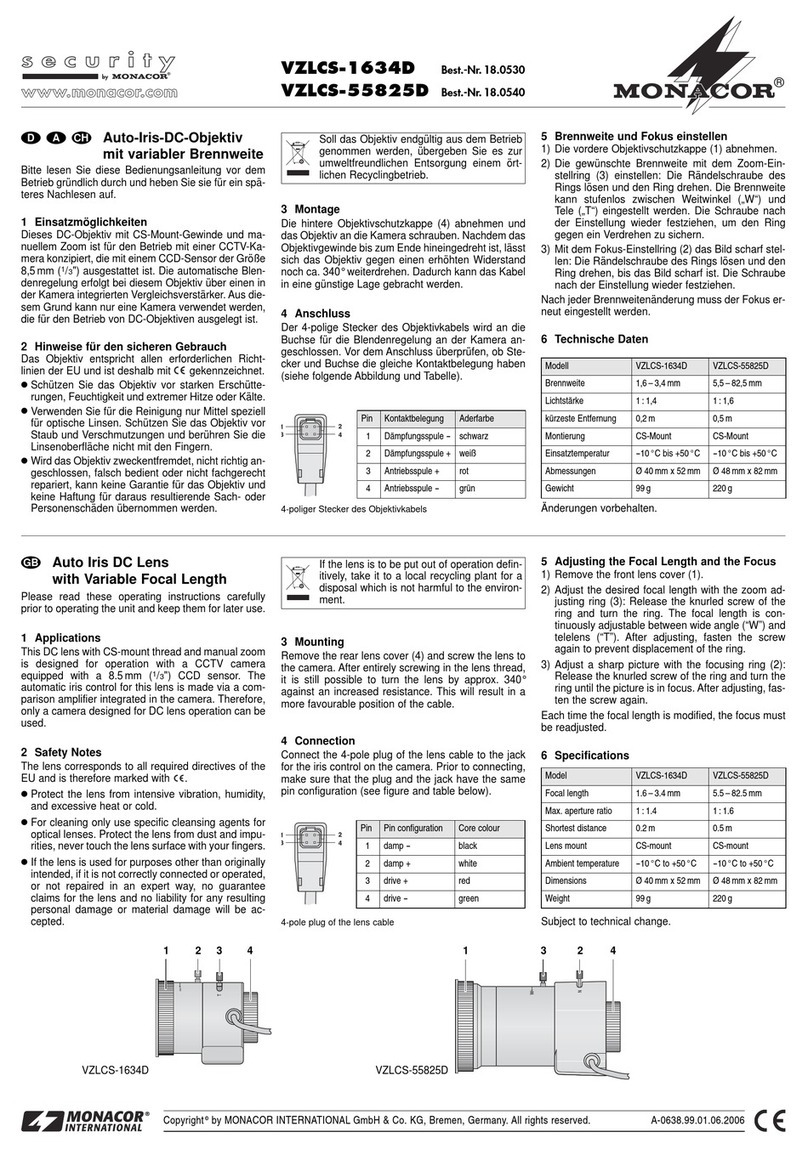
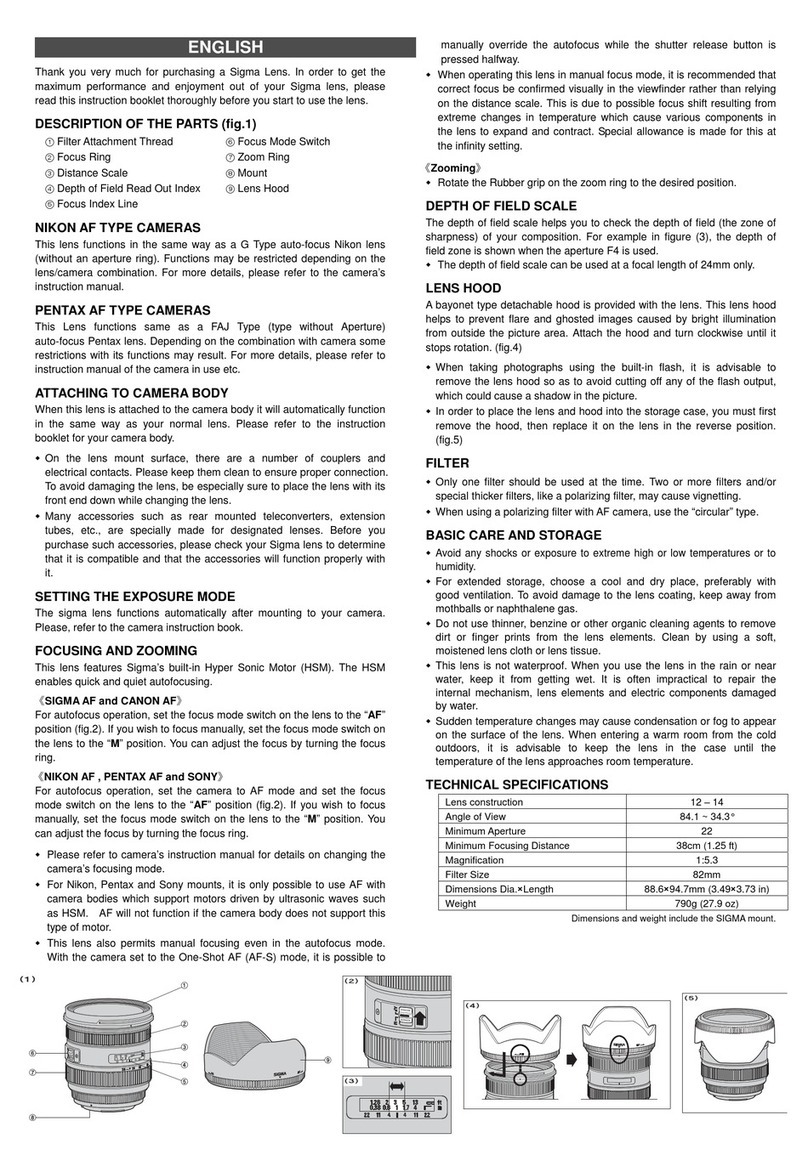
1 Einsatzmöglichkeiten
Diese AI-Objektive (Auto Iris) sind für den Betrieb mit einer
CCTV-Kamera konzipiert. Die Objektivblende wird durch das
Kamera-Videosignal der Helligkeit entsprechend automatisch
eingestellt. Die Objektive eignen sich für folgende Kameras:
2 Hinweise für den sicheren Gebrauch
Das Objektiv entspricht der EU-Richtlinie für elektromagneti-
sche Verträglichkeit 89/336/EWG.
●Schützen Sie das Objektiv vor Feuchtigkeit, Hitze und Kälte
(zulässiger Einsatztemperaturbereich
-
5°C bis +45°C).
●Verwenden Sie zum Reinigen nur Mittel speziell für optische
Linsen.
●Wird das Objektiv zweckentfremdet, nicht richtig ange-
schlossen oder nicht fachgerecht repariert, kann für even-
tuelle Schäden keine Haftung übernommen werden.
●Soll das Objektiv endgültig aus dem Betrieb genommen
werden, übergeben Sie es zur Entsorgung einem örtlichen
Recyclingbetrieb.
3 Anschluß
Das Anschlußkabel an den 4-poligen Stecker anlöten. Dabei
die Kontaktbelegung der entsprechenden Kamerabuchse be-
achten (siehe Bedienungsanleitung der Kamera).
*nicht bei allen Modellen
4 Montage
Die hintere Objektivschutzkappe abnehmen, und das Objektiv
an die Kamera schrauben. Nachdem das Objektivgewinde bis
zum Ende hineingedreht ist, läßt sich das Objektiv gegen
einen erhöhten Widerstand noch ca. 340° weiterdrehen. Da-
durch lassen sich die Bedienelemente und die Kabeldurch-
führung in eine günstige Lage drehen.
5 Schärfe und Zoom einstellen
1)Die Rändelschraube des Schärfeeinstellrings lösen [VLC-
3514A ohne Schärfeeinstellung (Fixfokus)].
2)Die Schärfe einstellen. Zum Sichern gegen Verdrehen die
Rändelschraube festziehen.
3)Zoom (nur VZLCS-914A): Die Rändelschraube des Zoom-
Einstellrings „T W“ lösen, und den Ring drehen. Zum
Sichern gegen Verdrehen die Rändelschraube festziehen.
6 Einstellungen LEVEL und ALC
1)Ist das Bild auf dem Monitor grundsätzlich zu dunkel oder
zu hell, läßt sich der Videosignalpegel zum Steuern der
Blende korrigieren. An der Kamera die AGC ausschalten.
Die Schutzkappe über dem Trimmpoti LEVEL abnehmen,
und das Trimmpoti mit einem kleinen Schraubendreher ver-
stellen:
Bild zu dunkel in Richtung „H“ drehen
Bild zu hell in Richtung „L“ drehen
Die Abdeckkappe wieder aufsetzen.
2)Die Steuerung der Blende erfolgt durch die durchschnitt-
liche Bildhelligkeit (Werkseinstellung). Das Trimmpoti ALC
(Automatic Light Control) steht in der Position „A“ (Aver-
age). Objekte vor einem sehr hellen Hintergrund (z.B. im
Gegenlicht) erscheinen dadurch zu dunkel. Das Poti ALC in
diesem Fall so weit in Richtung „P“ (Peak = Spitzenwert-
steuerung) drehen, bis der Bildbereich optimal sichtbar ist.
7 Technische Daten
Die technischen Daten sind auf der Rückseite angegeben. Sie
entsprechen den Angaben des Herstellers.
Änderungen vorbehalten.
AI Lenses
1 Applications
These AI lenses (Auto Iris) are designed for the operation with
a CCTV camera. The iris of the lens is adjusted automatically
by means of the camera video signal according to the bright-
ness. The lenses are suitable for the following cameras:
2 Safety Notes
This lens is in accordance with EC directive 89/336/EEC for
electromagnetic compatibility.
●Protect the lens from humidity, heat and cold (admissible
ambient temperature range
-
5°C to +45°C).
●For cleaning only use specific cleansing agents for optical
lenses.
●If the lens is used for other purposes than originally intended
or not properly connected or not repaired by an expert, no
liability can be assumed for any probable damage.
●Should the lens definitively be put out of operation, it has to
be disposed of in a local recycling plant.
3 Connection
Solder the connecting cable to the 4-pole plug. Please ob-
serve the configuration of the corresponding camera jack (see
instruction manual of the camera).
*not with all models
4 Mounting
Remove the rear lens cap and screw the lens onto the cam-
era. After the thread of the lens has been turned into till the
end, the lens can still be turned further by approx. 340° against
an increased resistance. Thereby, the operating elements as
well as the cable inlet can be turned into a favourable position.
5 Adjusting Focus and Zoom
1)Loosen the knurled screw of the focus adjusting ring [VLC-
3514A without focussing (fix focus)].
2)Adjust the focus. Fasten the knurled screw to prevent dis-
placement of the ring.
3)Zoom (VZLCS-914A only):
Loosen the knurled screw of the zoom adjusting ring “T W”,
and turn the ring. Tighten the knurled screw to prevent dis-
placement of the ring.
6 Adjustments of LEVEL and ALC
1)If the picture displayed on the monitor is too dark or too
bright, the video signal level can be corrected to control the
iris. Switch off theAGC on the camera. Remove the protec-
tion cap above the trim potentiometer LEVEL and adjust the
trim potentiometer with a small screwdriver:
Picture too dark turn in the direction “H”
Picture too bright turn in the direction “L”
Reposition the cap.
2)The iris is controlled by the average brightness of the pic-
ture (default setting). The trim potentiometer ALC (Automa-
tic Light Control) is in position “A” (Average). Therefore,
subjects against a too bright background (e.g. in case of
backlight) are too dark. In this case, turn theALC trim poten-
tiometer in the direction “P” (Peak = peak value control),
until the picture is optimal.
7 Specification
The specifications are indicated on the back page. According
to the manufacturer.
Subject to technical changes.
D A CH
GB
Objectifs à commande
automatique de diaphragme
1 Possibilités d’utilisation
Ces objectifs à commande automatique de diaphragme sont
conçus pour des caméras CCTV. Le diaphragme de l’objectif
est réglé automatiquement en fonction de la luminosité par le
signal vidéo de la caméra. Les objectifs conviennent pour les
caméras suivantes:
2 Conseils d’utilisation
Cet objectif répond à la norme européenne relative à la com-
patibilité électromagnétique 89/336/CEE.
●Protégez-le de l’humidité, de la chaleur et du froid (tem-
pérature ambiante de
-
5°C à +45°C).
●Pour le nettoyer, utilisez uniquement des produits spéciale-
ment conçus pour le nettoyage d’objectifs.
●Nous déclinons toute responsabilité en cas de dommage si
l’objectif est utilisé dans un but autre que celui pour lequel
il a été conçu, s’il n’est pas correctement branché ou
réparé.
●Lorsque l’objectif est définitivement retiré du service, vous
devez le déposer dans une usine de recyclage adaptée.
3 Branchements
Soudez le câble de branchement à la fiche 4 pôles. Respec-
tez la configuration de la prise (voir notice d’utilisation de la
caméra).
*pas sur tous les modèles
4 Montage
Retirez le couvercle de protection arrière de l’objectif, vissez
l’objectif sur la caméra. Une fois le filetage inséré jusqu’au
bout, l’objectif peut être tourné contre une résistance plus
grande, de 340° environ, permettant ainsi un meilleur posi-
tionnement des réglages et de l’entrée de câble.
5 Réglages de la précision et du zoom
1)Desserrez la vis moletée de l’anneau de réglage de la pré-
cision (VLC-3514A: objectif fixe, pas de réglage).
2)Réglez la précision, puis revissez.
3)Zoom (VZLCS-914A uniquement):
Devissez la vis de l’anneau de réglage du zoom “T W”,
tournez l’anneau. Fixez la vis pour éviter toute torsion.
6 Réglages LEVEL et ALC
1)Si l’image sur le moniteur est trop foncée ou trop claire, cor-
rigez le niveau du signal vidéo. Déconnectez sur la caméra
le réglageAGC. Retirez le capot du potentiomètre LEVEL et
réglez le potentiomètre avec un petit tournevis:
Image trop sombre le tourner vers “H”
Image trop claire le tourner vers “L”
Remettez le capot de protection.
2)L’objectif est contrôlé par la luminosité moyenne de l’image
(réglage par défaut). Le potentiomètreALC (Automatic Light
control) est en position A (Average: moyenne); par consé-
quent, les objets devant un fond trop clair (par exemple en
contre-jour), apparaissent trop sombres. Tournez le poten-
tiomètre ALC dans la direction “P” (Peak: réglage de la va-
leur de crête) jusqu’à obtention d’une image correcte.
7 Caractéristiques techniques
Les caractéristiques techniques figurent sur la face arrière. D’a-
près les données du constructeur.
Tout droit de modification réservé.
F B CH
Lens Camera
VLCS-816A
VLCS-2516A
VLCS-3816A
VZLCS-914A 8.5mm CCD chip (1/3")
VLC-614A
VLC-1214A
VLC-3514A
VLC-4814A
12.7mm CCD chip (1/2")
8.5mm CCD chip (1/3")
Mounting
CS mount
C mount
Colour of the core Connection
red operating voltage 8V to 16V
white video signal
black ground
shielding* ground
Objectif Caméra
VLCS-816A
VLCS-2516A
VLCS-3816A
VZLCS-914A Puce CCD 8,5mm (1/3")
VLC-614A
VLC-1214A
VLC-3514A
VLC-4814A
Puce CCD 12,7mm (1/2")
Puce CCD 8,5mm (1/3")
Filetage
CS-Mount
C-Mount
Aderfarbe Anschluß
rot Betriebsspannung 8–16V
weiß Videosignal
schwarz Masse
Abschirmung* Masse
Couleur conducteur Branchement
rouge tension d’alimentation 8–16V
blanc signal vidéo
noir masse
vert* libre
VLCS-814A Best.-Nr. 19.3860
VLCS-2516A Best.-Nr. 19.3740
VLCS-3816A Best.-Nr. 19.3780
VZLCS-914A Best.-Nr. 19.3980
VLC-614A Best.-Nr. 19.3820
VLC-1214A Best.-Nr. 19.3720
VLC-3514A Best.-Nr. 19.3760
VLC-4814A Best.-Nr. 19.3810
green* not connected
grün* bleibt frei
blindage* masse
Objektiv Kamera
VLCS-816A
VLCS-2516A
VLCS-3816A
VZLCS-914A 8,5-mm-CCD-Chip (1/3")
VLC-614A
VLC-1214A
VLC-3514A
VLC-4814A
12,7-mm-CCD-Chip (1/2")
8,5-mm-CCD-Chip (1/3")
Montierung
CS-Mount
C-Mount