manuals.online logo
Brands
  1. Home
  2. •
  3. Brands
  4. •
  5. Mutable Instruments
  6. •
  7. Modulator
  8. •
  9. Mutable Instruments Tides User manual

Mutable Instruments Tides User manual

Other manuals for Tides

3

Other Mutable Instruments Modulator manuals

Mutable Instruments Tides User manual

Mutable Instruments

Mutable Instruments Tides User manual

Mutable Instruments Tides User manual

Mutable Instruments

Mutable Instruments Tides User manual

Popular Modulator manuals by other brands

Channel Vision Digital RF Modulator E-1200 installation instructions

Channel Vision

Channel Vision Digital RF Modulator E-1200 installation instructions

Trophy AMD-53-S2 instruction manual

Trophy

Trophy AMD-53-S2 instruction manual

axing AVM 5-00 Operation instructions

axing

axing AVM 5-00 Operation instructions

IKUSI MAC-HOME HD user manual

IKUSI

IKUSI MAC-HOME HD user manual

Wisi MINI OM 10 operating instructions

Wisi

Wisi MINI OM 10 operating instructions

Elan MOD3000 installation instructions

Elan

Elan MOD3000 installation instructions

RCA CRF910 user manual

RCA

RCA CRF910 user manual

Thor Broadcast H-IP-32RF manual

Thor Broadcast

Thor Broadcast H-IP-32RF manual

Delphi SA10003 installation guide

Delphi

Delphi SA10003 installation guide

Crucial Audio Die Gotterdämmerung operating instructions

Crucial Audio

Crucial Audio Die Gotterdämmerung operating instructions

Televes 554912 user manual

Televes

Televes 554912 user manual

Pico Macom PM45 Specifications

Pico Macom

Pico Macom PM45 Specifications

FTE Maximal MODIG AIR user manual

FTE Maximal

FTE Maximal MODIG AIR user manual

ProTelevision PT 5780 instruction manual

ProTelevision

ProTelevision PT 5780 instruction manual

Argent Cables HD DVB-T MODULATOR user guide

Argent Cables

Argent Cables HD DVB-T MODULATOR user guide

SSS Siedle BVM 650-0 Product information

SSS Siedle

SSS Siedle BVM 650-0 Product information

ClearView SD4260 manual

ClearView

ClearView SD4260 manual

Televes T.0X COFDM-QAM CI User instructions

Televes

Televes T.0X COFDM-QAM CI User instructions

manuals.online logo
manuals.online logoBrands
  • About & Mission
  • Contact us
  • Privacy Policy
  • Terms and Conditions

Copyright 2025 Manuals.Online. All Rights Reserved.

Tides
Tidal modulator
About unipolar and bipolar outputs
The bipolar output is not a merely scaled and off-
set version of the unipolar output! It is made of two
bumps, a positive one occurring during the attack,
and a negative one occurring during the release.
PLL mode
Hold the frequency range (B) button for 1s. Tides
enters the PLL mode.
In PLL mode, a signal must be provided to the
CLOCK input. Tides will adjust its output frequen-
cy to match the frequency of this signal or a multi-
ple/division of it as set by the Frequency knob.
Hold the frequency range (B) button again to leave
the PLL mode.
Tips and tricks:
• Tides works wonders as a master modulator for
a classic analog VCO.
• When using Tides as an oscillator for bass
sounds, try both the unipolar and bipolar out-
puts; and the medium and high ranges - they all
sound different.
• Use the PLL mode to create just-intonation mel-
odies on top of a drone sent to the CLOCK input.
• A different flavor of sync sounds can be ob-
tained by patching a PWM or square source into
the FREEZE input.
• Use the wavefolder on a low-frequency envelope
to create bumps and bounces.
• Use the PLL mode, and trigger the CLOCK and
TRIG inputs from a rhythmic sequencer.
• In typical Buchla fashion, the low/high tide out-
puts can be used to trigger another module to
chain envelopes and create complex shapes.
Calibration
1. Connect a patch cable to the FM input. Leave
the other end of the cable unplugged (this
prevents the normalling to +/-1 semitone to be
activated).
2. Connect a patch cable to the Level input. Leave
the other end of the cable unplugged (this
prevents the normalling to full amplitude to be
activated).
3. Connect a MIDI>CV interface or precision volt-
age source to the V/Oct input.
4. Hold the Mode switch (A) for one second. All
LEDs are lit in yellow.
5. Play a C2 note, or send a 1V voltage from your
CV source.
6. Press the mode switch (A). All LEDs are lit in
green.
7. Play a C4 note, or send a 3V voltage from your
CV source.
8. Press the mode switch (A).
The module is now calibrated for accurate V/Oct
operation!
Unipolar Bipolar
About Tides
Tides is, depending on your point of view, a volt-
age-controlled (looping) AR/AD generator which
can reach audio frequencies; or a dynamically
waveshaped synth voice with the ability to go into
subsonic territories.
Installation
Tides requires a -12V / +12V power supply (2x5
pins connector). The red stripe of the ribbon cable
(-12V side) must be oriented on the same side as
the “Red stripe” marking on the board.
The power consumption is as follows:
-12V: 5mA ; +12V: 55mA.
Online manual and help
The manual can be found online at
mutable-instruments.net/modules/tides/manual
For help and discussions, head to
mutable-instruments.net/forum
A
B
CD
EFG
1 2 3
458
910 11
76
12 13
Front panel
Controls
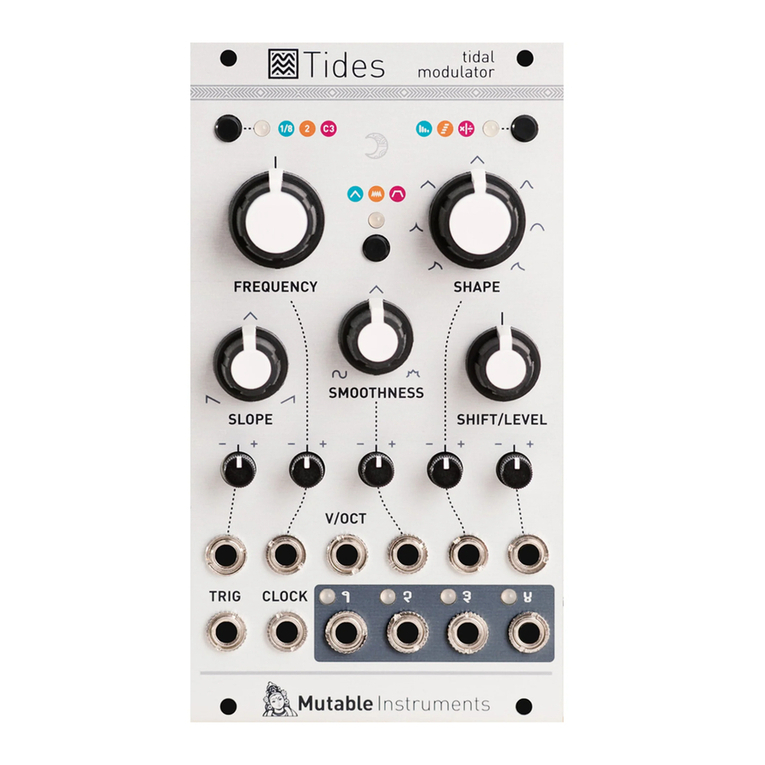
A. Mode selection. Goes back and forth between
one-shot AD (green LED), looping (LED off), and
one-shot AR (red LED) modes.
B. Range selection. Goes back and forth between
very low (green LED), low (LED off), and audio (red
LED) range.
C. Frequency/rate control.
D. Attenuverter for the FM input. When no sig-
nal is patched into the FM input, serves as a fine
tuning control.
E. Waveshape of the ascending and descending
segments.
F. Ratio between the duration of the ascending and
descending segments.
G. Curve transformation. From 12 o’clock to 7
o’clock (counter-clockwise), applies a 2-pole low-
pass filter. From 12 o’clock to 5 o’clock (clockwise),
applies a wavefolder.
Inputs and Outputs
1. 2. 3. CV inputs for shape, slope, and smoothness
controls.
4. Trigger/Gate input. On a rising edge, resets the
waveform and starts the ascent. On a falling edge,
and in AR mode, starts the descent.
5. Freeze input. A gate signal applied on this input
can stop the envelope/oscillator and hold the
signal.
6. V/Oct input. 1V/Oct frequency/rate control.
7. FM input, attenuated and inverted by the attenu-
verter (D).
8. Waveform amplitude CV - normalled to a con-
stant 8V source.
9. Clock input for PLL or tap tempo operation.
10. 11. End of attack (high tide) and end of decay/
release (low tide) logic outputs.
12. 13. Unipolar (0 to 8V) and bipolar (-5V to 5V)
outputs.