8
EN
your level and experience).
• Wear a helmet and all safety equipment necessary to the practice of ying.
• Have thoroughly checked all your equipment.
• Be aware of all the information contained in this manual.
Preparation and take-off
We recommend that you rst practice inating your glider before to make the
rst ight.
For static control sessions, playing with the wind, neutral position on trimmers is
standard. For a classic take off, you can put the trim position “-2cm, full pulled”.
Generally you will not need to hold the front risers to inate the glider. A symmetric
impulsion on the harness carabineers will be enough to raise it up above you.
An adapted “tempo” and visual control will enable to decide to accelerate until
the take off.
Max glide ratio, mini sink rate
You will nd the max glide ratio while puling symmetrically on your brakes about
10 to 20% of the range, depending the trim position (on that kind of proles,
“hands up” position is fast and steep). More the trim is pulled, lees you’ll have
to brake to get the best glide ratio.
Accelerated ight
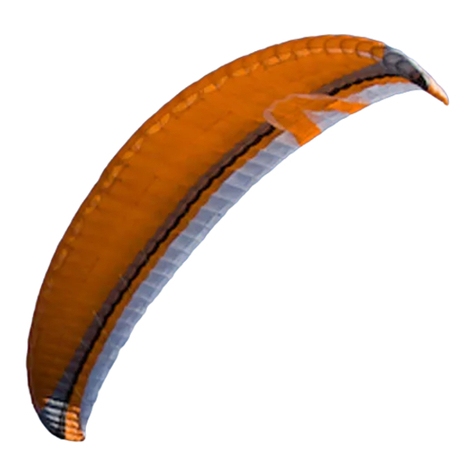
Once you have become accustomed to ying the X-FLY, you can practice using
the trimmers, which enables you to increase the speed of your glider, and to
decrease strongly your ight angle. Caution: when ying accelerated, your wing
will react in a more radical manner in turns and the glide angle will be a lot steeper.
The active ying is important in these moments.
Active ying
It is recommended with this type of glider to adopt an active handling style that
will help you to y safely. The key to active handling is to keep your glider above
your head. If the glider has a tendency to lag behind, raise your hands. If the glider
has a tendency to shoot forward, then control it with the brakes. In all cases,
always remember to keep sufcient air-speed and avoid over-piloting. Apply the
same active piloting on the ground.
In turbulent conditions
The X-FLY is very stable and solid due to its design. However an extreme tur-
bulence could generate a collapse but the X-FLY would resume normal ight
in almost all congurations. So in case of doubt, pull symmetrically on your
brakes around 35% of the range and let the glider y. Get the teaching you’re
your instructor. Practice active ying and don’t be out of time with the glider’s