▀ To the installer
It is time to install the Effecta Lambda wood boiler. Please follow the examples we provide for a
safe installation. After installation, be sure to instruct the customer on how the heating system
and the boiler work, in order to avoid unnecessary complications in the future.
Set up
The boiler is positioned so that the surface temperature of flammable building material not
exceed 80°C. The boiler should be positioned at least 15 cm (1.) from the wall. The distance
from the smoke connection to a flammable wall with ignition protective covering must be at
least 30 cm (4.). In order to clean the boiler, a minimum clear space of 1 metre (2.) is required
in front of the boiler and on the side at the convection section and at any inspection panel in the
chimney. A passage with a minimum width of 0.5 (3.)
m is required along one of the long sides of the boiler.
The boiler room
The boiler must be installed in a boiler room or boiler
house. The ceilings and walls must be fitted with
ignition protective covering and the floor must
be made of non-combustible material. Minimum
ceiling height at the boiler is 2 metres. The boiler
room or boiler house must be equipped with a
fresh air intake with the minimum dimensions
150 x 150 (5.) mm or with a sufficiently large
free sectional area to avoid low pressure in
the boiler room. It must be impossible to
close the air intake.
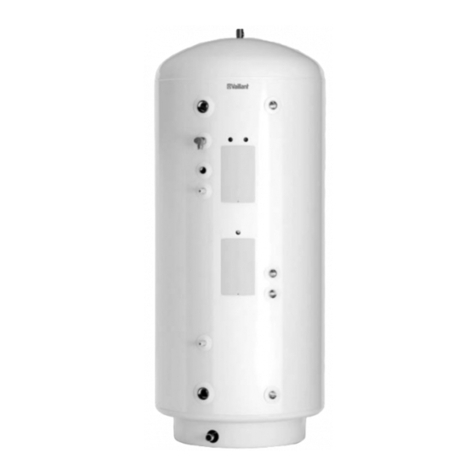
Accumulator tank
Be sure that the accumulator tanks
are well insulated. For the Effecta
Lambda to function as optimally as possible,
an accumulator tank volume of 1,500-2,500 litres is
required.
Chimney
The chimney should have a diameter of at least 150 mm. If your chimney is smaller, Effecta
should be consulted before installation. The draught in the chimney should be about 15 pa at
low temperatures. It is important that the chimney is tested and approved by a certified chimney
sweep before a new boiler is installed. If the chimney has a strong draught, a draught stabiliser
(see page 24.) may need to be installed for good boiler operation. If you have a tall chimney and
an outgoing flue gas temperature below 170°C, there is a risk of condensation in the chimney,
which can damage the chimney in the long term. A suitable temperature is 70-80°C one metre
down into the chimney. Ask your local chimney sweep for help to measure the temperature. If
the chimney is tall and has a large area, a draught that is too strong may mean high levels of
flue gas and over ignition in the loading compartment. If this is the case, a counter draught door
must be installed.