1. NAVTEX SYSTEM
1.1 NAVTEX introduction
NAVTEX provides shipping with navigational and meteorological warnings and urgent information
by automatic display and/or print out from a dedicated receiver.
NAVTEX is a component of the IMO/IHO World-Wide Navigational Warning Service (WWNWS) de-
fined by IMO Assembly resolution A.706(17), as amended, and the WMO Manual on Marine Mete-
orological Services, Part Ibis, Provision of warnings and weather and sea bulletins (GMDSS appli-
cation). It has been included as an element of the Global Maritime Distress and Safety System
(GMDSS).
The original NAVTEX specification allowed for equipment with integral printers and precluded the
fitting of equipment which relied on other ways of recording and displaying NAVTEX data.
The use of Liquid Crystal Displays and other Visual Display Units is now ubiquitous on ship’s bridges
and this revision of the specification allows for their use in displaying NAVTEX data.
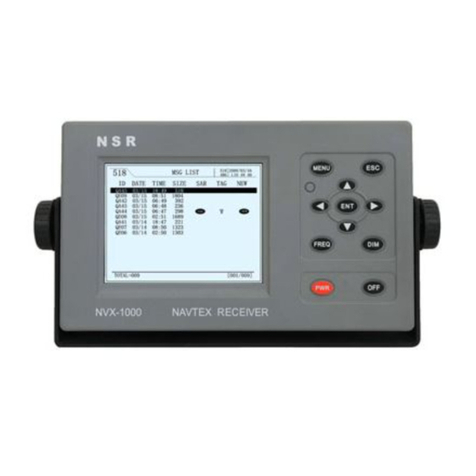
IMO Resolution MSC.148(77) states that the equipment should comprise radio receivers, a signal
processor and:
either:
a) an integrated printing device; or
b) a dedicated display device, printer output port and a non-volatile message memory; or
c) a connection to an integrated navigation system and a non-volatile message memory.
International NAVTEX services, refer to the frequency of 518kHz, and through international co-ordi-
nation to broadcast and automatically receive the maritime safety information in English language.
Domestic NAVTEX services, refer to the authority-specified frequencies 490kHz and 4209.5kHz, to
broadcast and automatically receive the marine safety information in a national language.