ORBCOMM CT 3000 User manual

CT 3000/CT 3100
Installation Guide
W000-C, Version 0.04
Mar 2018

CT 3000/CT 3100 - INSTALLATION GUIDE
AS001, 0.01
© ORBCOMM PROPRIETARY
W000-C, VERSION 0.04 2 © ORBCOMM PROPRIETARY
LEGAL NOTICE
This documentation is owned by ORBCOMM and protected by applicable copyright laws and international treaty
provisions. Other copyrighted names used are the property of their respective owners. Therefore, you must treat this
documentation like any other copyrighted material. This publication, or any part thereof, may not be reproduced or
transmitted in any form or by any means, electronic or mechanical, including photocopying, recording, storage in an
information retrieval system, or otherwise, without prior written permission by ORBCOMM, Inc. 395 W Passaic Street,
Suite 325, Rochelle Park, NJ 07662 USA Phone 703-433-6325. The information in this document is for information
purposes only and contains technical information and descriptions of the ORBCOMM product(s) and is subject to
change without notice. No warranty or representation, express or implied, is made with respect to its contents.

CT 3000/CT 3100 - INSTALLATION GUIDE
AS001, 0.01
© ORBCOMM PROPRIETARY
W000-C, VERSION 0.04 3 © ORBCOMM PROPRIETARY
CONTACT INFORMATION
Visit ORBCOMM Online
www.ORBCOMM.com
Contact Customer Care
(International) +1-703-433-6300
(North America) 1.800.ORBCOMM (1-800-672-2666)
Headquarters
395 W Passaic Street, Suite 325
Rochelle Park, NJ 07662 USA
Tel: +1-703-433-6300
Fax: 1-703-433-6400
Email: [email protected]

CT 3000/CT 3100 - INSTALLATION GUIDE
AS001, 0.01
© ORBCOMM PROPRIETARY
W000-C, VERSION 0.04 4 © ORBCOMM PROPRIETARY
TABLE OF CONTENTS
Legal Notice ................................................................................................................................2
Contact Information .....................................................................................................................3
TABLE OF CONTENTS ..................................................................................................................4
Preface........................................................................................................................................5
Purpose ..............................................................................................................................5
Notation..............................................................................................................................5
1. Installation Procedure.....................................................................................................6
2. RTU LEDs.......................................................................................................................9
2.1. Normal Mode ..........................................................................................................9
3. Regulatory Statements .................................................................................................10

CT 3000/CT 3100 - INSTALLATION GUIDE
AS001, 0.01
© ORBCOMM PROPRIETARY
W000-C, VERSION 0.04 5 © ORBCOMM PROPRIETARY
PREFACE
Purpose
This document describes the installation and operation process for ORBCOMM’s CT 3000 (p/n XT6475A31100030G)
and CT 3100 (p/nXT6475A31100070G) GPS/cellular reefer tracking devices.
Notation
Images shown in this document may not be exactly as shown.

CT 3000/CT 3100 - INSTALLATION GUIDE
AS001, 0.01
© ORBCOMM PROPRIETARY
AS001, 0.01
W000-C, VERSION 0.04 6 © ORBCOMM PROPRIETARY
1. INSTALLATION PROCEDURE
1. Gather the required tools.
2. Identify the system components.
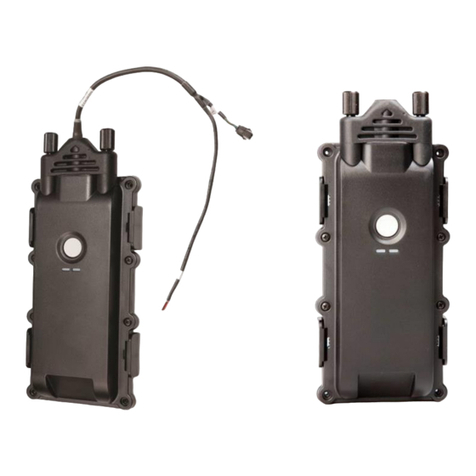
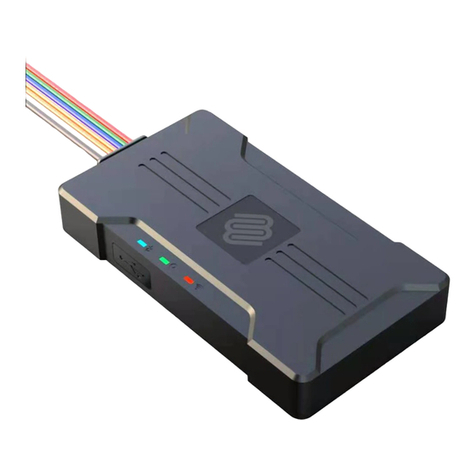
Figure 1: CT 3000/CT 3100 Device
Figure 2: CT 3000/CT 3100 Harness
3. Disconnect the reefer power.
4. Determine the mounting location on the panel.

CT 3000/CT 3100 - INSTALLATION GUIDE
AS001, 0.01
© ORBCOMM PROPRIETARY
AS001, 0.01
W000-C, VERSION 0.04 7 © ORBCOMM PROPRIETARY
5. Drill a 1-1/8” hole in the panel.
6. Feed the connector through from the back of the panel and connect to the device.
7. Remove the red backing tape and adhere the device to the panel so the arrow faces up.

CT 3000/CT 3100 - INSTALLATION GUIDE
AS001, 0.01
© ORBCOMM PROPRIETARY
AS001, 0.01
W000-C, VERSION 0.04 8 © ORBCOMM PROPRIETARY
8. Route the harness into the control box and connect to the 3-pin power and 7-pin serial connector.
9. Close the controller door and power up the reefer
10. Check the status of the reefer LEDs for correct operation.

CT 3000/CT 3100 - INSTALLATION GUIDE
AS001, 0.01
© ORBCOMM PROPRIETARY
AS001, 0.01
W000-C, VERSION 0.04 9 © ORBCOMM PROPRIETARY
2. RTU LEDS
•Green LED: Next to push button. Used for GPS status
•Tricolor LED (Red, Green, Blue): On center. Used for installation status and result when device is in installation
mode. In normal mode, the Tricolor LED indicate status of Reefer Controller, Zigbee and Battery status. Each
color of the LED will blink so that only one color will be ON at a time. In scenarios where any of the LED color is
indicated as fully on, the other LED colors will not be turned ON.
•Blue LED: Farthest away from push button. Used for cellular status.
2.1. Normal Mode
•Cellular Blue LED Status
•OFF: Module off or scanning
•Blinking: Registered
•GPS Green LED Status
•OFF: GPS OFF
•Blinking: GPS Lock
•ON: No GPS Lock.
•Reefer Controller: Center LED. RED
•No Reefer LED status while RTU is in install mode.
•OFF: Reefer is off (No AC power for normal RTU) OR no RS-232 physical connection.
•Slow Blink (Once in 3 sec): Reefer controller communication OK.
•Med Blink (Once every second): RS-232 physical connection but no reefer communicating.
•Fast Blink (3 times per second): Reefer upload in process
•Zigbee: Center LED Green
•No Zigbee LED status while RTU is in install mode.
•OFF: Mesh OFF.
•Slow Blink (Once in 3 sec): Mesh Bound Fast Blink (3 times per second): Mesh searching for network.
This is a cycle of 100 ms ON followed by 200 ms OFF.
•Battery Status: Center LED Green or Blue
•Normal RTU: Center Green LED ON Solid: No Battery Detected.

CT 3000/CT 3100 - INSTALLATION GUIDE
AS001, 0.01
© ORBCOMM PROPRIETARY
AS001, 0.01
W000-C, VERSION 0.04 10 © ORBCOMM PROPRIETARY
3. REGULATORY STATEMENTS
FCC:
This device complies with Part 15 of the FCC Rules. Operation is subject to the following two conditions:
(1) this device may not cause harmful interference, and
(2) this device must accept any interference received, including interference that may cause undesired operation.
Changes or modifications made to this equipment not expressly approved by Xirgo Technology may void the FCC authorization to
operate this equipment.
Note: This equipment has been tested and found to comply with the limits for a Class B digital device, pursuant to Part 15 of the FCC
Rules. These limits are designed to provide reasonable protection against harmful interference in a residential installation. This
equipment generates, uses and can radiate radio frequency energy and, if not installed and used in accordance with the
instructions, may cause harmful interference to radio communications. However, there is no guarantee that interference will not
occur in a particular installation. If this equipment does cause harmful interference to radio or television reception, which can be
determined by turning the equipment off and on, the user is encouraged to try to correct the interference by one or more of the
following measures:
•Reorient or relocate the receiving antenna.
•Increase the separation between the equipment and receiver.
•Connect the equipment into an outlet on a circuit different from that to which the receiver is connected.
•Consult the dealer or an experienced radio/TV technician for help.
Radiofrequency radiation exposure Information:
This equipment complies with FCC radiation exposure limits set forth for an uncontrolled environment. This equipment should be
installed and operated with minimum distance of 20 cm between the radiator and your body. This transmitter must not be co-located or
operating in conjunction with any other antenna or transmitter.
IC:
This device complies with Industry Canada licence-exempt RSS standard(s). Operation is subject to the following two conditions:
(1) this device may not cause interference, and
(2) this device must accept any interference, including interference that may cause undesired operation of the device.
Le présent appareil est conforme aux CNR d'Industrie Canada applicables aux appareils radio exempts de licence. L'exploitation est
autorisée aux deux conditions suivantes :
(1) l'appareil ne doit pas produire de brouillage, et
(2) l'utilisateur de l'appareil doit accepter tout brouillage radioélectrique subi, même si le brouillage est susceptible d'en
compromettre le onctionnement.
Under Industry Canada regulations, this radio transmitter may only operate using an antenna of a type and maximum (or lesser) gain
approved for the transmitter by Industry Canada. To reduce potential radio interference to other users, the antenna type and its gain
should be so chosen that the equivalent isotropically radiated power (e.i.r.p.) is not more than that necessary for successful
communication.
Conformément à la réglementation d'Industrie Canada, le présent émetteur radio peut fonctionner avec une antenne d'un type et d'un
gain maximal (ou inférieur) approuvé pour l'émetteur par Industrie Canada. Dans le but de réduire les risques de brouillage
radioélectrique à l'intention des autres utilisateurs, il faut choisir le type d'antenne et son gain de sorte que la puissance isotrope
rayonnée équivalente (p.i.r.e.) ne dépasse pas l'intensité nécessaire à l'établissement d'une communication satisfaisante.
These radio transmitters (IC: 10281A-XT6475A, Model Number: XT6475A) have been approved by Industry Canada to operate with the
antenna types listed below with the maximum permissible gain and required antenna impedance for each antenna type indicated.
This manual suits for next models
1
Table of contents
Other ORBCOMM GPS manuals