7
stars you can see with the unaided eye (6th magnitude or
fainter is desirable).
Tracking Celestial Objects
Celestial objects appear to move slowly across the sky
because of the rotation of the Earth on its polar axis. When
you observe an object through the telescope, you’ll see it drift
gradually across the field of view.To keep the object centered
in the field, use the altitude and azimuth slow-motion controls
as needed. Objects will appear to move faster at higher mag-
nifications, when the field of view is narrower.
How to Find Interesting Celestial Objects
To locate celestial objects with your telescope, you first
need to become reasonably familiar with the night sky.
Unless you know how to recognize the constellation Orion,
for instance, you won’t have much luck locating the Orion
Nebula. A simple planisphere, or star wheel, can be a valu-
able tool for learning the constellations and seeing which
ones are visible in the sky on a given night.
A good star chart or atlas can come in very handy for help-
ing find objects among the dizzying multitude of stars over-
head. Except for the Moon and the brighter planets, it’s pret-
ty time-consuming and frustrating to hunt for objects
randomly, without knowing where to look. You should have
specific targets in mind before you begin looking through
the eyepiece.
Start with a basic star atlas, one that shows stars no fainter
than 5th or 6th magnitude. In addition to stars, the atlas will
show the positions of a number of interesting deep-sky
objects, with different symbols representing the different
types of objects, such as galaxies, open star clusters, globu-
lar clusters, diffuse nebulas, and planetary nebulas. So, for
example, your atlas might show that there is a globular clus-
ter sitting just above the lid of the “Teapot” pattern of stars in
Sagittarius. You then know to point your telescope in that
direction to home in on the cluster, which happens to be
6.9-magnitude Messier 28 (M28).
You can see a great number and variety of astronomical
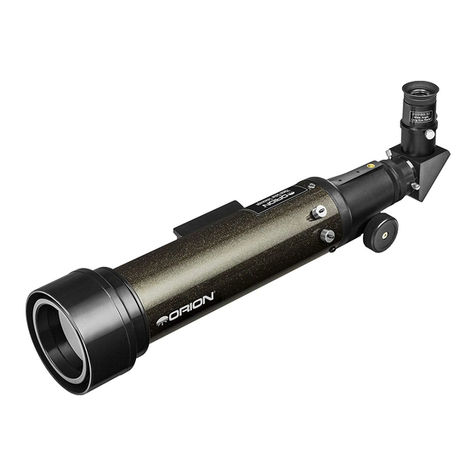
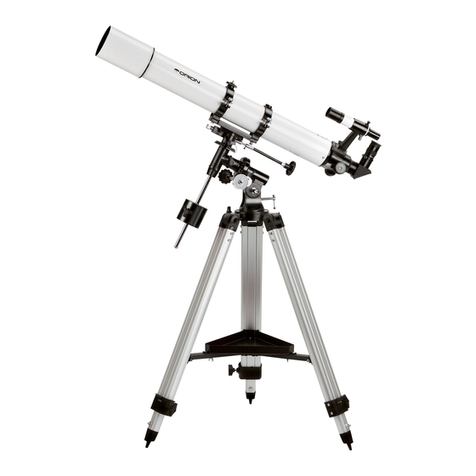
objects with your Explorer 90 AZ telescope, including:
The Moon
With its rocky, cratered surface, the Moon is one of the easi-
est and most interesting targets to view with your telescope.
The best time to observe our one and only natural satellite is
during a partial phase, that is, when the Moon is NOT full.
During partial phases, shadows on the surface reveal more
detail, especially right along the border between the dark and
light portions of the disk (called the “terminator”). A full Moon
is too bright and devoid of surface shadows to yield a pleas-
ing view. Use a Moon Filter to dim the Moon for a better view.
The filter simply threads on to the bottom of the eyepiece.
The Planets
The planets don’t stay put like the stars, so to find them you
should refer to Sky Calendar at our website (www.tele-
scope.com), or to charts published monthly in Astronomy,
Sky & Telescope, or other astronomy magazines. Venus,
Mars, Jupiter, and Saturn are the brightest objects in the
sky after the Sun and the Moon.Your Explorer 90 is capable
of showing you these planets in some detail. Other planets
may be visible but will likely appear starlike. Because plan-
ets are quite small in apparent size, optional higher-power
eyepieces are recommended and often needed for detailed
observations. Not all the planets are usually visible at any
one time.
JUPITER The largest planet, Jupiter, is a great subject to
observe.You can see the disk of the giant planet and watch
the ever-changing positions of its four largest moons, Io,
Callisto, Europa, and Ganymede. If atmospheric conditions
are good, you may be able to resolve thin cloud bands on
the planet’s disk.
SATURN The ringed planet is a breathtaking sight when it is
well positioned.The tilt angle of the rings varies over a peri-
od of many years; sometimes they are seen edge-on, while
at other times they are broadside and look like giant “ears”
on each side of Saturn’s disk. A steady atmosphere (good
seeing) is necessary for a good view. You may see a tiny,
bright “star” close by;that’s Saturn’s brightest moon, Titan.
VENUS At its brightest, Venus is the most luminous object
in the sky, excluding the Sun and the Moon. It is so bright
that sometimes it is visible to the naked eye during full day-
light! Ironically, Venus appears as a thin crescent, not a full
disk, when at its peak brightness. Because it is so close to
the Sun, it never wanders too far from the morning or
evening horizon. No surface markings can be seen on
Venus, which is always shrouded in dense clouds.
MARS If atmospheric conditions are good, you may be able
to see some subtle surface detail on the Red Planet, possi-
bly even the polar ice cap. Mars makes a close approach to
Earth every two years; during those approaches its disk is
larger and thus more favorable for viewing.
Stars
Stars will appear like twinkling points of light in the tele-
scope. Even powerful telescopes cannot magnify stars to
appear as more than points of light!You can, however, enjoy
the different colors of the stars and locate many pretty dou-
ble and multiple stars. The famous “Double-Double” in the
constellation Lyra and the gorgeous two-color double star
Albireo in Cygnus are favorites. Defocusing the image of a
star slightly can help bring out its color.
Deep-Sky Objects
Under dark skies, you can observe a wealth of fascinating
deep-sky objects, including gaseous nebulas, open and
globular star clusters, and some of the brighter galaxies.
Most deep-sky objects are very faint, so it is important that
you find an observing site well away from light pollution.
Take plenty of time to let your eyes adjust to the darkness.
Don’t expect these subjects to appear like the photographs
you see in books and magazines; most will look like dim
gray smudges. (Our eyes are not sensitive enough to see
color in such faint objects.) But as you become more experi-
enced and your observing skills get sharper, you will be
able to ferret out more and more subtle details.