IMPORTANT SAFETY INSTRUCTIONS
3
TM
11. Check all nuts and bolts regularly to ensure that the ladder stays sturdy.
12. Please contact pool site dealer or manufacturer for additional safety signs if deemed necessary.
13. For pool service, choose a certified pool professional. For additional safety information, see www.APSP.org
Consumer Awareness Booklets and Information Source
CONTACT: U.S. Consumer Product Safety Commission at www.cpsc.gov/safety-education/safety-guides/pools-and-spas, Pub. #362 “Safety Barrier
Guidelines for Home Pools.”
1. The Sensible Way to Enjoy Your Above-ground/On-ground Swimming Pool.
2. Children Aren’t Waterproof.
3. Layers of Protection.
4. Pool and Spa Emergency Procedures for Infants and Children.
5. Be Safety Aware Copies of the above brochures are available free from the APSP. Go to: www.APSP.org
Safety Education Programs and Materials
Educational programs and materials (i.e., seminars, workshops, brochures, videos, instructional guides) are available from the APSP, other aquatic safety groups,
and from private firms. As a means of communicating useful safety information to pool owners/operators and users, industry members are permitted to provide such
information to owners/operators and to request or require owners/operators to sign a statement that they have received, read, and will follow the guidelines.
Other sources of safety information:
• www.healthycanadians.gc.ca
• www.poolcouncil.ca
• www.toronto.ca/health
ANSI American National Standards Institute
25 West 43rd Street, New York NY 10036
Contact: 212-642-4900
www.ansi.org
APSP Association of Pool & Spa Professionals
(formerly National Spa and Pool Institute)
2111 Eisenhower Avenue, Alexandria VA 22314
Contact: 703-838-0083
www.apsp.org/164/index.aspx.
NSPI National Spa and Pool Institute (ss APSP)
UL Underwriters Laboratories
333 Pfingsten Road, Northbrook IL 60062-2096
Contact: 847-272-8800
www.ul.com
Filtration Systems
Any equipment connected to the circulation systems shall be positioned so as to prevent their being used as a means of access to the pool by young children.
(See the latest published edition of ANSI/ APSP-8 Model Barrier Code for Residential Swimming Pools, Spas, and Hot Tubs.)
Barriers
Barriers are necessary to provide protection against potential drowning and near drowning, and barriers are not a substitute for the constant supervision of children.
(See latest published edition of ANSI/APSP-8 Model Barrier Code for Residential Swimming Pools, Spas, and Hot Tubs.)
Risk of Drowning, Entrapment, and Diving Accidents
Publications are available that describe the risk of drowning, entrapment, and diving accidents. Available publications related to pool safety include the Association of
Pool and Spa Professionals’ (APSP) booklets entitled: The Sensible Way to Enjoy Your Above-ground/On-ground Swimming Pool, Children Aren’t Waterproof, Pool
and Spa Emergency Procedures for Infants and Children, Layers of Protection, and the latest published edition of ANSI/APSP-8 Model Barrier Code for Residential
Swimming Pools, Spas, and Hot Tubs.
Installer Responsibilities
All of these components shall be positioned so as to prevent their being used as a means of access to the pool by young children.
All safety signs shall be affixed above the water line according to manufacturer’s instructions.
(See the latest published edition of ANSI/APSP-8 Model Barrier Code for Residential Swimming Pools, Spas, and Hot Tubs.)
Safety Care for Children
Risk of Drowning:
1. Assign an adult to be responsible for watching children in the pool. Give this person a “water watcher” tag and ask that they wear it the entire time they are in
charge of supervising children in the pool. If they need to leave for any reason, ask this person to pass the “water watcher” tag and the supervision
responsibility to another adult.
2. The pool presents a drowning hazard even during filling and draining of the pool. Maintain constant supervision of children and do not remove any safety barriers
until the pool is completely empty and stowed away.
3. Children, especially children younger than five years, are at high risk of drowning. Drowning occurs silently and quickly and can occur in as little as 2” (5 cm) of water.
4. Keep children in your direct sight, stay close, and actively supervise them when they are in or near the pool and when you are filling and emptying the pool.
5. When searching for a missing child, check the pool first, even if the child is thought to be in the house.
6. Do not leave toys inside the pool when when no longer in use, as toys and similar items might attract a child to the pool. Position furniture (for example, tables,
chairs) away from pool, so that children cannot climb on it to gain access to the pool. After using the pool, remove water to a level of 1/2” (1 cm) or less.
7. Locate pumps and filters in such a way that children cannot climb on them and gain access to the pool.
Swimming Pool Barriers
Very Important:
1. Swimming pool barriers, which restrict access to the pool by small children, may be required by law. A barrier is necessary to provide protection against potential
drowning and near drowning. Barriers are not a substitute for constant supervision of children.
2. Keep unsupervised children from accessing the pool by installing fencing or other approved barriers around all sides of pool. Provincial or local laws or codes may
require fencing or other approved barriers. Check provincial or local laws and codes before setting up pool.
3. See latest published edition of CPSC Pub. No. 362 found at www.poolsafely.gov.
Swimming Pool Equipment
1. The use of artificial pool lighting is at the discretion of the pool owner. Lighting, when installed, should be in accordance with the Canadian Electrical Code and in
consultation with a licensed electrical professional.
2. Keep all electrical lines, radios, speakers, and other electrical appliances away from the pool.
3. Do not place pool near or under overhead electrical lines.
4. All electrical components installed in and/or adjacent to an above-ground/on-ground residential swimming pool must be installed in accordance with and shall
comply with the requirements of the Canadian Electrical Code, and any provincial or local code.
Swimming Pool Awareness
Warning:
1. ADULT ASSEMBLY REQUIRED: This pool may contain potentially hazardous sharp edges, sharp points, or small parts.
2. Do not install the pool on a slope or inclined surfaces, on soft or loose soil conditions (such as sand or mud), or on an elevated surface such as a deck, platform
or balcony. It may collapse under the weight of the filled pool.
3. TO AVOID DANGER OF SUFFOCATION: Keep the plastic bag used in this product away from babies and children; do not use the bag in cribs, beds, carriages,
or playpens. The plastic bag could block the nose and mouth and prevent breathing. The plastic bag is not a toy.
4. If a drain or suction outlet cover is missing or broken, do not use the pool. Suction can cause body part entrapment, hair and jewellery entanglement, or drowning.
Repair or replace the drain or suction outlet cover before using the pool again
5. When using the pool at night, artificial lighting should be used to illuminate all safety signs, ladders, steps, deck surfaces, and pathways.
6. The floor of the pool shall be visible at all times from the outside perimeter of the pool.
7. Keep your pool clean and clear. The deepest part of pool must be visible at all times from outside of the pool.
8. Call for emergency if needed.
9. Basic lifesaving equipment, including one of the following, should be on hand at all times:
• A light, strong, rigid pole (shepherd’s crook) not less than 12’ [3.66 m] long.
• A ¼” [6.35 mm] diameter rope as long as one and one half (1 ½) times the maximum width of the pool or 50’ [15.24 m], whichever is less, which has been firmly
attached to a Coast Guard-approved ring buoy having an outside diameter of approximately 15” [38.1 cm], or similarly approved flotation device.
10. Never allow fooling around, diving, or jumping into or around the pool. This could lead to serious injury, paralysis or death.
DO NOT ALLOW anyone to swim alone without supervision.
According to the International Standard, IEC 60364-7-702, on electrical installation of swimming pools and other basin equipment, the following installation distances
must be respected:
The filter pump must be positioned more than 6’ (2 m) away from the pool walls.
The power cord plug to the 100-120 V electrical power source of the filter pump must be positioned more than 12’ (3.66 m) away from the pool walls.
Check with your local authority to determine the appropriate standard and requirements for “electrical installation of swimming pools and basin equipment”.
The following table is for reference only:
Circulation Systems
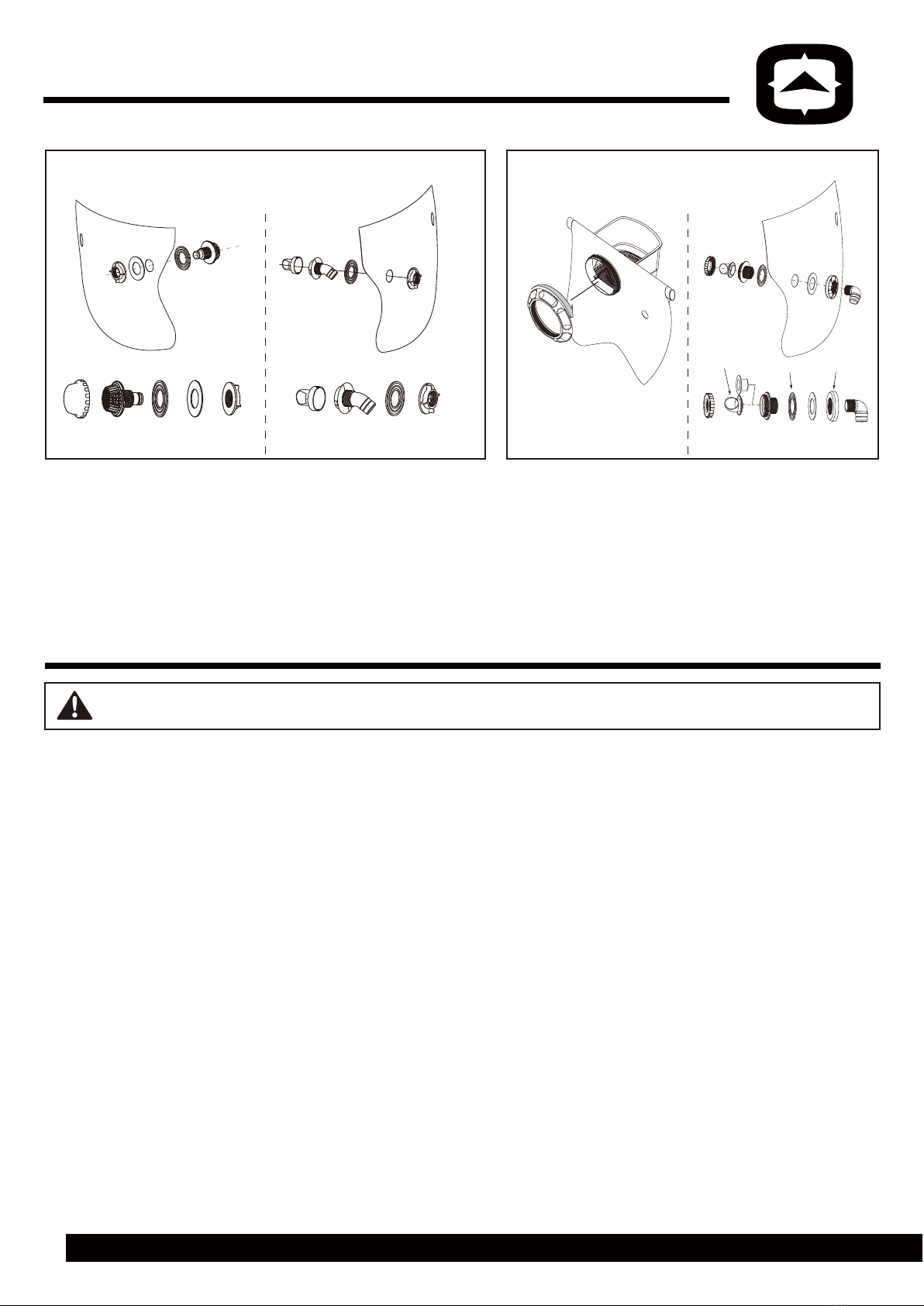
1. Follow written instructions regarding positioning of all equipment connected to the circulation systems and operating the components.
2. Circulation equipment should be installed per manufacturer’s instructions to provide proper mounting and support, to prevent damage from misalignment,
settlement, and vibration, and to minimise the potential for the accumulation of debris and moisture. Please refer to pump’s instruction manual.
3. A replacement pump should never exceed the maximum flow rate marked on the suction fitting.
Ladder
1. The ladder should be located on a solid base and is to be installed per the manufacturer’s instructions.
2. One person on the ladder at a time.
3. This ladder is designed and manufactured for a specific pool wall height and/or deck of the pool.
4. When entering/exiting the pool, face the ladder at all times.
5. To prevent entrapment or drowning do not swim through, behind, or around the ladder.
6. Remove and secure the ladder when pool is not occupied.
Pool Cover
Pool covers used for safety barriers shall comply with the latest published edition of ASTM F-1346, Standard performance specifications for safety covers and
labeling requirements for all covers for swimming pools, spas, and hot tubs.
Chemicals
For safety’s sake, ensure the deepest part of the pool is always visible. The user must properly maintain pool water clarity at all times. Check the pH and chlorine
levels periodically, and make sure they are within the recommended limits. Additional water treatment chemicals might be needed from time to time. Have the water
sample tested by a local pool supply store to determine if additional chemicals are needed. Turn on the pump for the recommended hours daily. Clean and replace
filter cartridge frequently. Replace only with genuine OutboundTM Brand filter cartridges. Refer to the Filter Pump manual for additional water care information.
Risk of Entrapment
1. Entrapment Avoidance: There shall be no protrusions or obstructions in the swimming area, which may cause entrapment or entanglement of the user.
If a suction outlet cover is missing or broken, do not use the pool. Suction can cause body part entrapment, hair and jewellery entanglement, evisceration, or drowning.
Repair or replace the suction outlet cover before allowing the pool to be used.
2. Never play or swim near drains or suction fittings. Your body or hair may be trapped, causing permanent injury or drowning.
Risk of Drowning
1. Keep unsupervised children from accessing the pool by installing fencing or other approved barriers around all sides of pool. Provincial or local laws or codes may
require fencing or other approved barriers. Check provincial or local laws and codes before setting up the pool.
2. Remove pool ladders after leaving the pool.
3. Toys, chairs, tables, or similar objects that a young child could climb should be at least four 4’ [1.22 m] from the pool. The pump filter system should be positioned
so as to prevent it from being used as a means of access to the pool by young children.
Diving Risk
1. Above-ground/on-ground residential swimming pools are for swimming and wading only. No diving boards, slides, or other equipment are to be added to an
above-ground/on-ground pool.
2. Do not dive into this pool. Diving into shallow water can result in a broken neck, paralysis, or death.
Risk of Electrocution
1. Keep all electrical lines, radios, speakers, and other electrical appliances away from the pool.
2. Do not place the pool near or under overhead electrical lines.
First Aid
1. Keep a working phone and a list of emergency numbers near the pool.
2. Become certified in cardiopulmonary resuscitation (CPR). In the event of an emergency, immediate use of CPR can make a lifesaving difference.
Special Warning
1. Local building codes may require obtaining a building or electrical permit. The installer shall follow regulations on setback, barriers, devices, and other conditions.
2. Safety signs shall comply with requirements of ANSI-Z535 and use signal wording.
3. DO NOT attempt to assemble this pool in adverse weather conditions, windy conditions, or when the temperature is below 15.5°C (60°F).
4. This is a storable pool, which should be disassembled and stored when temperatures are expected to fall below 0°C (32°F).
5. Ensure that all pools and their related components that are installed in an indoor environment comply with the ventilation requirements of ANSI/ASHRAE 62 or the
latest published edition of “Ventilation for acceptable indoor air quality”, Table 2, Article 2.1.
6. The placement of the pool and portable pools shall be set up so that they comply with local safety and building codes.
Pool Maintenance
1. Empty pool completely after each use, and store the empty pool in such a way that it does not collect water from rain or any other source.
2. After using pool, remove water to a level of 1/2” (1 cm) or less.
Extra Safety Warning
1. When you touch the filter, pump, or electrical parts, be sure the ground under your feet is “Bone Dry.”
2. Connect power cords to a 3-wire grounding-type outlet only.
3. Keep all breakable objects out of the pool area.
4. Alcohol consumption and pool activities do not mix. Never allow anyone to swim, dive, or slide under the influence of alcohol or drugs.
5. Severe electrical shock could result if you install your pump or filter on a deck. The pump or filter could fall into the water, causing severe shock or electrocution.
6. Do not allow roughhousing and fooling around.
7. Do not engage in extended breath holding activities underwater; you may black out and drown.
8. Install pool ladder(s) or a staircase for entry into and exit from the pool.
9. Check regularly for signs of wear or loose bolts that could make the pool unsafe.
10. Instruct pool users about the proper use of all pool ladder(s) and staircases.
WARNING
IMPORTANT SAFETY INSTRUCTIONS
When installing and using this product, basic safety precautions should always be followed, including the following:
READ AND FOLLOW ALL INFORMATION AND INSTRUCTIONS
Keep for future reference. Failure to follow these warnings and instructions can result in serious injury or death to users, especially children.
NOTICE: CUSTOMERS WHO PURCHASE POOLS MAY BE REQUIRED BY LOCAL OR STATE LAW TO INCUR ADDITIONAL EXPENSES
WHEN INSTALLING A POOL, IN ORDER TO COMPLY WITH PROVINCIAL OR LOCAL LAWS REGARDING FENCING AND OTHER SAFETY
REQUIREMENTS. CUSTOMERS SHOULD CONTACT THEIR LOCAL BUILDING CODE ENFORCEMENT OFFICE FOR FURTHER DETAILS.
TRILEAF DISTRIBUTION IS NOT RESPONSIBLE FOR ANY ADDITIONAL EXPENSES THAT YOU MAY INCUR.
DO NOT SIT ON
OR LAY OVER
POOL WALL
YOU CAN BE PERMANENTLY
INJURED.
WARNING
AVOID ENTRAPMENT!
STAY AWAY FROM DRAINS & SUCTION
FITTINGS.
YOUR HAIR, BODY & JEWELLERY
CAN GET SUCKED INTO DRAIN.
YOU COULD
BE HELD UNDER WATER & DROWN. DO NOT
USE POOL IF DRAIN OR SUCTION OUTLET
COVER IS MISSING OR BROKEN.
DANGER
PREVENT DROWNING!
WATCH CHILDREN WHO ARE IN OR
NEAR THIS POOL CLOSELY. CHILDREN
UNDER 5 ARE AT HIGHEST RISK OF
DROWNING. EMPTY POOL OR PREVENT
ACCESS WHEN NOT IN USE.
NO DIVING!
SHALLOW WATER.
YOU CAN BREAK
YOUR NECK AND BE
PARALYSED.
• Set up the pool only on LEVEL, STABLE, and COMPACT soil.
• DO NOT set up the pool on sand.
• Excessive sand inside the pool will DAMAGE the pool liner and filtration system.
Failure to follow these instructions will void the warranty.