Before you start
To achieve the best possible result when ironing, the laundry shall
be lightly moist. Never iron textiles with buttons, zippers etc.
Start
Make sure that the power switch is on. Decide which type of
ironing method to use by consulting the section “ Cold ironing
techniques”
Flip down the manoeuvre shield and let the moving rollers grab
your textiles. Keep the textiles and the iron cloth tensioned
during the complete process.
In you want to pause the process flip the manoeuvre shield up
to the position Stop.
When the complete textile is fed into the rollers, let the cold
ironer work for 2-3 minutes (skip this step when ironing using
the technique “Ironing without iron cloth”).
Stop
Flip the manoeuvre shield up to the horizontal position to make
the rollers stop. This stop function should not be confused
with the finger protection function.
Reverse/release
When the manoeuvre shield is flipped to the position,
Reverse/release the cold ironer reverse. After a few seconds the
rollers separate, and the textiles can easily be taken out.
When you are finished
Always leave the iron cloth to dry freely in the collecting tray
under the feeding table.
Leave the manoeuvre shield in the horizontal position, Stop.
Turn off the power switch.
Cold ironing techniques
There are several techniques to use when cold ironing. In the
section below we present the most common techniques.
Cold ironing on the inside of the iron cloth
Napkins, towels and other small to normal sized textiles are
ironed inside the iron cloth. The iron cloth is pulled out entirely.
Place the textile on the iron cloth, close to the rollers. Flip the
manoeuvre shield down to the position, Start/forward. Feed the
textile into the iron cloth, evenly. Iron the textile for 2-3 minutes.
Cold ironing on the outside of the iron cloth
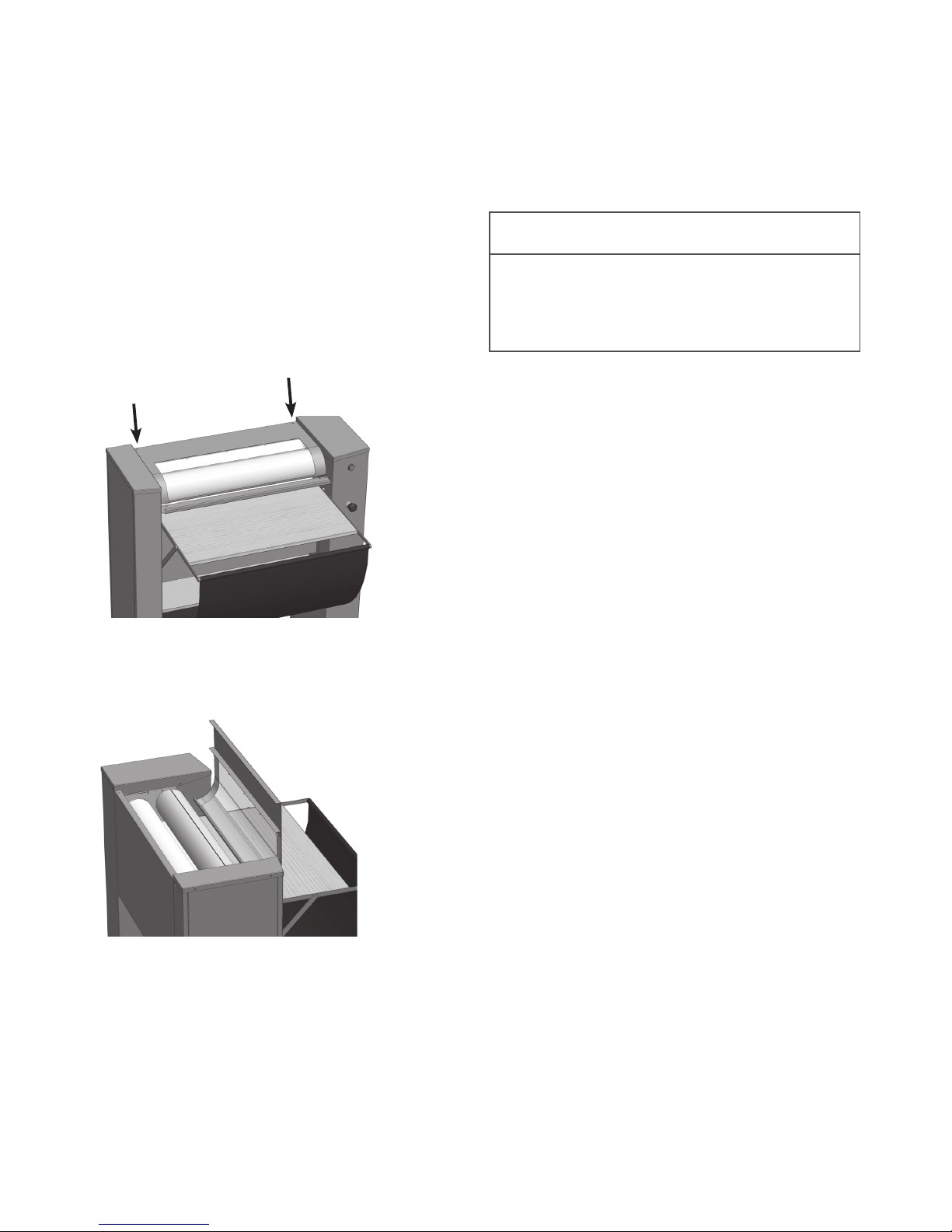
Larger textiles such as bed linens, table cloths etc. are ironed on
the outside of both roller and iron cloth. The iron cloth should be
wrapped around the roller. Make sure that the iron cloth is fed
onto the roller evenly. Leave a few decimeters of iron cloth out,
to attach the textile to be ironed. Place the textile directly on the
iron cloth that is sticking out. Flip the manoeuvre shield down to
the position, Start/forward. The top part of the textile is fed into
the iron cloth and the rest of the textile wraps around the outside
of the rollers. Pull gently on the textile to reduce wrinkles.
Cold ironing without the iron cloth
Very large textiles should be ironed with the iron cloth com-
pletely wrapped around the rollers. Place the textile between
the roller with the iron cloth and the aluminium roller below. The
textile is ironed and falls down into the collecting tray under the
feeding table. Repeat the procedure until satisfaction.
If the cold ironer stops
The cold ironer stops if it is overloaded. Follow the instructions
below; if the cold ironer stops during the process of ironing or if
the rollers does not move when using the manoeuvre shield.
• The cold ironer is equipped with an input stop. When the rollers
are overloaded with textiles, the cold ironer stops. Flip up
the manoeuvre shield to the position, Reverse/release.
Remove the textiles by hand. Iron less textiles or change iron-
ing technique and try again.
• If what stated above does not work, the motor might be over-
loaded. This occurs when too heavy textiles are fed into the
rollers. To reset the motor overload protection, push the blue
button on the right side of the ironer.
• If none of the above works. Check the emergency stop.
Reset the emergency stop by turning the handle clock-wise.
WARNING
Do not reach for or touch the rollers when they are mov-
ing or when they are stopped. - Risk for severe squeezing.
Do not allow children to play on or around the cold ironer.
DO NOT bypass any safety devices.
REVERSE
STOP
FORWARD
STOP