Ronix 3231V User manual

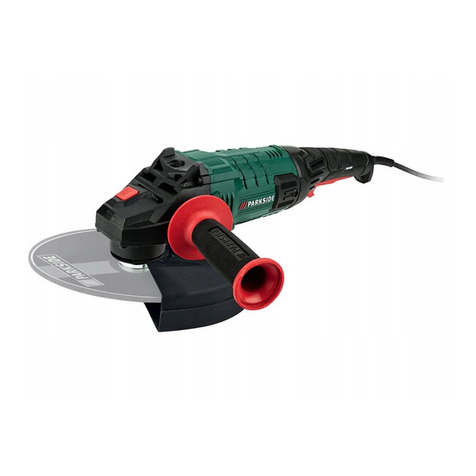
ANGLE GRINDER
3231V

USER MANUAL 3
SPECIFICATION
Model 3231V
Power 2400W
Voltage 220V
Frequency 60Hz
No load speed 8000RPM
Disc Diameter 180mm
Net weight 5.2Kg
Accessories
Side handle, wheel
guard 180mm, 1pair
carbon brush
PARTS LIST

ANGLE GRINDER
4
GENERAL POWER TOOL SAFETY WARNINGS
WARNING!
- Read all safety warnings and all instructions. Failure to follow
the warnings and instructions may result in electric shock, re
and or serious injury.
- Save all warnings and instructions for future reference.
- The term “power tool” in the warnings refers to your mains-
operated (corded) power tools or battery operated (Cordless)
Power tools.
.WORK AREA SAFETY
- Keep work area clean and well lit. Cluttered or dark areas invite
accidents.
- Don’t operate power tools in explosive atmospheres, such as
in the presence of ammable liquids, gases or dust. Power tools
create sparks which may ignite the dust or fumes.
- Keep children and bystanders away while operating a power
tool. Distractions can cause you to lose control.
.ELECTRIC SAFETY
- Power tool plugs must match the outlet. Never modify the plug
in any way. Don’t use any adaptor plugs with earthed (grounded)
power tools. Unmodied plugs and matching outlets will reduce
risk of electric shock.
- Avoid body contact with earthed or grounded surfaces such as
pipe, radiators, ranges and refrigerators. There is an increased
risk of electric shock if your body is earthed or grounded.
- Don’t expose power tools to rain or wet conditions. Water
entering a power tool will increase the risk of electric shock.
- Don’t abuse the cord. Never use the cord for carrying, pulling

USER MANUAL 5
or unplugging the power tool. Keep cord away from heat, oil,
sharp edges or moving parts. Damaged or entangled cords
increased the risk of electric shock.
- When operating a power tool outdoors, use an extension cord
suitable for outdoor use. Using a cord suitable for outdoor use
will reduce the risk of electric shock.
- If operating a power tool in a damp location is unavoidable,
use a residual current device (RCD) protected supply. Use of
an RCD reduces the risk of electric shock.
- Use of power supply via a RCD with a rated residual current of
30mA or less is always recommended.
.PERSONAL SAFETY
- Stay alert, watch what you are doing and use common sense
when operating a power tool. Don’t use a power tool while you
are tired or under the inuence of drugs, alcohol or medication.
A moment of inattention while operating power tools may result
in serious personal injury.
- Use personal protective equipment. Always wear eye protection.
Protective equipment such as dust mask, non-skid safety shoes,
hard hat, or hearing protection used for appropriate conditions
will reduce personal injuries.
- Prevent unintentional starting. Ensure the switch is in the
off-position before connecting to power source and/or battery
pack, picking up or carrying the tool. Carrying power tools with
your nger on the switch or energizing power tools that have the
switch on invites accidents.
- Remove any adjusting key or wrench before turning the power
tool on. A wrench or a key left attached to a rotating part of the
power tool may result in personal injury.
- Don’t overreach. Keep proper footing and balance at all times. This

ANGLE GRINDER
6
enables better control of the power tool in unexpected situations.
- Dress properly. Don’t wear loose clothing or jewelry. Keep
your hair, clothing, and gloves away from moving parts. Loose
cloths, jewelry or long hair can be caught in moving parts.
- If devices are provided for connection of dust extraction and
collection facilities, ensure these are connected and properly
used. Use of dust collection can reduce dust-related hazards.
POWER TOOL USE AND CARE
- Don’t force the power tool. Use the correct power tool for your
application. The correct power tool will do the job better and
safer at the rate for which it was designed.
- Don’t use the power tool if the switch doesn’t turn it on and
off. Any power tool that cannot be controlled with the switch is
dangerous and must be repaired.
- Disconnect the plug from the power source and/or the battery
pack from the power tool before making any adjustments,
changing accessories, or storing power tools. Such preventive
safety measures reduce the risk of starting the power tool
accidentally.
- Store idle power tools out of the reach of children and don’t
allow persons unfamiliar with power tool or these instructions to
operate the power tool. Power tools are dangerous in the hand
s of untrained users.
- Maintain power tools. Check for misalignment or binding of
moving parts, breakage o parts and any other condition that
may affect the power tool’s operation. If damaged, have the
power tool repaired before use. Many accidents are caused by
poorly maintained power tools.
- Keep cutting tools sharp and clean. Properly maintained cutting

USER MANUAL 7
tools with sharp cutting edges are less likely to bind and are
easier to control.
- Use the power tool, accessories and tool bits etc. in accordance
with the instruction, taking into account the working conditions
and the work to be performed. Use of the power tool for operations
different from those intended could result in a hazardous situation.
SERVICE
- Have your power tool serviced by qualied repair person using
only identical replacement parts. This will ensure that the safety
of power tool is maintained.
- Follow instruction for lubricating and changing accessories.
- Keep handles dry, clean and free from oil and grease.
SPECIFIC SAFETY RULES
- Always use proper guard with grinding wheel. A guard protects
operator from broken wheel fragments.
- Accessories must be rated for at least the speed recommended
on the tool warning label. Wheels and other accessories running
over rated speed can y apart and cause injury.
- Hold tool by insulated gripping surfaces when performing an
operation where the grinding tool may contact hidden wiring or
its own cord. Contact with a “live” wire will make exposed metal
parts of the tool “live” and shock the operator.
- When using depressed center grinding wheels, be sure to use
only berglass-reinforced wheels.
- Always use safety glasses or goggles. Ordinary eye or sun
glasses are NOT safety glasses.
- Check the wheel carefully for cracks or damage before operation.

ANGLE GRINDER
8
Replace cracked or damaged wheel immediately. Run the tool
(with guard) at no load for about a minute, holding tool away from
others. If wheel is awed, it will likely separate during this test.
- Use only anges specied for this tool.
- Be careful not to damage the spindle, the ange (especially
installing surface) and the lock nut. Damage to these parts
could result in wheel breakage.
- NEVER use tool with wood cutting blades or other saw blades.
Such blades when used on a grinder frequently kick and cause
loss of control leading to personal injury.
- Hold the tool rmly.
- Keep hands away from rotating parts.
- Make sure cord is clear of wheel. Do not wrap cord around
your arm or wrist. If control of tool is lost, cord may become
wrapped around you and cause personal injury.
- Make sure the wheel is not contacting the work piece before
the switch is turned on.
- Before using the tool on an actual work piece, let it run for a
while. Watch for vibration or wobbling that could indicate poor
installation or a poorly balanced wheel.
- Use the specied surface of the wheel to perform the grinding.
- Watch out for ying sparks. Hold the tool so that sparks y
away from you and other persons or ammable materials.
- Do not leave the tool running. Operate the tool only when
hand-held.
- Do not touch the work piece immediately after operation; it
may be extremely hot and could burn your skin.
- ALWAYS wear proper apparel including long sleeve shirts,
leather gloves and shop aprons to protect skin from contact with
hot grindings.
- Use of this tool to grind or sand some products, paints and

USER MANUAL 9
wood could expose user to dust containing hazardous substances.
Use appropriate respiratory protection.
WARNING!
MISUSE or failure to follow the safety rules stated in this instruction
manual may cause serious personal injury.
FUNCTIONAL DESCRIPTION
CAUTION:
Always be sure that the tool is switched off and unplugged before
adjusting or checking function on the tool.
.SHAFT LOCK
CAUTION:
- Never actuate the shaft lock when the spindle is moving. Or
the tool may be damaged.
- Press the shaft lock to prevent spindle rotation when installing
or removing accessories.

ANGLE GRINDER
10
ASSEMBLY
CAUTION:
Always be sure that the tool is switched off and unplugged
before carrying out any work on the tool.
.INSTALLING SIDE GRIP (HANDLE)
CAUTION:
- Always be sure that the side grip is installed securely before
operation.
- Screw the side grip securely on the position of the tool as
shown in the gure.
.INSTALLING OR REMOVING WHEEL GUARD
CAUTION:
- When using a depressed center grinding wheel/Multi-disc, ex
wheel, wire wheel brush, cut-off wheel or diamond wheel, the
wheel guard must be tted on the tool so that the closed side of
the guard always points toward the operator.
- Mount the wheel guard with the protrusion on the wheel guard
band aligned with the notch on the bearing box. Then rotate the
wheel guard around 180 degrees. Be sure to tighten the screw
securely.

USER MANUAL 11
- To remove wheel guard, follow the installation procedure in
reverse.
.INSTALLING OR REMOVING DEPRESSED CENTER GRINDING
WHEEL/MULTI-DISC
WARNING!
- Always use supplied guard when depressed center grinding
wheel/Multi-disc is on tool. Wheel can shatter during use and
guard helps to reduce chances of personal injury.
- Mount the inner ange onto the spindle. Fit the wheel / disc on
the inner ange and screw the lock nut onto the spindle.
- To tighten the lock nut, press the shaft lock rmly so that the
spindle cannot revolve, then use the lock nut wrench and se-
curely tighten clockwise.
Lock nut
Depressed center grinding
wheel/Multi-disc
Inner nge
- To remove the wheel, follow the installation procedure in reverse.
OPERATION
WARNING!
- It should never be necessary to force the tool. The weight
Table of contents
Other Ronix Grinder manuals