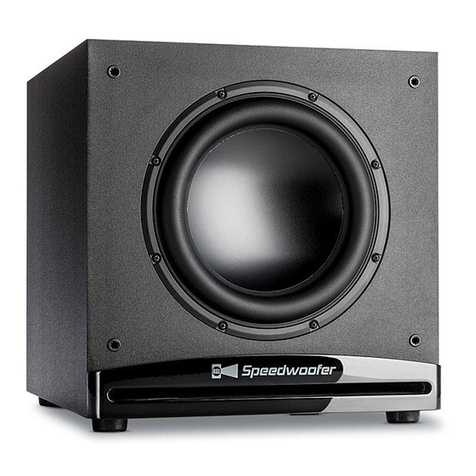
Power Indicator - When the LED is red, the Speedwoofer is in standby mode. Aer receiving a signal, the
LED turns green or blue (depending on version of Speedwoofer) and your subwoofer is in operaon
mode. No light means the sub isn't receiving power. Re-check the power switch and AC power connec-
on. For standby to funcon, the auto power switch must be set to on.
Wireless Pairing Switch - To use your Speedwoofer wirelessly, you'll need the oponal wireless trans-
mier. To pair the Speedwoofer, refer to the instrucons included with the transmier.
Volume - Controls the volume of bass output. During setup, we suggest seng the volume control near
the 12 o'clock posion. This allows maximum exibility if you need to perform ne volume adjustments
later. If you nd that you have to turn the volume up too high or down too low, refer to the setup in your
A/V receiver to adjust the its output level to the subwoofer.
Crossover-DSP Sengs – The crossover knob selects both the crossover frequency and also lets you
select from 2 DSP sound modes. If the knob is turned fully counterclockwise unl it clicks (LFE enabled),
the internal crossover of the Speedwoofer is bypassed and the crossover funcon will be handled by your
home theater receiver or processor. Also, with the Speedwoofer’s crossover bypassed, the DSP mode will
extend the Speedwoofer’s bass response. This is ideal for home theater.
If the knob is rotated clockwise o the bypass posion, the Speedwoofer’s crossover is acve, and you
can select the appropriate frequency. For example, an 80Hz seng means your Speedwoofer will handle
all frequencies at 80Hz and below. An 80Hz seng is recommended for larger bookshelf speakers. For
smaller bookshelf speakers, we recommend a seng of 90-100Hz. We also suggest listening with dier-
ent crossover sengs so the Speedwoofer integrates seamlessly with the rest of your system.
Also, with the internal crossover acve, the DSP will enable your Speedwoofer to deliver the same perfor-
mance as our original Speedwoofer 10S. This may be a good choice if you primarily listen to music or if
you wish to limit the bass that is transmied to other rooms. To use this mode with your home theater
receiver’s internal crossover also acve, turn the crossover knob fully clockwise. This will prevent the in-
ternal crossover from interfering with your home theater receiver’s crossover.
Phase - Allows you to slightly delay the bass through the subwoofer, which can help the subwoofer blend
perfectly with the rest of your system. The bass should sound like it’s coming from your front speakers
instead of a separate subwoofer. The standard seng is 0 degrees, but feel free to experiment.
Auto Power - In the auto power on posion, the Speedwoofer will remain in standby mode unl it re-
ceives an audio signal. The power indicator will change from red to green and the Speedwoofer is in oper-
aon mode. In the auto power o posion, the Speedwoofer will always stay in operaon mode, which
will not harm the subwoofer.
Line In/LFE In - LFE stands for low frequency eects. For home theater, use a single RCA cable from the
receiver's subwoofer or LFE out to the Speedwoofer's LFE in. For a 2 channel system, use a stereo pair of
RCA cables to the Speedwoofer's line In le and right inputs.
Line Out - Can be used for 2 dierent purposes. For a 2 channel system, this can feed the signal back to
your stereo amplier for the other speakers. The line outs can also be used to connect an addional
Speedwoofer. See the Dual Speedwoofer secon.
Speaker Level In - This connecon can be used in stereo systems with ampliers that do not have pre-
amplier outputs. In this case, you can connect one set of speaker wires to your Speedwoofer and anoth-
er stereo set to your main speakers. Use the Speedwoofer’s internal crossover.
If you experience ground-loop hum, this is not the fault of the subwoofer. It is the result of dierences in
the ground characteriscs between dierent audio equipment. Fortunately, this is easy to x. Connect a
length of wire from your audio amplier’s ground to the Speedwoofer amplier’s ground. If your audio
amplier does not have a ground lug, then loosen a screw around the perimeter of the chassis. Wrap the
stripped end of the wire around the screw and re-ghten. The hum should vanish.
2