manuals.online logo
Brands
  1. Home
  2. •
  3. Brands
  4. •
  5. Sony
  6. •
  7. CD Player
  8. •
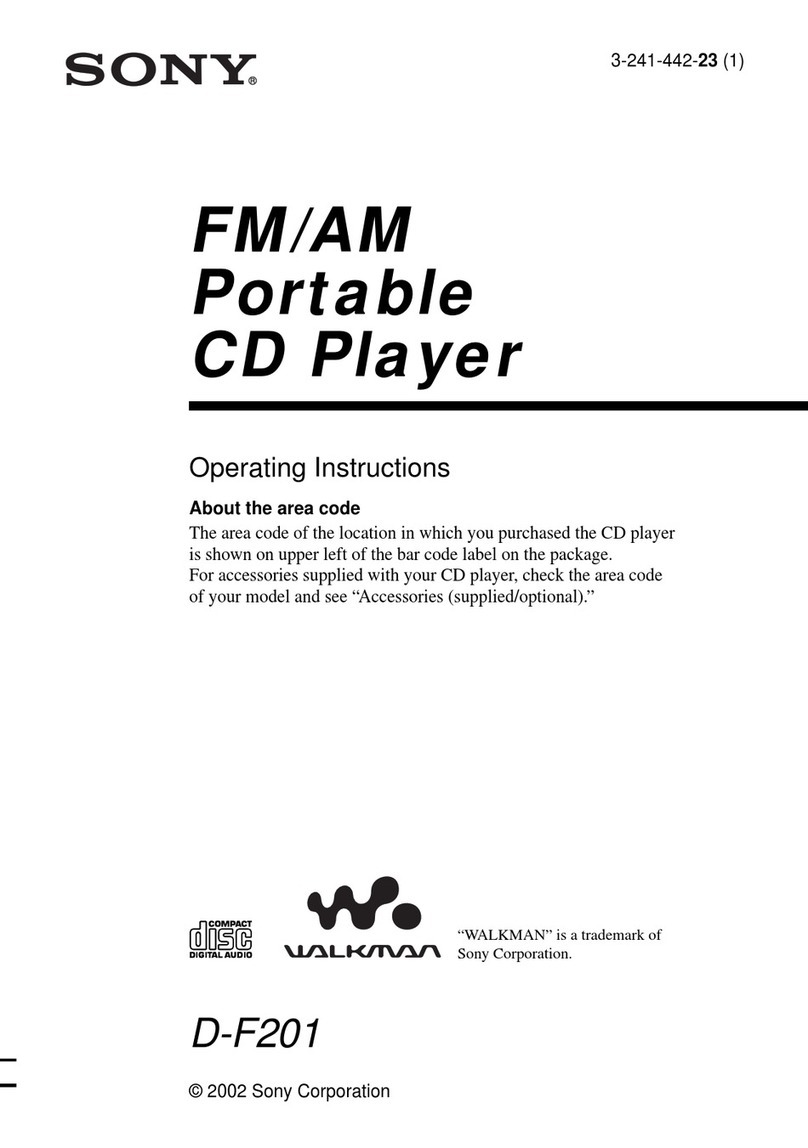
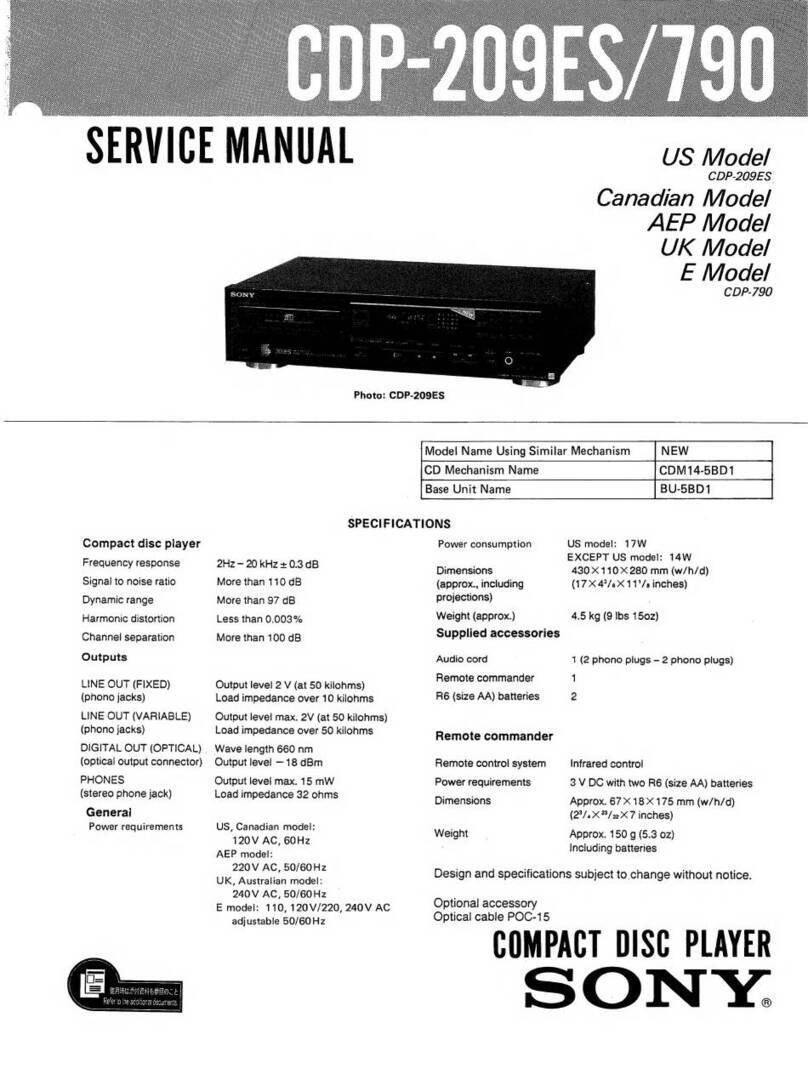
  9. Sony D-555 User manual

Sony D-555 User manual

Other manuals for D-555

1

This manual suits for next models

1

Other Sony CD Player manuals

Sony DVP-FX750 User manual

Sony

Sony DVP-FX750 User manual

Sony CD Walkman D-EG3 User manual

Sony

Sony CD Walkman D-EG3 User manual

Sony CDX-GT930UI - Fm/am Compact Disc Player User manual

Sony

Sony CDX-GT930UI - Fm/am Compact Disc Player User manual

Sony CD Walkman D-EJ611 User manual

Sony

Sony CD Walkman D-EJ611 User manual

Sony WX-GT80UI User manual

Sony

Sony WX-GT80UI User manual

Sony D-NE1 - Portable Cd Player User manual

Sony

Sony D-NE1 - Portable Cd Player User manual

Sony CDP-C745 User manual

Sony

Sony CDP-C745 User manual

Sony CFD-440 User manual

Sony

Sony CFD-440 User manual

Sony CDX-GT81UW - Usb Receiver User manual

Sony

Sony CDX-GT81UW - Usb Receiver User manual

Sony CDX-DAB500U User manual

Sony

Sony CDX-DAB500U User manual

Sony WALKMAN D-CJ01 User manual

Sony

Sony WALKMAN D-CJ01 User manual

Sony CFD-S20CP - Cd Radio Cassette-corder User manual

Sony

Sony CFD-S20CP - Cd Radio Cassette-corder User manual

Sony MZ-R55 User manual

Sony

Sony MZ-R55 User manual

Sony MZ-NH700 User manual

Sony

Sony MZ-NH700 User manual

Sony CDP-CX151 User manual

Sony

Sony CDP-CX151 User manual

Sony CDX-GT20W - Fm/am Compact Disc Player User manual

Sony

Sony CDX-GT20W - Fm/am Compact Disc Player User manual

Sony CDP-791 User manual

Sony

Sony CDP-791 User manual

Sony CDX-2180 User manual

Sony

Sony CDX-2180 User manual

Sony Walkman D-NE900 User manual

Sony

Sony Walkman D-NE900 User manual

Sony D-FJ737 User manual

Sony

Sony D-FJ737 User manual

Sony RC-BX30 User manual

Sony

Sony RC-BX30 User manual

Sony SCD-XA5400ES - Es Super Audio Cd Player User manual

Sony

Sony SCD-XA5400ES - Es Super Audio Cd Player User manual

Sony CDP-NW10 - Compact Disc Player User instructions

Sony

Sony CDP-NW10 - Compact Disc Player User instructions

Sony D-CS901 - Portable Cd Player User manual

Sony

Sony D-CS901 - Portable Cd Player User manual

Popular CD Player manuals by other brands

Philips AZ 8060 null

Philips

Philips AZ 8060 null

Philips CDR-775 null

Philips

Philips CDR-775 null

RCA RP-7923 instruction manual

RCA

RCA RP-7923 instruction manual

Pioneer DEH-P3550MP XM Operation manual

Pioneer

Pioneer DEH-P3550MP XM Operation manual

Philips CD582 user manual

Philips

Philips CD582 user manual

Philips AZ 6821 operating manual

Philips

Philips AZ 6821 operating manual

Lasonic MSU-2020 user manual

Lasonic

Lasonic MSU-2020 user manual

THOMSON RCD150 user manual

THOMSON

THOMSON RCD150 user manual

Denon DCD-1420 Service manual

Denon

Denon DCD-1420 Service manual

Panasonic SJ-MR100 operating instructions

Panasonic

Panasonic SJ-MR100 operating instructions

Onkyo DX-7210 instruction manual

Onkyo

Onkyo DX-7210 instruction manual

Denon DVM-4800 Service manual

Denon

Denon DVM-4800 Service manual

JBL MR-32 Operation manual

JBL

JBL MR-32 Operation manual

RCA RCD152 Specifications

RCA

RCA RCD152 Specifications

Technics SL-PS770A Service manual

Technics

Technics SL-PS770A Service manual

Clarion compact disc owner's manual

Clarion

Clarion compact disc owner's manual

Philips Expanium AZ 1538 user manual

Philips

Philips Expanium AZ 1538 user manual

Rotel RCD 975 owner's manual

Rotel

Rotel RCD 975 owner's manual

manuals.online logo
manuals.online logoBrands
  • About & Mission
  • Contact us
  • Privacy Policy
  • Terms and Conditions

Copyright 2025 Manuals.Online. All Rights Reserved.

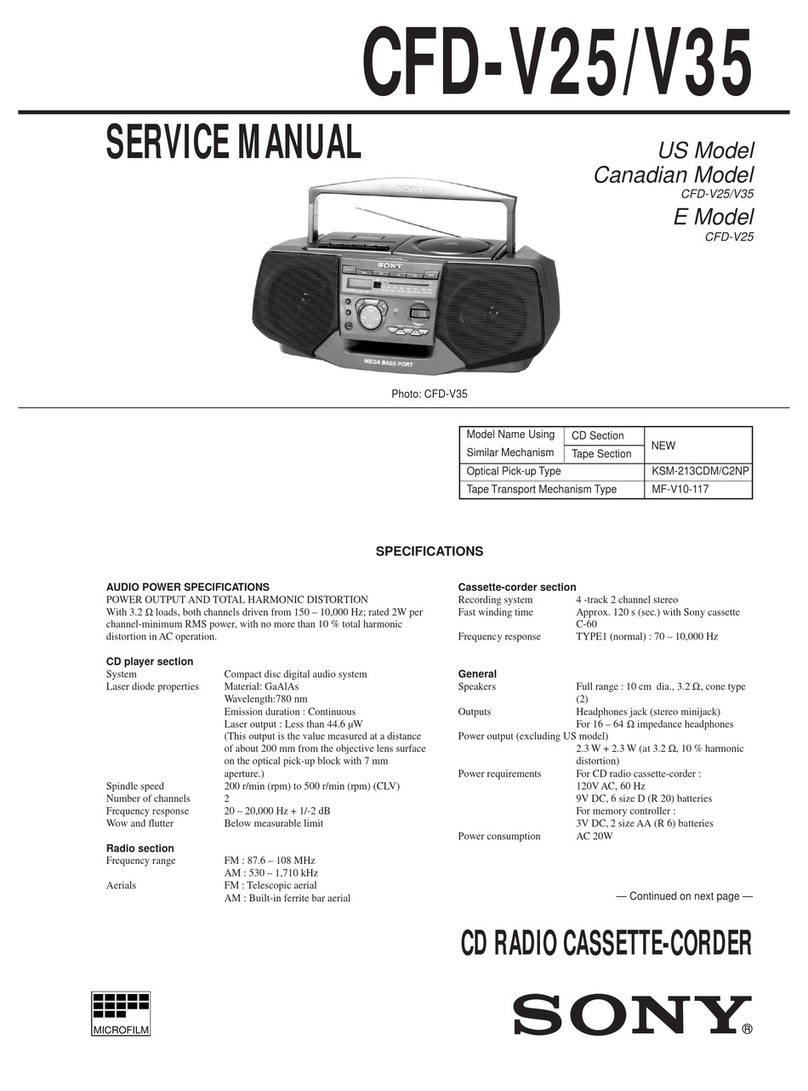
SERVICE
MANUAL
US
Model
D-555
AEP
Model
UK
Model
E
Model
D-2Z555
DISChan
D-=250
CDM-
555
Model
Name
Using
Similar
Mecanism
Tape
Transport
Mechanism
Type
SPECIFICATIONS
CD
section
General
System
Compact
disc
digital
audio
system
Power
requirements
Supplied
rechargeable
sei)
pack
(BP-2EX)
or
BP-100
(optional)
Laser
diode
properties
Material:
GaAlAs
Wavelength:
780
nm
Emission
duration:
Continuous
Laser
output:
Less
than
44.6
pW
This
output
is
the
value
measured
at
a
distance
of
200
mm
from
the
objective
lens
surface
on
the
Optical
Pick-up
Block.
Error
correction
Sony
Super
Strategy
Cross
Interleave
Reed
Solomon
Code
D-A
conversion
16-bit
linear,
8fs
digital
filter
Frequency
response
20
-
20,000
Hz
+1
dB*
Signal-to-noise
ratio
|
More
than
90
dB
Wow
and
flutter
Below
measurable
limit*
Outputs
(at
9
V
input
level)
Line
output
(stereo
minijack)
Output
level
0.7
V
rms
at
50
kilohms
Load
impedance
over
10
kilohms
Optical
digital
output
(optical
output
connector)
Output
level:
-21
—
-15
dBm
Wavelength:
630
—
690
nm
at
peak
level
Headphones
(stereo
minijack)
9
mW
+
9
mW
at
32
ohms
*
Measured
by
EIAJ
CP-307
MICROFILM
DC
IN
9
V
jack
accepts:
Supplied
AC
power
adaptor
for
use
on
120V
AC,
60
Hz
Sony
CPM-200P
car
mount
plate
(optional)
or
Sony
DCC-120A
car
battery
cord
(optional)
for
use
on
12
V
car
battery
Power
consumption
3,2
WDC
Dimension
Approx.
127.6
x
33
x
145
mm
(5
x
15/16
x
5"/16
inches)
(w/h/d)
not
incl.
inclined
part
(depth),
projecting
parts
and
controls
Approx.
130
x
33.8
x
145.5
mm
(5's
x
15/16
x
5/16
ees)
(w/h/d)
incl.
projecting
parts
and
controls
Weight
Approx.
520g
(1.2Ib)
not
incl.
rechargeable
battery
Approx.
600g
(1.5Ib)
incl.
rechargeable
battery
(BP-2EX)
Supplied
accessories
AC
power
adaptor
(1)
Rechargeable
battery
pack
(1)
Carrying
case
(1)
Connecting
cord
(1)
(stereo
miniplug
-
two
phono
plugs)
Design
and
specifications
subject
to
change
without
notice.
Notes
on
AC
power
adaptor
Disconnect
the
AC
power
adaptor
when
the
unit
will
not
be
used.
A
e
Use
only
the
supplied
AC
power
adaptor
or
the
—
recommended
car
battery
cord
manufactured
by
Sony.
Polarity
of
the
plugs
of
other
manufacturers
may
be
different.
Polarity
of
the
Sony
plug
COMPACT
DISC
COMPACT
PLAYER
SONY.
D-555/Z555
|
TABLE
OF
CONTENTS
Section
Title
Page
Specifications:
++++++r
etree
eects
cece
cence
teen
eens
1
1.
GENERAL
Location
and
Fanction
of
Controls:-+:--::++++::
2
2.
SERVICING
NOTES
Notes
on
Handing
the
Optical
Pick-up
Block::
3
Flexible
Circuit
Board
Reparing:::::++:++++++++:
3
Notes
on
Chip
Component
Replacement::++:::++
3
Before
Replacing
the
Optical
Block
-+--:++++++::
3
Notes
on
Laser
Diode
Emission
Check-::-++-++*
4
Laser
Diode
Check
Procedure
--++---++-++++++#+++.
4
Service
Mode
(service
program)
-:++++rsssterrees
5
Section
Title
Page
3.
ELECTRICAL
ADJUSTMENTS:---:-----+++--+++++5:
6
’
4,
DIAGRAMS
4-
i.
Waveforms
errr
e
rere
eee
ee
ee
ee
ee
ay
12;
4-2,
Block
Diagram
-:+s+tstesese
eet
ee
tects
eeees
13
4-3.
Printed
Wiring
Boards—Main
Section—---:
16
4-4,
Schematic
Diagram—Main
Section—-::::::-
21
4-5.
Schematic
Diagram—Servo
Section—::-::::
24
4-6.
Printed
Wiring
Boards—Servo
Section—-:-:
27
4-7.
IC
Block
Diagram
--+++recsceeeeeeeeeeeeeeee
31
5.
EXPLODED
VIEWS.
-
0050+
esiisinsie
ec
cdse
sesamiae
33
G.
ELECTRICAL
PARTS!
LIST
«+
+=isiis's
cscs
sessions
37
SECTION
1
GENERAL
Kd
/
BR
(AMS*/
SEARCH/INDEX)
buttons
@
(stop)
button
OPEN
button
®&
Il
(play/
pause)
button
p,_/_f\_\
PHONES
(headphones)
jack
HOLD
switch
Hee
(stereo
minijack)
KEY
MODE
(locating
mode
select)
button
Front
display
window
Normally
displays
the
track
number
and
the
elapsed
playing
time.
When
the
power
is
supplied
through
the
DC
IN
9V
jack
the
window
will
light
up.
°°
PLAY
MODE
(playing
mode
select)
button
ENTER/REMAIN
button
*AMS
is
the
abbreviation
of
Automatic
Music
Sensor.
“If
lit
for
a
long
time,
the
unit
may
become
warm,
but
that
is
not
a
problem.
EFFECT
(sound
effect
control)
button.
EQ
(graphic
equalizer
band
select
button)
VOLUME
control
buttons
Adjusts
the
sound
from
the
PHONES
jack.
EFFECT
MODE
(sound
effect
mode
select)
button
REMOTE
jack
LINE
OUT
jack
(stereo
minijack)
DC
IN
SV
(external
power
:
OPTICAL
DIGITAL
OUT
input)
jack
connector
Upper
display
window
Normally
displays
the
level
of
the
volume
and
the
left
(L)-and
right
(R)
-
channel.
When
the
power
is
supplied
through
the
DC
IN
9V
jack
the
window
will
light
up.
a

|
D-555/Z555
SECTION
2
SERVICING
NOTES
NOTES
ON
HANDLING
THE
OPTICAL
PICK-
Before
Replacing
the
Optical
Block
UP
BLOCK
Please
be
sure
to
check
thoroughly
the
parameters
: , ;
.
as
par
the
“Optical
Block
Checking
Procedures”
The:
Taser
ioc:
i
the
“opheal
picky
Weck
tay
(Part
No.:
9-960-027-11)
issued
separately
before
suffer
electrostatic
breakdown
because
of
the
poten-
replacing
the
optical
block.
tial
difference
generated
by
the
charged
electrostatic
Note
and
specifications
required
to
check
are
given
load,
etc.
on
clothing
and
the
human
body.
: ;
;
below.
During
repair,
pay
attention
to
electrostatic
break-
down
and
also
use
the
procedure
in
the
printed
e
FOK
output:
IC501
Q)
pin
matter
which
is
included
in
the
repair
parts.
When
checking
FOK,
remove
the
lead
wire
to
disc
motor
and
unsolder
and
open
IC801
pin.
®
Scarve
P-to-P
value:
2.95
Vp-p
e@
Adjusted
part
for
focus
gain
adjustment:
RV505
Flexible
Circuit
Board
Repairing
©
RE
signal
P-to-P
value:
0.75
—
1.4
Vp-p
1.
Keep
the
temperature
of
the
soldering
iron
at
©
Traverse
signal
P-to-P
value:
1.8
Vp-p
270°
10°C
during
repairing.
@
The
grating
holder
can
not
repair.
2.
Do
not
touch
the
soldering
iron
more
than
4
e@
Adjusted
part
for
tracking
gain
adjustment:
RV501
seconds
or
3
times
on
the
same
conductor
of
the
circuit
board.
3.
Do
not
apply
force
on
the
conductor
when
soldering
or
unsoldering.
Notes
on
chip
component
replacement
@
Never
reuse
a
disconnected
chip
component.
®
Notice
that
the
minus
side
of
a
tantalum
capacitor
may
be
damaged
by
heat.
SAFETY-RELATED
COMPONENT
WARNING!!
COMPONENTS
IDENTIFIED
BY
MARK
A
OR
DOTTED
LINE
WITH
MARK
A
ON
THE
SCHEMATIC
DIAGRAMS
AND
IN
THE
PARTS
LIST
ARE
CRITICAL
TO
SAFE
OPERATION.
REPLACE
THESE
COMPONENTS
WITH
SONY
PARTS
WHOSE
PART
NUMBERS
APPEAR
AS
SHOWN
IN
THIS
MANUAL
OR
IN
SUPPLEMENTS
PUB-
LISHED
BY
SONY.
D-555/Z555
|
NOTES
ON
LASER
DIODE
EMISSION
CHECK
The
laser
beam
on
this
model
is
concentrated
so
as
to
be
focused
on
the
disc
reflective
surface
by
the
objec-
tive lens
in
the
optical
pick-up
block.
Therefore,
when
checking
the
laser
diode
emission,
observe,
from
more
than
30cm
away
from
the
objective
lens.
Laser
Diode
Check
Procedure
The
laser
diode
on
this
set
will
not
emit
unless
the
top
panel
is
closed
and
S901
(leaf
SW
type)
is
turned
on.
The
laser
diode
will
always
emit
even
if
focus
search
is
not
performed
in
service
mode.
The
laser
diode
is
checked
using
the
current
value
which
flows
to
the
laser
diode
inside
the
UPF.
Procedure
1
(service
mode
or
normal
operation)
Check
the
laser
diode
emission
with
the
eye.
1.
Open
upper
panel.
2.
$901
onas
Fig.
1.
(In
service
mode,
this
operation
is
not
neces-
sary.)
3.
Pressthe
PI
key.
(In
service
mode,
this
operation
is
not
neces-
sary.)
4.
Observe
the
objective
lens
and
confirm
that
the
laser
diode
is
emitting
light.
At
this
time,
the
laser
diode
goes
on
about
10
seconds
due
to
focus
serarch.
If
it
does
not,
APC
circuit
or
UPF
is
defective.
$901
Fig.
1
Turning
S907
on
Procedrue
2
(service
mode
or
normal
operation)
Check
by
the
curent
with
flows
in
the
laser
diode.
1.
Close
the
top
panel,
2.
Remove
the
main
board
and
read
the
current
value
on
the
label
affixed
to
the
UPF.
(Label
on
UPF)
KSS-167B
JAPAN
S
123
current
value
This
means
49.9
mA.
The
current
value
varies
with
the
set.
3.
Connect
a
VOM
as
shown
in
Fig.
2.
4.
Press
the
PJ
key.
5.
Calculate
the
current
by
the
VOM
reading.
VOM
reading
(V)
+
10
=
current
(A)
ex.
VOM
reading
=0.49
V
0.49
+
10
=
0.049
(A)
=
49
(mA)
6.
Confirm
that
the
ammeter
reading
is
within
the
range
given
below.
value
on
label*?,
mA
(25°C)
variation
relative
to
temperature:
0.4
mA/°C
(Current
increases
when
temperature
rises
and
decreases
when
it
drops.)
If
the
value
is
more
than
the
range
given,
APC
circuit
has
been
defective
or
the
laser
diode
has
deteriorated.
If
it
is
less,
APC
circuit
or
UPF
is
defective.
—
servo
board
—
VOM
(dc
3
V
range)
Fig.
2
VOM
Connection
SERVICE
MODE
(service
program)
This
set
has
built-in
service
program
in
the
micro-
computer
as
usual
sets.
The
operation
method
of
service
program
is
ex-
plained
below.
[ads
Main
operation
in
service
mode
for
details,
refer
to
step
2.
@
(STOP)
[servo
all
off]
PIL
(PLAY/PAUSE)
he
OCUS
on
and
CLV-S
]
mode
(RUN-UP
mode)
on
PPI(FF)
el
goes
to
ou
ieee)
circum
ference.
Be
KEY-MODE
Hi
144(FR)
tracking
servo
=a
OFF
«ON
ere
goes
to
jai)
sled
servo
on
REMAIN
circumference.
(display
stop]
Be
sure
to
set
HOLD
switch
OFF.
If
not
key
inputs
can
not
be
operated.
Fig.
3
Key
Positions
Step
1
(Service
Mode
setting
method)
1.
Turn
the
HOLD
switch
OFF
with
the
external
power
supply
not
plugged
in
(no
power
applied
to
set)
and
press
the
PUT
key.
2.
Solder
jumper
TEST
point.
(IC801
pin
(9)
(BAT-E)
pin
is
grounded.
3.
Plugin
external
power
supply.
This
puts
the
set
into
service
mode.
—
main
board
—
L
|
D-555/Z555
Step
2
(Service
Mode
operation)
1,
When
service
mode
is
set,
the
display
will
change
6
times,
and
those
6
changes
will
be
repeated
over
and
over.
With
this
the
LCD
display
should
be
present
in
service
mode,
Even
if
LCD
does
not
display,
other
operations
will
be
performed.
2.
When
DP
or
Kd
key
is
pressed,
the
UPF
moves
to
the
inside
or
outside
circumference.
Tracking
servo
and
sled
servo
go
off
when
this
is
done,
so
press
KEY-MODE
to
turn
on
the
tracking
servo
if
necessary.
3.
When
REMAIN
is
pressed,
the
display
stops.
When
REMAIN
is
released,
the
display
con-
tinues
to
change.
This
allows
check
of
each
segment.
4.
When
Pil
key
is
pressed,
CLV-S
(pull-in
mode)
starts
while
performing
focus
search.
When
there
is
no
disc
installed,
focus
search
is
re-
peated
several
times
while
disc
motor
is
rotating.
5.
When
KEY-MODE
is
pressed,
tracking
servo,
sled
servo
and
CLV-A
(servo
during
PLAY)
go
ON.
6.
When
4
and
5
are
performed,
the
disc
begins
to
play.
At
this
time,
the
top
panel
should
be
closed
and
S901
are
to
be
ON.
7.
All
servo
(focus,
tracking,
sled
and
spindle)
go
off
when
M
key
is
pressed.
But
disc
motor
continues
rotating
for
a
while
by
inartia.
Step
3
(Service
Mode
release)
1,
First
be
sure
to
unplug
the
external
power
supply,
then
remove
the
TEST
point
solder
jumper.
2.
The
set
will
now
operated
normally.
TEST
Solder
jumper
for
service
mode.
sited
checking
or
adjusting
in
service
a
be
sure
to
remove
this
solder
jumper.
i
24
fa
-
e
st.
a
eS
&*
sas
®@
p07
Cal4
obs
330K)
=
°
feel
-
ee
ee
ae
&
.
Mis
}
oir
a4
fo
--y
om
DiS
Re3
sy
38
“=
©
co"
Sl
pqaedt
st
8
1
a
a4
=e
e
wie
BEE4
©
\
e
be
s e
weee
Glass
@
ses
=
9822
ra
“
g
Eh
teg?
AVEO
as
Sd
BES
ee.
=
AKO
Ds,
ie
=
Rete
ms
1
See
J
P&S
2
og
a
Sq
|
heb
23
a
ae
S
=
©
®
a2
=f]
Mm
Fig.
4
TEST
Point
Position
_5—
D-555/Z555
|
SECTION
3
ELECTRICAL
ADJUSTMENTS
Notes
on
Adjustment
iV
ty
Perform
adjustments
except
for
RECHARGEA-
BLE
VOLTAGE
ADJUSTMENT
and
BATTERY
DISPLAY
ADJUSTMENT
in
service
mode.
Be
sure
to
release
service
mode
after
completing
adjustment.
(Refer
to
‘Service
Mode
(service
program)’’
on
page
5.)
.
Perform
adjustments
in
the
order
given.
.
Use
YEDS-18
disc
(part
No.:
3-702-101-01)
unless
otherwise
indicated.
.
Power
supply
voltage:
DC
9
V
HOLD
switch:
OFF
PREPARATION
Put
the
set
into
service
mode
(see
page
5)
and
per-
form
the
following
checks.
Repair
if
there
are
any
abnormalities.
I.
7
“
nN
Sled
Motor
Check
Press
the
OPEN
button
and
open
the
top
panel.
.
Press
thep>P|
,
Kd
keys
and
make
sure
that
the
UPF
moves
smoothly,
without
catching,
from
the
inmost
~
outmost
>
inmost
circumference.
p>
:
UPF
moves
outward
kd<q
:
UPF
moves
inward
Focus
Search
Check
.
Press
the
OPEN
button
and
open
the
top
panel.
.
Press
the
P¥B
key.
(Focus
search
is
performed
continuously.)
.
Observe
the
UPF
objective
lens
and
check
that
it
moves
smoothly
up
and
down
with
no
catching
or
noises.
.
Press
the
Mf
key.
Check
that
focus
search
operation
stops.
If
it
does
not
stop,
press
the
Ml
key
again
longer
than
before.
But
disc
motor
continues
rotating
for
a
while
by
inartia.
VC
(1/2
Vcc)
Connecting
Point
FOCUS
BIAS
ADJUSTMENT
TRACKING
BALANCE
ADJUSTMENT
When
the
adjustments
above
are
performed,
connect
the
O
side
of
oscilloscope
to
the
point
below.
oscilloscope
to
adjustment
Point
10
lt
:
001/50.(2)
C543
Bz
c
aa
_—
Bis
see
sohl
wwe
R54
35.0
e
%
3|
“Y\-
Fe)
9802
ea
s
ire}
e
°
cso3ae)
@
Jt
90012750
13%
Gisi73s
|
&
2goP75o
(st
eo
Ad
cig
’305
Fats
Q
(_
[pe
K
=SS
|
GerAases
|
D-555/Z555
Battery
Display
Adjustment
+6
V
Adjustment
Adjustment
Procedure:
VOM
Adjustment
Procedure:
VOM
(de
range)
(de
range)
main
board
P|
main
board
|
|
+
TP
(VREF)
0-1.
IP
196
Vi9w———
6
10802
(3)
O=--/
1.
Put
the
set
into
service
mode
(see
page
5).
2.
Connect
the
VOM
to
main
board
TP
(+6
V).
3.
Adjust
RV401
for
+6+0.1
V
reading
on
the
VOM.
1.
Apply
dc
+3.5
V
to
terminals
for
bult
in
battery
(BP-2).
2.
Insert
the
disc
(YEDS-18)
and
put
the
set
into
play
mode.
3.
Adjust
RV801
so
that
main
board
IC802
(i)
voltage
and
TP
(VREF)
voltage
are
equal.
4.
If
1C802
a)
voltage
is
heigher
than
TP
(VREF)
voltage
when
turning
the
RV801
fully
counter-
clockwise,
short
the
jumper
point
(A)
as
shown
below
and
adjust
RV801.
Adjustment
Location:
main
board
4.
After
adjustment,
release
service
mode
(see
page
5).
Adjustment
Location:
main
board
battery
terminals
TP(+6V)
TP
(VREF)
~
°
1C7504@-TEBSR
dig
eS
~
=
rs
renincav7—
Ea4%
Gee
ee
si
C417
kine
°
ed
0.001750
(SL)
FF}
330P/50
(SL)
e
e =
+4,
|Soee
o°°
(34)
"fad
cars
{
VREF)
f
°
yet
e
ov
11
@@5
2
=
:
=
in
on
£805
Tie
e
©
ce
48P/50
SL)
e
pe
Ge
@c906
,
ee
@c3is
@
68P/50
(SL)
me
0.047/25
(B)
~e
0808
°
x
'
2826
x
530'-05LP-lag
1K-7-97
oftesr?
Re06
iva
DACUPR
|
FF
ue
2eF
D-555/Z555
|
+3.4
V
Adjustment
Rechargeable
Voitage
Adjustment
VOM
(de
range)
VOM
(de
range)
main
board
|
|
main
board
||
+
Adjustment
Procedure:
Adjustment
Procedure:
TP
(+3.4
V)
TP
(R.
ae
4
;
1,
Put
the
set
into
service
mode
(see
page
5).
1,
Connect
the
VOM
to
main
board
test
point
TP
2.
Connect
the
VOM
to
main
board
test
point
TP
(R.V).
(+3.4
V).
2.
Apply
DC
9V
with
requrated
de
power
supply
3.
Adjust
the
pattern
connecting
(
@
or
©)
to
from
external
power
jack
CN401.
obtain
3.4
to
3.55
V
reading
on
the
VOM.
3.
Adjust
RV402
for
7.05
—
7.5
V
reading
on
the
VOM.
VOM
reading
Note:
Measure
after
the
VOM
reading
becomes
stable.
down
Adjustment
Location:
main
board
O:
short
XX:
open
4.
After
adjustment,
release
service
mode
(see
page
5).
Adjustment
Location:
main
board
LIS@.
ooiy50
81)
lu
ASB
1038x7714
oni
0-oSPcP-I6
i
gd
040)
aoi/s0
st)
*
be
Sec?
2m
la
9202
78
e
€+|>
ef
rs
A
a
ee
ce
{Re¥)
es
|
Chat
0@001/50
(SL)
TP(R.V)
PLL
Free
Run
Frequency
Check
and
Adjustment
Check/Adjustment
Procedure:
frequency
counter
servo
board
=
as
os
cuumee
.
Disconnect
the
jumper
point
@)
(EFM)
in
the
diagram
below.
.
Connect
a
frequency
counter
to
servo
board
test
point
TP
(PLCK).
3.
Put
the
set
into
service
mode
(see
page
5);
.
Check
that
the
frequency
counter
reading
is
4.3218
+0.01
MHz.
If
not,
adjust
RV504
so
that
it
is
4.3218
+0.01
MHz.
.
After
adjustment,
release
service
mode
(see
page
St
6.
Short
the
jumper
point
shorted
in
step
1.
Cheek/Adjustment
Location:
servo
board
e
®eaeneee,
SXBL1T
2S
EFM
solder
jumper
point
Disconnect
for
checking
an
[eciestmen
t.
Short
after
checking
and
adjustment.
6.04/25
(B)|
7
|S
2g0P/50
{SL}
ay
PAde
EFM
solder
jumper
point
——
|
“F655
9S
050
5
|
D-555/Z555
Tracking
Balance
Adjustment
Conditions:
The
set
should
be
placed
either
horizontally.
oscilloscope
Adjustment
Procedure:
(DC
range)
servo
board
TP
(TE)
eS
i
+
VC
(1/2
Vec)
0m
—
(See
page
6.)
1.
Connect
the
oscilloscope
to
servo
board
TP
(TE).
2.
Put
the
set
into
service
mode
(see
page
5).
3.
Press
the
PPI
and
44
keys
to
move
the
UPF
to
the
center.
4.
Insert
the
disc
(YEDS-18)
and
close
the
top
panel.
5.
Press
the
PBN
key.
It
will
go
from
focus
search
to
focus
on,
and
CLV
pull-in
mode
state.
Tracking
and
sled
are
OFF.
.
Adjust
RVS0O2
so
that
the
oscilloscope
waveform
is
symmetrical
on
the
top
and
bottom
in
relation
toOV.
Note:
Take
sweep
time
as
long.as
possible
to
obtain
best
waveform.
A
A
1.3—2.3
Vp-p9V
a
|
B
A=B
A=8
.
Unplug
the
external
power
supply
to
stop
spindle
motor
from
rotating.
.
After
adjustment,
release service
mode
(see
page
SD
Adjustment
Location:
servo
board
ce
i}
terpedia
[YS
S545
o
ae
te
i
wn
Sie
eee
wu
exit
a
502
(FED
TOES
§
(Te)
e
a
@csost
e@
|
#8
0.0012/50
tas
e
01/25
(B)
x
3
2gvWPED
(aL
50
GE}
D-555/Z555
|
Focus
Bias
Adjustment
Conditions:
The
set
should
be
placed
either
horizontally.
Adjustment
Procedure:
oscilloscope
(DC
range)
servo
board
C)
Le
2k2
(RF)
O——"——O
+
Vc
(1/2
Vcc)
O=———_©
-
(See
page
6.)
oscilloscope
(DC
range)
O
1C502
@8)
(FE)
+
VC
(1/2
Vec)
!
=
(See
page
6.)
servo
board
.
Put
the
set
into
service
mode
(see
page
5).
.
Connect
the
oscilloscope
to
servo
board
test
point
TP
(RF).
.
Press
the
PPI
and
M4
keys
to
move
the
UPF
to
the
center.
(Move
the
UPF
to
the
music
area
on
the
disc
to
enable
easy
visibility
of
the
eye
pat-
tern).
.
Insert
the
disc
(YEDS-18)
and
close
the
top
panel.
.
Press
the
P&B
key.
It
will
go
from
focus
search
to
focus
on,
and
[cuv
pull-in
mode
state.
Tracking
and
sled
re)
OFF.
.
Press
the
KEY-MODE
button.
(Tracking
and
sled
go
ON.)
.
Adjust
RV503
so
that
the
oscilloscope
waveform
eye
pattern
is
good.
A
good
eye
pattern
means
that
the
diamond
shape
(©)
in
the
center
of
the
waveform
can
be
clearly
distinguished.
RF
Signal
Reference
Waveform
(eye
pattern)
VOLT/DIV:
200
mV
TIME/DIV:
500nS_
\
RNIN
_
KKK
KAALKAY.
|
B6de%
og
y
MA
A)
0.1
V
-
Push
the
Hi
(STOP)
button
spindle
motor
from
rotating
and
remove
the
disc.
.
Remove
the
disc
and
connect
the
oscilloscope
to
main
board
IC502
@8)
(FE).
.
Adjust
RV503
again
refering
to
the
table
followed.
more
than
+50
mV
|
Not
adjust
again.
+50
mV
~
+20
mV
Adjust
RV503
again
for
+50
mV
reading
on
oscilloscope.
+20
mV
~
—20
mV
Adjust
RV503
again
for
-20
mV
reading
on
oscilloscope.
11.
After
adjustment,
release
service
mode
(see
page
5).
Adjustment
Location:
servo
board
<M
csi
@
|
Ral
©
"ed
XN4609-TW
10SN9
(WH)
WZZ41+99S-£95-4
=,
=
wn
o
is
(i