Page 2 of 23 Guide for Installation and use of Southwire C7Overhead Conductor
requirements to ensure the installation is trouble-free. Proper installation will ensure a long
service life for the conductor.
Special Precautions
The C7carbon fiber composite core is stronger than even Southwire’s ultra-high-strength steel
core, HS285. Linear composites like the C7core achieve their superior properties by orienting
the strength members, in this case carbon fiber strands, in the same direction as the
mechanical load. A steel core strand is strong when loaded in any direction; therefore, it can
resist incidental compression and crushing loads during handling and installation. In tension,
the C7core is almost 50% stronger than standard steel core. It is also one-fifth of the weight of
steel.
Polymer composites do not match the hardness and abuse tolerance associated with steel. A
steel core will bend, whereas a composite will resist bending up to the breaking point. Steel is
hard, and resists crushing forces much better than a polymer composite. Fortunately, the
aluminum outer shell protects the core strands during normal bending and crushing. Common-
sense precautions are needed to prevent damage. Handling damage severe enough to damage
the core will leave its mark on the aluminum strands, making damage easy to detect should it
occur. Two failure modes and the countermeasures are discussed below:
1) Excessive bending: a steel strand will kink if it is bent, but it can be straightened with
only moderate loss of strength. Each C7core is tested at the factory to ensure it can
tolerate bending down to an approximately 20 in diameter circle. Unlike steel strands,
C7strands do not yield or kink when bent past a safe diameter. They reach a limit, and
then break. The goal during all handling and installation is to keep a safe margin to the
breaking point. Handling incidents are largely unavoidable; the most important safety
measure is to detect and report any event where the bending limit could have been
exceeded.
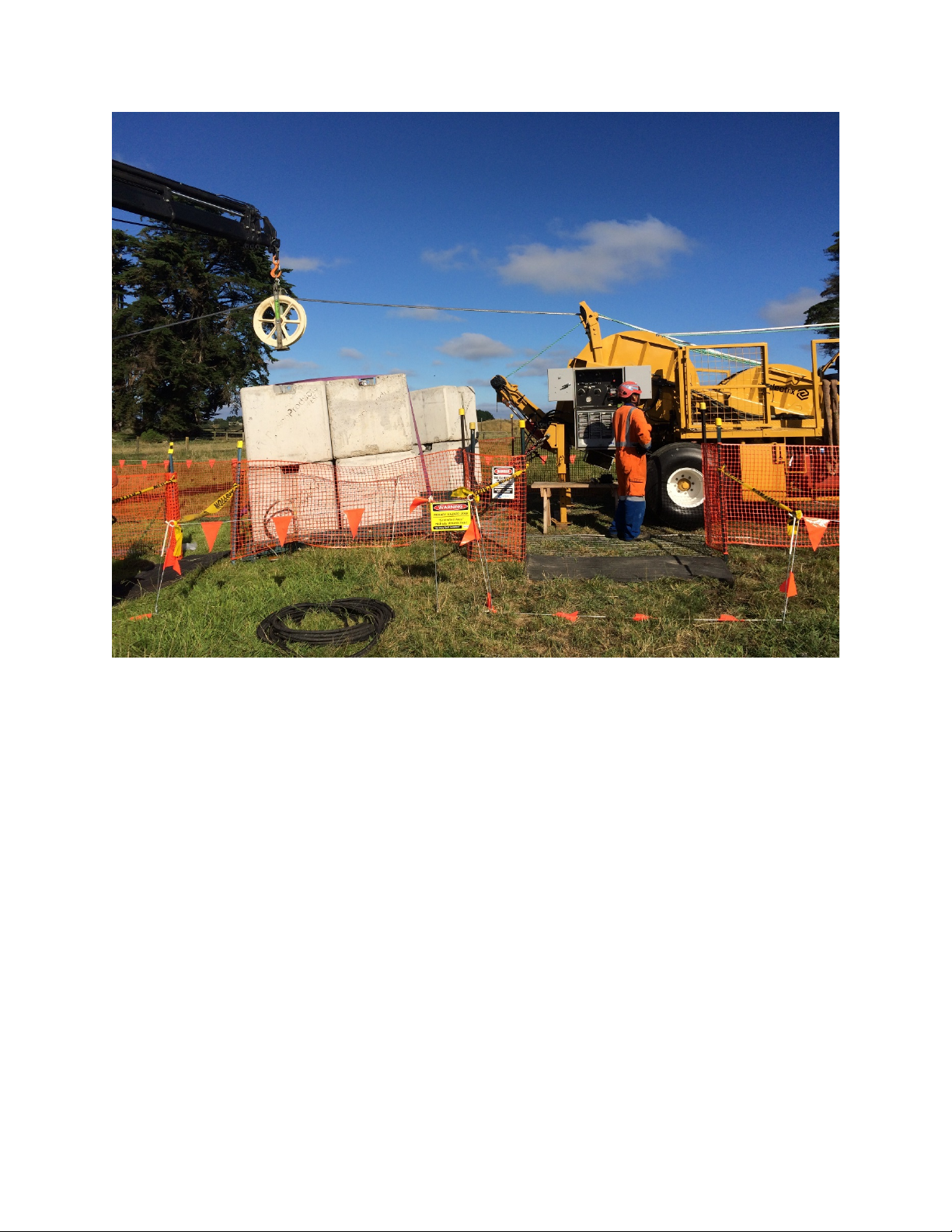
To ensure a safe margin to any damage threshold, Southwire recommends a finished
conductor be placed on a reel with a drum diameter greater than 30 times the
conductor diameter. The entrance block and any running angles should use a block with
a bottom groove diameter of at least 30x the conductor diameter. For turning angles
less than 20°, the sheave bottom groove diameter must be at least 20 times the
conductor diameter. On tangent structures, a sheave bottom groove diameter of 20x
the conductor diameter minus 4 in (10 cm), is acceptable.