Startco Engineering Ltd. Page 1
SE-601 DC Ground-Fault Monitor Rev. 0
Pub. SE-601-M, July 4, 2002.
1. GENERAL
The SE-601 is a microprocessor-based ground-fault
monitor for ungrounded dc systems. Its output relay can
operate in the fail-safe or non-fail-safe mode for
undervoltage or shunt-trip applications, and the output
contacts are isolated for use in independent control circuits.
Additional features include LED and fluorescent-flag
indication, front-panel and remote reset, self test, 0 to 5-V
analog output, digital selector switches, and autoreset or
latching trips. The SE-601 can be DIN-rail, surface, or
panel mounted.
Ground-fault current is sensed using an SE-GRM
Ground-Reference Module—a resistor network that limits
ground-fault current to 25 mA. The trip level of the ground-
fault circuit is selectable from 1 to 20 mA. Trip time is
selectable from 0.05 to 2.5 s.
2. OPERATION
2.1 CONFIGURATION-SWITCH SETTINGS (See Fig. 1)
2.1.1 RELAY OPERATING MODE
The SE-601 has one output relay with isolated normally
open and normally closed contacts. The relay contacts
(terminals 13, 14, 15, and 16) are shown with the SE-601
de-energized. Switch 1 is used to set the operating mode of
the output relay. In the fail-safe mode, the output relay
energizes and the contacts change state when the SE-601 is
energized and remain in that state unless the ground-fault
circuit trips or the SE-601 is de-energized. In the non-fail-
safe mode, the output contacts do not change state when the
SE-601 is energized or de-energized—the output relay only
energizes when a trip occurs.
2.1.2 AUTORESET
Switch 2 is used to select autoreset or latching trips. See
2.2.3.
2.2 FRONT-PANEL CONTROLS
2.2.1 TRIP LEVEL
The LEVEL (mA) selector switch is used to set the
ground-fault trip level.
Ground-fault current is a function of fault resistance,
system voltage, and the SE-GRM Ground-Reference
Module. Table 1 lists the SE-601 trip levels and fault-
resistance values for 24-, 48-, 125-, and 250-Vdc systems.
TABLE 1. SE-601 TRIP LEVELS AND
FAULT-RESISTANCE VALUES
FAULT RESISTANCE (kΩ)
TRIP
LEVEL
(mA)
24 Vdc
SYSTEM
SE-GRM024
48 Vdc
SYSTEM
SE-GRM048
125 Vdc
SYSTEM
SE-GRM125
250 Vdc
SYSTEM
SE-GRM250
1
2
3
4
5
6
8
10
15
20
11.5
5.5
3.5
2.5
1.9
1.5
1.0
0.7
0.3
0.1
22.3
11.0
7.0
5.0
3.8
3.0
2.0
1.4
0.6
0.2
60.0
28.7
18.3
13.1
10.0
7.9
5.3
3.7
1.6
0.6
120.0
57.5
36.6
26.2
20.0
15.8
10.6
7.5
3.3
1.2
2.2.2 TRIP TIME
The TIME (s) selector switch is used to set the ground-
fault trip time.
2.2.3 RESET
The reset circuit responds only to a momentary closure so
that a jammed or shorted switch will not maintain a reset
signal. The front-panel RESET switch is disabled when
remote-reset terminals 6 and 7 are shorted.
If Switch 2 is in the LATCHING position, a trip remains
latched until the RESET switch is pressed, the remote-reset
terminals are momentarily shorted, or the supply voltage is
cycled. Cycling the supply voltage will not reset (black) the
fluorescent flag.
If Switch 2 is in the AUTORESET position, a trip will
reset when the fault is removed. The fluorescent flag will
not reset until the RESET switch is pressed or the remote-
reset terminals are momentarily shorted. Cycling the supply
voltage will not reset the fluorescent flag unless the remote-
reset terminals are shorted.
2.2.4 TEST
The TEST switch is used to test the ground-fault circuit,
trip indication, and the output relay. When the TEST switch
is pressed for one second the circuit will trip, both "–" and
"+" FAULT LED’s will illuminate, the fluorescent flag will
be set (red), and the output relay will operate.
2.3 FRONT-PANEL INDICATION
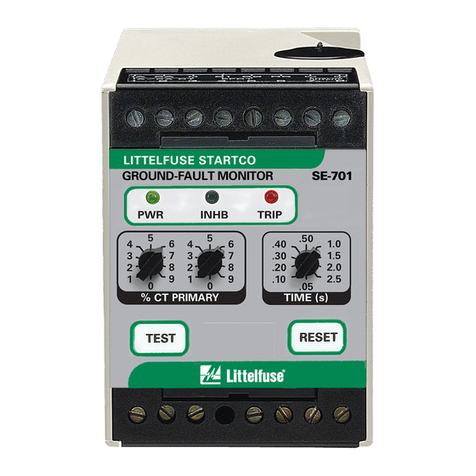
2.3.1 POWER
The green LED labeled PWR indicates presence of the
supply voltage.
2.3.2 TRIP
The FAULT LED's and the fluorescent flag labeled TRIP
indicate a ground-fault trip. The "–" FAULT LED indicates
a ground-fault on the negative dc bus. The "+" FAULT
LED indicates a ground-fault on the positive dc bus.