3
( ) Install IC1 following the precautions given for MOS IC's. Solder.
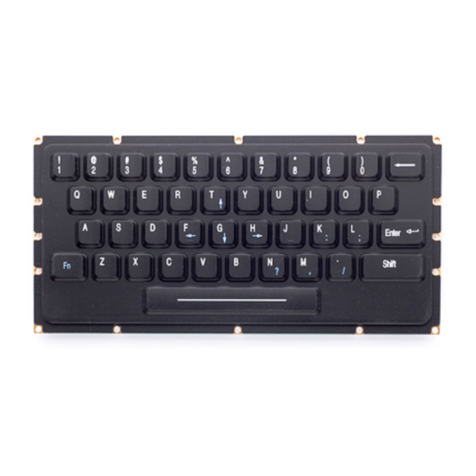
( ) To finish the keyboard assembly snap the plastic key tops on their
respective keyswitch as noted on the key configuration drawing. If some of
the keytops are loose you can securely fasten them to the switches by
using a small amount of plastic cement. Blank keytops may be supplied for
the RCVS/XMIT and ECHO positions.
The programming of the "CASE", "PARITY" and the "KEYPRESSED" jumpers
depends on what your keyboard will be used for. For upper case characters only
connect a jumper from the pad marked "CASE" to "U". For upper plus lower case
connect the jumper from the "CASE" pad to "U + L". For a positive keypressed
strobe (KP line normally low, goes high when a key is pressed) connect a jumper
from the KP pad to "+", for a negative keypressed strobe (KP line normally high,
goes low when a key is pressed) connect a jumper from the KP pad to "-". A
jumper for "PAR" should also be installed to its respective "U" or "U + L" pad
depending on whether upper case or upper plus lower case characters will be
used.
Notice to CT-1024 Terminal Owners
In order for the KBD-5 to be used on the CT-1024 terminal the keyboard
should be programmed for a negative keypressed strobe (KP select jumper con-
nected to -) and for upper case characters only, ("CASE" jumper connected to U).
This is the normal programming for other TV TYPEWRITERS but may need to be
modified for your particular application. The parity bit is not used in the
CT-1024 but the "PAR" jumper should be connected to "U". The terminals R, T and
E of J1 can be connected to control the receive/transmit and echo functions of
your CT-1024 if a serial interface is installed. Connect R to JS-1 pin 5, T to
JS-1 pin 4 and E to JS-1 pin 8 of the serial interface.
Checkout
The only equipment needed to check the operation of your keyboard is a DC
milliammeter and a DC voltmeter. Apply +5 volts, ground, and -12 volts to the
proper pins and check for currents of about 4 mA on the -12 line and about 8mA
on the +5 line (no keys pressed). If the currents are much higher than this stop
immediately and check for parts inserted incorrectly or solder bridges. If the
currents check OK check the keypressed output. If the KP select jumper is set
for (-) the KP output should be high (4.5V nominal) and go low (0.1 volts
nominal) when a key is pressed. If the KP output is held low check for possible
solder bridges or a shorted key switch. If the KP select jumper is set for (+)
the KP output will be normally low and will go high when a key is pressed. If
all seems well refer to the ASCII code tables supplied and check the outputs of
bits 1-7 with-your voltmeter for each individual character. Be sure to use the
correct table depending on how the "CASE" selector is wired on your keyboard.
With the "CASE" selector set for the upper case only the SHIFT control will have
no effect on the output code when any letter is pressed but will make bit 5 a 0
when any character of column 3 of Table 1 is pressed. When in the upper case
only mode the SHIFT key will not affect any of the characters in columns 4 or,5.
Pressing the control key forces bit 7 to be a 0 therefore allowing you to select
the operators in columns 0 and 1. When in the upper plus lower case mode the
SHIFT key makes bit 6 a 1 when letters of columns 4 and 5 of table 2 are pressed
and makes bit 5 a 0 when any character of column 3 is selected. The control key
operates as before.