INSTALLATION AND MAINTENANCE INSTRUCTIONS
MHRA and MHWA Mini-Horns
MHRZA and MHWZA Silencable Mini-Horns
D690-07-00 1 I56-3027-000
Specications
General Specications
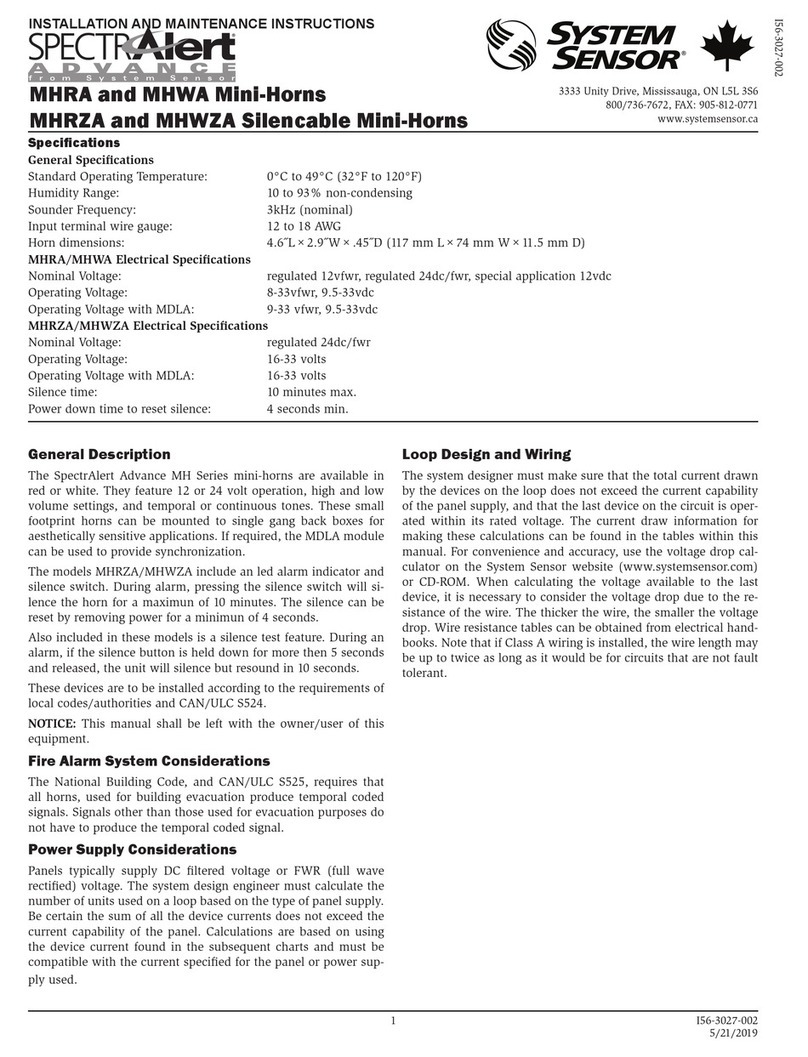
Standard Operating Temperature: 0°C to 49°C (32°F to 120°F)
Humidity Range: 10 to 93% non-condensing
Sounder Frequency: 3kHz (nominal)
Input terminal wire gauge: 12 to 18 AWG
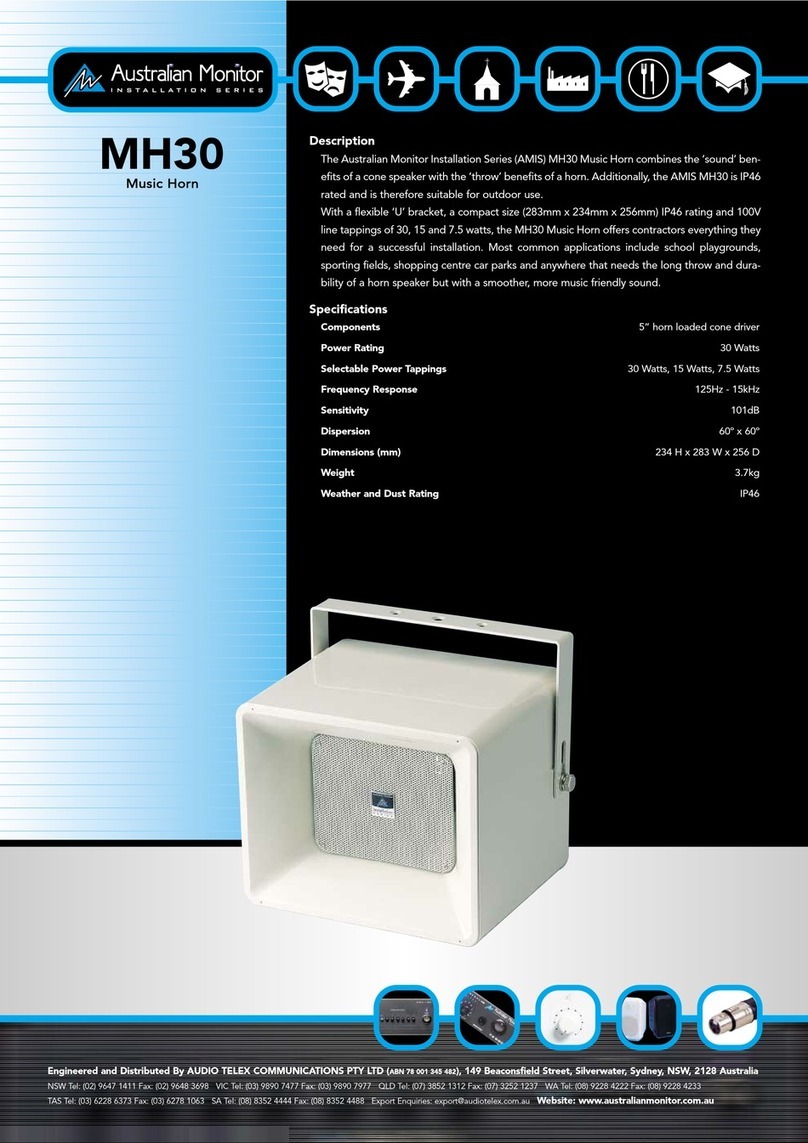
Horn dimensions: 4.6˝L×2.9˝W×.45˝D (117 mm L×74 mm W×11.5 mm D)
MHRA/MHWA Electrical Specications
Nominal Voltage: regulated 12dc/fwr or regulated 24dc/fwr
Operating Voltage: 8-33 volts
Operating Voltage with MDLA: 9-33 volts
MHRZA/MHWZA Electrical Specications
Nominal Voltage: regulated 24dc/fwr
Operating Voltage: 16-33 volts
Operating Voltage with MDLA: 16-33 volts
Silence time: 10 minutes max.
Power down time to reset silence: 4 seconds min.
General Description
The SpectrAlert Advance MH Series mini-horns are
available in red or white. They feature 12 or 24 volt
operation, high and low volume settings, and tempo-
ral or continuous tones. These small footprint horns
can be mounted to single gang back boxes for aes-
thetically sensitive applications. If required, the MDLA
module can be used to provide synchronization.
The models MHRZA/MHWZA include an led alarm
indicator and silence switch. During alarm, pressing
the silence switch will silence the horn for a maximun
of 10 minutes. The silence can be reset by removing
power for a minimun of 4 seconds.
Also included in these models is a silence test fea-
ture. During an alarm, if the silence button is held
down for more then 5 seconds and released, the unit
will silence but resound in 10 seconds.
These devices are to be installed according to the re-
quirements of local codes/authorities and CAN/ULC
S524.
NOTICE: This manual shall be left with the owner/
user of this equipment.
Fire Alarm System Considerations
The National Building Code, and CAN/ULC S525,
requires that all horns, used for building evacuation
produce temporal coded signals. Signals other than
those used for evacuation purposes do not have to
produce the temporal coded signal.
Power Supply Considerations
Panels typically supply DC ltered voltage or FWR
(full wave rectied) voltage. The system design en-
gineer must calculate the number of units used on
a loop based on the type of panel supply. Be certain
the sum of all the device currents does not exceed
the current capability of the panel. Calculations are
based on using the device current found in the sub-
sequent charts and must be compatible with the cur-
rent specied for the panel or power supply used.
Loop Design and Wiring
The system designer must make sure that the total
current drawn by the devices on the loop does not
exceed the current capability of the panel supply, and
that the last device on the circuit is operated within
its rated voltage. The current draw information for
making these calculations can be found in the tables
within this manual. For convenience and accuracy,
use the voltage drop calculator on the System Sen-
sor website (www.systemsensor.com) or CD-ROM.
When calculating the voltage available to the last de-
vice, it is necessary to consider the voltage drop due
to the resistance of the wire. The thicker the wire, the
smaller the voltage drop. Wire resistance tables can
be obtained from electrical handbooks. Note that if
Class A wiring is installed, the wire length may be up
6581 Kitimat Rd., Unit #6, Mississauga, Ontario, L5N 3T5
1-800-SENSOR2, FAX: 905-812-0771
www.systemsensor.ca