HFp Antenna User’s Guide
Page 3
The HFp Antenna
The HFp design provides a highly efficient vertically polarized antenna design in an extremely
portable package — the entire kit weighs just over 2 pounds (1 kg). The antenna is highly
configurable, and covers all the Amateur bands from MHz to 30 MHz (as well as most
frequencies in between). An optional coil is available for 80 Meters, which also provides
operation of 5 and 60 Meters. Typical setup time is about 5 minutes.
In this User’s Guide, you will find two tables showing optimum configurations for each Ham
band. One table is for use with the HFp on the ground, and one is for the HFp elevated off the
ground. The elevated configuration is when the antenna is on a balcony, or mounted with the
optional Pole Mount Kit. There is also a laminated card in the antenna bag, with the same
configuration tables on it. The card makes it easy to take the setup information with you on your
portable operation trips.
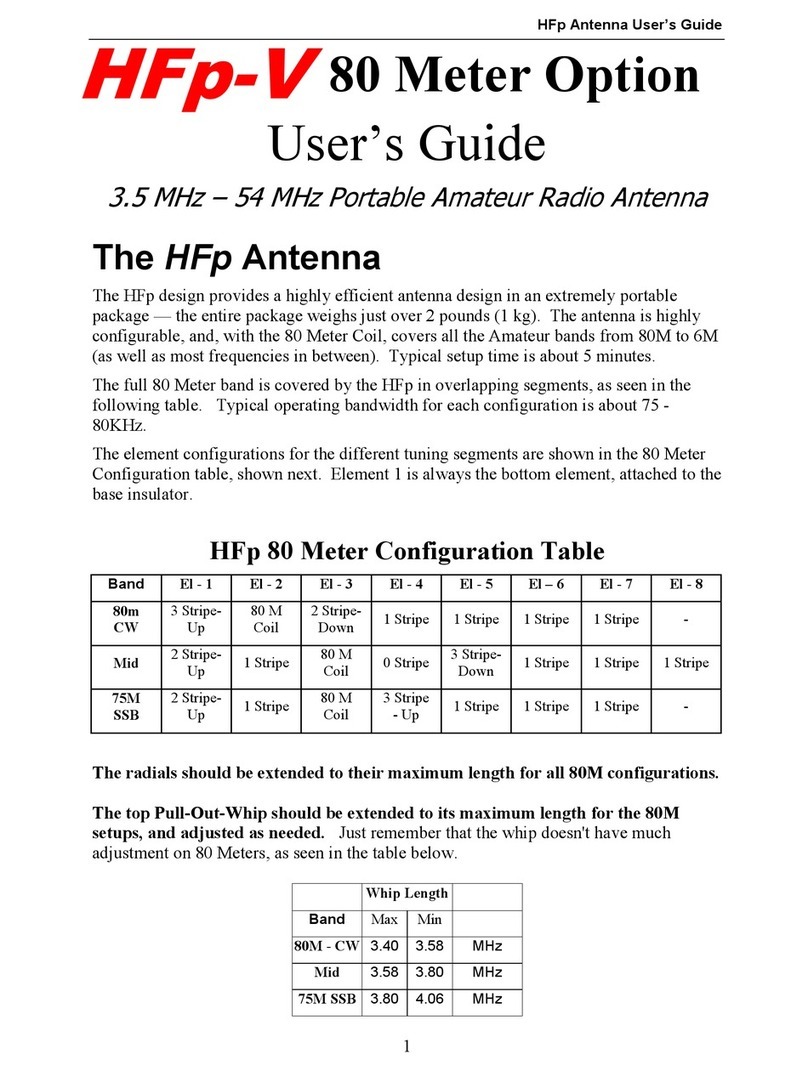
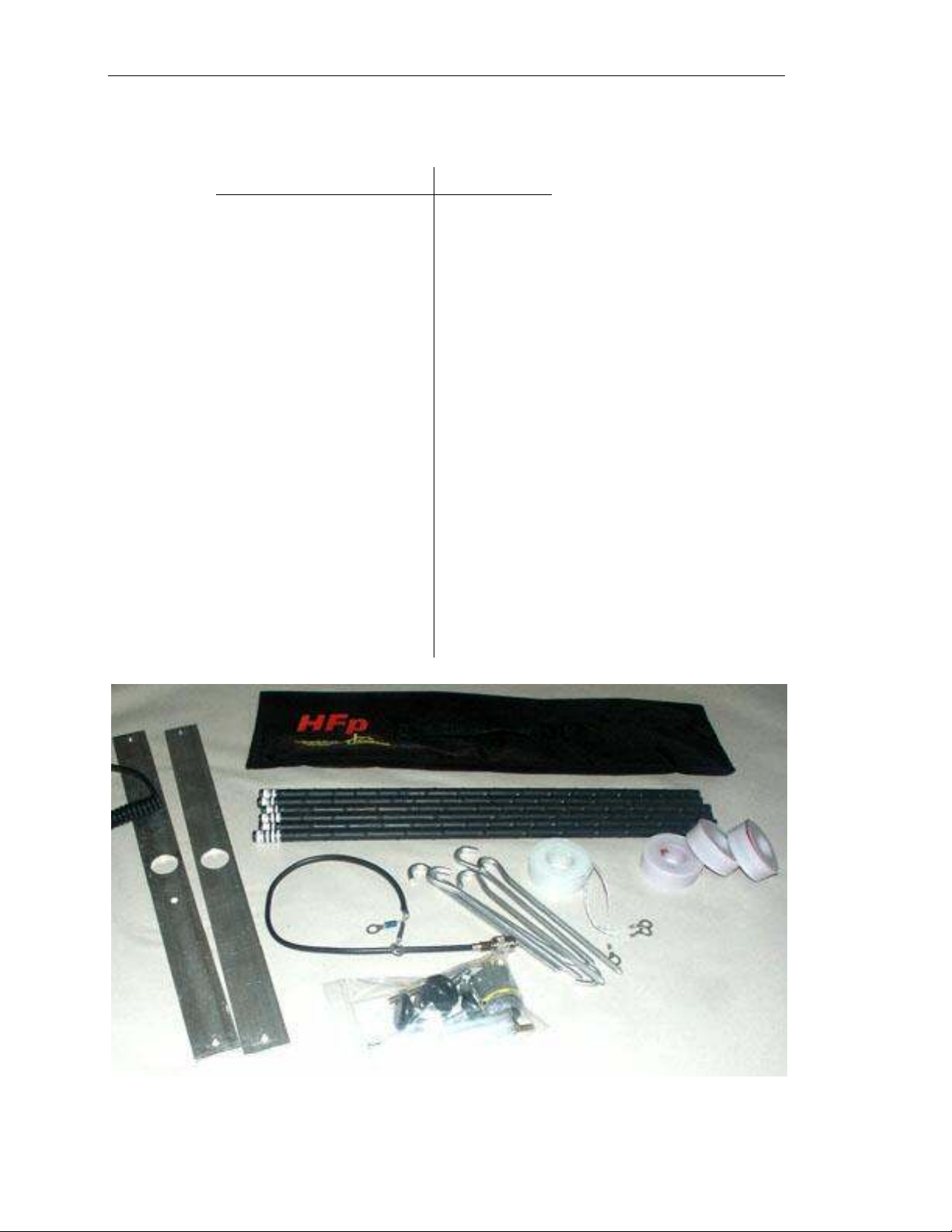
The antenna is configured for different bands by the selection and orientation of the seven
elements that are included in the kit. Four of the elements are marked with a single stripe and
contain no loading coil. One element is marked with two stripes and contains a small inductive
load. One element is marked with three stripes and contains a larger inductive load. And one
element is half the length of the others, and has no stripe.
In addition to using combinations of elements, the orientation of the loaded elements (the two
and three stripe elements) either UP or DOWN determines the operating frequency. In the
configuration tables later in the User’s Guide as well as on the laminated configuration card, you
will see elements marked, for example,“2-stripe up”. If you assemb e these e ements in the
wrong orientation, the antenna wi not tune to the desired frequency. The one-stripe and
zero-stripe elements have no orientation, and may be assembled into the antenna either “up” or
“down”.
We have run extensive tests on the antenna, and our research verifies the “physics” of antennas:
vertical antennas require radials to perform at their peak efficiency. Further, tuned radials
optimize that efficiency.
The HFp is designed to operate optimally with three tuned radia wires. This is true for ground
mounted operation as well as elevated operation. The antenna will certainly radiate with one or
two radials, but unless you are hanging from a cliff, you’ll make a lot more contacts by taking
the two or three minutes to set up all three. The radial wires are coiled on plastic spools, and are
marked in several places along their length. In use, the ring terminal is attached to the antenna
base, and the wire is un-spooled to the correct mark for the band in use, as indicated in the
Configuration Chart. This length is the correct “tuned length” for the radial wire, not the
quarter-wave length, and will be different for ground-mount or elevated mount locations.
Guy lines are included with the HFp for use when it is windy, or when the antenna will be left up
for some time. It is recommended that the guys always be used for the 40 meter configuration.
The guy lines have lug rings which are placed between two of the upright elements (typically
between the fourth and fifth elements from the bottom). The lines are then run out to their full
length and secured with the aluminum stakes provided, or tied to a handy rock. Some small flag
material attached to the guys will help prevent people from walking into them. If the guys are
run in the same direction as the radial wires, they will help protect the radials from being tripped
upon, as well.