3. Installation
WARNING: Make sure that all AC power sources are switched off or disconnected before and during
installation.
Mounting:
• Install the transfer switch in a dry and well-ventilated area.
• To gain access to the transfer switch, remove the four screws in the front panel.
• The transfer switch can be wall-mounted by using the four holes in the rear of the casing.
Electrical connections:
• The input cables (mains/generator) and the inverter (or inverter/charger) and the output cable (to the appliances) should be
connected according to the connection diagram as shown below.
• The input and output cables must have the correct core thickness for a safe installation. Undersized cables can cause
overheating of the cables. The maximum cable core thickness is 6mm².
• Use the provided cable glands to pass the input and output cables through the casing.
• Tighten all connections with a nominal torque moment of 1.2Nm. This is to limit transition resistance as far as possible. Loose
connections can cause dangerous overheating of the terminals.
Connection diagram VE Transfer Switch 5kVA.Connection diagram VE Transfer Switch 10kVA.
Digital Multi Control panel connection:
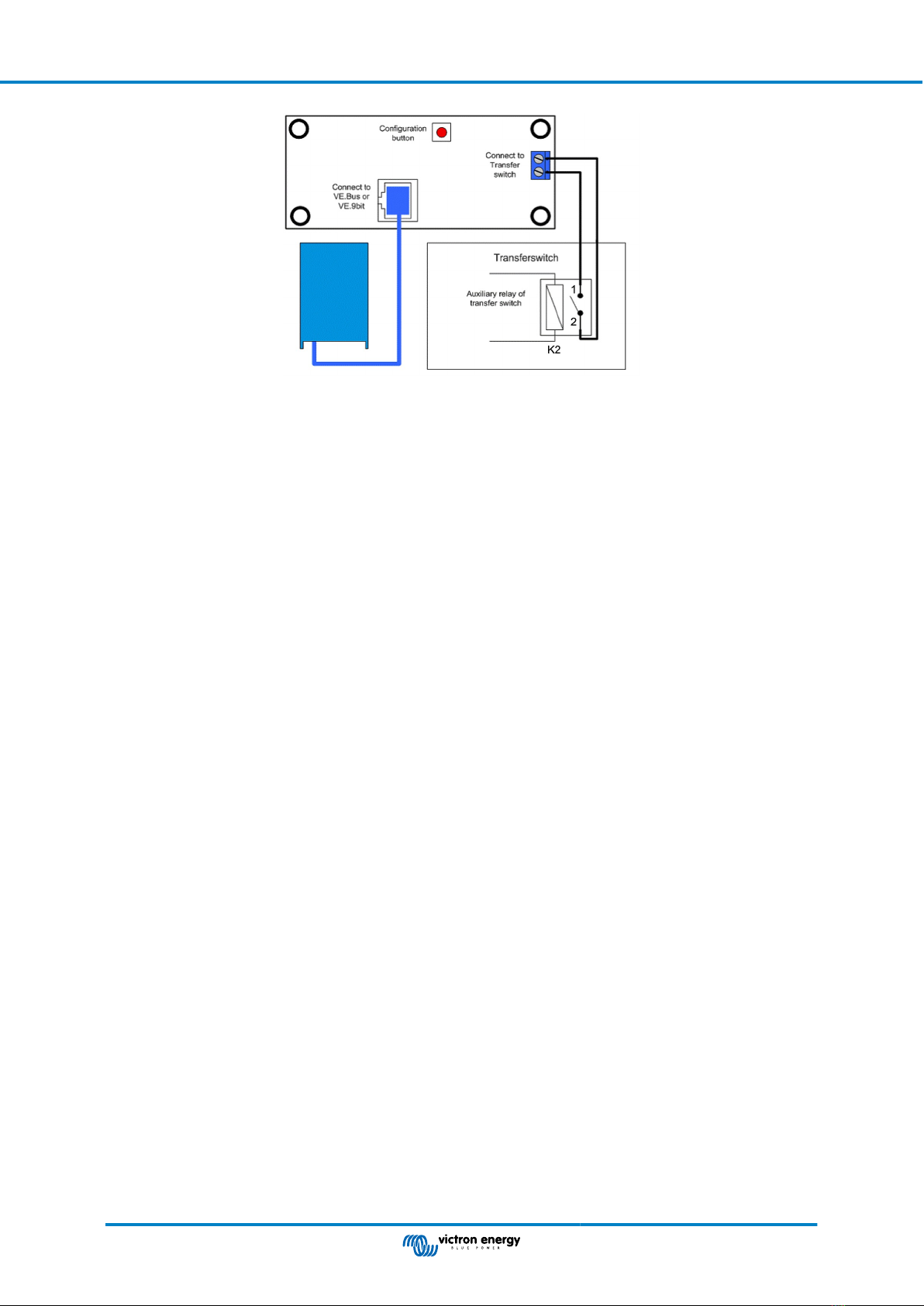
When the transfer switch is used together with a MultiPlus and a Digital Multi Control panel (DMC):
• Connect the transfer switch Auxiliary contact 1 and 2 of relay K2 (NO) to the screw connector on the back of the DMC as
indicated in the connection diagram below.
• When the transfer switch auxiliary contact is open, the MultiPlus current limit is controlled by the knob on the front of the DMC.
The display on the DMC will show the current limit value.
• When the transfer switch auxiliary contact is closed, a pre-set (generator) current limit is sent to the MultiPlus. The display on
the DMC will show the text: "GEN".
• For more information on this feature and on how to set the preset (generator) current limit see the Digital Multi Control Panel
manual.
VE Transfer Switch
Page 3 Installation