Weather-Rite TT Series Manual

NOT FOR RESIDENTIAL USE Weather-Rite LLC
1100 Seven Mile Road NW
Comstock Park, MI 49321
Telephone: +1.612.338.1401
Fax: +1.616.784.0435
Toll Free: 800.589.3691
www.weather-rite.com
WARNING
Installation must be done by a registered installer/
contractor qualified in the installation and service of
gas/oil-fired heating equipment or your fuel supplier
Improper installation, adjustment, alteration, service
or maintenance can result in death, injury or property
damage Read the installation, operation and service
manual thoroughly before installing or servicing
this equipment
Installer
Please take the time to read and understand
these instructions prior to any installation.
Installer must give a copy of this manual to the owner.
Owner
Keep this manual in a safe place in order to provide
your service technician with necessary information.
© 2017 Weather-Rite LLC
WARNING
FOR YOUR SAFETY
If you smell gas:
1. Open windows.
2. DO NOT try to light any appliance.
3. DO NOT use electrical switches.
4. DO NOT use any telephone in
your building.
5. Extinguish any open flame.
6. Leave the building.
7. Immediately call your local fuel
supplier after leaving the building.
Follow the fuel supplier’s
instructions.
8. If you cannot reach your fuel
supplier, call the Fire Department.
Fire Hazard
Keep all flammable objects, liquids and
vapors the minimum required clear-
ances to combustibles away from
equipment.
Some objects will catch fire or explode
when placed close to equipment.
Failure to follow these instructions can
result in death, injury or property
damage.
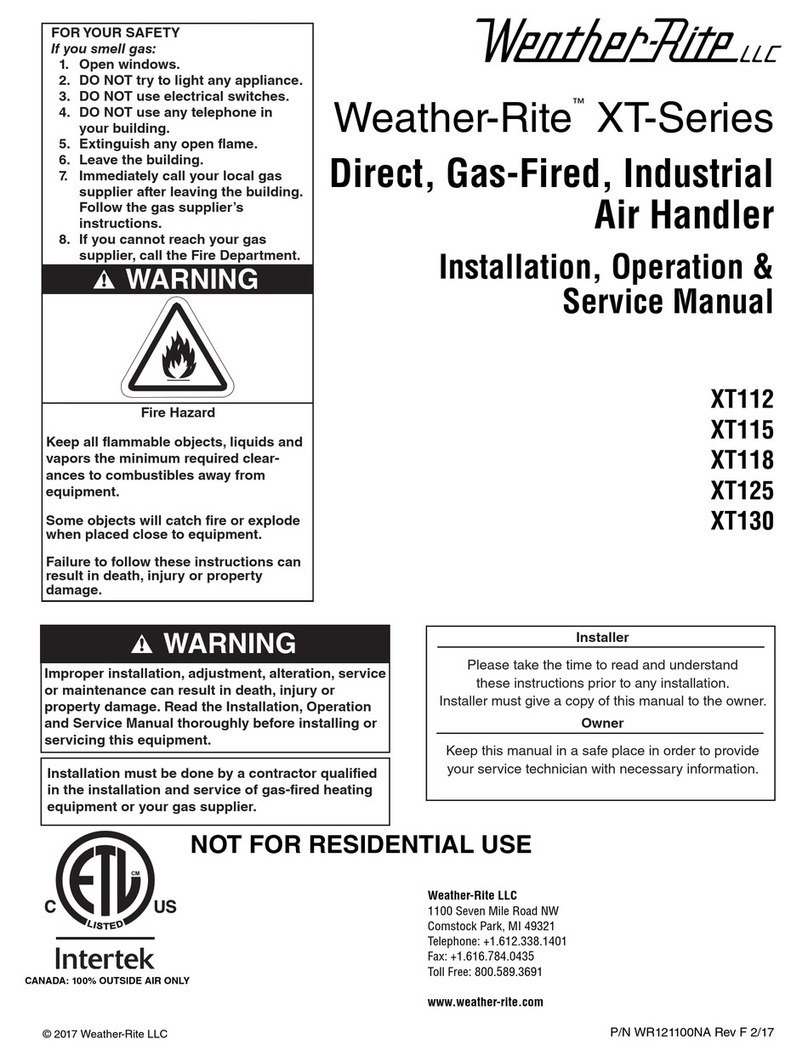
WEATHER-RITE™ TT-Series
Direct, Gas Fired,
Industrial Air Handler
Installation, Operation &
Service Manual
TT112
TT115
TT118
TT212
TT215
TT218
TT221
TT224
TT230
TT233
TT236
P/N WR161100NA RevB 09/17


Conçus pour les applications non-résidentielles
Weather-Rite LLC
1100 Seven Mile Road NW
Comstock Park, MI 49321
Téléphone: +1.612.338.1401
Fax: +1.616.784.0435
Numéro sans fraís: 800.589.3691
www.weather-rite.com
ATTENTION
Linstallation doit être effectuée par un installateur
éprouvé/contractant qualifié dans linstallation et la
maintenance du syst me de chauffage par infrarouge
activé au gaz.
Linstallation, lajustement, laltération, le démarrage
ou lentretien inadéquat peuvent causer la mort, des
blessures ou des dégâts matériels. Lire enti rement
le manuel dinstallation, dopération et dentretien
avant linstallation ou l'entretien de cet équipement.
Installateur
Prenez le temps de lire et comprendre ces instructions
avant toute installation.
Linstallateur doit remettre au propriétaire
un exemplaire de ce manuel.
Propriétaire
Gardez ce manuel dans un endroit sûr pour
fournir des informations au réparateur
en cas de besoin.
© 2017 Weather-Rite LLC
AVERTISSEMENT
POUR VOTRE SECURITE
Si vous sentez une odeur de gaz:
1. Ouvrir les fenêtres.
2. N’essayer pas d’allumer un appareil.
3. N’utiliser pas d’interrupteurs
électriques.
4. N’utiliser pas de téléphone dans votre
bâtiment.
5. Eteindre flamme nue.
6. Quitter le bâtiment.
7. Après avoir quitté le bâtiment, appelez
immédiatement votre fournisseur local
de gaz.
Suivre les instructions du fournisseur
de gaz.
8. Si vous ne pouvez pas joindre votre
fournisseur de gaz, appeler le service
d’incendie.
Risque d’incendie
Garder tous les objets, liquides ou vapeurs
inflammables à la distance minimale de
l’unité de chauffage requise avec les
matériaux combustibles.
Certains objets prendront feu ou exploseront
s’ils sont placés à proximité de l’unité de
chauffage.
Le non respect de ces instructions peut
entraîner la mort, des blessures corporelles
ou des dommages matériels.
WEATHER-RITE™ TT-Series
L’appareil de traitment de l’air à
combustion directe, au gaz pour
les applications industrielles
Manuel d'installation,
d'opération, et d'entretien
TT112
TT115
TT118
TT212
TT215
TT218
TT221
TT224
TT230
TT233
TT236
P/N WR161100NA RevB 09/17


© 2017
Weather-Rite LLC
All rights reserved. No part of this work covered by the copyrights herein may be reproduced
or copied in any form or by any means - graphic, electronic, or mechanical, including
photocopying, recording, taping or information storage and retrieval systems - without the
written permission of Weather-Rite LLC.
TABLE OF CONTENTS
SECTION 1: Air Handler Safety.............................................. 1
1.1 Description of Operation...............................................1
1.2 Inspection and Setup ................................................... 1
1. 3 S a fe t y L a bels and Their Placement ............................. 2
1.4 California Proposition 65 .............................................. 2
1. 5 L a bel Placement .......................................................... 2
SECTION 2: Installer Responsibility ..................................... 8
2.1 Corrosive Chemicals.................................................... 8
2.2 Required Equipment .................................................... 8
SECTION 3: Critical Considerations ................................... 10
3.1 Required Clearances to Combustibles....................... 10
3.2 Purge of Supply Duct ................................................. 10
3.3 Hardware ................................................................... 10
SECTION 4: National Standards and Applicable Codes ... 11
4.1 Fuel Codes................................................................. 11
4.2 Installation Codes ...................................................... 11
4.3 Aircraft Hangars ......................................................... 11
4.4 Parking Structures and Repair Garages .................... 11
4.5 Electrical .................................................................... 11
4.6 Venting....................................................................... 11
4.7 High Altitude .............................................................. 11
SECTION 5: Specifications .................................................. 12
SECTION 6: Liftingan Air Handler ...................................... 27
6.1 Lifting an Air Handler ................................................. 27
SECTION 7: Air Handler Assembly...................................... 30
SECTION 8: VIBRATION ISOLATION ................................... 33
8.1 Pad Isolator for Curb-Mounted Air Handler................ 33
8.2 Neoprene or Spring Isolators for Hanging-Mounted
Air Handler................................................................. 35
8.3 Neoprene or Spring Isolators for Pad-Mounted Air
Handlers.................................................................................. 39
SECTION 9: Roof Curb ......................................................... 47
9.1 Roof CurbAssembly and Installation......................... 47
9.2 Air Handler Mounting to Roof Curb............................ 49
SECTION 10: Upright Stand ................................................. 50
10.1 Upright Stand ........................................................... 50
10.2 Upright Stand Installation.........................................50
10.3 Attaching Air Handler to Stand................................. 50
SECTION 11: Vertical mountingLegs ................................. 55
11.1 Attaching Legs to Air Handler ................................... 55
11.2 Attaching Legs to Slab.............................................. 55
SECTION 12: Filter Section .................................................. 57
12.1 Filter Section Installation - Horizontal Air Handlers.. 58
12.2 Filter Section Installation - Upright Air Handlers ......59
SECTION 13: Inlet Hoods ..................................................... 60
13.1 Inlet Hood Installation (Models TT112 - TT215) ....... 61
13.2 Inlet Hood Assembly (Models TT218 and TT221) ... 62
13.3 Inlet Hood Installation (Models TT224 and TT230) . 63
13.4 Inlet Hood Installation (Models TT233 and TT236) . 67
SECTION 14: Service Platform............................................. 68
SECTION 15: Dampers ......................................................... 70
15.1 Discharge Damper Installation................................. 70
15.2 Inlet Damper Installation.......................................... 71
SECTION 16: Discharge plenum and Discharge Louvers. 73
16.1 Four-Way Discharge Plenum Installation ................. 73
16.2 Double Deflection Discharge Louver Installation ......74
SECTION 17: Duct Considerations .................................... 75
17.1 Inlet Air Duct............................................................. 76
17.2 Return Air Duct......................................................... 76
17.3 Discharge Duct Work ............................................... 76
SECTION 18: Gas Piping...................................................... 77
18.1 Gas Manifolds.......................................................... 77
18.2 Gas Piping and Pressures ....................................... 77
18.3 Gas Manifold Venting............................................... 78
18.4 Gas Piping ............................................................... 83
18.5 Pressure Test Ports.................................................. 83
18.6 Line Pressure Test - Leak Testing............................ 84
SECTION 19: Electrical......................................................... 85
19.1 Wiring and Electrical Connections ........................... 85
19.2 Remote Panel .......................................................... 85
19.3 Motor Current Draw................................................. 85
19.4 Control Current Draw............................................... 85
19.5 Safety Systems........................................................ 86
SECTION 20: Sequence of Operation ................................. 87
20.1 Air Handler Configuration ........................................ 87
20.2 Remote Panel Options............................................. 88
20.3 Basic Sequence of Operation.................................. 90
20.4 Flame Control .......................................................... 90
20.5 Air Volume Control Options ..................................... 99
20.6 Night Setback Options............................................101
20.7 Other Control Options............................................ 102
SECTION 21: Temperature Controls ................................. 104
21.1 System OverviewFor All Series............................. 104
SECTION 22: Direct Fired Burner ...................................... 108
22.1 Direct Fired Burner Ignition.................................... 109
22.2 Direct Fired Burner Flame Proving (Flame Rod) ....110
22.3 Direct Fired Burner Flame Proving
(Ultra Violet Scanner) ............................................. 111
SECTION 23: Direct fired process air heaters...................112
23.1 Direct Fired Process Air Heater Models..................113
23.2 Installer's Responsibilities ......................................113
23.3 Installer's Responsibility for Process Heaters
Connected to Paint Booths .....................................114
23.4 WEATHER-RITE™Control Packages .....................115
SECTION 24: Start-up Procedures .................................... 122
24.1 Installation of Recirculating Air Handler................. 123
24.2 Mechanical ............................................................ 123
24.3 Electrical................................................................ 124
24.4 Airflow.................................................................... 124
24.5 Gas Piping and Initial Pressure Settings................ 127
24.6 Safety Shut Off Valve Check.................................. 131
24.7 Air Volume Control................................................. 131
Printed in U.S.A.

SECTION 25: Maintenance .................................................133
25.1 General ..................................................................134
25.2 Unit Exterior ...........................................................134
25.3 Blower Section .......................................................134
25.4 Motor and Drive Components ................................137
25.5 Supply Blower ........................................................138
25.6 Manifold and Controls ............................................ 138
25.7 Burner ....................................................................139
SECTION 26: Replacement Parts.......................................141
26.1 Replacement Blower Components.........................141
26.2 Damper Components.............................................147
26.3 Burner Components...............................................148
26.4 Manifold Components ...........................................149
26.5 Combustion Components ......................................149
26.6 Electrical Components ...........................................151
26.7 Miscellaneous Mechanical Components................154
SECTION 27: Troubleshooting...........................................156
27.1 Initial Checks ..........................................................157
27.2 Supply Fan.............................................................. 157
27.3 Burner.....................................................................158
27.4 Temperature Controls .............................................159
27.5 Series 14 - Preliminary Circuit Analysis ..................159
27.6 Series 44 - Preliminary Circuit Analysis..................164
27.7 Series 94 - Preliminary Circuit Analysis..................168
27.8 Series MP - Trouble Shooting .................................172
27.9 Flame®Safeguard...................................................186
27.10 WEATHER-RITE™TT-Series Start-Up Procedure. 191
SECTION 28: The WEATHER-RITE™TT-Series Warranty. 195

SECTION 1: AIR HANDLER SAFETY
1 of 198
SECTION 1: AIR HANDLER SAFETY
Yo ur Safety Is Important To Us!
This symbol is used throughout
the manual to notify youof
possible fire, electrical or burn
hazards. Please pay special
attention when reading and
following the warnings in these
sections. Installation, service and,
at a minimum, annual inspection of air handlers must
be done by a contractor qualified in the installation
and service of gas-fired heating equipment.
Read this manual carefully before installation,
operation or service of this equipment.
This air handler is designed for heating non-
residential indoor spaces. Do not install in residential
spaces. These instructions, the layout drawing, local
codes and ordinances and applicable standards that
apply to gas piping (where applicable), electrical
wiring, ventilation, etc., must be thoroughly
understood before proceeding with the installation.
Protective gear is to be worn during installation,
operation and service. Thin sheet metal parts have
sharp edges. To prevent injury, the use of work
gloves is recommended.
Before installation, check that the local distribution
conditions, nature of gas and pressure and
adjustment of the appliance are compatible.
This equipment must be applied and operated under
the general concepts of reasonable use and installed
using the best building practices.
This appliance is not intended for use by persons
(including children) with reduced physical, sensory or
mental capabilities, or lack of experience and
knowledge, unless they have been given supervision
or instruction concerning the use of the appliance by
a person responsible for their safety.
Children should be supervised to ensure that they do
not play with the appliance.
For additional copies of the Installation, Operation
and Service Manual, please contact Weather-Rite
LLC.
Gas-fired appliances are not designed for use in
atmospheres containing flammable vapors or dust or
atmospheres containing chlorinated or halogenated
hydrocarbons. Recirculated room air may be
hazardous if containing flammable solids, liquids,
and gases; explosive materials; and/or substances
which may become toxic when exposed to heat (i.e.
refrigerants, aerosols, etc.).
1.1 Description of Operation
This air handler is a direct gas-fired applianc8e. It is
designed for indoor or outdoor installation with fresh
outdoor air delivered to the burner. Air handlers are
designed to operate in temperatures as lowas -40 °F
(-40 °C). The air handler is factory-tested to fire with
natural gas or LPG (check the air handler's rating
plate for information on the appropriate type of fuel).
The burner will operate to maintain the selected
discharge air temperature or room/space air
temperature, depending on the selected options. See
Page 104, Section 21.
The air handler may be provided with several
different controls and options to meet various
application requirements. Be sure to read this entire
manual before installation and start-up.
1.2 Inspection and Setup
The air handler is shipped in multiple sections based
on the configuration selected. The air handler was
inspected and operated prior to shipment.
Immediately upon receipt of the air handler, check
the fuel and electrical characteristics of the air
handler and verify that they match the fuel and
electrical supply available. Verify that the
specifications on the air handler rating plate match
the order. Check the air handler for any damage that
may have occurred during shipment. If any damage
is found, file a claim with the transporting agency. Do
not refuse shipment. Check the installation location
to ensure proper clearances to combustibles. See
Page 10, Section 3.1.
Any small options which do not come attached to the
air handler (i.e. remote panel or disconnect) will be
found inside the air handler.
Larger accessories (i.e. legs, stand, filter section,
inlet hood) may either ship with the air handler or
separately. Check the bill of lading for information.
If the air handler must be temporarily stored, (i.e. job
site is not ready for installation of the air handler), the
air handler should be set on 4" x 4" (10 cm x 10 cm)
pieces of timber on the ground in a protected area.
Cover the air handler to protect it from the
environment.

TT-SERIES INSTALLATION, OPERATION AND SERVICE MANUAL
2 of 198
1.3 Safety Labels and Their Placement
Product safety signs or labels should be replaced by
product user if they are no longer legible. Please
contact Weather-Rite LLC or your WEATHER-RITE™
independent distributor to obtain replacement signs
or labels. See Page 2, Figure 1 through Page 6,
Figure 8.
1.4 California Proposition 65
In accordance with California Proposition 65
requirements, a warning label must be placed in a
highly visible location on the outside of the
equipment. (i.e. near equipment's serial plate). See
label placement drawing on Page 2, Figure 1 through
Page 3, Figure 2 for label location. Avoid placing
label on areas with extreme heat, cold, corrosive
chemicals or other elements. To order additional
labels, please contact Weather-Rite LLC or your
WEATHER-RITE™independent distributor.
1.5 Label Placement
FIGURE 1: TT-112-TT221 Horizontal
3
1
2
45
11
6
810 9
7
13
13 12
Item Part Number Description
1 91070002 Danger - Severe Injury
2 Ref Logo
3 91070001 Danger - Electric Shock
4 91070004 Warning - Fire
5 91070006 Warning - Burn
6 91070005 Warning - Fall
7 19162 Rotation
8 19030 Recommended Entry
9 91010427 Vent Outdoors
10 14302333 Installation Manual Enclosed
11 14302372 Burner Access
12 14302389 Sight Port
13 14302390 Test

SECTION 1: AIR HANDLER SAFETY
3 of 198
FIGURE 2: TT224-TT236 Horizontal
FIGURE 3: TT112- 221 Upright
13 12
11
7
136
2
45
10
89
Item Part Number Description
1 91070002 Danger - Severe Injury
2 Ref Logo
3 91070001 Danger - Electric Shock
4 91070004 Warning - Fire
5 91070006 Warning - Burn
6 91070005 Warning - Fall
7 19162 Rotation
8 19030 Recommended Entry
9 91010427 Vent Outdoors
10 14302333 Installation Manual Enclosed
11 14302372 Burner Access
12 14302389 Sight Port
13 14302390 Test
6
3
2
1010
8
9
45
13
11 12
1
7
Item Part Number Description
1 91070002 Danger - Severe Injury
2 Ref Logo
3 91070001 Danger - Electric Shock
4 91070004 Warning - Fire
5 91070006 Warning - Burn
6 91070005 Warning - Fall
7 19162 Rotation
8 19030 Recommended Entry
9 91010427 Vent Outdoors
10 14302333 Installation Manual Enclosed
11 14302372 Burner Access
12 14302389 Sight Port
13 14302390 Test

TT-SERIES INSTALLATION, OPERATION AND SERVICE MANUAL
4 of 198
FIGURE 4: TT224-TT236 Upright
7
1
63
2
1010
9
8
11
45
12
13
Item Part Number Description
1 91070002 Danger - Severe Injury
2 Ref Logo
3 91070001 Danger - Electric Shock
4 91070004 Warning - Fire
5 91070006 Warning - Burn
6 91070005 Warning - Fall
7 19162 Rotation
8 19030 Recommended Entry
9 91010427 Vent Outdoors
10 14302333 Installation Manual Enclosed
11 14302372 Burner Access
12 14302389 Sight Port
13 14302390 Test

SECTION 1: AIR HANDLER SAFETY
5 of 198
FIGURE 5: TT118Upright
FIGURE 6: TT118Horizontal
7
1
10
9
8
11
2
1
36
45
12
13
Item Part Number Description
1 91070002 Danger - Severe Injury
2 Ref Logo
3 91070001 Danger - Electric Shock
4 91070004 Warning - Fire
5 91070006 Warning - Burn
6 91070005 Warning - Fall
7 19162 Rotation
8 19030 Recommended Entry
9 91010427 Vent Outdoors
10 14302333 Installation Manual Enclosed
11 14302372 Burner Access
12 14302389 Sight Port
13 14302390 Test
2
13 13 12
11
7
1
3 6
10 9
8
1
45
Item Part Number Description
1 91070002 Danger - Severe Injury
2 Ref Logo
3 91070001 Danger - Electric Shock
4 91070004 Warning - Fire
5 91070006 Warning - Burn
6 91070005 Warning - Fall
7 19162 Rotation
8 19030 Recommended Entry
9 91010427 Vent Outdoors
10 14302333 Installation Manual Enclosed
11 14302372 Burner Access
12 14302389 Sight Port
13 14302390 Test

TT-SERIES INSTALLATION, OPERATION AND SERVICE MANUAL
6 of 198
FIGURE 7: 2" NPT or Smaller Gas Train Control Panel Interior
FIGURE 8: 2.5" NPT or Larger Gas Train Control Panel Interior
Exterior Interior
22
21
3
2
6
23 24
10
Item Part Number Description
3 91070001 Danger - Electric Shock
6 91070005 Warning - Fall
10 14302333 Installation Manual Enclosed
21 Ref Serial Data Plate
22 Ref Electrical Schematic
23 91070016 California Proposition 65
24 Ref Agency Approval - ETL (optional)
25 Ref Agency Approval - ULC (optional)
3 6
Exterior
10
22
24
23
21
Interior
Item Part Number Description
3 91070001 Danger - Electric Shock
6 91070005 Warning - Fall
10 14302333 Installation Manual Enclosed
21 Ref Serial Data Plate
22 Ref Electrical Schematic
23 91070016 California Proposition 65
24 Ref Agency Approval - ETL (optional)
25 Ref Agency Aprroval - ULC (optional)

SECTION 1: AIR HANDLER SAFETY
7 of 198
FIGURE 9: Remote Panel
FIGURE 10: Aux Control Panel
Item Part Number Description
3 91070001 Danger - Electric Shock
20a 91070032 Danger - Electric Shock
20b910700033 Danger - Electric Shock
Item Part Number Description
3 91070001 Danger - Electric Shock
20a 91070032 Danger - Electric Shock
20b910700033 Danger - Electric Shock

TT-SERIES INSTALLATION, OPERATION AND SERVICE MANUAL
8 of 198
SECTION 2: INSTALLER RESPONSIBILITY
The installer is responsible for the following:
• To install and commission the air handler, as well
as the gas and electrical supplies, in accordance
with applicable specifications and codes.
Weather-Rite LLC recommends the installer
contact a local building inspector or Fire Marshal
for guidance.
•Touse the information given in a layout drawing
and in the manual together with the cited codes
and regulations to perform the installation.
• To install the heater in accordance with the
clearances to combustibles.
•Tofurnish all needed materials not furnished as
standard equipment.
• To plan location of supports.
• To provide access to
air handler
for servicing.
• To provide the owner with a copy of this
Installation, Operation and Service Manual.
• To never use heater as support for a ladder or
other access equipment and never hang or
suspend anything from heater.
•Toensure there is adequate air circulation around
the air handler and to supply air for combustion,
ventilation and distribution in accordance with
local codes.
• To assemble or install any accessories or
associated duct work using best building
practices.
• To properly size supports and hanging materials.
• To ensure heater is placed in an approved
application.
2.1 Corrosive Chemicals
Weather-Rite LLC cannot be responsible for ensuring
that all appropriate safety measures are undertaken
prior to installation; this is entirely the responsibility of
the installer. It is essential that the contractor, the
sub-contractor, or the owner identifies the presence
of combustible materials, corrosive chemicals or
halogenated hydrocarbons* anywhere in the
premises.
* HalogenatedHydrocarbons are a family of chemical
compounds characterized by the presence of halogen elements
(fluorine, chlorine, bromine, etc.). These compounds are
frequently used in refrigerants, cleaning agents, solvents, etc. If
these compounds enter the air supply of the burner, the life span
of the air handler components will be greatly reduced. An out-
side air supply must be provided to the burners whenever the
presence of these compounds is suspected. Warranty will be
invalid if the air handler is exposed to halogenated hydrocar-
bons.
2.2 Required Equipment
When lifting of the equipment is required, the
installing contractor is responsible for supplying or
arranging for the appropriate lifting equipment so that
the air handler and accessories may be placed in a
safe manner.
The qualified installer or service technician is
responsible for having the appropriate equipment for
the safe installation and start-up of a direct-fired air
handler. Tools required to commission the equipment
include, but are not limited to, the following:
• Various screwdriver types and sizes
• Various adjustable wrenches
• Torque wrenches
WARNING
Explosion Hazard
Equipment must have access to
uncontaminated air at all times.
Failure to follow these instructions can result
in death, injury or property damage.
CAUTION
Product Damage Hazard
Do not use equipment in area containing
corrosive chemicals.
Refer to appropriate Material Safety Data
Sheets (MSDS).
Failure to follow these instructions can result
in product damage.

SECTION 2: INSTALLER RESPONSIBILITY
9 of 198
• Pipe wrenches sized appropriately for the gas
train components
• Drill motor and various drills
• U-tube manometer or Magnehelic®gauge (0 to
1. 0 " w.c.)
• U-tube manometer or gas pressure gauge (0 to
5# and 0 to 30" w.c.)
• Volt meter
• Clamp style ammeter
• Belt tension gauge
• Paintable latex caulk (silicone caulk is not to be
used)

TT-SERIES INSTALLATION, OPERATION AND SERVICE MANUAL
10 of 198
SECTION 3: CRITICAL CONSIDERATIONS
3.1 Required Clearances to Combustibles
Clearances are the required distances that
combustible objects must be away from the air
handler to prevent fire hazards. Combustibles are
materials that may catch on fire and include common
items such as wood, paper, rubber, fabric, etc.
Maintain clearances to combustibles at all times
for safety.
Check the clearances on each air handler being
installed to make sure the product is suitable for your
application and the clearances are maintained.
Minimum clearances for all models are as follows:
• 18" (45.7 cm) Above the top of the equipment
• 18" (45.7 cm) Along the sides of the equipment
• 18" (45.7 cm) Under the floor of the equipment
(when suspended)
Read and followthe safety guidelines below:
• Locate the air handler so that the air intakes are
not too close to any exhaust fan outlets (refer to
applicable codes for minimum distance to exhaust
fan outlets), gasoline storage, propane tanks or
other contaminants that could potentially cause
dangerous situations.
• Keep gasolines or other combustible materials
including flammable objects, liquids, dust or
vapors away from this air handler or any other
appliance.
• Maintain clearances from heat sensitive material,
equipment and workstations.
Clearances to combustibles do not denote
clearances for accessibility. Minimum clearance
for access is 48" (122 cm). Minimum clearance for
accessibility applies to the control enclosure,
blower access panel and filter access panel
(when equipped).
The stated clearances to combustibles represent
a surface temperature of 90 °F (50 °C) above
room temperature (90 °F [50 °C] plus ambient
temperature). Building materials with a lowheat
tolerance (i.e. plastics, vinyl siding, canvas, tri-ply,
etc.) may be subject to degradation at lower
temperatures. It is the installer's responsibility to
assure that adjacent materials are protected from
degradation. Maintain clearances from heat
sensitive material, equipment and work stations.
• Maintain clearances from vehicles parked below
the air handler.
See Page 11, Section 4.4
.
3.2 Purge of Supply Duct
If this heating unit is to be installed indoors, and its
outdoor air supply ducted from outdoors, ANSI
Standards Z83.4/CSA 3.7, Z83.18 and Z83.25/CSA
3.19 require that all supply duct shall be purged a
minimum of four times prior to any ignition attempt. If
the volume of the outdoor air supply duct exceeds
the heating unit's ability to complete the required four
air changes prior to ignition, youmust contact the
factory to purchase an extended purge card of the
appropriate duration to meet this requirement.
3.3 Hardware
Unless otherwise specified, all hardware must be
torqued to settings from Page 10, Table 1.
Table 1: Recommended Torque Settings
WARNING
Fire Hazard
Keep all flammable objects, liquids and
vapors the minimum required clearances to
combustibles away from equipment.
Some objects will catch fire or explode when
placed close to equipment.
Failure to follow these instructions can result
in death, injury or property damage.
Bolt Head
Grade Marking
Nut Grade
Marking
Bolt Size Grade 2 Grade 5
10-24 27 in•lb42 in•lb
1/4-20 65 in•lb101 in•lb
5/16-18 11 ft•lb17 ft•lb
3/8-16 19 ft•lb30 ft•lb

SECTION 4: NATIONAL STANDARDS AND APPLICABLE CODES
11 of 198
SECTION 4: NATIONAL STANDARDS AND
APPLICABLE CODES
All appliances must be installed in accordance with
the latest revision of the applicable standards and
national codes. This also refers to the electric, gas
and venting installation.
4.1 Fuel Codes
The type of gas appearing on the nameplate
must be the type of gas used. Installation must
comply with national and local codes and
requirements of the local gas company.
United States: Refer to NFPA 54/ANSI Z223.1 -
latest revision, National Fuel Gas Code.
Canada: Refer to CSA B149.1- latest revision,
Natural Gas and Propane Installation Code.
4.2 Installation Codes
Installations must be made in accordance with
NFPA 90A - latest revision, Standard for the
Installation of Air-Conditioning and Ventilation
Systems.
4.3 Aircraft Hangars
Installation in aircraft hangars must be in
accordance with the following codes:
United States: Refer to Standard on Aircraft
Hangars, NFPA 409 - latest revision.
Canada: Refer to Natural Gas and Propane
Installation Code, Standard CSA B14 - latest
revision.
4.4 ParkingStructures and Repair Garages
Installation in garages must be in accordance
with the following codes:
United States: Refer to Standard for Parking
Structures, NFPA 88A - latest revision or the
Code for Motor Fuel Dispensing Facilities and
Repair Garages, NFPA 30A - latest revision.
Canada: Refer to Natural Gas and Propane
Installation Code, Standard CSA B149.1 - latest
revision.
4.5 Electrical
Electrical connection to air handler must be in
accordance with the following codes:
United States: Refer to National Electrical
Code®, NFPA 70 - latest revision. Wiring must
conform to the most current National Electrical
Code®, local ordinances, and any special
diagrams furnished.
Canada: Refer to Canadian Electrical Code,
CSA C22.1 Part 1 - latest revision.
4.6 Venting
This air handler must be vented in accordance
with the requirements within this manual and
with the following codes and any state,
provincial or local codes which may apply:
United States: Refer to NFPA 54/ANSI Z223.1-
latest revision, National Fuel Gas Code.
Canada: Refer to CSA B149.1 - latest revision,
Natural Gas and Propane Installation Code.
4.7 High Altitude
These air handlers are approved for installations
up to 2000' (609.6 m) (US), 4500' (1371.6 m)
(Canada) without modification. Consult factory if
US installation is above 2000' or Canadian
installation is above 4500’(1371.6 m).

TT-SERIES INSTALLATION, OPERATION AND SERVICE MANUAL
12 of 198
SECTION 5: SPECIFICATIONS
Dimension and estimated weight tables apply to both
upright and horizontal air handlers of the same
model.
The maximum total static pressure is listed by model
in Page 24, Table 27. To calculate the available
external static pressure (ESP), calculate the internal
static pressure (ISP) with the use of Page 75, Table
32 and then subtract that value from the TSP. If more
external static pressure is required, this needs to be
requested with the order as required motor
horsepower (HP) may increase from the
specifications given.
The legend belowis a list of abbreviations used in
this section and applies to Page 12, Figure 11
through Page 23, Figure 22.
Table 2: Legend
FIGURE 11: Horizontal Model Dimensions (Models TT112 and TT115)
Table 3: Cabinet Dimensions (Models TT112 and TT115)
Table 4: Filters (Permanent, Polyester or Pleated)
RA = Return Air BD = Bottom Discharge
OA = Outside Air ED = End Discharge
CE = Control Enclosure AD2 = Filter Access Door
AD1 = Unit Access Panel TD = Top Discharge
SD = Side Discharge
Model A B C D E F G H J K L M N P Q R S T V W X Y Z*
TT112 in
cm
28.0
71.1
36.0
91.4
58.0
147.3
13.4
34.0
15.6
39.6
24.0
61.0
15.0
38.1
5.0
12.7
17.2
43.7
16.0
40.6
10.2
25.9
1.0
2.5
26.0
66.0
34.0
86.4
48.0
121.9
5.0
12.7
19.5
49.5
7.0
17.8
8.0
20.3
1.0
2.5
18.5
47.0
33.0
83.8
2.0
5.1
TT115 in
cm
28.0
71.1
36.0
91.4
58.0
147.3
15.9
40.4
18.6
47.2
24.0
61.0
15.0
38.1
5.0
12.7
17.2
43.7
16.0
40.6
8.9
22.6
1.0
2.5
26.0
66.0
34.0
86.4
48.0
121.9
5.0
12.7
19.5
49.5
8.3
21.1
8.0
20.3
3.8
9.7
18.5
47.0
33.0
83.8
2.0
5.1
SIDE
VIEW N
V
S
R
TD G F QK
C
A D
W
X
V
M
PLAN
VIEW N N
S
B E
L
BD RA
H
P
AD2
AD2AD1
CE
Y
OA
OA
ED
ED
BD
RA
J
MOTORIZED
DISCHARGE
DAMPER (OPTIONAL)
BURNER / BLOWER SECTION FILTER SECTION
(OPTIONAL)
MOTORIZED
INLET DAMPER
(OPTIONAL)
INLET HOOD
WITH BIRDSCREEN
(OPTIONAL)
ZZ
NOTE: *'Z' dimension reflects curbangle for
horizontal orientation. (Optional)
Model Quantity Size
in cm
TT112 3
3
2 x 20 x 20
2 x 16 x 20
5.08 x 50.8 x 50.8
5.08 x 40.6 x 50.8
TT115 3
3
2 x 20 x 20
2 x 16 x 20
5.08 x 50.8 x 50.8
5.08 x 40.6 x 50.8

SECTION 5: SPECIFICATIONS
13 of 198
FIGURE 12: Upright Model Dimensions (Models TT112 and TT115)
Table 5: Estimated ShippingWeights (Models TT112 and TT115)
Table 6: Estimated ShippingWeights - Motors
SIDE
VIEW N
END
VIEW
E
BL
SD
RA
N
H
AD1
AD2
P
N
V
F
C
G
K
D
T
S
R
D
A X
W
S
V
M
CE
J
Y
SD
RA
TD TD
OA OA
MOTORIZED
DISCHARGE
DAMPER (OPTIONAL)
BURNER / BLOWER
SECTION
FILTER SECTION
(OPTIONAL)
MOTORIZED
INLET DAMPER
(OPTIONAL)
Model
Burner/
Blower
Section
Filter
Section
Inlet
Hood WeatherizingDischarge/
Inlet Damper
Roof Curb
LegsStand Service
Platform
Four-Way
Discharge
Plenum
Double
Deflection
Discharge
Louvers
Burner/
Blower
Filter
Section
TT112 lb
kg
400
181.4
63
28.6
30
13.6
75
34.0
40
18.1
75
34.0
98
44.5
70
31.8
125
56.7
400
181.4
80
36.3
70
31.8
TT115 lb
kg
525
238.1
63
28.6
30
13.6
75
34.0
40
18.1
75
34.0
98
44.5
70
31.8
125
56.7
400
181.4
80
36.3
70
31.8
Size HP
kW .75
.56 1
.75 1.5
1.1 2
1.5 3
2.2 5
3.7 7.5
5.6 10
7.5 15
11.2 20
14.9 25
18.6 30
22.4 40
30.0 50
37.0 60
44.7 75
55.9
Standard lb
kg 35
15.9 35
15.9 45
20.4 45
20.4 70
31.8 85
38.6 130
59.0 155
70.3 220
99.8 275
124.7 300
136.1 360
163.3 500
226.8 550
249.5 800
362.9 950
430.9
2-Speed lb
kg 70
31.8 85
38.6 125
56.7 150
68.0 185
83.9 215
97.5 270
122.5 310
140.6 405
183.7 455
206.4 525
238.1 570
258.5 700
317.5 760
344.7 N/A N/A

TT-SERIES INSTALLATION, OPERATION AND SERVICE MANUAL
14 of 198
FIGURE 13: Horizontal Model Dimensions (Model TT118)
Table 7: Cabinet Dimensions (Model TT118)
Table 8: Filters (Permanent, Polyester, or Pleated)
CE
BB
Y
VTN
UPQ
RK
N
U
S
N
KMP
X
L
AD2
J
AD1
AD1
AD1
H
G
FE
D
C
A
B
EE
S
DD
BD RA
AD1 AD1
MOTORIZED
DISCHARGE
DAMPER (OPTIONAL)
BLOWER SECTION FILTER / BURNER
SECTION
MOTORIZED
INLET DAMPER
(OPTIONAL)
INLET HOOD
WITH BIRDSCREEN
(OPTIONAL)
SIDE
VIEW
PLAN
VIEW OA
OA
ED
ED
BD RA
N
NOTE: *'S' dimension reflects curbangle for
horizontal orientation. (Optional)
Model A B C D E F G H J K L M N P Q R S* T U V X Y BB DD EE
TT118
in
cm
17.0
43.2
26.0
66.0
60.0
152.4
19.1
48.5
21.9
55.6
50.0
127
16.2
41.1
33.0
83.8
58.0
147.3
19.5
49.5
18.0
45.7
30.0
76.2
8.0
20.3
18.9
48.0
10.4
26.4
10.3
26.2
2.0
5.1
12.0
30.5
45.0
114.3
1.9
4.8
0.8
2.0
28.0
71.1
38.0
96.5
5.0
12.7
10.0
25.4
Model Quantity Size
in cm
TT1186 2 x 20 x 25 5.08 x 50.8 x 63.5
This manual suits for next models
11
Table of contents
Other Weather-Rite Air Handler manuals
Popular Air Handler manuals by other brands

EQK
EQK EAC2H18R2C user manual

Salda
Salda RIS 400 PE 0 MOUNTING AND INSTALLATION INSTRUCTION

Lennox
Lennox VOSB Series installation instructions

Allied Systems
Allied Systems Long Reach JSP Installation maintenance and service manual

Everwell
Everwell FAHC18HA15 installation manual

Vents
Vents VUT 2000 PBE EC user manual

Exhausto
Exhausto VEX300 Series Electrical installation guide

Dantherm
Dantherm HCV 3 manual

IBC
IBC AHU Series Installation & operating manual

York
York Solution FIELD DISASSEMBLY AND REASSEMBLY

Trox Technik
Trox Technik X-CUBE X2 compact 2 Transport and installation manual

IV Produkt
IV Produkt Envistar Compact Series Operation and maintenance manual