manuals.online logo
Brands
  1. Home
  2. •
  3. Brands
  4. •
  5. Whirlpool
  6. •
  7. Dishwasher
  8. •
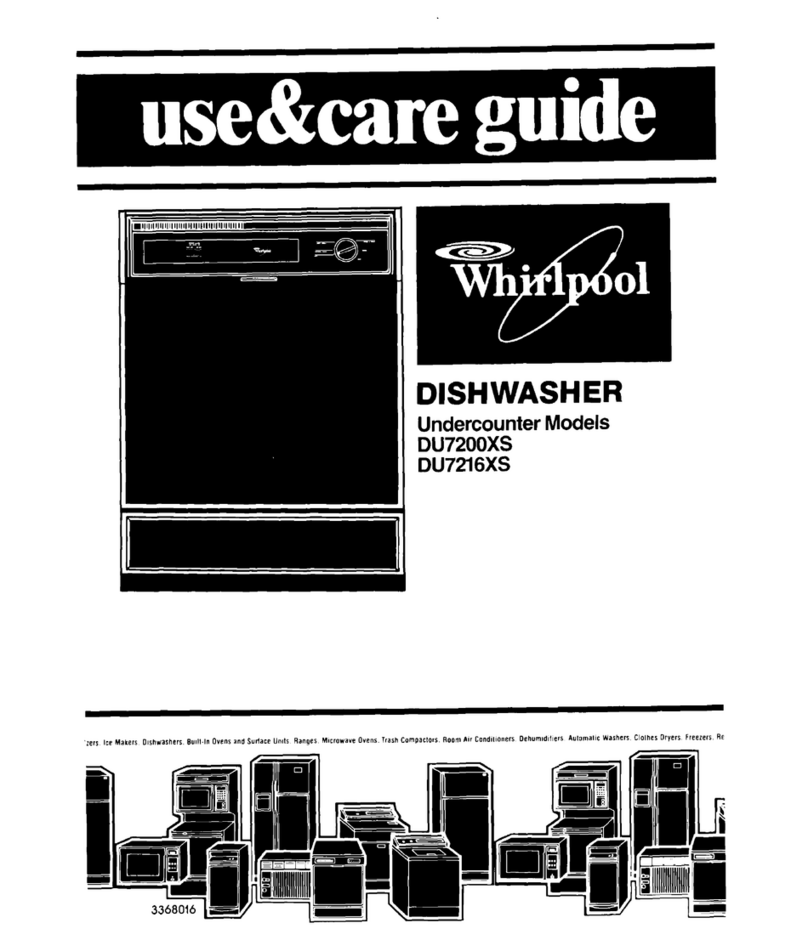
  9. Whirlpool DU8350XT Series User manual

Whirlpool DU8350XT Series User manual

Other Whirlpool Dishwasher manuals

Whirlpool W10130985A User manual

Whirlpool

Whirlpool W10130985A User manual

Whirlpool DU1055XT User manual

Whirlpool

Whirlpool DU1055XT User manual

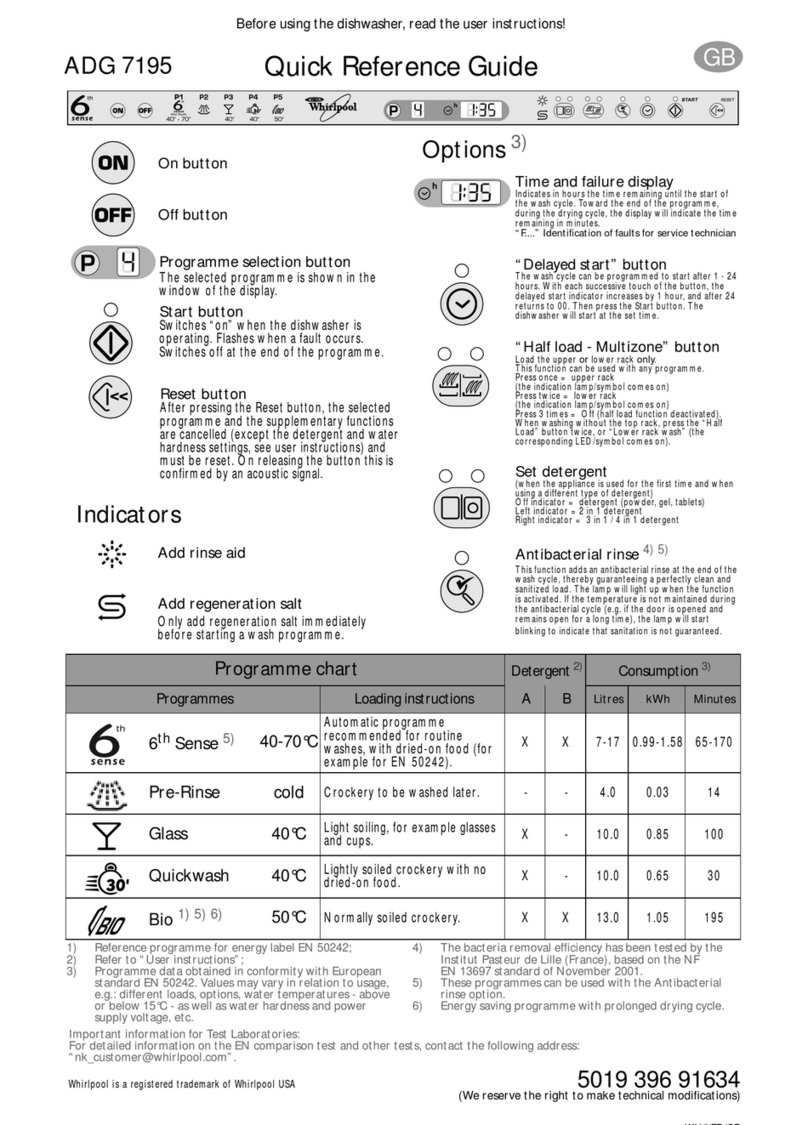
Whirlpool ADG 6966 IXM User manual

Whirlpool

Whirlpool ADG 6966 IXM User manual

Whirlpool WSIP 4O33 PFE User manual

Whirlpool

Whirlpool WSIP 4O33 PFE User manual

Whirlpool Series 960 User manual

Whirlpool

Whirlpool Series 960 User manual

Whirlpool DU8lOOXX User manual

Whirlpool

Whirlpool DU8lOOXX User manual

Whirlpool 200 380 21 User manual

Whirlpool

Whirlpool 200 380 21 User manual

Whirlpool W2I HD526 UK User manual

Whirlpool

Whirlpool W2I HD526 UK User manual

Whirlpool 900 SERIES User manual

Whirlpool

Whirlpool 900 SERIES User manual

Whirlpool ADP6000WH User manual

Whirlpool

Whirlpool ADP6000WH User manual

Whirlpool ADG 937 User manual

Whirlpool

Whirlpool ADG 937 User manual

Whirlpool Estate DU7770XS User manual

Whirlpool

Whirlpool Estate DU7770XS User manual

Whirlpool DU1098XR Series User manual

Whirlpool

Whirlpool DU1098XR Series User manual

Whirlpool ADP 402 User manual

Whirlpool

Whirlpool ADP 402 User manual

Whirlpool ADP 941/1 WH User manual

Whirlpool

Whirlpool ADP 941/1 WH User manual

Whirlpool ADG 9999 M User manual

Whirlpool

Whirlpool ADG 9999 M User manual

Whirlpool ADP 5600 User manual

Whirlpool

Whirlpool ADP 5600 User manual

Whirlpool 400 series User manual

Whirlpool

Whirlpool 400 series User manual

Whirlpool ADP 950/3 WH User manual

Whirlpool

Whirlpool ADP 950/3 WH User manual

Whirlpool WDF518SAFM User manual

Whirlpool

Whirlpool WDF518SAFM User manual

Whirlpool WUE2B19 Installation and operation manual

Whirlpool

Whirlpool WUE2B19 Installation and operation manual

Whirlpool DU1301XTV Assembly instructions

Whirlpool

Whirlpool DU1301XTV Assembly instructions

Whirlpool ADP 431 WT User manual

Whirlpool

Whirlpool ADP 431 WT User manual

Whirlpool WDF540PADW User manual

Whirlpool

Whirlpool WDF540PADW User manual

Popular Dishwasher manuals by other brands

Samsung DW-FN320T user manual

Samsung

Samsung DW-FN320T user manual

LG LDS 5811WW Service manual

LG

LG LDS 5811WW Service manual

Elba EDW-B1462D owner's manual

Elba

Elba EDW-B1462D owner's manual

VESTEL NOVUS Series Service manual

VESTEL

VESTEL NOVUS Series Service manual

Bosch SMS4EMW00E Instructions for use

Bosch

Bosch SMS4EMW00E Instructions for use

Global-Tek GT-CR 2 manual

Global-Tek

Global-Tek GT-CR 2 manual

Smeg Dishwasher 85028 Instructions for installation and use

Smeg

Smeg Dishwasher 85028 Instructions for installation and use

LG LD-4080W Service manual

LG

LG LD-4080W Service manual

Bauknecht GCF 625 operating instructions

Bauknecht

Bauknecht GCF 625 operating instructions

Sharp QW-HX13F47EI-EU user manual

Sharp

Sharp QW-HX13F47EI-EU user manual

Asko D5536XLFI operating instructions

Asko

Asko D5536XLFI operating instructions

Modena WP 7134 WVM User manual book

Modena

Modena WP 7134 WVM User manual book

Beko DFN39340X instruction manual

Beko

Beko DFN39340X instruction manual

AEG FAVORIT 65050 VI1P user manual

AEG

AEG FAVORIT 65050 VI1P user manual

Siemens SN23HI37VE user manual

Siemens

Siemens SN23HI37VE user manual

Maytag MDB4651AWB - Tall Tub Dishwasher User instructions

Maytag

Maytag MDB4651AWB - Tall Tub Dishwasher User instructions

Hotpoint Ariston LL 42 Instruction book

Hotpoint Ariston

Hotpoint Ariston LL 42 Instruction book

Siemens SN45ZW56CS user manual

Siemens

Siemens SN45ZW56CS user manual

manuals.online logo
manuals.online logoBrands
  • About & Mission
  • Contact us
  • Privacy Policy
  • Terms and Conditions

Copyright 2025 Manuals.Online. All Rights Reserved.

s j11
UNDERCOUNTER
DISHWASHER
Model DU8350XT Series
Contents Qlye
Page
BEFORE YOU USE YOUR DISHWASHER L How Much Detergent to Use 7
IMPORTANT SAFETY INSTRUCTIONS 2 RINSE AID DISPENSER. 7
PARTS AND FEATURES 3 BEFORE STARTING YOUR DISHWASHER, 8
FOR BEST RESULTS 4 STARTING YOUR DISHWASHER. 8
The Filtering System 4 Selecting a Cycle
Water Must Be Hot
4
HEAT DRY or AIR DRY? : 8
9
Quiet Operating Tips 4 Changing a Setting 9
PROPER LOADING ” 5 To Add a Dish After Starting 9
Top Rack Loading 5 ENERGY SAVING TIPS. 10
Bottom Rack Loading 6 SPECIAL TIPS ON DISHWASHER USE. 11
Silverware Basket Loading 6 COMMON DISHWASHING PROBLEMS., 42
ADDING DETERGENT. 7 IF YOU NEED SERVICE OR ASSISTANCE, 14
The Detergent Dispenser 7 WHIRLPOOL DISHWASHER WARRANTY 16
01989 Whirlpool Corporation
Before you use your dishwasher
It is your r&ponsibility to be sure your dishwasher:
l
Is installed by a qualified installer.
l
Has been installed where it is protected from the elements.
l
Has been installed on a floor strong enough to support its weight.
l
Has been properly connected to electricity, water and drain.*
l
Has been properly electrically grounded.*
l
Has had all hang tags and temporary labels removed.
l
Is not used by children or anyone unable to operate it properly.
l
Is properly maintained.
*See Installation Instructions for complete information.
Important safety instructions
To reduce the risk of tire, electrical shock, or injury when using your
dishwasher, follow basic precautions including the following:
l
Read all instructions before using the tom rack until the heating element has
dishwasher. cooled for at least 20 minutes.
l
DISHWASHER MUST BE ELECTRICALLY
l
DO NOT wash plastic items unless marked
GROUNDED. Read the Installation Instruc- “Dishwasher Safe” or the equivalent. If not
tions for details. marked, check manufacturer’s recommen-
l
Be sure your dishwasher is installed on a dations.
level floor that will hold the weight, and in
l
DO NOT use your dishwasher unless all en-
an arec! suitable for its size and use. closure panels are properly in place.
l
When discarding an old dishwasher, al- * DO NOT sit on, stand on or abuse the dish-
ways remove the door to prevent acciden- washer door or dish racks.
tal entrapment.
l
DO NOT tamper with controls.
l
REMEMBER, use your dishwasher only for
the job It was designed to do.
l
If hot water has not been used recently
[usually two weeks or longer), hydrogen
l
Store dishwasher detergent in a cool, dry gases may build up in the water heater
place WHERE CHILDREN CAN’T REACH IT. and the hot water pipes. HYDROGEN GAS
l
Use ONLY detergents and rinse aids recom- IS EXPLOSIVE. To prevent injury or
mended for use in a dishwasher. damage, before using your dishwasher,
l
Locate sharp items and knives so that they turn on all hot water faucets and allow
are not likely to damage door seal or cut water to run for several minutes. This will
the user allow gases to escape. Do not smoke or
l
DO NOT let children play in or on the use any open flame near the faucet while
dishwasher. it is open.
* DO NOT reach into the area below the bot-
l
Disconnect electrical power to the dish-
washer before attempting to service.
- SAVE THESE INSTRUCTIONS -

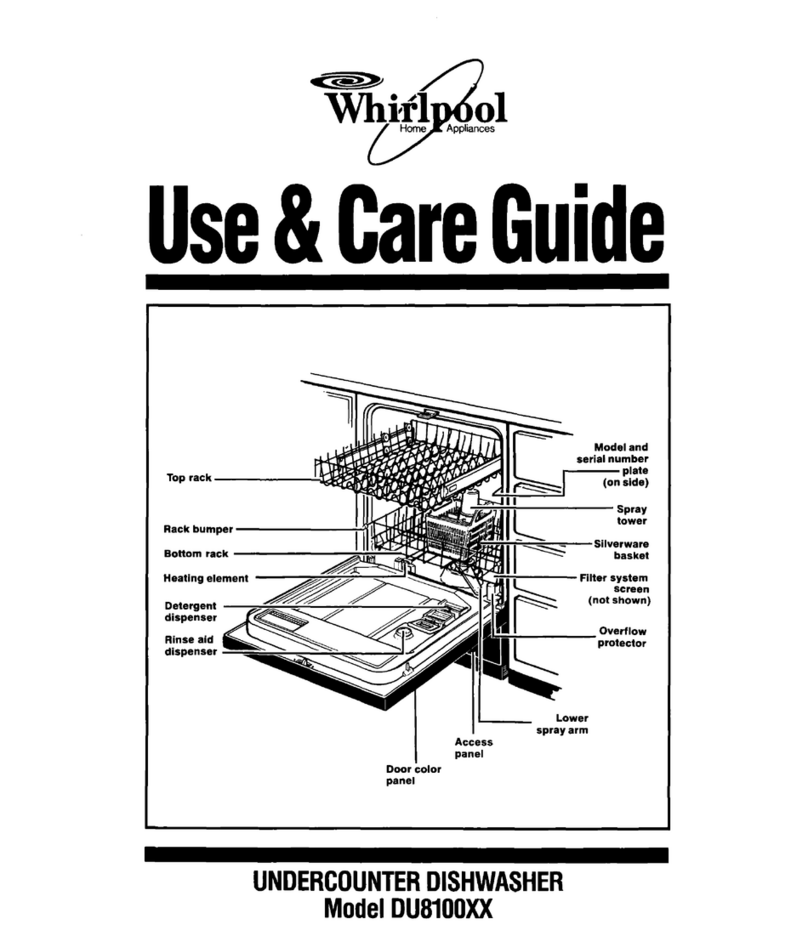
Parts and features
Model DU8350XT Series
BOTTOM RACK
RACK BUMPER
DETERGENT DISPENS PROTECTOR is
designed to prevent
too much water from
(Permanent Label)
Thank you for buying a Whirlpool appliance. Please complete and mail the Owner Regis-
tration Card provided with this product. Then complete the form below. Have this information
read 4 If you iced service or call with a question
l
Copy Moo II and Serial Ncrmbers from plate (see
Model Number
diagram c .)ove) and purchase date from sales
slip Serial Number
l
Keep this b
lok
and sales slip together in a handy
place
Purchase Date
Service
Comoanv Phone Number
For Best Results
Your dishwasher cleans by spraying a mix-
ture of hot, clean water and detergent against
soiled surfaces of dishes. When a cycle is
started, the dishwasher fills with waterto about
the level of the heating element. This water is
pumped through the rotating spray arms,
drained through the filter system which re-
moves food and soil, and pumped back
through the rotating spray arms. Soiled water
is pumped out and replaced with clean water
during a cycle-the number of times depends
on the cycle being used.
The self-cleaning filtering system and
removable pump guard help eliminate pre-
rinsing by removing food particles from the
Load dishes so soiled surfaces face pow-
erful spray from rotating arms.
The filtering system
It is not necessary to rinse dishes before 3. Press the outside wall of the pump guard at
putting them into the dishwasher. Just remove the center to release the latch.
large pieces and quantities of food and bones. 4. Lift out and rinse clean.
The filtering system helps keep food particles
out of the wash water. Small particles are flushed To replace the pump guard...
away as water is pumped out. Larger particles 1. Insert pump guard legs (on inside wall) into
are trapped in the pump guard. matching openings in filter screen.
2. Press down on outside wall until latch snaps
To remove the pump guard for cleaning. into place.
1. Wait at least 20 minutes after a cycle for 3. Replace bottom rack with rack bumpers in
the heating element to cool down. front.
2 Unload and remove the bottom rack.
Water must be hot
For best cleaning and drying results, water should be at least
140°F (60°C).
1. Turn on hot water faucet nearest the dishwasher. Let water run
until it is as hot as possible.
Check Water
Temperature
2. Hold a candy or meat thermometer in the stream of hot water
to measure the temperature.
3. Ifthe temperature is too low, have a qualified person raise
the water heater thermostat setting.
Quiet operating tips
To avoid thumping and claftenng noises during
operation:
l
Make sure lightweight load items are secured
in the rack.
l
Make sure pot lids and handles, pizza pans,
cookie sheets, etc. do not touch interior walls
4
or interfere with either of the spray arms
rotation.
. Load dishes so they don’t touch one another.
NOTE: Keep sink dmin plugs inserted during
dishwasher opemtion to prevent noise trans-
fer through drains.
Proper loading
Always load dishes so soiled surfaces are reached by spray from rotating spray arms.
Water must be able to drain off completely for best drying results. Be careful to separate
items so spray can reach all surfaces.
Top rack loading
UP AND GLASS LOAD
The top rack is designed for cups, glasses
and smaller items.
.
.
Place so open ends face down for clean-
ing and draining.
load glasses in top rack only. Bottom
rack is not designed for glasses. Damage
may occur.
l
Load plastic items in the top rack only.
Only plastic items marked “dishwasher
safe”’ are recommended.
l
Plastic items can be melted in the bottom
rack.
l
Place items in the rows between prongs.
Placing them over the prongs can lead
to breakage.
l
Be sure lightweight items are held firmly
in place.
l
China, crystal and other delicate items
must not touch each other during dish-
washer operation. Damage may occur.
l
Small bowls, pans and other
UtenSik can
be placed in the top rack.
. Items with cooked-on or dried-on foods should be loaded in the bottom rack with
soiled surfaces facing the spray.
Bottom rack loading
l
Make sure pot handles and other items do
not stop rotation of either the upper or lower
spray arm. Spray arms must move freely.
l
Load items so they do not block or cover
the spray tower.
l
Securely place heavily soiled cookware
face down in rack.
l
Place plates, soup bowls, etc., between
prongs and facing the spray
l
Load cookie sheets, cake pans and other
large items at sides or back. Loading
such items in front may keep water spray
from reaching detergent dispenser and
srlverware basket.
NOTE:
l
Do not load glasses, cups or plastic Items
in the bottom rack.
l
When lower rack is removed, replace
6 with bumpers in front.
Siheruare ha3het loading
Ldaa ‘arics ana spoons s.z theL don’t
nest together. SD~CIY;a” * r+:acb viested
Items
NO YES
Mix items in each section of the basket
with some pointing up and some down.
Small items - baby bottle caps, tar lids,
etc. - can be put in any section.
Make sure sharp items (knaves. forks,
skewers, etc ] are put in point down
The silverware basket can be loaded
while it’s In place on the door, or it can
be taken out for loading on the
Counter
or table
It can also be removed for easy un-
loading Always unload or remove the
basket before unloading the racks to
avoid spelling water droplets on the
To remove the basket, slide it toward
the top of the door - by the handle. Lift
it off the holding buttons. Replace it in
reverse order.
To open the basket, unhook the latch
as shown. Be sure the
cover is completely
latched before
pulling out the
bottom rack and
before closing
the drshwasher
door.
Adding detergent
The kind and amount of dishwasher detergent you use is an important part of
getting your dishes clean. Read this section carefully.
Use automatic dish-
washer detergent only.
Other detergents are
too mild and much too
sudsy to work in the
dishwasher.
Different brands of
dishwasher detergent
have different amounts
of phosphorus, Phos-
phorus softens water and
helps prevent water
spots on dishes.
If water is hard and
phosphorus content is
low (6.0% or less), you
may need to use more
detergent or use a brand
with a higher phosphorus
content (8.7% or higher).
Do not add detergent
until you are ready to
wash. Fresh automatic
dishwasher detergent
is necessary for best
washing results. Store
detergent tightly closed
in a cool dry place.
How much detergent to use
The detergent dispenser
The detergent dispenser has one section with
a cover and one without.
l
Put detergent in both sections for cycles with
two washes.
l
Put detergent in the covered section only for
cycles with one wash.
l
Push the cover down
until it is latched.
\ ,\!L
Detergent in the open
section falls into the dish-
washer when the door is
closed. The covered sec-
tion opens automatically
when the main wash
starts.
NOTE: It is normal for cover to open partially
when dispensing detergentThe coverwill open
fully when the door is opened.
COVER COVER LATCH I
Use covered section for. _. 1’ Use both
LIGHT WASH Cycle sections for.. .
POTS&PANS Cycle
NORMAL WASH Cycle
The amount of detergent to use
depends on the hardness of your
water. Iftoo little is used, dishes won’t
be clean. However, if too much is
used in soft water, glassware will
begin to etch.
Find out your water’s hardness by
asking your local water depart-
ment, water softener company or
county extension agent.
l
HARD - Fill 1or both sections to top line
if water hardness is 8 or more grains
per gallon, or 136 or more parts per
million.
l
MEDIUM - Fill 1or both sections to mid-
dle line if water hardness is 5 to 7 grains
per gallon, or 85 toll9 parts per million.
. SOFT - Fill 1or both sections to bottom
line if water hardness is 0 to4 grains per
gallon, or 0 to 68 parts per million.
Rinse aid dispenser
A rinse aid helps keep water from forming droplets and drying
as spots. Keep the dispenser filled with a rinse aid such as Jet-
Dry.” A small amount is released automatically during the final
rinse of each cycle.
Check the dispenser periodically to see if it needs refilling. An
“E” will be visible inside dispenser when it is empty Make sure
dishwasher door is fully open when refilling. Do not fill past the
smallest opening in the lower part of the dispenser. If you overfill,
excess rinse aid can come out. This will not harm the dishwasher.
Keep the dispenser fill cap tightly closed. 3
Before starting your dishwasher
1.
Read “Important Safety Instructions” on page
2 before starting your dishwasher.
2. Spin the Upper and Lower Spray Arms to
make sure nothing will stop them from turning
freely.
3. Push door firmly when closing and it will auto-
matically latch.
4. Run hot water at sink nearest dishwasher until
it is hot. Turn it off.
Starting your dishwasher
POTS & PANS Cycle...
1.
Turn Cvcle Control Knob clockwise to dot
2.
markedl POTS &.PANS. [POTS & PANS and NOR-
MAL WASH Cycles share the same spot on the
dial. The Selector Buttons determine which
cycle operates.) The dishwasher will auto-
matically start.
Push the POTS & PANS Selector Button only.
(The HEAT DRY option is preset. The AIR DRY
option cannot be selected.)
LIGHT WASH Cycle...
1.
Turn Cycle Control Knob clockwise to dot
marked LIGHT WASH. The dishwasher will au-
tomatically start.
2. Push the HEAT DRY or AIR DRY Selector Button.
Selecting a cycle
CYCLE SELECTOR BUllON
OPTION SELECTOR BUTTON
NORMAL WASH Cycle...
1.
Turn Cycle Control Knob clockwise to dot
marked NORMAL WASH. (NORMAL WASH and
POTS & PANS Cycles share the same spot on
the dial. The Selector Buttons determine
which cycle operates.) The dishwasher will
automatically start.
2. Push the HEAT DRY or AIR DRY Selector Button.
RINSE & HOLD Cycle...
1.
Turn Cycle Control Knob clockwise to dot
marked RINSE & HOLD. The dishwasher will
automatically start.
2. Push the AIR DRY Selector Button only.
POTS 81PANS Cycle
Maximum cleaning for cooked- or
baked-on foods Timer delays while
the dishwasher automatically heats
the water to 145 F (63 C] in both
washes and the last rinse (marked
l
).
Cycle time will be about
1%
to 2
hours, depending on time needed
to heat water.
NORMAL WASH Cycle
A double wash for normal to heav-
ily soiled loads. (The Energy Guide
Label data ISbased on this cycle.]
Cycle time ISabout 63 minutes.
LIGHT WASH Cycle
For normal,everyday soiled loads
Cycle time is about 58 minutes.
RINSE & HOLD Cycle
For rinsing a few items to be
washed one or more days later.
Cycle time is about 12 minutes.
Use AIR DRY only
HEAT DRY or AIR DRY?
If the HEAT DRY Option is selected, air in the
dishwasher is heated during the “dry” part of
the cycle.
If the AIR DRY Option is selected, air in the
dishwasher is not heated. Using this option helps
save energy, but dishes ta ke longer to dry (over-
night] and some water spotting may result.
Some items (such as plastics) may need towel
drying.
For best results, use a liquid rinse aid such as
Jet-Dry.”
Changing a setting
You can change a setting anytime during
any cycle.
1. Lift up on the door latch to unlatch the door
and stop the cycle. Don’t open the door until
the spray arms stop spinning.
2. Turn the Cycle Control Knob clockwise to the
cycle you want.
3. Be sure the detergent dispensers are filled
properly for the new cycle.
4. Press door firmly to latch it. The dishwasher
will automatically start the new cycle.
To add a dish after starting
3. Open the door and add the dish.
4. Close the door. Do not latch it. Wait 30 sec-
1. To be sure the added item is washed and
rinsed, make sure the Cycle Control Knob
has not passed LIGHT WASH.
3. Lift up on the door latch to unlatch the door
and stop the cycle. Don’t open the door until
the spray arms stop spinning.
onds for air in the dishwasherto warm up. This
helps reduce the amount of moisture that
can come from the vent when restarting the
cycle.
5. Press door firmly to latch it. The dishwasher
will automatically start where it stopped.
Energy saving tips
You can help save energy if you:
1. Wash full loads. Running a half-filled dish-
washer uses the same amount of electricity
and hot water as a fully loaded machine.
3. Air dry dishes when you don’t need a rapid
drying cycle. Allow longer drying times
(overnight).
2.
4.
5.
6.
7.
Use the LIGHT WASH Cycle for normally
soiled loads. It uses less hot water and energy
than other wash cycles.
I
load correctly for best washing results. In-
correct loading may cause poor washing
and the need to rewash all or part of the
load.
Don’t pre-rinse normally soiled dishes. Se-
lect the correct cycle for the load and use
the recommended amount of detergent for
good washing results without hand rinsing.
Use your dishwasher during off-peak hours.
Local utilities recommend this to avoid
heavy usage of energy at certain times of
day
Kitchen cleanup can be done quickly and
efficiently through the use of your dishwasher.
Most appliance parts that can fit in the dish-
washer can be cleaned by it. Burned-on soil,
however, should be cleaned by hand.