manuals.online logo
Brands
  1. Home
  2. •
  3. Brands
  4. •
  5. Zanussi
  6. •
  7. Dishwasher
  8. •
  9. Zanussi ZDI 6555 User manual

Zanussi ZDI 6555 User manual

Other Zanussi Dishwasher manuals

Zanussi DCS 383 User manual

Zanussi

Zanussi DCS 383 User manual

Zanussi ZDM17301SA User manual

Zanussi

Zanussi ZDM17301SA User manual

Zanussi ZDT36001FA User manual

Zanussi

Zanussi ZDT36001FA User manual

Zanussi DCS 14 W User manual

Zanussi

Zanussi DCS 14 W User manual

Zanussi DCS11 User manual

Zanussi

Zanussi DCS11 User manual

Zanussi ZDLN6621 User manual

Zanussi

Zanussi ZDLN6621 User manual

Zanussi ZDF3023X User manual

Zanussi

Zanussi ZDF3023X User manual

Zanussi ZDSN151X1 User manual

Zanussi

Zanussi ZDSN151X1 User manual

Zanussi DW 4826 User manual

Zanussi

Zanussi DW 4826 User manual

Zanussi ZDI101 User manual

Zanussi

Zanussi ZDI101 User manual

Zanussi DE 3043 User manual

Zanussi

Zanussi DE 3043 User manual

Zanussi ZDT16002 User manual

Zanussi

Zanussi ZDT16002 User manual

Zanussi ZDM11301WA User manual

Zanussi

Zanussi ZDM11301WA User manual

Zanussi ZT 455 User manual

Zanussi

Zanussi ZT 455 User manual

Zanussi ZDT15010FA User manual

Zanussi

Zanussi ZDT15010FA User manual

Zanussi DW683 User manual

Zanussi

Zanussi DW683 User manual

Zanussi DS30 User manual

Zanussi

Zanussi DS30 User manual

Zanussi N 900 User manual

Zanussi

Zanussi N 900 User manual

Zanussi ZDLN2621 User manual

Zanussi

Zanussi ZDLN2621 User manual

Zanussi DW927 User manual

Zanussi

Zanussi DW927 User manual

Zanussi ZDF 2010 User manual

Zanussi

Zanussi ZDF 2010 User manual

Zanussi DW 920 User manual

Zanussi

Zanussi DW 920 User manual

Zanussi DWS4825 User manual

Zanussi

Zanussi DWS4825 User manual

Zanussi ZDI 6764 User manual

Zanussi

Zanussi ZDI 6764 User manual

Popular Dishwasher manuals by other brands

Samsung DW-FN320T user manual

Samsung

Samsung DW-FN320T user manual

LG LDS 5811WW Service manual

LG

LG LDS 5811WW Service manual

Elba EDW-B1462D owner's manual

Elba

Elba EDW-B1462D owner's manual

VESTEL NOVUS Series Service manual

VESTEL

VESTEL NOVUS Series Service manual

Bosch SMS4EMW00E Instructions for use

Bosch

Bosch SMS4EMW00E Instructions for use

Global-Tek GT-CR 2 manual

Global-Tek

Global-Tek GT-CR 2 manual

Smeg Dishwasher 85028 Instructions for installation and use

Smeg

Smeg Dishwasher 85028 Instructions for installation and use

LG LD-4080W Service manual

LG

LG LD-4080W Service manual

Bauknecht GCF 625 operating instructions

Bauknecht

Bauknecht GCF 625 operating instructions

Sharp QW-HX13F47EI-EU user manual

Sharp

Sharp QW-HX13F47EI-EU user manual

Asko D5536XLFI operating instructions

Asko

Asko D5536XLFI operating instructions

Modena WP 7134 WVM User manual book

Modena

Modena WP 7134 WVM User manual book

Beko DFN39340X instruction manual

Beko

Beko DFN39340X instruction manual

AEG FAVORIT 65050 VI1P user manual

AEG

AEG FAVORIT 65050 VI1P user manual

Siemens SN23HI37VE user manual

Siemens

Siemens SN23HI37VE user manual

Maytag MDB4651AWB - Tall Tub Dishwasher User instructions

Maytag

Maytag MDB4651AWB - Tall Tub Dishwasher User instructions

Hotpoint Ariston LL 42 Instruction book

Hotpoint Ariston

Hotpoint Ariston LL 42 Instruction book

Siemens SN45ZW56CS user manual

Siemens

Siemens SN45ZW56CS user manual

manuals.online logo
manuals.online logoBrands
  • About & Mission
  • Contact us
  • Privacy Policy
  • Terms and Conditions

Copyright 2025 Manuals.Online. All Rights Reserved.

DISKMASKIN
ASTIANPESUKONE
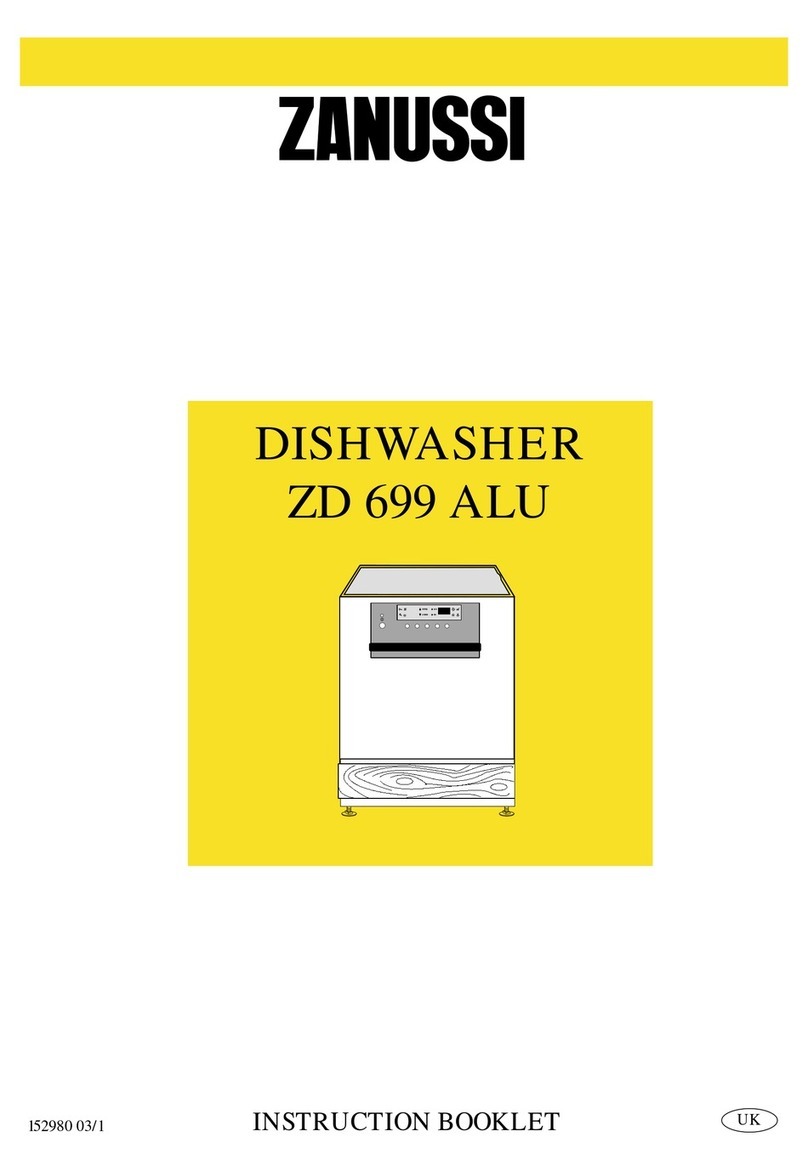
DISHWASHER
ZDI 6555
Bruksanvisning
Käyttöohje
Instruction book
S
FIN
GB
30
Important safety information 31
escription of the appliance 31
The control panel 32
Before use 32
Setting the water softener 32
Rinse aid 34
Using your appliance 35
Loading your appliance 35
Adjusting the height of the upper basket 35
Use of detergent 36
Hints and tips 36
Washing programmes 37
Operating sequence 38
Hints for test centres 39
Maintenance and cleaning 40
Internal cleaning 40
Cleaning the filters 40
External cleaning 40
Prolonged periods of non-operation 40
Frost precautions 40
Moving the machine 40
Something not working 41
Service and spare parts 42
Protection against flooding 42
Installation instructions 43
Water supply connections 43
Water outlet hose connection 43
Electrical connection 43
Contents
Dimensions Width 59.6 cm
Height 81.8 - 87.8 cm
Max depth 57.5 cm
Max depth with open door 111.4 cm
Electrical connection Voltage 230 V - 50 Hz
Motor rating during wash 200 W
Power of heating element 2100 W
Overall power 2300 W
Water supply pressure Minimum 50 kPa (0.5 bar)
Maximum 800 kPa (8 bar)
Capacity 12 place settings
Technical specifications
This appliance complies with the following E.E.C. irectives:
- 73/23 of 19.2.73 (Low Voltage irective) and subsequent modifications;
- 89/336 of 3.5.89 (Electromagnetic Compatibility irective) and subsequent modifications.
31
Installation
●This appliance is heavy. Care should be taken when moving it.
●It is dangerous to alter the specifications or attempt to modify
this product in any way.
●Care must be taken to ensure that the appliance does not
stand on the electrical supply cable.
●Any electrical work required to install this appliance should
be carried out by a qualified electrician or competent person.
●Any plumbing work required to install this appliance should
be carried out by a qualified plumber or competent person.
Child Safety
●This appliance is designed to be operated by adults.
Children should not be allowed to tamper with the controls or
play with the product.
●Keep all packaging well away from children.
●Keep all detergents in a safe place out of children's reach.
uring Use
●Items that are contaminated by petrol, paint, steel or iron
debris, corrosive, acidic or alkaline chemicals must not be
washed in this dishwasher.
●Under no circumstances should you open the door whilst the
appliance is in operation. Always turn off the appliance
before opening the door.
●Only use detergent specifically designed for use in
dishwashers.
●Long bladed knives stored in an upright position are a
potential hazard.
●Long and/or sharp items of cutlery such as carving knives
must be positioned horizontally in the upper basket.
●When finishing loading or unloading close the door, as an
open door can be a hazard.
●Do not sit or stand on the open door.
●Isolate the appliance from the power supply and turn off the
water supply after use.
●Care should be taken when cleaning the bottom door seal
and hinge area as any exposed metal edges may cut if care
is not taken.
●This product should be serviced by an authorised Service
engineer, and only genuine spare parts should be used.
●Under no circumstances should you attempt to repair the
machine yourself. Repairs carried out by inexperienced
persons may cause injury or serious malfunctioning.
Contact your local Service Force Centre. Always insist on
genuine spare parts.
Conservation
In the interest of the environment:
●Materials marked with the symbol are recyclable.
●Check with your local Council or Environmental Health Office
to see if there are facilities in your area for re-cycling this
appliance.
●When the appliance is to be scrapped, cut off the power
supply cable and make the door closing device unusable to
prevent young children from being trapped inside.
●Help to keep your country tidy - use authorised disposal sites
for your old appliance.
Important safety information
It is most important that this instruction book should be retained with the appliance for future reference. Should the appliance be
sold or transferred to another owner, or should you move house and leave the appliance, always ensure that the book is left with the
appliance in order that the new owner can get to know the functioning of the appliance and the relevant safety information.
This information has been provided in the interest of your safety. You MUST read it carefully before installing or using the appliance.
1. Levelling spacers
2. Upper basket stop
3. Salt container
4. Lower spray arm
5. Detergent dispenser
6. Control panel
7. Rating plate
8. Rinse aid dispenser9. Large filter
10. Central filter
11. Upper spray arm
12. Upper basket
escription of the appliance
1
2
3
4
5
7
8
9
10
11
IN86
12
6
Before using your dishwasher for the
first time:
1. Ensure that the electrical and water connections comply
with the installation instructions
2. Remove all packaging from inside the appliance
3. Set the water softener
4. Pour 1 litre of water inside the salt container and then fill
with salt
5. Fill the rinse aid dispenser.
Setting the water softener
The dishwasher is equipped with a water softener designed to
remove minerals and salts from the water supply, which would
have a detrimental or adverse effect on the operation of the
appliance.
The higher the content of these salts, the harder your water is.
Water hardness is measured in equivalent scales, Clarke
degrees, French degrees and PPM (parts per Million).
The softener should be adjusted according to the hardness of
the water in your area. Your local Water Authority can advise
you on the hardness of the water in your area.
The dishwasher is factory set at level 3.
If this level is not suitable for your area the softener should be
adjusted.
If your water is level 1 it is already soft and therefore there
is no need to use salt.
With the setting of the water softener at level 1 the salt
indicator light on the control panel will always remain off.
Use salt from level 2 upwards.
From level 2 upwards, if salt refilling is necessary, the salt
indicator light will illuminate only in setting mode and at
the end of the washing programme.
uring the run of the programme it will remain off.
Before use
Level Use of
salt
French
degrees
(°TH)
PPM
(Parts per
Million)
German
degrees
(°dH)
1
2
3
4
5
NO
YES
YES
YES
YES
< 4
4 - 18
19 - 29
30 - 40
41 - 50
< 8
8 - 30
31 - 50
51 - 70
71 - 90
< 80
81 - 300
301 - 500
501 - 700
701 - 900
Water hardness
32
1. On/Off indicator light
2. On/off push button
3. oor handle
4. Programme selection push buttons
6. elay start push button
This option allows the start of the programme to be
delayed by 3, 6 or 9 hours.
7. Indicator lights
Phase indicator lights
Washing phase
illuminates when the washing phase is running
rying phase
illuminates when the drying phase is running
End of programme
illuminates when the washing programme has
ended
Salt and rinse aid indicator lights
Salt refilling indicator light
illuminates when the salt has run out and the
salt container requires refilling.
Rinse aid refilling indicator light
illuminates when the rinse aid has run out and
the rinse aid container requires refilling.
The control panel
33
To select a different level be sure that
the dishwasher is off and then proceed
as follows:
1. Press 70° 80Iand 65° programme push buttons
simultaneously.
2. While keeping the programme push buttons 70° 80Iand
65°° pressed switch on the dishwasher by pressing the
On/Off push button.
The On/Off indicator light comes on.
At the same time, the indicator lights of the 70° 80Iand 65°
push buttons start flashing.
Press the 70° 80Ipush button, the indicator light of the 65°
push button turns off, while the indicator light of the 70° 80I
push button remains fixed for about 5 seconds and then
starts to flash indicating the current level.
The current level is indicated by the number of flashes
made by the 70° 80Iindicator light, that alternates 5
seconds off with a number of flashes, this continues for
about 60 seconds.
Example:
1 flash = level 1
2 flashes = level 2
3 flashes = level 3
4 flashes = level 4
5 flashes = level 5
3. To change the level, press the 70° 80Iprogramme push
button. Each time the push button is pressed the level
changes.
Example:
If the current level is 3, by pressing the 70° 80Iprogramme
push button once, level 4 is selected.
If the current level is 5, by pressing the 70° 80Iprogramme
push button once, level 1 is selected.
The 70° 80Iindicator light remains off for about 5 seconds
after which it starts flashing indicating the new level
selected.
4. To memorise the new level, switch off the dishwasher by
pressing the On/Off push button.
Filling with salt
Only use salt specifically designed for use in
dishwashers.
All other types of salt not specifically designed for use in
a dishwasher, especially table salt, will damage the water
softener.
Only fill with salt just before starting one of the complete
washing programmes.
This will prevent any grains of salt or salty water, which
may have been spilled, remaining on the bottom of the
machine for any period of time, which may cause
corrosion.
To fill:
1. To fill with salt, unscrew the cap of the salt
container.
2. Pour 1 litre of water inside the container (this is necessary
only before filling with salt for the first time).
3. Using the funnel provided,
pour in the salt until the
container is full.
Do not worry if water over
flows from the unit when
filling with salt, this is quite
normal.
4. Replace the cap making
sure that there is no
trace of salt on the screw
thread or on the gasket.
5. Screw on the cap tightly.
The salt container will require topping up periodically.
You are reminded of this by the salt indicator light on the
control panel which comes on when the salt has finished.
The salt indicator light on the control panel can remain
illuminated for 2-6 hours after the salt has been
replenished, assuming the dishwasher remains switched
on. If you are using salts that take longer to dissolve then
this can take longer. The function of the machine is not
affected.
SO478
SO477
SALE
SALT
SALZ
SEL
SR06
34
Rinse aid
Rinse aid is automatically added during the last rinse, ensuring
thorough rinsing, and spot and streak free drying. The
dispenser, which is positioned inside the door, holds about 110
ml of rinse aid, which is sufficient for 16 - 40 dishwashing
programmes, depending upon the dosage setting.
Filling with rinse aid
1. Open the container by turning the lid (A) anticlockwise.
2. Add the rinse aid until the container is completely full.
The indicator (B) will be completely dark.
3. Top up the rinse aid when the rinse aid indicator light on the
control panel illuminates.
If rinse aid refilling is necessary, the rinse aid indicator
light will illuminate only in setting mode and at the end of
the washing programme.
uring the run of the programme it will remain off.
Ensure that the lid is closed after every refill.
Do not put liquid detergent in the rinse aid compartment. Clean
up any rinse aid spilt during filling with an absorbent cloth to
avoid excess foaming during the next wash.
It is possible to deactivate the rinse aid indicator light (see
the following instructions). By default the rinse aid indicator
light is active.
To deactivate the rinse aid indicator
light be sure that the dishwasher is off
and then proceed as follows:
1. Press 70° 80Iand 65° programme push buttons
simultaneously.
2. While keeping the programme push buttons 70° 80Iand 65°
pressed switch on the dishwasher by pressing the On/Off
push button.
The On/Off indicator light comes on.
At the same time, the indicator lights of the 70° 80Iand 65°
push buttons start flashing.
3. Press the 65° push button, the correspondent indicator light
keeps flashing while the indicator light of the 70° 80Ipush
button turns off.
At the same time the indicator light "end of programme"
starts to flash.
4. Press the 65° push button again, the "end of programme"
indicator light turns off, this means that the rinse aid
indicator light has been deactivated.
5. To memorise the operation, switch off the dishwasher by
pressing the On/Off push button.
To reactivate the rinse aid indicator light follow the same
process until the "end of programme" indicator light starts to
flash.
Adjusting the dose
According to the finish and drying results obtained, adjust the
dose of rinse aid by means of the 6 position selector (C)
(position 1 minimum dosage, position 6 maximum dosage).
Increase the dose if there are drops of water or lime spots on
the dishes after washing.
Reduce it if there are sticky whitish streaks on the dishes.
BR01 BR03
SO479
SO477
BR02
35
Loading your appliance
Before placing dishes in the machine, remove any scraps of
food, to avoid clogging the filters and consequently reducing
the performance.
o not load very small items which can fall through the
baskets.
Open the door and slide out the baskets to load the dishes.
The lower basket
The lower basket is designed to take saucepans, lids, plates,
salad bowls, cutlery etc.
Serving dishes and large lids should be arranged around the
edge of the basket, ensuring that the upper spray arm can turn
freely.
The rows of prongs on the lower basket can be easily lowered
to allow you to load pots, pans and bowls.
To lower the prongs:
- Slightly pull them upward
and let them drop down
(see picture).
- To bring them back to the
standing position, just pull
them up again.
The cutlery basket
Long bladed knives stored in an upright position are a
potential hazard.
Long and/or sharp items of cutlery such as carving knives
must be positioned horizontally in the upper basket.
Take care when loading or unloading sharp items such as
knives.
Cutlery should be placed in the removable cutlery basket with
the handles facing downwards. If the handles protrude from
the bottom of the basket, obstructing the lower spray arm, load
the cutlery with the handles facing upwards.
Mix spoons with other cutlery to prevent them from sticking
together.
The cutlery basket is in two parts which can be separated to
give greater loading flexibility. To separate the two parts, slide
them horizontally in opposite directions and pull them apart. To
reassemble, reverse the
procedure.
For best results we
recommend you to use the
cutlery grids provided (if the
size and dimensions of the
cutlery allow it).
The upper basket
The upper basket is designed for plates (dessert plates,
saucers, dinner plates of up to 25 cm in diameter), salad
bowls, cups and glasses.
Arrange items on and
underneath the cup racks so
that water can reach all
surfaces.
Glasses with long stems can
be placed upside down in the
cup racks.
Light items (plastic bowls
etc.) should be loaded in the
upper basket and arranged
so they do not move.
In case that plates are loaded in the upper
basket:
load t em starting from t e
rear positions of t e basket;
tilting t em slig tly forwards
and avoiding t e front
positions near t e door.
Before closing the door, ensure that the spray arms can
rotate freely.
Adjusting the height of the upper basket
If washing very large plates (over 27 cm and up to 32 cm in
diameter) you can load them in the lower basket after moving
the upper basket to the higher position.
To move to the higher position proceed as follows:
1. Move the front runner stops (A) of the upper basket
outwards and slide the basket out.
2. Refit the basket in the higher position and replace the stops
(A) in their original position.
When the top basket is in
the higher position it will
only take plates up to 20
cm in diameter and you will
not be able to use the cup
racks.
After loading your machine always close the door, as an
open door can be a hazard.
Using your appliance
UI48 UI21
UI86
UI07
UI63
US47
US71
RC01
To save energy
Place dishes in the machine immediately after every meal and
wait until the dishwasher is full before washing.
Do not prewash dishes under running water.
Select the QUICK 60° A 30Iprogramme when dishes are not
very soiled, following the instructions given in the "Washing
programmes" chart.
For best washing results
Before loading, remove all scraps of food and soak very
heavily soiled pots and pans.
Arrange saucepans, cups and glasses etc. upside-down.
Tilt items with convex or concave surfaces so that the water
drains off easily.
Avoid contact between the dishes as far as possible.
Items not suitable for dishwashers
The following items should not be washed in the dishwasher
(unless they are sold as dishwasher proof):
- Cutlery with wooden or horn handles or glued parts
- bronze cutlery
- saucepans with wooden handles
- aluminium ware
- crystal ware
- leaded glass
- plastic items
- antique or fine decorated china
Certain types of decoration can discolour when washed in a
dishwasher.
Crystal-ware and plastic objects, if not guaranteed dishwasher
proof should be washed by hand.
Certain types of glass can also become opaque after being
washed several times in a dishwasher.
A chemical reaction can occur between silver cutlery and
stainless steel cutlery. As a precaution, do not wash together.
Iron and cast iron objects can rust and stain other items.
Aluminium tends to go black, copper, pewter and brass tend to
stain.
If in doubt check with manufacturer of the item.
When buying new dishes, ensure that they are dishwasher
proof.
Hints and tips
36
Use of detergent
Only use detergents specifically designed for use in
dishwashers.
If using powder detergents proceed as follows:
1. Open the dispenser lid by pulling the catch (D).
2. Add the detergent according to the instructions given in the
"Washing programmes" chart.
As all detergents are not the same, you should also consult
the instructions on the packet.
3. Always close the lid.
4. The programmes with prewash require a small extra
amount of detergent to be poured over the lid of the
dispenser. Follow the recommended quantity of detergent
given in the "Washing programmes" chart.
If using detergent in tablets proceed as follows:
1. For all programmes; place 1 tablet inside the detergent
dispenser.
2. Always close the lid.
3. For all programmes with prewash; place a portion of a
further tablet on the lid of the detergent dispenser.
ONLY in case of use of detergent in tablets with "Quick 60° A
30I"programme, it is advisable to put the tablet directly in the
dishwasher and not in the dispenser or in special tablet
containers.
Insufficient quantities of detergent will produce poor
washing results, whereas an excessive amount of
detergent will not improve washing results and is also
wasteful.
Using no more than the correct amount also contributes
to reducing pollution.
Compact detergents with enzymes
In these compact powders the environmentally unfriendly
components have been replaced by natural enzymes and
other more biodegradable substances.
The enzymes deploy their full dirt dissolving power at a
temperature as low as 50°C.
By choosing the BIO/50°C programmes you can therefore
achieve the same cleaning results that would otherwise be
achievable only with 65°C programmes and conventional
detergents.
DE17 DE02
Washing programmes
37
Type of load egree of soil
Normal soil.
Crockery, cutlery,
pots and pans
Normal soil.
Crockery and cutlery
Normal soil.
Crockery and cutlery
Light soil.
Crockery, cutlery,
delicate china and
glassware
Fresh soil.
Crockery and cutlery
Required
push buttons Cycle
description
Recommended
quantity of detergent
wash prewash
25 g 5 g
20 g 10 g
20 g /
25 g 5 g
25 g 5 g
Warm prewash
Main wash up to 70°C
1 cold rinse
1 hot rinse
Turbo dry
Main wash up to 60°C
1 hot rinse
Cold prewash
Main wash up to 65°C
1 cold rinse
1 hot rinse
Turbo dry
Cold prewash
Main wash up to 50°C
2 cold rinses
1 hot rinse
Turbo dry
Cold prewash
Main wash up to 45°C
2 cold rinses
1 hot rinse
Turbo dry
*Ideal for washing a complete load of 12 place settings with normal soil.
Characterised by a duration of about 80 minutes and a washing temperature of 70°C.
The time value is approximate and depends on the pressure and the temperature of the water and also by the variations
of the power supply.
** Ideal for washing crockery and cutlery of breakfast and dinner (fresh soil).
Characterised by a duration of about 30 minutes and a washing temperature of 60°C.
The time value is approximate and depends on the pressure and the temperature of the water and also by the variations
of the power supply.
This is the perfect daily programme, made to meet the needs of a family of 4 persons who only wish to load breakfast
and dinner crockery and cutlery.
*** Testing programme for EN 50242 (see "Hints for Test Centres). This programme, developed for the use of detergents with
enzymes, allows to achieve, with reduced consumption of energy the same cleaning results that would otherwise be obtained
only with the 65°C programmes and conventional detergents. To compensate the lower temperature, the duration of the
programme has been prolonged.
On/Off
+
70° 80I
On/Off
+
65°
On/Off
+
60° A 30I
On/Off
+
BIO 50°
On/Off
+
45°
*Intensive 70° 80I
** Quick 60° A 30I
***
Bio 50°
Normal 65°
elicate 45°
38
1. Check the filters
Ensure they are clean and properly positioned (see
"Maintenance and cleaning").
2. Press the On/Off push button
The On/Off indicator light will come on.
3. Check that there is rinse aid and salt
The corresponding indicator lights will illuminate if refilling
is necessary.
4. Load the dishes
Remove any scraps of food.
Pull the lower basket out and arrange the saucepans,
plates and cutlery in it.
Pull the upper basket out and arrange the plates,
saucers, glasses and cups etc. in it.
Slide the baskets back into the machine.
5. Ensure that the spray arms can
rotate freely.
6. Measure out detergent
Add the required amount of detergent into the dispenser
according to the recommended quantity given in the
"Washing programmes" chart.
Close the detergent dispenser lid.
7. Close the dishwasher door
8a. Setting and starting the programme
without "delay start"
Press the push button corresponding to the required
programme: the indicator light corresponding to the
programme illuminates and the phase indicator lights for
that programme start flashing.
The start of the programme will occur after about 6
seconds from the last pressure of a push button
(programme push button), in this time it is possible to
change programme simply pressing the push button of
another programme.
Once the programme has started the phase indicator
lights will turn off except for the phase under way.
It is possible to interrupt the programme by:
●opening the door
●pressing the On/Off push button (in this case all the
indicator lights turn off)
Close the door again or press the On/Off, the programme
will start from the point in which it was interrupted.
8b. Setting and starting the
programme with "delay start"
The setting of the delay start occurs before selecting the
programme.
Press the delay start push button and selected the
desired time (3, 6 or 9 hours) until the indicator light
corresponding to the chosen hours flashes.
Press the push button corresponding to the required
programme: the indicator light corresponding to the
programme illuminates and the phase indicator lights for
that programme start flashing.
The start of the countdown will occur after about 6
seconds from the last pressure of a push button
(programme push button).
The countdown will decrease with step of 3 hours and
you are informed of this by the indicator lights of the
hours.
During the countdown the only indicator lights illuminated
are the programme light and the light of the number of
hours to the start of the programme.
Once the delayed time has elapsed the programme will
start automatically.
It is possible to stop a countdown in progress or before it
starts, simply pressing the delay start push button until
the indicator lights of the hours are off.
9. To cancel a programme in progress
A programme in progress can be cancelled at any time.
Press for about 3 seconds the push button of the running
programme until all indicator lights are off.
Only the On/Off indicator light will remain on once the
programme has been cancelled.
It is now possible to select a new washing programme.
10. At the end of the washing
programme
The dishwasher will automatically stop and the phase
indicator light end of programme will come on.
The indicator light of the programme just ended will
remain on.
The dishwasher has finished the programme only when
the end of programme indicator light is illuminated.
If you do not wait for the end of the programme it will not
be possible to start a new programme if first you do not
cancel the previous.
(For instructions on how to cancel a programme see
point 9)
If during the drying phase (drying indicator light
illuminated) the dishwasher door is opened or the
On/Off push button is pressed, the running programme is
automatically cancelled.
In this case the machine returns to setting mode and it is
possible to select a new washing programme without
cancelling the previous.
Switch off the dishwasher by pressing the On/Off push
button and open the door.
Wait a few minutes before removing the dishes; in this
way ythey will be cooler.
Empty the lower basket first and then the upper one; this
will avoid water dripping from the upper basket onto the
dishes in the lower one.
Operating sequence