7
Choosing the Mounting Location
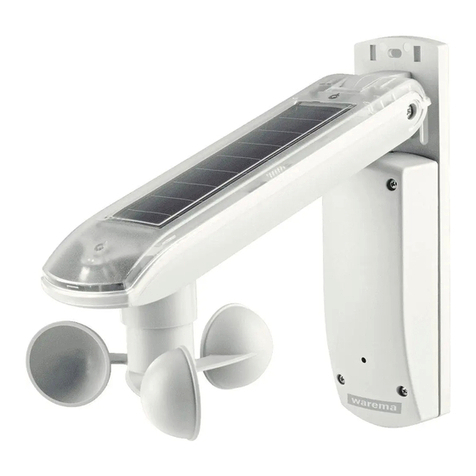
For accurate readings and a reliable GPS signal, selecting the best location for
the WeatherStation instrument is very important. Easy access and appearance
should be secondary considerations. Since each installation is unique, the best
separation distances from other equipment on the boat will vary depending on the
particular equipment and how it is configured. Choose a location that balances the
requirements below (see Figure 1).
• The WeatherStation instrument must be mounted in “clear air”—away from
obstructions in any direction that will interfere with air flowing through the unit. If
there is an obstruction, be sure to mount the WeatherStation instrument at least
2m (6') away. On land, avoid roof tops, chimneys, trees, etc.
• If possible, mount the WeatherStation instrument higher than any other object.
Mount it a minimum of 500mm (20") above the surrounding surfaces. (Note that the
higher the WeatherStation instrument is mounted, the less accurate the pitch and
roll readings will be.)
• Because the WeatherStation instrument has an electronic compass, it should
be at least 1m (3') away from any on-board radar equipment or other strong
magnetic fields from equipment such as radio transmitters, boat engines,
generators, etc.
• Because the WeatherStation instrument has a GPS, it must be lower than any
on-board INMARSAT communications antenna.
• Because the WeatherStation instrument has a GPS, be sure it is as far as
possible from high-powered transmitting antennas to avoid mutual interference.
• Because the WeatherStation instrument has a GPS, check for any
electromagnetic shading. That is, any obstructions from other vessels or
shoreline buildings that will interfere with the GPS signals that the
WeatherStation instrument must receive.
Figure 1. Antennas
Courtesy of Northstar BNT, Acton, MA
Min. 1m