7www.amico.com
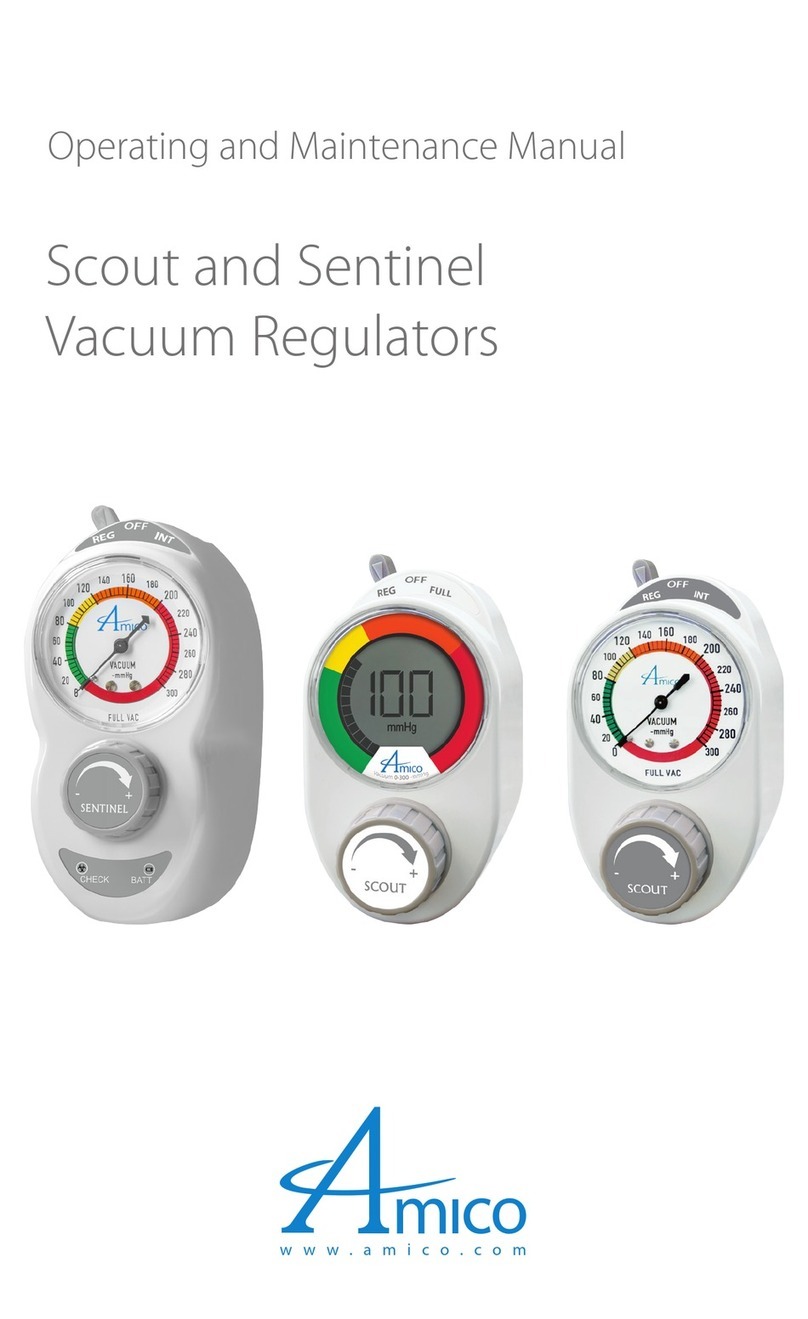
WARNING: The following tests are recommended prior to use on each patient. If the
Vacuum Regulator does not pass one or more of the following tests, it should be evaluated,
repaired and/or replaced by a qualified individual.
REGULATOR TESTING:
The following tests must be done with a minimum supply vacuum of -53 kPa (-400 mmHg):
1. Move the Selector Switch to the OFF position. Turn the Regulator Knob one complete turn in the
clockwise direction. Kink the vacuum tubing to block the outlet. There should be no movement
of the gauge reading.
2. Move the Selector Switch to the REG position. Turn the Regulator Knob fully in the
counterclockwise direction. Kink the vacuum tubing. Again, there should be no movement of
the gauge reading.
3. Kink the vacuum tubing and set the regulator as follows:
Standard: Increase the vacuum to -12 kPa (-90 mmHg)
Pediatric and Neonatal: Increase the vacuum to -5 kPa (-40 mmHg)
REGULATOR SETTING:
4. Open and close the kinked vacuum tubing slowly to reach various vacuum rates. Ensure that the
level of vacuum remains consistent when the vacuum tubing is kinked.
For Intermittent Regulators only:
a. Move the Selector Switch to INT.
b. Kink the vacuum tubing.
c. Timing cycles are approximately 16 seconds ON and 8 seconds OFF.
NOTE: The intermittent mode starts in the OFF phase.
d. Decrease the vacuum level to zero and move the Selector Switch to the OFF position.
RELIEF VALVE TESTING FOR PEDIATRIC AND NEONATAL REGULATORS ONLY
1. In the REG mode, kink the vacuum tubing and turn the Regulator Knob fully in the clockwise
direction to ensure that the vacuum level does not go over -21 kPa (-160 mmHg) for Pediatric,
and -13 kPa (-100 mmHg) for Neonatal. The Vacuum Regulator is equipped with a Safety Relief
Valve that triggers and emits an audible vibration once the maximum allowable vacuum is
reached. To reset the Safety Relief Valve, turn the Regulator Knob counterclockwise to reduce the
vacuum level. If the Safety Relief Valve fails to trigger when the maximum allowable vacuum is
reached, do not use the Vacuum Regulator and contact your service provider.
NOTE: This feature is only present for the Pediatric and Neonatal models.
SENTINEL CHECK FOR SENTINEL REGULATORS ONLY
1. On the back of the Vacuum Regulator, press the TEST button using a small screwdriver or allen
key and hold for 1 second. The Amber BATT LED will light up. This indicates that the batteries are
not dead. If the Red CHECK LED doesn’t turn on, this means that the unit is not contaminated.
Procedures Prior to Use