B) BALANCE POINTS (Cont.)
1. LOW BALANCE POINT – the outdoor temperature below which compressor terminals
will not be energized.
2. HIGH BALANCE POINT – the outdoor temperature above which the auxiliary heat terminal
will not be energized in the HEAT mode (does not effect Emergency Heat operation).
C) DISPLAY OPTIONS
1. TEMPERATURE SCALE – all temperatures displayed including room temperatures and
set points can be °F or °C.
2. SHOW TEMPERATURE SET POINTS ALWAYS – keeps the temperature settings visible on
the display at all times.
3. SHOW TEMPERATURE SET POINTS ONLY IF CHANGED – displays the temperature
settings (heat and/or cool) only when the user changes them. The first press of either
the up or down adjust buttons will display the settings.
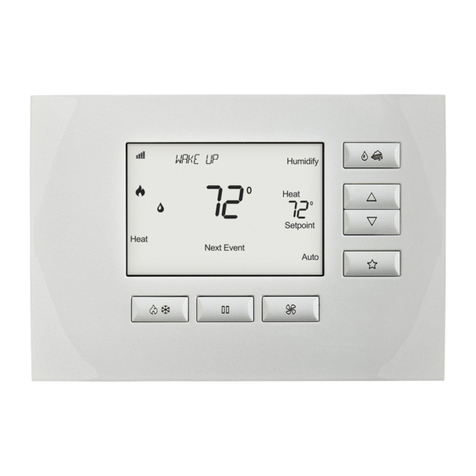
4. SHOW DATE AND TIME – the message display will, by default, scroll three messages
showing the status of the mode, fan and equipment outputs. A fourth date and time can be
added to this list. However, the automation system must transmit the time and date to
the thermostat at least once a day. If the automation system is not capable of doing
this, the date and time can be configured not to show.
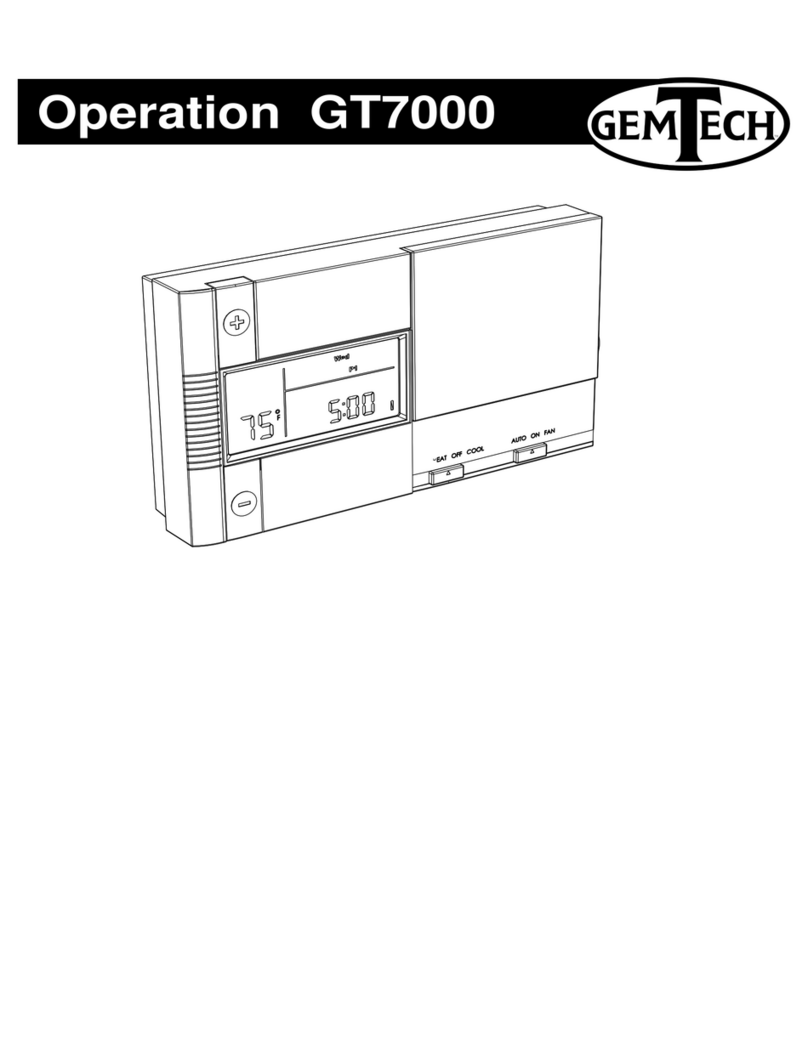
11. TO ACCESS THESE HVAC SET-UP FEATURES
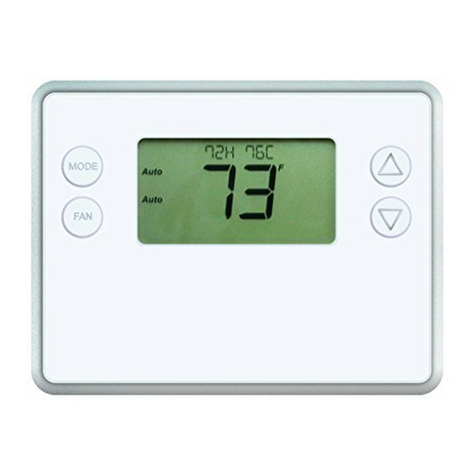
When first powered up, the message display will scroll through the current mode status,
fan status, and heating/cooling output status. This is referred to as Passive Display because
you do not interact with it. To get into the Set-Up Menu, press the Enter button
and Mode button at the same time. This is referred to as User Interactive Display, as the user
navigates through various menu and sub-menu selections to change variables.
13
10. OPTIONAL HVAC SET-UP FEATURES
There are a number of HVAC features that can be configured for the particular application.
These include temperature control options, display options and high/low balance points
(heat pumps only).
A) TEMPERATURE CONTROL OPTIONS
1. OFFSET – allows the user to offset the displayed room temperature ±3°F from true
temperature. This thermostat is calibrated to be within ±1°F of true temperature.
2. 1ST STAGE DIFFERENTIAL – determines the level of control and consequently the cycle
rate. Adjustable between 1°F and 5°F, this is the value above/below the set point
that the temperature must rise (fall) to start the cooling (heating). It is also the value
below (above) the set point that the temperature must fall (rise) for the cooling (heating)
to stop. For example, if the temperature setting was 70°F and the 1st stage differential
was set at 0.5°F, in the heat mode the heat would come on at 69.5°F and stay until the
temperature was 70.5°F. A small differential will result in a tighter control, but more
heating/cooling cycles.
3. 2ND STAGE DIFFERENTIAL – again adjustable between 1°F and 9°F, this also
determines the level of control by determining when to use the 2nd stage of heating or
cooling. It can also be used to keep 2nd stage cooling from coming on too soon when
1st stage is acting to control temperature levels or to keep costly auxiliary heat from
coming on too soon when the heat pump is sufficient.
B) BALANCE POINTS
These values are adjustable, but are only used by the thermostat when it has been
configured to operate as a heat pump and when a remote outdoor temperature sensor,
with address #1, is wired to the thermostat.
12