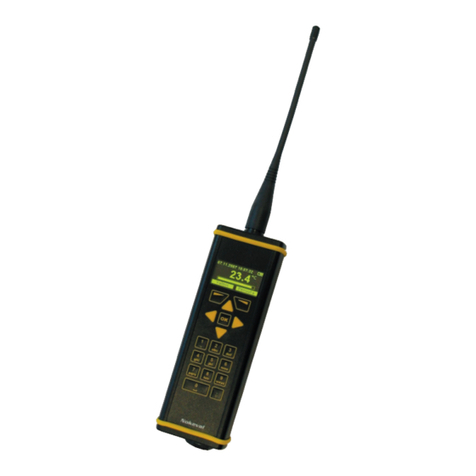
ARG 5410 MKII SARSAT Beacon Tester
4
5410-EQ001-HB1.doc © A·R·G ElectroDesign Ltd. 2004
1. Introduction
1.1 Overview
COSPAS-SARSAT beacons are battery powered devices capable of initiating
an alert by transmitting a distress message via satellite on the frequencies
406.025MHz and/or 121.5MHz. 121.5MHz beacons employ a swept tone
amplitude modulation, whereas 406MHz beacons transmit a short burst of
phase modulated power repeated at approximately 50 second intervals. Most
406MHz beacons also include a low power 121.5MHz swept tone transmitter,
intended to act as a homing signal for rescue forces.
The following terms are also used to describe these distress transmitters:
EPIRB: Emergency Position Indicating Radio Beacon - generally
used for beacons intended for marine use.
ELT: Emergency Locator Transmitter - usually refers to a beacon
carried by aircraft, and may be activated by a crash
detection switch.
PLB: Personal Locator Beacon - used by COSPAS-SARSAT to
denote a beacon intended for land mobile use. This term is
also used for beacons carried by aircrew.
The COSPAS-SARSAT system can provide the rescue forces with the location
of the beacon, based on the apparent frequency shift of the signal as
received by the moving satellite (the Doppler effect). In addition, each
406MHz transmission contains a coded message which can uniquely identify
the beacon, and may provide additional information such as method of
activation, nature of distress etc. A number of different protocols are used,
depending on the type of user and the national regulations guiding the use
of the beacon.