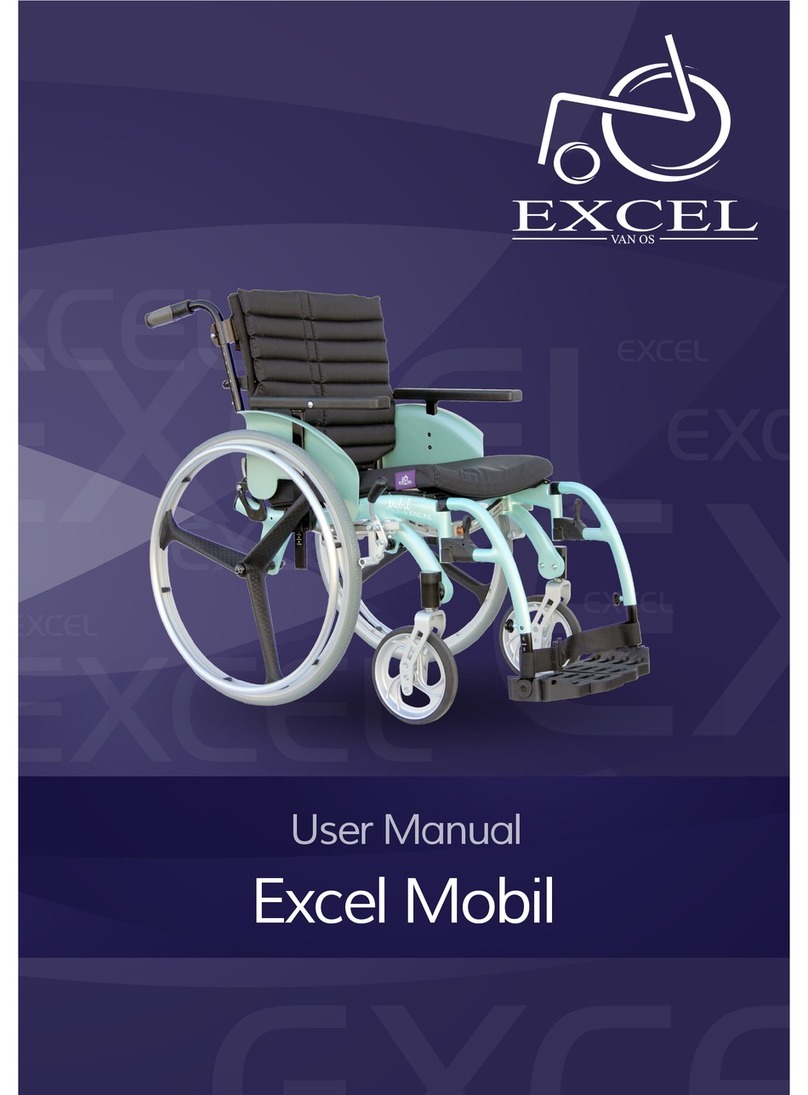
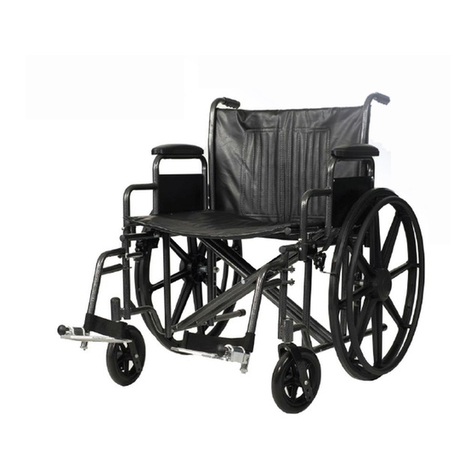
USER MANUAL - ALUMINUM WHEELCHAIR
Ladies and Gentlemen,
Thank you for purchasing our wheelchair, we appreciate the trust you have placed in us. We have made every effort to ensure that our
equipment meets your expectations. We hope that it will be practical, helpful and will make it much easier for you to move around the
house as well as during your daily walks. Before use, please read this user manual and strictly follow the safety regulations. Please keep
this manual, which also serves as a warranty card.
Intended use of the product:
A wheelchair is an auxiliary and rehabilitation device intended for individual transport of disabled people after spinal cord injury, with cerebral palsy
and with various injuries and paresis of the lower limbs. As well as for people with neuromuscular diseases, after brain injuries, and for geriatric
patients. It is also intended for people who want to actively and comfortably participate in everyday life despite problems with the musculoskeletal
system.
Contraindications:
Contraindications to the sitting position. Motor coordination disorders, labyrinth problems, spinal instability. Intellectually limited people should not use the product
without the supervision of a guardian.
Usage data:
Maximum patient weight ensuring safe use of the trolley: model:120 kg
Notes and warnings:
To avoid an accident, please:
1. Absolutely and thoroughly checking whether all components have no visible mechanical damage
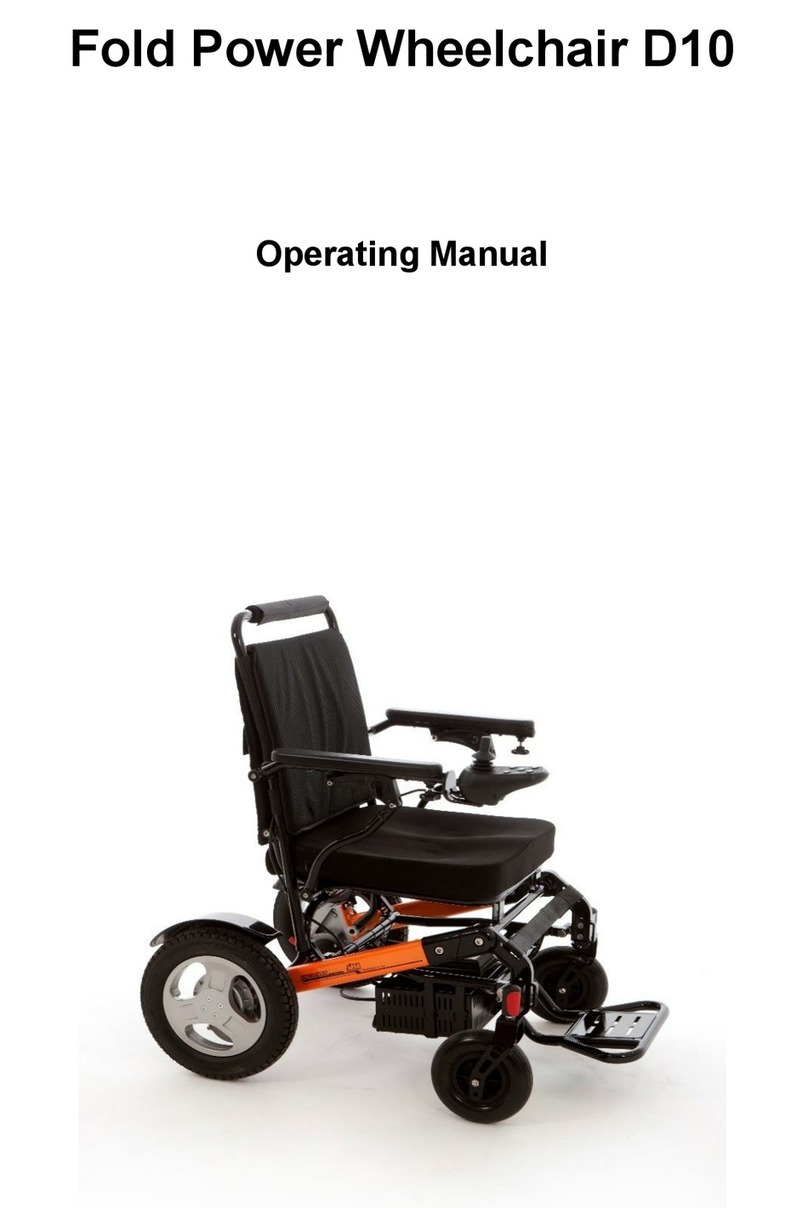
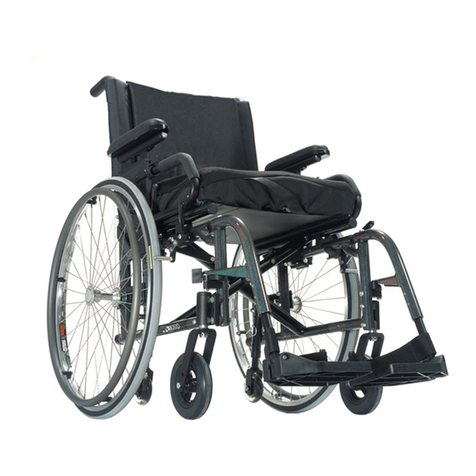
2. Check whether all elements have been properly connected, the stroller must look as shown in the photo in this manual
3. Each time after mounting the rear wheels, check whether the locking of the wheel connector axle (quick connector) has been activated; during installation, you should hear the
characteristic click of the latch, and additionally check by strongly tugging each wheel without pressing the "quick connector" button whether it is stably mounted
4. Checking whether the stroller is fully unfolded and whether the backrest is fully unfolded (latches blocked)
5. Not unfolding or using the stroller on a surface that does not provide reliable support for the user, i.e. icy, wet, greasy, heavily sandy
6. Use the stroller only on surfaces where all four wheels of the stroller touch the ground and the contact is sufficient to properly drive the wheels
7. Do not stand on the footrests when sitting or getting out of the stroller - first fold the footrests or move them completely aside
8. Not moving the stroller with the user. The stroller itself should be moved by grabbing the seat frame structure. Never carry the stroller by the
armrests or footrests
9. Apply brakes for the patient when getting in and out of the wheelchair!
10. Not exceeding the maximum user weight (patient weight kg) specified by the wheelchair manufacturer
To avoid injuries:
1. The stroller must be completely disassembled (after proper disassembly, it must look exactly as in the photo in this manual)
2. It is necessary to check the technical condition of the stroller each time before using it
3. It is unacceptable to use the stroller if any visible or palpable damage is found, or if the degree of wear of the stroller's parts indicates a potential risk of an
accident (e.g. wear of the wheels, cracks in the upholstery, etc.). All repairs should be entrusted to qualified personnel, and during the warranty period only
to the manufacturer's service center
4. The technical condition of the brakes (braking force) should be checked each time. The brakes are not used to slow down the stroller while driving, they should only be
used to prevent unwanted movements of the stroller
5. The brakes for the patient and the brakes for the caregiver must be properly adjusted (correct braking force, even pressure on both brakes).
Incorrect setting of one of the brakes for the patient results in blocking only one rear wheel, which may cause the wheelchair to rotate on large
slopes, which is difficult to control. Using the patient's brake while driving may result in an accident with all the consequences
6. If the wheel tires are contaminated with oil, grease, water or other substances, the braking efficiency may be reduced.
7. After long use of the stroller, the braking force may weaken due to the development of play between the brake pressure pin and the rear tire(s). It is possible
to adjust the parking brakes yourself. To do this, loosen the screws blocking the position of the brake mechanism, move the entire mechanism towards the
wheel to such a position that after re-tightening the brake, the wheel does not rotate (test the correctness of adjustment on the wheelchair with the patient).
After completing the adjustment, secure the mechanism again with the locking screws
8. Tire pressure should be checked regularly (applies to inflatable wheels). If the tire pressure is too low than recommended, the effectiveness of the brakes may be
significantly reduced. Recommended tire pressure - value indicated on the wheel tire
9. In the case of inflatable wheels, the maximum permissible wheel inflation pressure should not be exceeded
10. The stroller is intended for indoor and outdoor use only on hardened and even surfaces. When moving the stroller through doors and other
passages, make sure there is enough space on both sides to avoid hurting your hands or damaging the stroller
11. The trolley is not intended to transport a patient up stairs, as a stretcher or by pulling the patient on it
12. Be especially careful when moving on inclined surfaces. The help of a caregiver is necessary to overcome difficult architectural barriers (steep or
long driveways, high steps, etc.)
13. The stroller cannot be used as a seat in a motor vehicle (bus, train)
14. When using public roads, follow road traffic regulations
15. When reaching for objects, avoid leaning excessively from the stroller as this may result in falling (from the side, front, back).
16. Do not leave the patient in the wheelchair (even with the brakes on) on ramps, landings, etc.
17. Do not leave the stroller with the user in the immediate vicinity of an open fire source
18. Please remember that the surface temperature of the upholstery and frame elements may increase when exposed to the sun or another heat
source, while at low temperatures there is a risk of very cold metal parts of the stroller. This may cause burns or frostbite to parts of the body
19. When transporting the stroller (e.g. in the trunk of a car), do not burden the stroller with anything, do not place any objects on it, this may affect
its structure
20. Be especially careful when folding the stroller, as lack of attention may result in your fingers being trapped by the folding elements
21. Before driving, always make sure that no part of the patient's body or clothing is at risk of being caught by moving parts of the wheelchair.
22. Be especially careful when overcoming obstacles (going up and down curbs, overcoming thresholds, moving on surfaces
inclined slopes). In particular, you should limit your speed
Maintenance method:
The stroller should be cleaned regularly using only water and mild detergents certified by the National Institute of Hygiene. After doing so, the stroller should be wiped/
dried with a soft cloth. The upholstery and frame should be cleaned with a damp cloth without the addition of detergents or other similar agents (you can vacuum).
Contaminants such as threads, hair, etc. should be regularly removed from the moving parts of the stroller (wheels, footrests). In order to maintain the functional
parameters of the product, it is extremely important to keep all its elements clean and to store them. Storage in rooms with very high humidity (baths, laundries, etc.) or
outdoors, combined with lack of hygiene, will result in a rapid loss of functional and aesthetic parameters.
Do not use abrasive products! Do not use solvents, caustic agents, agents containing chlorine or other "aggressive" detergents. DO NOT wash the
stroller using pressure or steam washers. Rubber elements (wheels) are consumable elements and must be replaced with new ones if excessive wear
is detected.
Maintenance schedule:
Every weekCheck brake for failure, check all wheels for loose bolts, nuts and axles, check rear tire pressure (applies to pneumatic wheels)
PeriodicallyCheck the armrests, footrests and other parts of the stroller for wear. Check that all bolts are tight, check that the front and rear axle bolts are tight
(not applicable to quick connectors), check the "fatigue" of components for wear or cracks. Check the overall technical condition of the stroller.
2