EnglishDeutsch
 logo
Brands
  1. Home
  2. •
  3. Brands
  4. •
  5. Asko
  6. •
  7. Dishwasher
  8. •
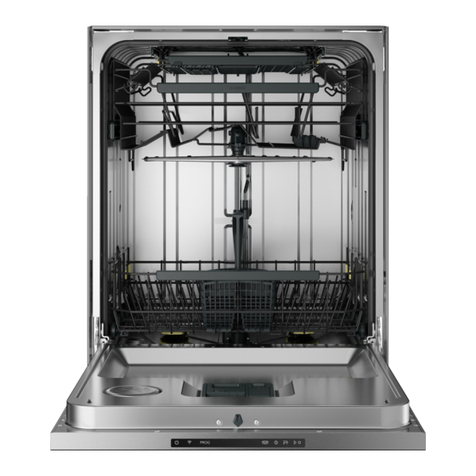
  9. Asko D3232 User manual

Asko D3232 User manual

Other manuals for D3232

3

Other Asko Dishwasher manuals

Asko D3252 User manual

Asko

Asko D3252 User manual

Asko D5233XXL User manual

Asko

Asko D5233XXL User manual

Asko DFI5448DXXL User manual

Asko

Asko DFI5448DXXL User manual

Asko 1402 Operating instructions

Asko

Asko 1402 Operating instructions

Asko DBI564ISSOF.U User manual

Asko

Asko DBI564ISSOF.U User manual

Asko DBI444IB User manual

Asko

Asko DBI444IB User manual

Asko D3100 User manual

Asko

Asko D3100 User manual

Asko D3451XL User manual

Asko

Asko D3451XL User manual

Asko DFI664XXLSOF.U User manual

Asko

Asko DFI664XXLSOF.U User manual

Asko D3532 User manual

Asko

Asko D3532 User manual

Asko DFI652 User manual

Asko

Asko DFI652 User manual

Asko DFI643AU User manual

Asko

Asko DFI643AU User manual

Asko DFI776XXLSOF User manual

Asko

Asko DFI776XXLSOF User manual

Asko DFI756MUXXL User manual

Asko

Asko DFI756MUXXL User manual

Asko D5253 Service manual

Asko

Asko D5253 Service manual

Asko DFI543A User manual

Asko

Asko DFI543A User manual

Asko DBI664IXXLSSOF Guide

Asko

Asko DBI664IXXLSSOF Guide

Asko D3251 User manual

Asko

Asko D3251 User manual

Asko DFI664XXLSOF User manual

Asko

Asko DFI664XXLSOF User manual

Asko D5424XL B User manual

Asko

Asko D5424XL B User manual

Asko D5538 Assembly instructions

Asko

Asko D5538 Assembly instructions

Asko DWCBI241.S.AU User manual

Asko

Asko DWCBI241.S.AU User manual

Asko D5223 Configuration guide

Asko

Asko D5223 Configuration guide

Asko DWCFS5936 User manual

Asko

Asko DWCFS5936 User manual

Popular Dishwasher manuals by other brands

Electrolux ESI5211LOX user manual

Electrolux

Electrolux ESI5211LOX user manual

KitchenAid KUDB230B Use and care guide

KitchenAid

KitchenAid KUDB230B Use and care guide

Brandt BDJ424DB instruction manual

Brandt

Brandt BDJ424DB instruction manual

Beko DFN26210W instruction manual

Beko

Beko DFN26210W instruction manual

NEFF S153ITX00E INFORMATION FOR USE

NEFF

NEFF S153ITX00E INFORMATION FOR USE

Midea SV 4.45 wi manual

Midea

Midea SV 4.45 wi manual

LG LDF7932 Specifications

LG

LG LDF7932 Specifications

Gorenje GV63214 instruction manual

Gorenje

Gorenje GV63214 instruction manual

Hotpoint HDA1100ZWH Installation information

Hotpoint

Hotpoint HDA1100ZWH Installation information

Blomberg LDFN2240W instruction manual

Blomberg

Blomberg LDFN2240W instruction manual

AEG FFB83836PM user manual

AEG

AEG FFB83836PM user manual

Cylinda DM3220RFD user manual

Cylinda

Cylinda DM3220RFD user manual

Atag DW8214MB manual

Atag

Atag DW8214MB manual

GE GLD8000 Series owner's manual

GE

GE GLD8000 Series owner's manual

Siemens SN23HI02KE INFORMATION FOR USE

Siemens

Siemens SN23HI02KE INFORMATION FOR USE

Omega ODW717X instruction manual

Omega

Omega ODW717X instruction manual

BORETTI BVW-683 operating instructions

BORETTI

BORETTI BVW-683 operating instructions

Siemens SN 56N591 operating instructions

Siemens

Siemens SN 56N591 operating instructions

https://manuals.online logo
https://manuals.online logoBrands
  • About & Mission
  • Contact us
  • Privacy Policy
  • Terms and Conditions

Copyright 2026 Manuals.Online. All Rights Reserved.

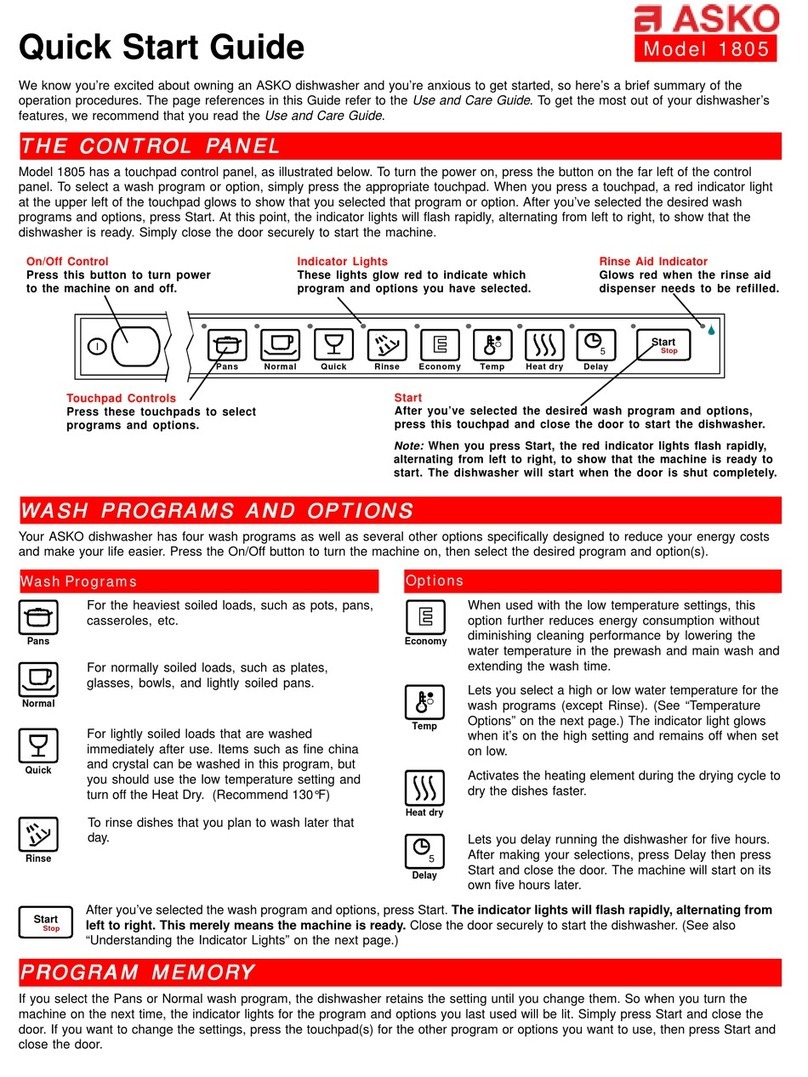
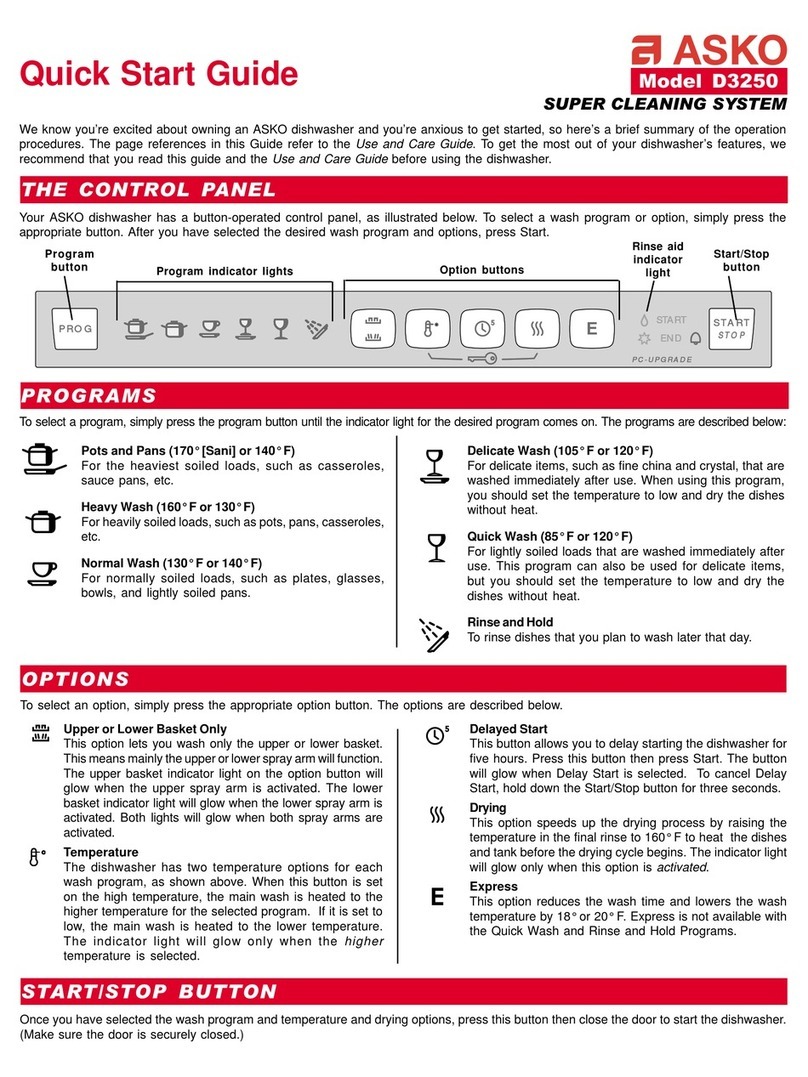
Quick Start Guide
We know you’re excited about owning an ASKO dishwasher and you’re anxious to get started, so here’s a brief summary of the operation
procedures. The page references in this Guide refer to the Use and Care Guide. To get the most out of your dishwasher’s features, we
recommend that you read this guide and the Use and Care Guide before using the dishwasher.
PROGRAMSPROGRAMS
PROGRAMSPROGRAMS
PROGRAMS
To select a program, simply press the program button until the indicator light for the desired program comes on. The programs are described below:
Pots and Pans (170° [Sani] or 140° F)
For the heaviest soiled loads, such as casseroles,
sauce pans, etc.
Heavy Wash (160° F or 130° F)
For heavily soiled loads, such as pots, pans, casseroles,
etc.
Normal Wash (150° F or 130° F)
For normally soiled loads, such as plates, glasses,
bowls, and lightly soiled pans, use the
Normal wash program with normal temperature
and normal drying .
To save more water and energy use economy
temperature and economy drying.
Temperature
The dishwasher has two temperature options for each
wash program, as shown above. When this button is set
on the normal temperature, the main wash is heated to the
higher temperature for the selected program. If it is set to
low (economy temperature), the main wash is heated to
the lower temperature. The indicator light will glow only
when the normal temperature is selected.
Delayed Start
This button allows you to delay starting the dishwasher for
five hours. Press this button then press Start. The button
will glow when Delay Start is selected. To cancel Delay
Start, hold down the Start/Stop button for three seconds.
THE CONTRTHE CONTR
THE CONTRTHE CONTR
THE CONTROL POL P
OL POL P
OL PANELANEL
ANELANEL
ANEL
Your ASKO dishwasher has a button-operated control panel, as illustrated below. To select a wash program or option, simply press the
appropriate button. After you have selected the desired wash program and options, press Start.
OPTIONSOPTIONS
OPTIONSOPTIONS
OPTIONS
To select an option, simply press the appropriate option button. The options are described below.
Delicate Wash (105° F or 120° F)
For delicate items, such as fine china and crystal, that are
washed immediately after use. When using this program,
you should set the temperature to economy and dry the
dishes with economy drying.
Quick Wash (85° F or 120° F)
For lightly soiled loads that are washed immediately after
use. This program can also be used for delicate items,
but you should set the temperature to economy and dry
the dishes with economy drying.
RinseandHold
To rinse dishes that you plan to wash later that day.
Drying
The dishwasher has two drying levels, Economy and
Normal. When you want to have the maximum drying result
you activate the Normal option. That will increase the last
rinse temperature to 160°F to heat the dishes and tank
before the drying cycle starts. The indicator light will glow
only when this option is activated.
STST
STST
STARAR
ARAR
ART/STT/ST
T/STT/ST
T/STOP BUTTOP BUTT
OP BUTTOP BUTT
OP BUTTONON
ONON
ON
Once you have selected the wash program and temperature and
drying options, press this button then close the door to start the
dishwasher. (Make sure the door is securely closed.)
Model D3232
SELF CLEANING SYSTEM
Program
button
Program indicator
lights
Power
button Option buttons
Start/Stop
button
Rinse aid
indicator
light
Press this button to turn the main power to the unit on
and off. Refer to the illustration above to see the
location of the power button.
POPO
POPO
POWER BUTTWER BUTT
WER BUTTWER BUTT
WER BUTTONON
ONON
ON
QQ
QQ
QUICK STUICK ST
UICK STUICK ST
UICK STARAR
ARAR
ART PRT PR
T PRT PR
T PROCEDURESOCEDURES
OCEDURESOCEDURES
OCEDURES
1. Load the dishwasher. (There’s no need to pre-rinse. Simply scrape off large food particles before you 3, 4
load the dishware.)
2. After you’ve pushed the baskets back inside the unit, manually rotate the upper and lower spray arms 3
to be sure they turn freely. Rearrange any item that blocks the wash arms.
3. Add 1 to 3 tablespoons of automatic dishwashing detergent and close the dispenser cover.
(See “Dishwashing Detergent” below.) 5
4. Make sure there is rinse aid in the dispenser. Add rinse aid, if needed. 6
5. Press the main power button on the far left side of the inner door panel to turn on power to the machine.
6. Press a program button.
7. Set the Temperature and Dry options as desired.
8. Press the Start/Stop button.
9. Close the door securely. (You should hear it click shut.) The dishwasher will start.
Refer to your Use and Care Guide for additional information.
Refer to this page in
the Use & Care Guide.
COMMON QUESTIONSCOMMON QUESTIONS
COMMON QUESTIONS
1) Where do I put the prewash detergent?
2) Where do I put the rinse aid?
3) Why does my dishwasher run so long?
4) Why am I getting a white film on my
dishes?
5) Why is there always water left in the
bottom of my machine?
ANSWERSANSWERS
ANSWERSANSWERS
ANSWERS
1) The prewash detergent goes in the small compartment between the main wash
detergent compartment and the rinse aid dispenser. (See page 5.)
2) The rinse aid goes into the rinse aid dispenser. (See page 6.)
3) If the temperature of the water entering your dishwasher is below 120°, the
dishwasher runs longer because it heats the water to the proper temperature for the
program selected. Raising your water heater setting may help shorten the cycle
times. If this doesn’t resolve the problem, call the ASKO Advisory Center.
4) You may be using too much detergent or washing your dishes in water that is too
hot. Try using less detergent and a lower temperature setting.
5) It’s normal to have some water left in the sump area near the drain. If the water fills
more than the drain area, see page 10 for possible solutions.
Art. 8078393. Rev 01
INTERRINTERR
INTERRINTERR
INTERRUPTINGUPTING
UPTINGUPTING
UPTING A PRA PR
A PRA PR
A PROGRAMOGRAM
OGRAMOGRAM
OGRAM TT
TT
TOO
OO
O ADDADD
ADDADD
ADD AN ITEMAN ITEM
AN ITEMAN ITEM
AN ITEM
If you want to interrupt a program to add an item, open the door slightly until the spray arms stop turning. You can then open the door fully and
place the item into the dishwasher. Close the door securely. The program will continue from where it was interrupted.
WARNING! Be extremely careful when opening the door during a program. The water is hot and you could get scalded.
CHANGING OR STOPPING A PROGRAMCHANGING OR STOPPING A PROGRAM
CHANGING OR STOPPING A PROGRAM
If you decide to change the program after you have started the machine, press the Start/Stop button for three seconds. You will have to select
the program and options again when you are ready to restart the program. (Note: If the program has already gone through the wash cycle,
you will have to add detergent.)
DISHWASHING DETERGENTDISHWASHING DETERGENT
DISHWASHING DETERGENT
We recommend that you use only unscented, granular automatic dishwashing detergent. Generally, one tablespoon of detergent is needed
for a normal wash load. More heavily soiled items, however, may need more detergent. Also, the amount of detergent needed can vary due
to differences in water hardness. The harder the water, the more detergent you may need. (See page 5.) In any case, you should never use
more than three tablespoons of detergent.
RINSE AIDRINSE AID
RINSE AIDRINSE AID
RINSE AID
Using liquid rinse aid prevents water spots from forming on dishes and improves drying by allowing water to “sheet” off the dishes. The rinse
aid is released during the final rinse. The Rinse Aid indicator light will glow when the rinse aid dispenser is empty. For information on how
to fill the rinse aid dispenser and control the amount released, refer to your Use and Care Guide.
NOTE: If you use a dishwashing detergent with a rinse aid additive, you should not fill the rinse aid dispenser.
CHILD-SAFE BCHILD-SAFE B
CHILD-SAFE BUTTUTT
UTTUTT
UTTON LON L
ON LON L
ON LOCKOCK
OCKOCK
OCK
To prevent a child from accidentally starting the dishwasher or changing the program settings, the dishwasher can be programmed not to
start unless two buttons are held down simultaneously. Refer to your Use and Care Guide for instructions on how to activate this feature.

END-OF-PROGRAM SIGNALEND-OF-PROGRAM SIGNAL
END-OF-PROGRAM SIGNAL
The dishwasher can be programmed to emit a short signal at the end of the program. Refer to your Use and Care Guide for instructions on
how to activate this feature.