9
EN
the lter in the cold water pipes upstream of the ob-
jects to be protected. Always provide stop valves.
Caution: The installation site must be protected
against frost and must guarantee the protection of
the lter from solvent vapors, fuel oil, lees, chemicals
of all types, UV irradiation, and heat sources see
tecnical data. The lters should be according to the
nominal connection width in the same dimension t-
ted in the pipework. Install the lter in the direction
of ow in the vertical or horizontal cold water pipe.
Caution: Keep plastic parts free of oil, grease, sol-
vents and acid or alkaline cleaning agents. Avoid
extreme pressure blows (closure-beat by downstream
magnet valve e.g.).
5. Installation
See installation drawing.
Install the lter and the stop valves before and after
the lter in ow direction in the water pipe (see ow
direction arrows an top section).
Route the ushing water connection with hose to the
sewage channel or provide a collection basin (capa-
city approx. 10 l).
Please note: According to DIN EN 1988-200, the
ushing water hose must be installed at a miniumum
distance of 20 mm to the highest possible waste wa-
ter level (free discharge).
6. Startup
Check the lter for correct and proper installation.
The shut-off valves must not be opened yet. Check
the lter bottom part and rinsevalve to ensure correct
t. Close the rinsevalve. It should not used any tool.
Maximum torque 8 - 10 Nm at recess of plastic
parts in brass parts. Slowly open the shut-off valves
before and after the domestic waterstation and dea-
erate the piping at the next tapping point after the
domestic water-station. Check the lter for leaks.
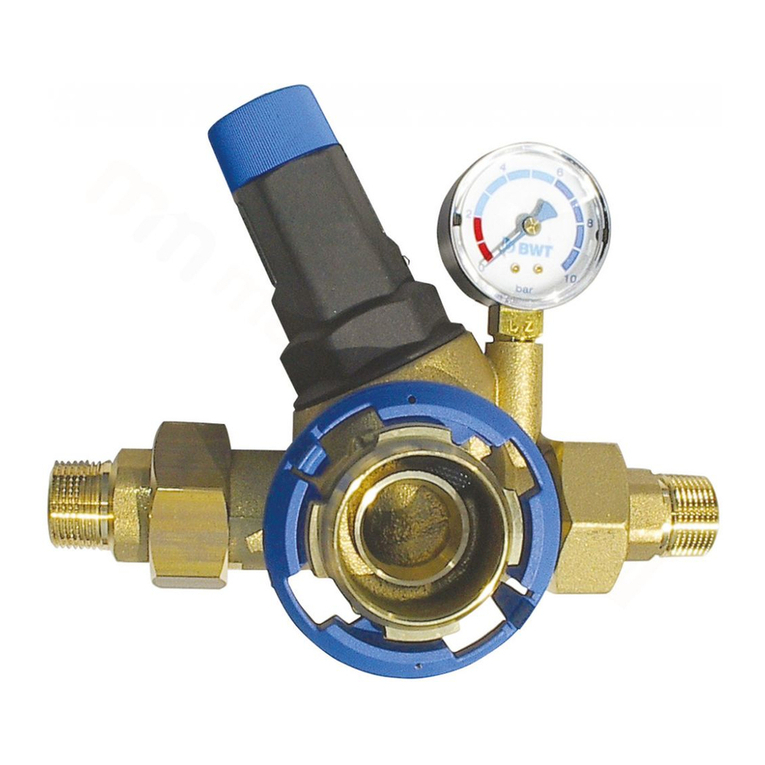
The pressure reducer is set to a back pressure of
4 bar at the factory. To change the back pressure,
loosen the locking screw (6) and turn the rotary knob
(7). The back pressure can be changed by turning
the setting knob (7) (control range 2 - 6 bar).
Clockwise rotation = higher back pressure.
Anti-clockwise = lower back pressure.
During setting, an outlet valve downstream from the
pressure reducer must be briey opened and closed
again a number of times. When water is removed,
the back pressure is temporarily reduced. The back
pressure must not exceed 80 % of the response pres-
sure of the hot water safety valve (DIN 1988-200).
7. Operation
The lter must be checked at regular intervals, i.e.
every two months (according to DIN 1988-200)
and also must be rinsed. If there is a noticeable
drop of the pressure, caused by increasing pollu-
tion of the lter cloth, the lterelement must be re-
placed. The lterelement must be replaced after 6
months at the latest (according to DIN 1988-200).
Close the stop valves before and after
the lter and provide a collecting basin under the
lter. Open rinsevalve for pressure relief and em-
pty the lter. Open the lter bottom part with tool
(wrench width 21) or by hand. Clean the lter bot-
tom part.
Exchangingthelterelement:
Water is a consumable liquid. When exchanging
the lter, proper hygiene must be ensured.
The plastic parts may only be cleaned with a soft,
damp cloth. Do not use any solvents or detergents
nor acid cleaners.
Remove the lterelement and exchanged against a
new lterelement. Place the lterelement in the top
section and screw it with the bottom part.
Close the rinsevalve. Slowly open the stop valves,
rst those before, then those after the lter. Check
the lter for proper sealing and then deaerate the
pipe at the bleeding point closest tot he lter (after
the lter).
8. Warranty
In the event of a failure during the warranty period,
please contact your contractual partner, the plumbing
company, stating the appliance type (see specica-
tions and/or rating plate of the appliance).
> 20 mm