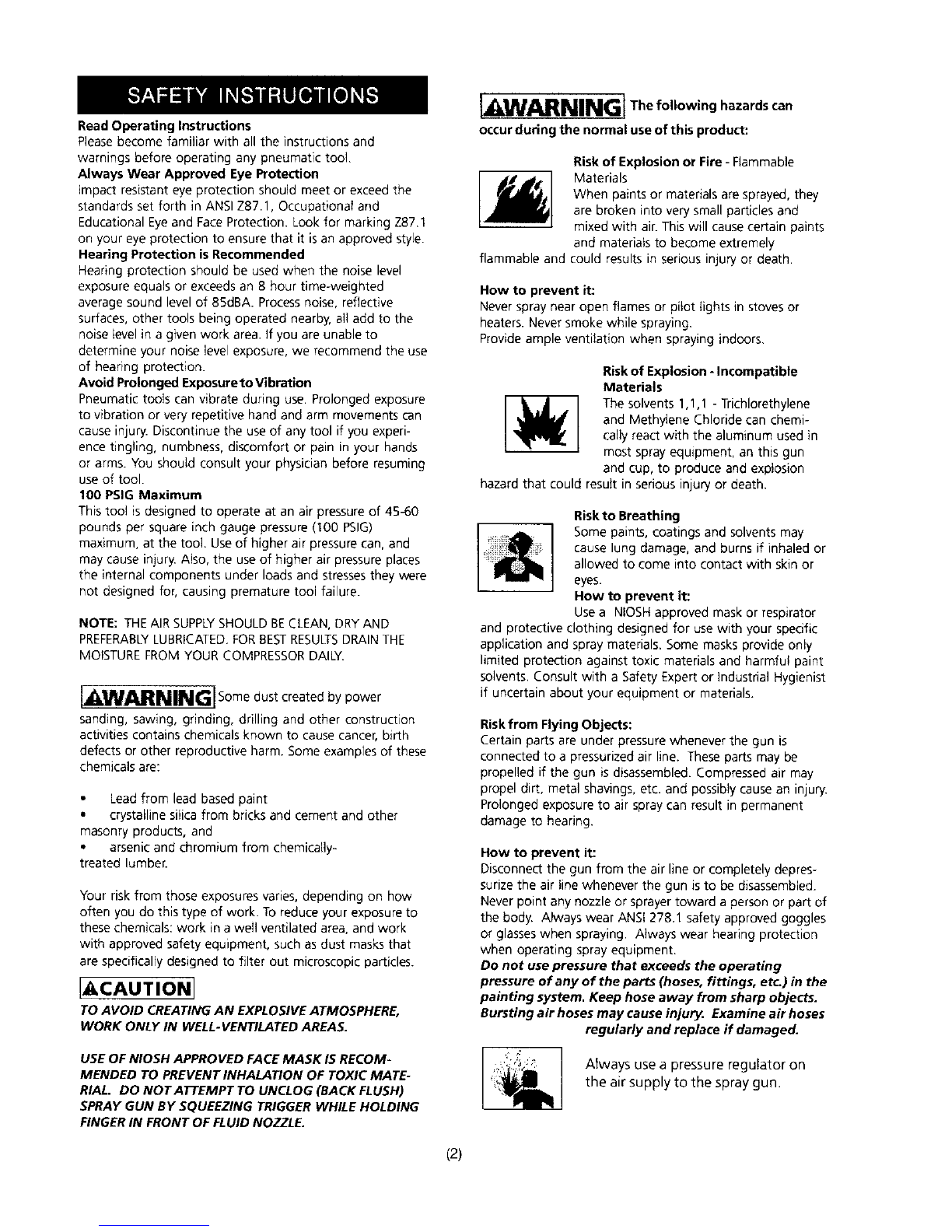
ReadOperating Instructions
Pleasebecome familiar with all the instructions and
warnings before operating any pneumatic tool.
Always Wear Approved Eye Protection
impact resistanteye protection should meet or exceed the
standards set forth in ANSIZ87.1, Occupational and
EducationalEyeand FaceProtection. Look for marking Z87.1
on your eye protection to ensure that it isan approved style.
Hearing Protection isRecommended
Hearing protectionshould be used when the noise level
exposure equals or exceeds an 8 hour time-weighted
average sound levelof 85dBA. Processnoise, reflective
surfaces, other tools being operated nearby, all add to the
noise level in a given work area. if you are unable to
determine your noise levelexposure, we recommend the use
of hearing protection.
Avoid Prolonged Exposureto Vibration
Pneumatic tools can vibrate during use. Prolonged exposure
to vibration or very repetitive hand and arm movements can
cause injury. Discontinue the use of any tool if you experi-
ence tingling, numbness, discomfort or pain in your hands
or arms. You should consult your physician before resuming
useof tool.
100 PSIG Maximum
This tool is designed to operate at an air pressureof 45-60
pounds per square inch gauge pressure (100 PSIG)
maximum, at the tool. Useof higher air pressure can, and
may cause injury, Also, the useof higher air pressure places
the internal components under loads and stressesthey were
not designed for, causing premature tool failure.
NOTE: THE AIR SUPPLYSHOULD BE CLEAN, DRY AND
PREFERABLYLUBRICATED. FOR BEST RESULTSDRAIN THE
MOISTURE FROM YOUR COMPRESSOR DAILY.
[ IIWARNING] Somedustcreated
by power
sanding, sawing, grinding, drilling and other construction
activities contains chemicals known to causecancer, birth
defects or other reproductiveharm. Some examples of these
chemicals are:
Leadfrom lead based paint
• crystalline silica from bricks and cement and other
masonry products, and
•arsenic and chromium from chemically-
treated lumber.
Your risk from those exposures varies, depending on how
often you do this type of work. To reduce your exposureto
these chemicals: work ina well ventilated area, and work
with approved safety equipment, such as dust masks that
are specifically designed to filter out microscopic particles.
!_CAUTIONI
TO AVOID CREATINGAN EXPLOSIVEATMOSPHERE,
WORK ONLY IN WELL-VENTILATEDAREAS.
USE OF NIOSH APPROVED FACE MASK IS RECOM-
MENDED TO PREVENT INHALATION OF TOXIC MATE-
RIAL. DO NOT ATTEMPT TO UNCLOG (BACK FLUSH)
SPRAY GUN BY SQUEEZING TRIGGER WHILE HOLDING
FINGER IN FRONT OF FLUID NOZZLE.
I WARNING The following hazards can
occurduring the normal useof this product:
Risk of Explosion or Fire - Flammable
Materials
When paints or materials are sprayed, they
are broken into very small particles and
mixed with ain This will cause certain paints
and materials to become extremely
flammable and could results in serious injury or death.
How to prevent it:
Never spray near open flames or pilot tights in stoves or
heaters. Never smoke while spraying.
Provide ample ventilation when spraying indoors,
Riskof Explosion -Incompatible
Materials
[_ The solvents 1,1,1 -Trichlorethylene
and Methylene Chloride can chemi-
callyreact with the aluminum used in
most spray equipment, an this gun
and cup, to produce and explosion
hazard that could result in serious injury or death.
Riskto Breathing
Some paints, coatings and solvents may
cause lung damage, and burns if inhaled or
allowed to come into contact with skin or
eyes.
How to prevent it:
Use a NIOSHapproved mask or respirator
and protective clothing designed for use with your specific
application and spray materials. Some masks provide only
limited protection against toxic materials and harmfut paint
solvents. Consult with a Safety Expert or industrial Hygienist
if uncertain about your equipment or materials.
Riskfrom FlyingObjects:
Certain parts are under pressure whenever the gun is
connected to a pressurized air line. Theseparts may be
propelled if the gun is disassembled. Compressed air may
propel dirt, metal shavings, etc. and possibly cause an injury.
Prolonged exposure to air spraycan result in permanent
damage to hearing.
How to prevent it:
Disconnect the gun from the air line or completely depres-
surize the air line whenever the gun is to be disassembled.
Never point any nozzle or sprayer toward a person or part of
the body. Always wear ANSI 278.1 safety approved goggles
or glasses when spraying. Always wear hearing protection
when operating spray equipment.
DO not use pressure that exceeds the operating
pressure of any of the parts (hoses, fittings, etc.) in the
painting system. Keep hose away from sharp objects.
Bursting air hoses may cause injury. Examine air hoses
regularly and replace if damaged.
Afways use a pressure regulator on
the air supply to the spray gun.
(2)