2
PN P85324A
A
B
C
D
E
F
G
H
A B C D E F G H
Figure 3: Jumper plug is used to
select dBA loudness.
Figure 4: Tap Settings (Factory setting is
70V @ 1/2W (F))
NOTE: Use needle nose pliers to pull and properly insert the jumper plug to the desired tap setting.
Connect speaker wires to common and positive of terminal block and select the power tap terminal for 1/8W, 1/4W, 1/2W, 1W or 2W; 25V or
70V as required (see Figures 1, 2, 3, 4 and Table 4). Each doubling of rated Watts increases sound output by 3 dBA.
Each letter corresponds to a plug position of the header located on the printed circuit board. Select voltage and wattage as shown in Table 4 below.
Table 4: Speaker Voltage and Wattage Connection Chart
Position 25V 70V
A 2 ------
B 1 ------
C 1/2 ------
D 1/4 2
E 1/8 1
F ------ 1/2
G ------ 1/4
H ------ 1/8
NOTE: Graph does not apply to 1575W models.
NOTE: The speaker strobe appliances must be set to the desired dBA sound output level before they are installed. This is done by properly
inserting jumper plugs in accordance with these instructions.
WARNING: Incorrect settings will result in improper performance.
CAUTION: Always operate audio amplifiers and speakers within their specified ratings. Excessive input may distort sound quality and may
damage audio equipment. Improper input voltage can damage speaker. If distortion is heard, check for clipping of the audio appliance with an
oscilloscope and reduce the amplifier input level or gain level to eliminate any clipping.
135 185
CANDELA
POINTER
15
75 1
3010
CANDELA
POINTER
BOTTOM VIEW
Figure 5: E50-24MCW; E50-24MCWH
NOTE: The E50-24MCW comes pre-set at 15cd. The E50-24MCWH comes pre-set at 185cd.
CAUTION: The candela select switch must be field set to the required candela intensity before installation. When changing the setting of the
candela select switch make certain that it clicks in place. After changing the candela setting the appliance must be retested to verify proper
operation. Improper setting of the candela select switch may result in operation at the wrong candela.
MOUNTING OPTIONS
CAUTION: The following figures show the maximum number of field wires (conductors) that can enter the backbox used with each mounting option. If these
limits are exceeded, there may be insufficient space in the backbox to accommodate the field wires and stresses from the wires could damage the product.
Although the limits shown for each mounting option comply with the National Electrical Code (NEC), Cooper Wheelock recommends use of
the largest backbox option shown and the use of approved stranded field wires, whenever possible, to provide additional wiring room for easy
installation and minimum stress on the product from wiring.
SPEAKER
MOUNTING
PLATE
(2) SCREW #8-32X2"
GRILLE
4"SQ.X2-1/8
BACK BOX
MAXIMUM NUMBER OF CONDUCTORS
AWG #18 AWG #16 AWG #14 AWG#12
8 8 8 8
FLUSH MOUNTING
(STROBE SPEAKER)
A
NOTE: Speaker-strobe mounting depicted above. For non-strobe speaker surface mounting, use E50SB:
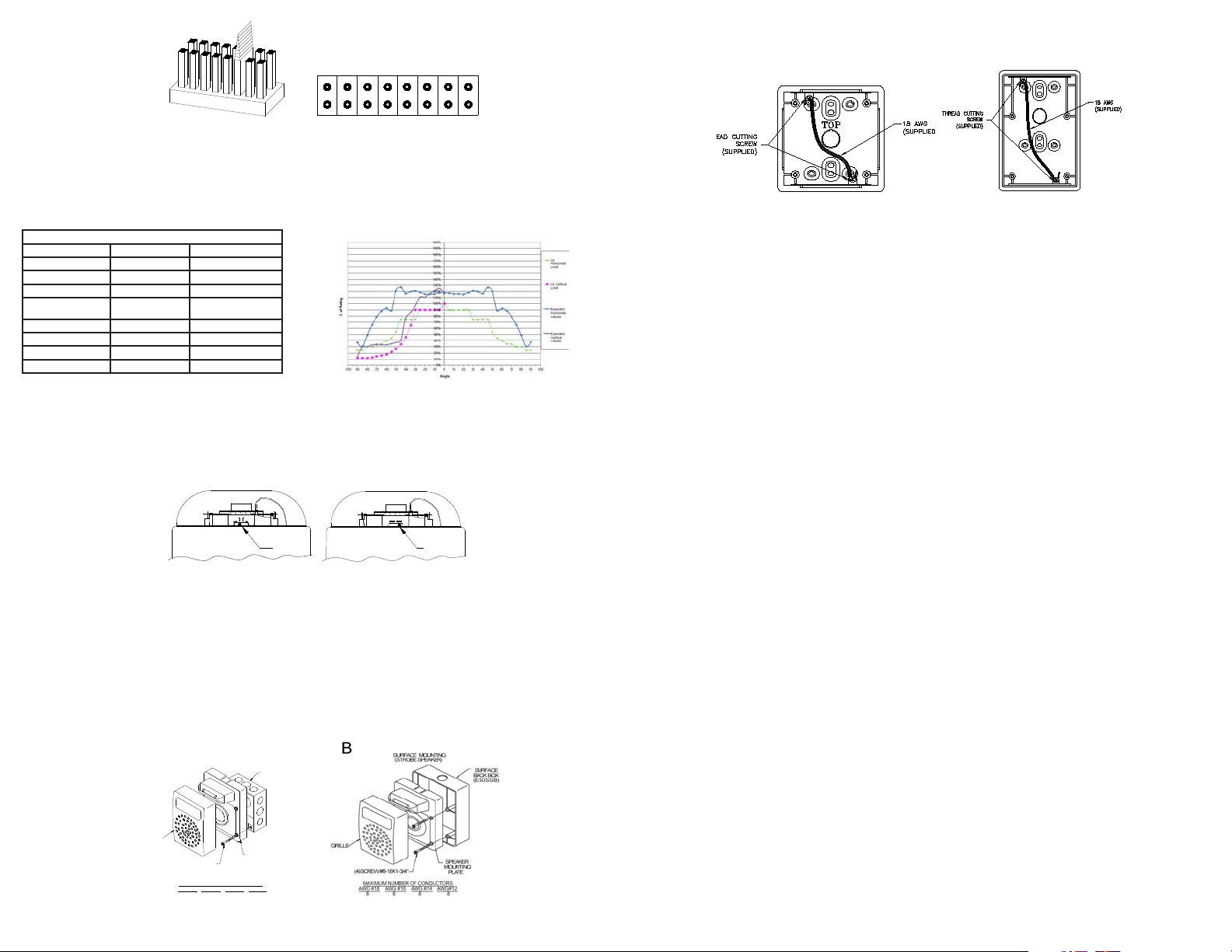
NOTE: Surface backbox (E50SSB) in Figure B, is compatible with wiremold and conduit. Mounting holes are for single-gang, double-gang,
and #10 wood screws for stud mounting. If metal conduit is installed onto top and bottom conduit entrances, then an insulated grounding
wire (18 AWG, supplied) must be connected between the top and bottom plate by using thread cutting screws (supplied) to provide electrical
continuity per UL 50. See Figure 6.
Figure 6: Surface Backbox E50SB (left) and E50SSB (right)
MOUNTING PROCEDURES
CAUTION: Check that the installed product will have sufficient clearance and wiring room prior to installing backboxes and conduit, especially
if sheathed multiconductor cable or 3/4” conduit fittings are used.
E50H models have an integrated Speaker Mounting Plate.1.
The Speaker Mounting Plate must be oriented correctly when it is mounted to the backbox. Turn the Speaker Mounting Plate so that the2.
arrow above the words “Horizontal Strobe” points to the top side of the Speaker Mounting Plate.
First mount the Speaker Mounting Plate to the backbox. Next slide the grille over the Speaker Mounting Plate strobe until both snaps are3.
engaged.
When terminating field wires, do not use more lead length than required. Excess lead length could result in insufficient wiring space for4.
the signaling appliance.
Conduit entrances to the backbox should be selected to provide sufficient wiring clearance for the installed product.5.
Do not pass additional wires (used for other than the signaling appliance) through the backbox. Such additional wires could result in6.
insufficient wiring space for the signaling appliance.
Mounting hardware for each mounting option is supplied.7.
All models can be flush mounted to a 4” square by 2-1/8” deep backbox in the wall (Figure A).8.
Use care and proper techniques to position the field wires in the backbox so that they use minimum space and produce minimum stress9.
on the product. This is especially important for stiff, heavy gauge wires and wires with thick insulation or sheathing.
Use care to prevent speaker cone damage when driving screws for speaker product mounting.10.
WARNING: When installing strobes in an open office or other areas containing partitions or other viewing obstructions, special atten-
tion should be given to the location of the strobes so that their operating effect can be seen by all intended viewers, with the intesity,
number, and illumination, regardless of the viewer’s orientation.
The 110cd and 135/185cd settings are Listed for use in sleeping or non-sleeping areas when installed in accordance with appropriate NFPA
Standards and the Authority Having Jurisdiction.
WARNING: Installers must advise owners and operators of buildings with sleeping occupants, e.g., hotels and motels, to warn
guests, residents and employees to not move the bed location to a position violating points (1) and (2) above or serious injury and or
loss of life may occur during a fire emergency.
WARNING: A small possibility exists that the use of multiple strobes within a person’s field of view, under certain circumstances,
might induce a photo-sensitive response in persons with epilepsy. Strobe reflections in a glass or mirrored surface might also induce
such a response. To minimize this possible hazard, cooper wheelock strongly recommends that the strobes installed should not pres-
ent a composite flash rate in the field of view which exceeds five (5) hz at the operating voltage of the strobes. Cooper wheelock also
strongly recommends that the intensity and composite flash rate of installed strobes comply with levels established by applicable
laws, standards, regulations, codes and guidelines.
If this appliance is required to produce a distinctive three-pulse Temporal Pattern Fire Alarm Evacuation Signal (for total evacuation) in ac-
cordance with NFPA 72, the appliance must be used with a fire alarm control unit that can generate the temporal pattern signal. Refer to
manufacturer’s installation manual for details.
NOTE: NFPA 72/ANSI 117.1 conforms to ADAAG Equivalent Facilitation Guidelines in using fewer, higher intensity strobes within the same
protected area.
CAUTION: Check the installation instructions of the manufacturers of other equipment used in the system for any guidelines or restrictions on
wiring and/or locating Notification Appliance Circuits (NAC) and notification appliances. Some system communication circuits and/or audio
circuits, for example, may require special precautions to assure electrical noise immunity (e.g., audio crosstalk).
NOTE: This equipment has been tested and found to comply with the limits for a Class A digital device, pursuant to part 15 of the FCC Rules.
These limits are designed to provide reasonable protection against harmful interference when the equipment is operated in a commercial
environment. This equipment generates, uses, and can radiate radio frequency energy and, if not installed and used in accordance with the in-
struction manual, may cause harmful interference to radio communications. Operation of this equipment in a residential area is likely to cause
harmful interference in which case the user will be required to correct the interference at his own expense.
This Class A digital apparatus meets all requirements of the Canadian Interference-Causing Equipment Regulations.
Cet appareil numérique de la classe A respecte toutes les exigences du Réglement sur le matériel brouilleur du Canada.
ANY MATERIAL EXTRAPOLATED FROM THIS DOCUMENT OR FROM COOPER WHEELOCK MANUALS OR OTHER DOCUMENTS DE-
SCRIBING THE PRODUCT FOR USE IN PROMOTIONAL OR ADVERTISING CLAIMS, OR FOR ANY OTHER USE, INCLUDING DESCRIPTION
OF THE PRODUCT’S APPLICATION, OPERATION, INSTALLATION AND TESTING IS USED AT THE SOLE RISK OF THE USER AND COOPER
WHEELOCK WILL NOT HAVE ANY LIABILITY FOR SUCH USE.
5/12